Within Evidence Gaps
What Should Ads Have to Prove?
Objective product claims need evidence strong enough to support both what is said and what consumers are likely to infer.
On this page
- Express claims versus implied promises
- Why reasonable basis matters before publication
- Common substantiation gaps in testimonials and statistics
Page outline Jump by section
Introduction
Advertising is a practical test of a core problem in logical fallacies: how much evidence is needed before a claim is presented as true. Consumers often encounter statements about performance, safety, popularity, savings, health benefits, environmental impact, or customer satisfaction. Some claims are stated directly, while others are implied through images, testimonials, statistics, or comparisons. The central governance question is whether advertisers should possess evidence before publication that is strong enough to support not only the literal words used but also the conclusions a reasonable consumer is likely to draw.
 Modern advertising regulation generally answers yes. Regulators in both the United States and the United Kingdom require objective claims to be supported by evidence before they are disseminated. The requirement exists because evidence gaps can transform persuasive marketing into a form of misleading reasoning, encouraging consumers to infer certainty, typicality, or effectiveness that has not actually been demonstrated.[Federal Trade Commission]ftc.govFederal Trade Commission | Protecting America's ConsumersThe official website of the Federal Trade Commission, protecting America's consu…[ASA]asa.org.ukClaims, endorsements and testimonialsAny claims made in endorsements or testimonials, which are likely to be interpreted as fact, must no…
What Counts as a Claim That Must Be Proven?
Not every statement in advertising requires the same level of proof. Obvious opinions and promotional exaggerations such as “amazing taste” or “the ultimate experience” are often treated differently from factual claims that can be tested. The key distinction is whether consumers are likely to interpret a statement as an objective assertion about reality.
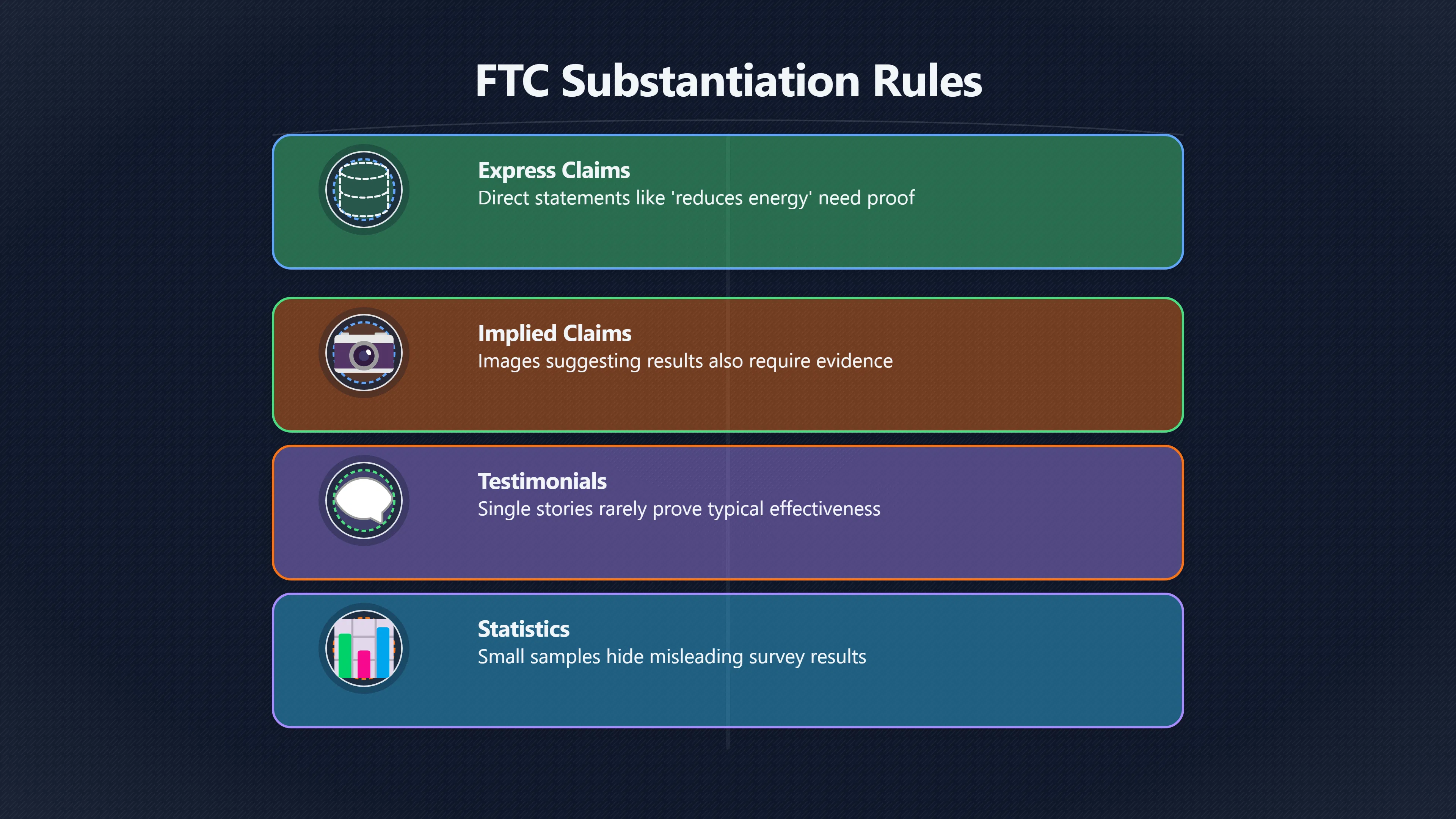
Regulatory guidance commonly focuses on both express claims and implied claims. An express claim is stated directly, such as “reduces energy consumption by 20%”. An implied claim may arise from imagery, context, demonstrations, charts, endorsements, or wording that leads consumers toward a factual conclusion even if the conclusion is never stated outright. Regulators therefore examine the overall impression created by an advertisement rather than only its literal wording.[Federal Trade Commission]ftc.govFederal Trade Commission | Protecting America's ConsumersThe official website of the Federal Trade Commission, protecting America's consu…[Kelley Drye & Warren LLP]kelleydrye.comKelley Drye & Warren LLPAdvertising and Marketing StandardsAs a general rule, claims in advertisements must be truthful and not misleadin…
This matters because evidence gaps often hide in implication. An advertiser may avoid explicitly saying that a product cures a condition, for example, while surrounding the product with imagery and testimonials that strongly suggest that result. If consumers reasonably infer the claim, regulators may expect evidence for it.[Federal Trade Commission]ftc.govFederal Trade Commission | Protecting America's ConsumersThe official website of the Federal Trade Commission, protecting America's consu…
Why Evidence Must Exist Before Publication
The strongest substantiation policies reject the idea that advertisers may make claims first and gather support later. The rationale is straightforward: once consumers have acted on a claim, the harm may already have occurred.
The United States Federal Trade Commission (FTC) has long maintained that advertisers must possess a “reasonable basis” before disseminating advertisements. According to FTC policy, firms that lack an adequate evidential basis before publication can violate consumer-protection law even if later evidence emerges. The agency’s guidance repeatedly stresses that advertisers should substantiate both express and implied claims before they appear in the marketplace.[Federal Trade Commission]ftc.govFederal Trade Commission | Protecting America's ConsumersThe official website of the Federal Trade Commission, protecting America's consu…[Federal Trade Commission]ftc.govFederal Trade Commission | Protecting America's ConsumersThe official website of the Federal Trade Commission, protecting America's consu…
The United Kingdom’s advertising framework follows a similar logic. The CAP Code requires advertisers to hold documentary evidence for objective claims capable of substantiation, and the absence of adequate evidence can itself make a claim misleading.[ASA]asa.org.ukClaims, endorsements and testimonialsAny claims made in endorsements or testimonials, which are likely to be interpreted as fact, must no…[Clearcast Help Desk]help.clearcast.co.ukClearcast Help Desk NOG 3Misleading Advertising - Welcome to our Help DeskThe ASA may regard claims as misleading in the absence of adequate substantiation…. c…
From a logical-fallacy perspective, this requirement attempts to stop unsupported leaps before they reach consumers. Instead of asking regulators or critics to prove a claim false after publication, the burden initially rests with the advertiser to show why the claim should be believed.
How the “Reasonable Basis” Standard Works
A common misunderstanding is that every advertising claim requires the same type of proof. In practice, substantiation standards are usually tied to the strength and nature of the claim.
Several factors influence what counts as a reasonable basis:
- How specific the claim is.
- How important the claim is to consumer decisions.
- The consequences if the claim is wrong.
- Whether scientific, technical, or statistical assertions are involved.
- Whether the advertisement itself suggests a particular level of proof.
For example, a statement that “two out of three doctors recommend” a product requires evidence that such a survey actually exists and was conducted reliably. Likewise, a quantified performance claim normally requires testing capable of supporting the precise figure presented.[Federal Trade Commission]ftc.govFederal Trade Commission | Protecting America's ConsumersThe official website of the Federal Trade Commission, protecting America's consu…
Health and safety claims generally attract especially demanding scrutiny because consumers may rely on them when making decisions that affect wellbeing. FTC guidance on health-related products emphasises that such claims should be supported by appropriate scientific evidence rather than speculation, anecdotes, or isolated findings.[Federal Trade Commission]ftc.govFederal Trade Commission | Protecting America's ConsumersThe official website of the Federal Trade Commission, protecting America's consu…[Federal Trade Commission]ftc.govFederal Trade Commission | Protecting America's ConsumersThe official website of the Federal Trade Commission, protecting America's consu…
When Testimonials Create Evidence Gaps
Testimonials are among the most effective tools for creating persuasive impressions, but they are also a frequent source of evidential weakness.
A genuine customer may honestly report a remarkable experience. The logical problem arises when a single experience is presented in a way that encourages consumers to infer a typical outcome. One person’s success story may establish that something happened once; it does not automatically establish that most users can expect the same result.
Advertising regulators have repeatedly emphasised that testimonials alone are generally insufficient to prove objective performance claims. UK guidance states that testimonials should not be treated as adequate evidence that a product actually works as claimed. Similarly, FTC endorsement guidance requires advertisers to possess substantiation for performance claims conveyed through endorsements.[Federal Trade Commission]ftc.govFederal Trade Commission | Protecting America's ConsumersThe official website of the Federal Trade Commission, protecting America's consu…[ASA]asa.org.ukClaims, endorsements and testimonialsAny claims made in endorsements or testimonials, which are likely to be interpreted as fact, must no…[ASA]asa.org.ukClaims, endorsements and testimonialsAny claims made in endorsements or testimonials, which are likely to be interpreted as fact, must no…
Several common evidence gaps appear in testimonial-based advertising:
- Anecdote presented as proof of effectiveness.
- Exceptional outcomes presented as ordinary outcomes.
- Selective use of favourable experiences while ignoring contrary results.
- Claims embedded in endorsements that lack independent verification.
- Influencer endorsements that imply expertise or effectiveness without supporting evidence.
In logical terms, these practices often resemble hasty generalisation: broad conclusions are encouraged from evidence that may be genuine but is not representative.
How Statistics Can Mislead Without Being False
Statistics often appear more rigorous than testimonials, yet they can create their own substantiation problems.
A numerical claim may technically rest on real data while still conveying a misleading impression. For example, percentages can appear impressive without revealing sample size, methodology, comparison groups, or relevant limitations. A survey showing that 90% of respondents preferred a product may sound compelling until consumers learn that only a small, self-selected group participated.
Advertising authorities increasingly provide guidance on survey claims and sampling issues because consumer interpretation often extends beyond what the underlying data can justify. If an advertisement suggests broad market support, the evidence should be capable of supporting that broader inference.[ASA]asa.org.ukClaims, endorsements and testimonialsAny claims made in endorsements or testimonials, which are likely to be interpreted as fact, must no…
Common statistical substantiation gaps include:
- Small or unrepresentative samples.
- Unclear survey methods.
- Selective reporting of favourable results.
- Failure to disclose meaningful qualifications.
- Claims of superiority based on weak comparisons.
- Presenting preliminary findings as settled conclusions.
The fallacy is frequently not fabrication but overextension. The evidence may support a narrow statement while the advertisement encourages a much broader belief.

Environmental, Health, and “Number One” Claims
Certain categories repeatedly generate disputes because consumers tend to treat them as factual and consequential.
Health and Wellness Claims
Claims about treatment, prevention, diagnosis, safety, or health improvement often imply scientific validation. Regulators have repeatedly warned that health-related advertising should be supported by competent evidence appropriate to the claim’s strength and specificity. Weak studies, isolated findings, or customer stories may not justify strong promises.[Federal Trade Commission]ftc.govFederal Trade Commission | Protecting America's ConsumersThe official website of the Federal Trade Commission, protecting America's consu…[Federal Trade Commission]ftc.govFederal Trade Commission | Protecting America's ConsumersThe official website of the Federal Trade Commission, protecting America's consu…
Environmental Claims
Terms such as “eco-friendly”, “sustainable”, “green”, or “biodegradable” can appear straightforward while concealing complex factual questions. Recent advertising disputes have shown that broad environmental claims often require substantial evidence and a clear basis for comparison. Unsupported environmental marketing can encourage consumers to infer benefits that have not been demonstrated.[Taylor Wessing]taylorwessing.comaq top 10 asa rulings q1 2025Taylor WessingTop 10 ASA rulings: Q1 202520 Mar 2025 — The CAP Code requires absolute claims to be supported by substantial evidence, whi…
Market-Leading Claims
Statements such as “No. 1”, “best-selling”, or “most recommended” imply measurable superiority. Such claims typically require documentary support demonstrating that the advertised ranking or leadership position is actually true under the criteria consumers are likely to assume.[ASA]asa.org.ukClaims, endorsements and testimonialsAny claims made in endorsements or testimonials, which are likely to be interpreted as fact, must no…
Why Substantiation Is a Governance Response to Fallacious Reasoning
Advertising substantiation rules are not merely technical compliance requirements. They represent a policy response to recurring patterns of weak reasoning in commercial persuasion.
Without substantiation requirements, advertisers would have strong incentives to present limited evidence as comprehensive proof, exceptional cases as normal outcomes, and suggestive correlations as established facts. Consumers often lack the time, expertise, or access needed to evaluate every claim independently. Governance mechanisms therefore shift part of the evidential burden onto advertisers before claims reach the public.[Federal Trade Commission]ftc.govFederal Trade Commission | Protecting America's ConsumersThe official website of the Federal Trade Commission, protecting America's consu…[Clearcast Help Desk]help.clearcast.co.ukClearcast Help Desk NOG 3Misleading Advertising - Welcome to our Help DeskThe ASA may regard claims as misleading in the absence of adequate substantiation…. c…
The broader lesson for critical thinking is that persuasive advertising should be judged not only by whether some supporting evidence exists, but by whether the evidence actually matches the claim consumers are being invited to believe. A testimonial may be genuine, a statistic may be real, and a study may exist, yet the central inference can still exceed what the evidence justifies. That gap between support and conclusion is where many misleading advertising claims—and many logical fallacies—begin.[Federal Trade Commission]ftc.govFederal Trade Commission | Protecting America's ConsumersThe official website of the Federal Trade Commission, protecting America's consu…[ASA]asa.org.ukClaims, endorsements and testimonialsAny claims made in endorsements or testimonials, which are likely to be interpreted as fact, must no…[ASA]asa.org.ukClaims, endorsements and testimonialsAny claims made in endorsements or testimonials, which are likely to be interpreted as fact, must no…
Amazon book picks
Further Reading
Books and field guides related to What Should Ads Have to Prove?. Use these as the next step if you want deeper reading beyond the article.
The Skeptics' Guide to the Universe
Teaches evaluation of evidence and extraordinary claims.
eBay marketplace picks
Marketplace Samples
Example marketplace items related to this page. Use the search link to explore similar finds on eBay.



Endnotes
1.
Source: ftc.gov
Link:https://www.ftc.gov/legal-library/browse/ftc-policy-statement-regarding-advertising-substantiation
Source snippet
Federal Trade CommissionFTC Policy Statement Regarding Advertising SubstantiationThe Commission emphasizes that as a matter of law, firms...
2.
Source: asa.org.uk
Title: types of claims puffery and expressions of opinion
Link:https://www.asa.org.uk/advice-online/types-of-claims-puffery-and-expressions-of-opinion.html
Source snippet
Types of claims: Puffery and expressions of opinion12 Mar 2026 — The CAP Code requires advertisers to hold documentary evidence to sub...
3.
Source: ftc.gov
Link:https://www.ftc.gov/sites/default/files/attachments/training-materials/substantiation.pdf
Source snippet
Federal Trade CommissionAdvertising Substantiation PrinciplesBefore disseminating an advertisement, the advertiser must substantiate all...
4.
Source: kelleydrye.com
Link:https://www.kelleydrye.com/advertising-and-privacy-law/advertising-and-marketing-standards
Source snippet
Kelley Drye & Warren LLPAdvertising and Marketing StandardsAs a general rule, claims in advertisements must be truthful and not misleadin...
5.
Source: asa.org.uk
Title: misleading advertising
Link:https://www.asa.org.uk/advice-online/misleading-advertising.html
Source snippet
12 Mar 2026 — Section 3 of the CAP Code contains rules intended to prevent ads from misleading their audience, which include rules about...
6.
Source: ftc.gov
Title: health products compliance guidance
Link:https://www.ftc.gov/business-guidance/resources/health-products-compliance-guidance
Source snippet
Federal Trade CommissionHealth Products Compliance Guidance20 Dec 2022 — This document provides guidance from FTC staff on how to ensure...
7.
Source: ftc.gov
Title: A “reasonable basis” means objective evidence that supports the claim.Read more
Link:https://www.ftc.gov/business-guidance/resources/advertising-faqs-guide-small-business
Source snippet
Federal Trade CommissionAdvertising FAQ's: A Guide for Small BusinessBefore a company runs an ad, it has to have a "reasonable basis" for...
8.
Source: asa.org.uk
Title: substantiation sampling references and consumer goods
Link:https://www.asa.org.uk/advice-online/substantiation-sampling-references-and-consumer-goods.html
Source snippet
Substantiation: Consumer surveys and sample claims29 Apr 2025 — This guidance aims to answer some key questions that the Copy Advice t...
9.
Source: ftc.gov
Link:https://www.ftc.gov/business-guidance/advertising-marketing/health-claims
Source snippet
Health Claims | Federal Trade CommissionCompanies must have appropriate substantiation to back up claims for health-related products...
10.
Source: asa.org.uk
Link:https://www.asa.org.uk/topic/Claims_endorsements_and_testimonials.html
Source snippet
Claims, endorsements and testimonialsAny claims made in endorsements or testimonials, which are likely to be interpreted as fact, must no...
11.
Source: ftc.gov
Link:https://www.ftc.gov/system/files/ftc_gov/pdf/P204500%20Guides%20Concerning%20Endors%20and%20Testimonials.pdf
Source snippet
Federal Trade CommissionGuides Concerning the Use of Endorsements and...The advertiser must have substantiation, however, for any perfor...
12.
Source: ftc.gov
Link:https://www.ftc.gov/sites/default/files/attachments/press-releases/ftc-publishes-final-guides-governing-endorsements-testimonials/091005revisedendorsementguides.pdf
Source snippet
Federal Trade CommissionGuides Concerning the Use of Endorsements and...The advertiser must have substantiation, however, for any perfor...
13.
Source: asa.org.uk
Title: types of claims no 1
Link:https://www.asa.org.uk/advice-online/types-of-claims-no-1.html
Source snippet
Types of claims: "No. 1"11 Apr 2025 — The CAP Code requires marketers to hold documentary evidence to substantiate claims that consume...
14.
Source: ftc.gov
Link:https://www.ftc.gov/
Source snippet
Federal Trade Commission | Protecting America's ConsumersThe official website of the Federal Trade Commission, protecting America's consu...
15.
Source: ftc.gov
Link:https://www.ftc.gov/news-events/topics/truth-advertising/advertisement-endorsements
Source snippet
Advertisement EndorsementsEndorsements are an important tool for advertisers, and they can be persuasive to consumers. But the law says t...
16.
Source: help.clearcast.co.uk
Title: Clearcast Help Desk NOG 3
Link:https://help.clearcast.co.uk/en/article/nog-3-misleading-advertising
Source snippet
Misleading Advertising - Welcome to our Help DeskThe ASA may regard claims as misleading in the absence of adequate substantiation.... c...
17.
Source: asa.org.uk
Link:https://www.asa.org.uk/advice-online/substantiation.html
Source snippet
Substantiation12 Mar 2026 — Testimonials must relate to the product advertised and claims in a testimonial that are likely to be inter...
18.
Source: taylorwessing.com
Title: aq top 10 asa rulings q1 2025
Link:https://www.taylorwessing.com/en/insights-and-events/insights/2025/03/aq-top-10-asa-rulings-q1-2025
Source snippet
Taylor WessingTop 10 ASA rulings: Q1 202520 Mar 2025 — The CAP Code requires absolute claims to be supported by substantial evidence, whi...
19.
Source: asa.org.uk
Link:https://www.asa.org.uk/
Source snippet
CAPThe Advertising Standards Authority (ASA) is UK's regulator of advertising. We apply the Ad Codes, written by the Committees of...
20.
Source: asa.org.uk
Title: The CAP Code
Link:https://www.asa.org.uk/static/2a4eebb9-63f2-49a8-920925d6453f0fc4/8fa125a8-44d5-4181-a2580b294daaa27e/The-CAP-Code-Misleading-advertising.pdf
Source snippet
misleading advertisingTestimonials must relate to the advertised product. 3.47. Claims that are likely to be interpreted as factual and a...
21.
Source: uk.practicallaw.thomsonreuters.com
Link:https://uk.practicallaw.thomsonreuters.com/w-037-8294?contextData=%28sc.Default%29&transitionType=Default
Source snippet
Advertising Claims - Practical LawIt discusses the types of claims that require substantiation, the reasonable basis standard for substan...
22.
Source: pbwt2.gjassets.com
Title: FTCFinalizes Testimonal Rules Oct09
Link:https://pbwt2.gjassets.com/content/uploads/2015/07/FTCFinalizesTestimonalRules_Oct09.pdf
Source snippet
ADVERTISINGThird, the guides clarify that celebrity endorsers may be personally liable for false or unsubstantiated claims asserted in th...
23.
Source: adstandards.ie
Title: Misleading Advertising
Link:https://adstandards.ie/code/misleading-advertising/
Source snippet
ASA CodeMisleading advertising relates to ads which may mislead, exaggerate or make false claims via online, print, social posts and more...
24.
Source: chegg.com
Link:https://www.chegg.com/homework-help/questions-and-answers/federal-trade-commissions-advertising-substantiation-program-requires-advertisers-substant-q168881567
Source snippet
The Federal Trade Commissions advertising substantiation...Apr 15, 2024 — The Federal Trade Commissions advertising substantiation progr...
Additional References
25.
Source: asa.org.uk
Link:https://www.asa.org.uk/type/broadcast/code_section/03.html
Source snippet
03 Misleading advertisingAdvertisements must not mislead by suggesting that their claims are universally accepted if a significant divisi...
26.
Source: ftcdefenselawyer.com
Link:https://ftcdefenselawyer.com/advertising-claim-substantiation/
Source snippet
FTC Advertising Claim Substantiation Compliance AttorneySecond, before disseminating an ad, whether it is via the Internet, television or...
27.
Source: ftcdefenselawyer.com
Link:https://ftcdefenselawyer.com/advertising-claim-substantiation-copy/
Source snippet
FTC Health Products Compliance Guidance | HinchNewman...As a general rule, advertisers should not make claims through consumer testimoni...
28.
Source: jonesday.com
Link:https://www.jonesday.com/en/insights/2023/05/ftc-signals-intent-to-combat-deceptive-health-claims-advertising
Source snippet
FTC Targets Deceptive Health Claims AdvertisingFTC warns companies advertising health- and wellness-related products against making unsub...
29.
Source: aiadvertisingattorney.com
Link:https://www.aiadvertisingattorney.com/how-to-write-claims-in-advertising-you-can-substantiate-legally–examples-your-complete-digital-marketing-compliance-guide
Source snippet
The Ultimate Claims Substantiation Guide for Digital...5 Oct 2024 — “Before disseminating an advertisement, the advertiser must substant...
30.
Source: bipc.com
Link:https://www.bipc.com/ftc-issues-notice-of-penalty-offenses-companies-on-notice-to-substantiate-product-and-advertising-claims
Source snippet
FTC Issues Notice of Penalty Offenses: Companies...Apr 17, 2023 — Under the advertising substantiation doctrine, “companies must have a...
31.
Source: bakerbotts.com
Title: The Federal Trade Commissions New Guidelines for Endorsements and Testimonials
Link:https://www.bakerbotts.com/~/media/Files/Thought-Leadership/Publications/2024/February/The-Federal-Trade-Commissions-New-Guidelines-for-Endorsements-and-Testimonials.pdf
Source snippet
The Federal Trade Commission's New Guidelines for...by J Tortora · 2024 — As with all forms of advertising, endorsements must reflect th...
32.
Source: rpclegal.com
Title: cap publishes the best guide to objective vs subjective claims in the universe
Link:https://www.rpclegal.com/snapshots/advertising-and-marketing/winter-2021/cap-publishes-the-best-guide-to-objective-vs-subjective-claims-in-the-universe/
Source snippet
CAP publishes “the Best Guide to Objective vs Subjective...17 Jan 2022 — If you tie a “best'” claim to any specific or measurable criter...
33.
Source: marketinglaw.osborneclarke.com
Title: important reminders in new cap help note on testimonials and endorsements
Link:https://marketinglaw.osborneclarke.com/advertising-regulation/important-reminders-in-new-cap-help-note-on-testimonials-and-endorsements/
Source snippet
reminders in new CAP Help note on Testimonials...16 Jun 2015 — Ensure the endorsement is genuine – the CAP Code requires all testimonial...
34.
Source: millercanfield.com
Title: resources FTC Power to Demand Substantiation for Ads Faces Fiery Lawsuit
Link:https://www.millercanfield.com/resources-FTC-Power-to-Demand-Substantiation-for-Ads-Faces-Fiery-Lawsuit.html
Source snippet
FTC's Power to Demand Substantiation for Ads Faces Fiery...23 Jun 2025 — Under current Federal Trade Commission (FTC) policy, an adverti...
Topic Tree