Within Tu Quoque
Does Hypocrisy Reveal Hidden Costs?
A speaker's failure to follow an easy-sounding rule may reveal that the proposal is harder than advertised.
On this page
- Easy rules versus lived difficulty
- Alternative explanations for noncompliance
- Using conduct as a test of practicality
Page outline Jump by section
Introduction
A hypocrisy reply is usually a weak way to answer an argument. However, there is one setting in which it can reveal something genuinely important: when a speaker presents a rule, policy or personal standard as straightforward, yet consistently fails to follow it themselves. In those cases, the inconsistency may not show that the rule is false, but it can provide evidence that the rule is harder, costlier or less practical than advertised. Informal logicians have noted that some hypocrisy arguments derive their relevance not from disproving a claim, but from raising questions about the feasibility of putting that claim into practice.[Informal Logic]informallogic.caInformal Logic Tu Quoque Arguments and the Significance of HypocrisyTu quoque arguments are ad hominem arguments wherein a speaker (B) charges another (A) with inconsistency on an issue of dispute.Read more… PhilPapers The key distinction is between truth and implementation. A proposal may be correct in principle while still concealing obstacles[philpapers.org]philpapers.orgTu Quoque Arguments and the Significance of Hypocrisyby SF Aikin · 2008 · Cited by 39 — Though textbook tu quoque arguments are fallacies…, trade-offs or burdens that become visible when even its advocates struggle to comply with it.

Easy Rules Versus Lived Difficulty
Many practical arguments are not merely claims about what is desirable. They also contain an implied claim about what ordinary people can realistically do.
Consider a speaker who repeatedly insists that a particular budget rule, environmental practice or productivity habit is simple and should be followed by everyone. If that same speaker has extensive knowledge, motivation and resources, yet repeatedly fails to meet the standard, observers may reasonably wonder whether the proposal is more difficult than the speaker admits.
This does not establish that the recommendation is wrong. It does, however, create evidence that implementation costs have been understated. As Scott Aikin argues in discussions of hypocrisy arguments, some tu quoque responses function as evidence of a proposal’s impracticability rather than as attempts to prove it false.[Informal Logic]informallogic.caInformal Logic Tu Quoque Arguments and the Significance of HypocrisyTu quoque arguments are ad hominem arguments wherein a speaker (B) charges another (A) with inconsistency on an issue of dispute.Read more… PhilPapers The reasoning runs roughly as follows:[philpapers.org]philpapers.orgTu Quoque Arguments and the Significance of Hypocrisyby SF Aikin · 2008 · Cited by 39 — Though textbook tu quoque arguments are fallacies…
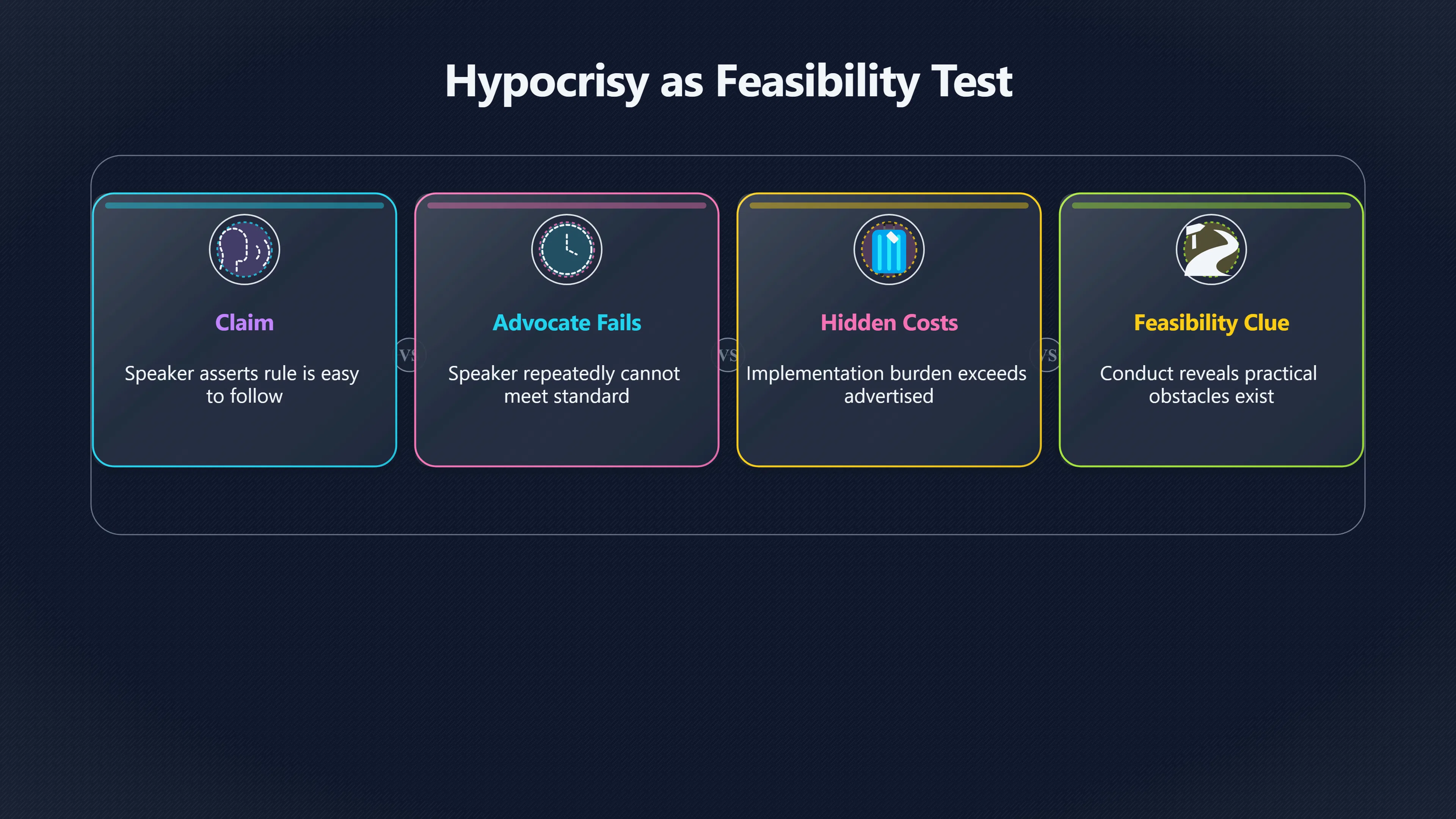
- The speaker claims that a rule is easy or practical.
- The speaker is unusually informed or committed to the rule.
- The speaker repeatedly fails to follow it.
- Therefore, there may be obstacles or costs not reflected in the original presentation.
The conclusion concerns feasibility, not truth.
Why This Can Be Rational
People often learn about hidden costs through observation rather than theory.
A manager who cannot maintain a supposedly simple reporting system may reveal that the paperwork burden is greater than expected. A financial adviser who repeatedly fails to follow a highly restrictive savings strategy may suggest that the strategy imposes lifestyle costs not acknowledged in the advice. A politician who advocates a policy but quietly seeks exemptions may indicate that compliance is more burdensome than public descriptions suggest.
In each case, conduct functions as data about implementation.
Alternative Explanations for Noncompliance
The strongest criticism of feasibility-based hypocrisy arguments is that failure to comply can have many causes besides impracticality.
A person may violate their own standard because of:
- Weak willpower.
- Carelessness.
- Changing priorities.
- Temporary emergencies.
- Lack of commitment.
- Personal circumstances unrelated to the proposal itself.
This is why hypocrisy alone cannot prove that a recommendation is unrealistic. The inference remains probabilistic rather than decisive.
For example, an individual may fully accept that exercise improves health while still failing to exercise regularly. Their inconsistency could reflect ordinary human weakness rather than any defect in the recommendation. Philosophical discussions of tu quoque repeatedly stress that personal inconsistency does not automatically undermine the content of an argument.[stanford]plato.stanford.eduEncyclopedia of Philosophy FallaciesIt involves not accepting a view or a recommendation because the espouser him…Read more… Encyclopedia of Philosophy[Internet Encyclopedia of Philosophy]iep.utm.eduInternet Encyclopedia of PhilosophyFallaciesIf the fallacious attack points out some despicable trait of the arguer, it also may be calle…
A careful assessment therefore asks additional questions:
- How often does the speaker fail to comply?
- Are the failures isolated or systematic?
- Does the speaker possess advantages that should make compliance easier?
- Are many other committed supporters experiencing similar difficulties?
- Is there independent evidence of hidden burdens?
The more widespread and persistent the pattern, the stronger the case that implementation problems are real.

Using Conduct as a Test of Practicality
When hypocrisy replies are at their strongest, they operate less like attacks on character and more like informal stress tests.
Instead of saying:
“You do not follow the rule, therefore the rule is false.”
the more defensible version is:
“You do not follow the rule, so perhaps the rule is harder to implement than you claim.”
This shift changes the logical role of the observation. The speaker’s behaviour becomes evidence about execution rather than evidence about truth.
Informal logic scholars have highlighted this distinction. Some arguments from hypocrisy are relevant because they challenge assumptions about competence, sincerity or practical viability. In particular, a pattern of noncompliance may indicate that a proposal encounters obstacles not apparent in abstract discussion.[Informal Logic]informallogic.caInformal Logic Tu Quoque Arguments and the Significance of HypocrisyTu quoque arguments are ad hominem arguments wherein a speaker (B) charges another (A) with inconsistency on an issue of dispute.Read more… PhilPapers A useful real-world analogy is product testing. Engineers may believe a design is simple until repeated failures under normal use reveal hidd[philpapers.org]philpapers.orgTu Quoque Arguments and the Significance of Hypocrisyby SF Aikin · 2008 · Cited by 39 — Though textbook tu quoque arguments are fallacies… en weaknesses. Likewise, advocates may sincerely believe a rule is easy until their own repeated inability to follow it exposes overlooked constraints.
When the Inference Becomes Stronger
Not all hypocrisy carries the same evidential weight.
The practicality inference becomes more persuasive when several conditions are present:
The speaker is highly motivated. If someone has strong incentives to comply yet still struggles, the failure is more informative.
The speaker has superior resources. Difficulties faced by a well-positioned advocate may suggest even greater difficulties for ordinary people.
The failures are recurring. A long pattern is more revealing than a single lapse.
The proposal is presented as easy. The contradiction matters most when simplicity itself is part of the claim.
Others report similar problems. Independent evidence reduces the chance that the issue is merely personal weakness.
Under these conditions, conduct can serve as a practical indicator that a recommendation’s costs have been underestimated.
The Boundary Between Insight and Fallacy
The central mistake of the tu quoque fallacy remains the same: hypocrisy does not by itself refute a claim. A person can be inconsistent and still be correct.[stanford]plato.stanford.eduEncyclopedia of Philosophy FallaciesIt involves not accepting a view or a recommendation because the espouser him…Read more… Encyclopedia of Philosophy[Internet Encyclopedia of Philosophy]iep.utm.eduInternet Encyclopedia of PhilosophyFallaciesIf the fallacious attack points out some despicable trait of the arguer, it also may be calle…
Yet hypocrisy can sometimes illuminate a different question. If a proposal is presented as easy, low-cost or universally manageable, repeated failures by its own advocates may reveal friction that the original argument ignored. The observation does not show that the proposal is false. It shows that implementation deserves closer scrutiny.
Seen this way, conduct becomes a source of evidence about practicality. The strongest hypocrisy replies do not claim that inconsistency settles the debate; they use inconsistency as a clue that the real-world costs of compliance may be higher than the rhetoric suggests.[Informal Logic]informallogic.caInformal Logic Tu Quoque Arguments and the Significance of HypocrisyTu quoque arguments are ad hominem arguments wherein a speaker (B) charges another (A) with inconsistency on an issue of dispute.Read more…[PhilPapers]philpapers.orgTu Quoque Arguments and the Significance of Hypocrisyby SF Aikin · 2008 · Cited by 39 — Though textbook tu quoque arguments are fallacies…
Amazon book picks
Further Reading
Books and field guides related to Does Hypocrisy Reveal Hidden Costs?. Use these as the next step if you want deeper reading beyond the article.
Atomic Habits
Rating: 3.5/5 from 7 Google Books ratings
Highlights the gap between endorsing a standard and successfully implementing it.
Thinking, Fast and Slow
Provides a framework for understanding practical decision-making failures.
eBay marketplace picks
Marketplace Samples
Topic-anchored marketplace searches for visual, collectible, or second-hand items related to this page.



Endnotes
1.
Source: philpapers.org
Link:https://philpapers.org/rec/AIKTQA
Source snippet
Tu Quoque Arguments and the Significance of Hypocrisyby SF Aikin · 2008 · Cited by 39 — Though textbook tu quoque arguments are fallacies...
2.
Source: plato.stanford.edu
Title: Encyclopedia of Philosophy Fallacies
Link:https://plato.stanford.edu/entries/fallacies/
Source snippet
It involves not accepting a view or a recommendation because the espouser him...Read more...
3.
Source: plato.stanford.edu
Title: grounds moral status
Link:https://plato.stanford.edu/entries/grounds-moral-status/
Source snippet
Grounds of Moral Statusby A Jaworska · 2013 · Cited by 397 — An entity has moral status if and only if it matters (to some degree) from t...
4.
Source: plato.stanford.edu
Title: category mistakes
Link:https://plato.stanford.edu/entries/category-mistakes/
Source snippet
Mistakes - Stanford Encyclopedia of Philosophyby O Magidor · 2019 · Cited by 172 — Category mistakes are sentences such as 'The number tw...
5.
Source: plato.stanford.edu
Title: logic informal
Link:https://plato.stanford.edu/archives/sum2002/entries/logic-informal/
Source snippet
LogicVan Eemeren and Grootendorst explain ad hominem as a violation of their first rule for "critical discussion," which maintains that "...
6.
Source: plato.stanford.edu
Title: logic informal
Link:https://plato.stanford.edu/entries/logic-informal/
Source snippet
more...
7.
Source: informallogic.ca
Title: Informal Logic Tu Quoque Arguments and the Significance of Hypocrisy
Link:https://informallogic.ca/index.php/informal_logic/article/view/543/506
Source snippet
Tu quoque arguments are ad hominem arguments wherein a speaker (B) charges another (A) with inconsistency on an issue of dispute.Read more...
8.
Source: iep.utm.edu
Link:https://iep.utm.edu/fallacy/
Source snippet
Internet Encyclopedia of PhilosophyFallaciesIf the fallacious attack points out some despicable trait of the arguer, it also may be calle...
9.
Source: Wikipedia
Title: Tu quoque
Link:https://en.wikipedia.org/wiki/Tu_quoque
Source snippet
Tu quoqueAlso known as the appeal to hypocrisy, "you too" fallacy, "two wrongs" fallacy, "pot calling the kettle black" fallacy, and "...
10.
Source: Wikipedia
Title: Ad hominem
Link:https://en.wikipedia.org/wiki/Ad_hominem
Source snippet
Ad hominemAd hominem short for argumentum ad hominem refers to when a speaker attacks the character, motive, or some other attribute o...
11.
Source: informallogic.ca
Link:https://informallogic.ca/index.php/informal_logic/user/setLocale/en_US?source=%2Findex.php%2Finformal_logic%2Farticle%2Fview%2F543
Source snippet
Tu Quoque Arguments and the Significance of Hypocrisyby SF Aikin · 2008 · Cited by 39 — Though textbook tu quoque arguments are fallacies...
12.
Source: ebsco.com
Link:https://www.ebsco.com/research-starters/religion-and-philosophy/ad-hominem
13.
Source: finmasters.com
Title: Tu Quoque Fallacy
Link:https://finmasters.com/tu-quoque-fallacy/
Source snippet
Definition and ExamplesTu quoque is a fallacy in which someone asserts that their opponent's argument must be invalid because it is incon...
14.
Source: holisticapologetics.com
Title: the tu quoque fallacy
Link:https://www.holisticapologetics.com/post/the-tu-quoque-fallacy
Source snippet
The "Tu Quoque" Fallacy24 Sept 2022 — Is Mark calling Jones a hypocrite in implying that, because of his hypocrisy, moral subjectivism is...
Additional References
15.
Source: logicallyfallacious.com
Link:https://www.logicallyfallacious.com/logicalfallacies/Ad-Hominem-Tu-quoque
Source snippet
Ad Hominem (Tu quoque)Description: Claiming the argument is flawed by pointing out that the one making the argument is not acting consist...
16.
Source: yourlogicalfallacyis.com
Link:https://yourlogicalfallacyis.com/tu-quoque
Source snippet
Your logical fallacy is tu quoqueThis fallacy is also known as the appeal to hypocrisy. It is commonly employed as an effective red herri...
17.
Source: windsor.scholarsportal.info
Link:https://windsor.scholarsportal.info/omp/index.php/wsia/catalog/download/454/812/3932?inline=1
Source snippet
ReasonPursuing Reason marks the latest collection of [essays]({{ 'essays/' | relative_url }}) from a scholar known for thoughtful theoretical treatments of a wide range of...
18.
Source: cerebralfaith.net
Title: For example, an argument may follow the rules of logic
Link:https://cerebralfaith.net/logical-fallacy-series-part-17-tu-quoque/
Source snippet
Logical Fallacy Series — Part 17: Tu QuoqueInformal fallacies, by contrast, are committed when the content of the argument is logically f...
19.
Source: reddit.com
Link:https://www.reddit.com/r/AskTrumpSupporters/comments/r601me/what_is_your_opinion_of_the_tu_quoque_fallacy_or/
Source snippet
, or it could be drawing the wrong conclusion from something that isn't...
20.
Source: academia.edu
Link:https://www.academia.edu/593058/Tu_quoque_arguments_subjunctive_inconsistency_and_questions_of_relevance
Source snippet
scourse, particularly in political and ethical contexts.Read more...
21.
Source: facebook.com
Link:https://www.facebook.com/ThinkingPowers/posts/the-false-moral-equivalence-fallacy-creates-a-false-comparison-between-actions-t/984934906964540/
Source snippet
't actually alike. It often pairs with a rhetorical technique...
22.
Source: 3quarksdaily.com
Title: tu quoque arguments and their relevance
Link:https://3quarksdaily.com/3quarksdaily/2015/09/tu-quoque-arguments-and-their-relevance.html
Source snippet
14 Sept 2015 — The tu quoque may take the form of charges of hypocrisy when someone affirms a practical proposal that she has regularly f...
23.
Source: philosophicalsociety.com
Link:https://www.philosophicalsociety.com/HTML/LogicalFallacies.html
Source snippet
claim by assailing the proponent of it.Read more...
24.
Source: press.rebus.community
Title: community Informal Fallacies –
Link:https://press.rebus.community/intro-to-phil-logic/chapter/chapter-4-informal-fallacies/
Source snippet
Fallacies – Introduction to Philosophy: LogicThis form of ad hominem consists in calling into question the moral character of the speaker...
Topic Tree