Within Fallacy Lab
Are Definitions Moving to Escape Evidence?
The no true Scotsman move protects a general claim by redefining membership whenever counterexamples appear.
On this page
- Redefined categories
- Counterexample handling
- Fair definition tests
Page outline Jump by section
Introduction
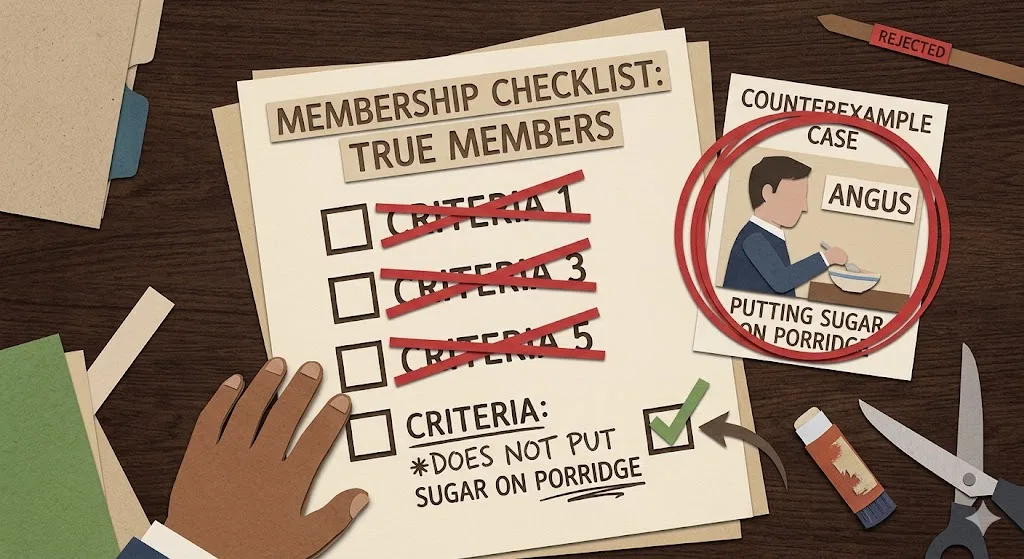
No True Scotsman is the fallacy of protecting a general claim by moving the definition of the group after a counterexample appears. The pattern is simple: someone says “No member of this group does X”; a real member of the group is shown doing X; the speaker replies that the person is not a “true”, “real”, “genuine” or “proper” member after all. The problem is not that definitions can never be refined. The problem is that the refinement arrives just in time to save the claim, with no independent test for who counts. In logical fallacies, this matters because it turns evidence into something the claim can always outrun. Instead of learning from counterexamples, the argument quietly changes the membership rules.[Scribbr]scribbr.comno true scotsman fallacyNo True Scotsman Fallacy | Definition & ExamplesJun 5, 2023 — The no true Scotsman fallacy is the attempt to defend a generalizati…
How the Category Gets Redefined
The classic example is attributed to philosopher Antony Flew: “No Scotsman puts sugar on his porridge.” When Angus is offered as a Scotsman who does exactly that, the reply becomes “No true Scotsman puts sugar on his porridge.” The word “true” does the argumentative work. It does not provide a census rule, legal definition, cultural criterion or evidence about Scottish eating habits. It merely protects the original generalisation from a case that would otherwise weaken it.[Wikipedia]WikipediaNo true ScotsmanNo true Scotsman
This is why No True Scotsman is often called an “appeal to purity”. The speaker treats the group as if its “real” members must preserve the quality being defended. A counterexample is not answered; it is expelled. The move is especially tempting where group identity is emotionally important: political camps, religions, fandoms, professions, nations, schools of thought and moral movements. “No real scientist would say that”, “no genuine patriot would object”, or “no true supporter would criticise the leader” may be valid only if there is a prior, defensible standard for the group. Without that standard, the phrase works as a gatekeeping device rather than a reason.[Logically Fallacious]logicallyfallacious.comhow to spot the no true scotsman fallacyLogically FallaciousHow to Spot the No True Scotsman Fallacy16 May 2026 — If you want to spot the No True Scotsman fallacy in arguments…
The fallacy usually has three moving parts:
- A broad claim: “All real members of this group have this trait” or “no real member behaves that way.”
- A counterexample: someone or something that appears to belong to the group but lacks the trait.
- A rescue definition: the category is narrowed after the fact so the counterexample no longer counts.
The key warning sign is timing. A definition offered before the dispute may be a normal clarification. A definition introduced only after the claim is challenged deserves scrutiny, especially if it excludes precisely the inconvenient case and nothing more.

Why Counterexamples Become So Threatening
A counterexample matters because many No True Scotsman arguments begin as universal or near-universal claims. “No X does Y” can be defeated by one genuine X that does Y. In ordinary reasoning, that should prompt a more careful claim: “many Xs do not do Y”, “X discourages Y”, “Y conflicts with the official rules of X”, or “this person is a member but is acting against the group’s stated values”. Those revisions may be fair because they concede that the first claim was too broad.
The fallacy appears when the speaker refuses that concession and instead makes the original claim unfalsifiable. If every counterexample can be dismissed as “not a true X”, then no evidence can count against the claim. The argument has shifted from an empirical statement about a group to a circular definition: true members are the ones who fit the claim, and anyone who does not fit the claim was never a true member.[Scribbr]scribbr.comno true scotsman fallacyNo True Scotsman Fallacy | Definition & ExamplesJun 5, 2023 — The no true Scotsman fallacy is the attempt to defend a generalizati…
This also explains why No True Scotsman overlaps with, but is not identical to, several neighbouring fallacies. It can resemble equivocation, because the meaning of a key term changes during the argument. Stanford’s discussion of fallacies describes equivocation as exploiting a term’s ambiguity across an argument, which is close to what happens when “Scotsman” quietly becomes “Scotsman who meets my preferred moral or behavioural test”.[stanford]plato.stanford.eduEncyclopedia of Philosophy FallaciesEncyclopedia of Philosophy Fallacies Encyclopedia of Philosophy It can also resemble moving the goalposts, because the standard for acceptance is changed after the evidence arrives. But the distinctive feature of No True Scotsman is that the shifted standard concerns membership in a category: who counts as a real member, genuine case or authentic example.
When Redefinition Is Fair
Not every disputed definition is a fallacy. Groups and concepts often have real boundaries. “No qualified surgeon performs operations without medical training” is not refuted by pointing to an untrained person who falsely claims to be a surgeon. “No legal voter in this election was under eighteen” is not refuted by a seventeen-year-old who attempted to vote, because the age rule is part of the prior legal definition. In those cases, the exclusion is not invented to dodge evidence; it is built into the category.
A fair definition has to do more than protect a favoured conclusion. It should be available before the counterexample, apply consistently to favourable and unfavourable cases, and be grounded in recognised criteria. Informal logic is concerned with real-life argument in public debate, education, law, medicine and everyday exchange, where definitions often need context rather than rigid dictionary treatment.[stanford]plato.stanford.eduEncyclopedia of Philosophy FallaciesEncyclopedia of Philosophy Fallacies Encyclopedia of Philosophy That context can make a narrowing definition legitimate, but it can also make a manipulative narrowing harder to spot.
A useful test is whether the revised definition would still be accepted if it weakened the speaker’s own side. Suppose someone says, “No true environmentalist flies long-haul.” If challenged with well-known environmental campaigners who have flown to climate conferences, the speaker might define “true environmentalist” as “someone who never uses high-emission transport”. That definition is clear, but it is also unusually strict and conveniently excludes many recognised examples. It may be a personal standard, but it cannot fairly support a broad claim about the movement unless the speaker argues for that standard independently.

Moving Definitions and Persuasive Labels
Moving definitions become more powerful when the disputed word carries emotional approval. Words such as “real”, “genuine”, “patriotic”, “responsible”, “civilised”, “free” or “extreme” do not merely classify; they praise or blame. This connects No True Scotsman to the wider problem of persuasive definition, where a familiar term is redefined in a way that helps one side of an argument while seeming neutral. Charles Stevenson introduced the idea of persuasive definition in work on emotive meaning, and later argumentation theorists have treated such definitions as powerful tools in moral, legal and political debate.[PhilPapers]philpapers.orgPhil Papers Persuasive definitionPhil Papers Persuasive definition
The persuasive force comes from a swap: the speaker keeps the positive emotional aura of the word while changing its descriptive boundary. “Freedom” may be redefined so only one policy counts as freedom. “Democracy” may be narrowed so inconvenient democracies are dismissed as not real democracies. “Science” may be used to include only conclusions one already accepts. In each case, the debate seems to be about a factual category, but the definition may be carrying a hidden value judgement.[cambridge]cambridge.orgUniversity Press & Assessment8University Press & Assessment8 University Press & Assessment
That does not mean every value-laden definition is dishonest. Political and ethical language is often contested because people genuinely disagree about what matters most. The problem arises when the redefinition is smuggled in as though it were already settled. A fair argument says, “Here is the definition I am using, and here is why it is justified.” A moving-definition argument says, in effect, “Your counterexample does not count because my preferred conclusion requires it not to count.”
Fair Definition Tests
The best response to No True Scotsman is not to argue endlessly about labels. It is to ask for the rule that decides membership and then test that rule for independence, consistency and usefulness.
A definition is more likely to be fair when it passes these checks:
- Prior rule: Was the definition stated before the counterexample appeared, or only afterwards?
- Independent basis: Does the definition rely on law, official rules, ordinary usage, expert practice, shared criteria or clearly argued principles?
- Consistent application: Would the speaker apply it to allies, heroes and convenient examples as well as to embarrassing ones?
- Falsifiability: Could any possible evidence count against the revised claim, or has the claim become true by definition?
- Proportionality: Does the definition clarify the category, or does it add an extreme purity test that ordinary usage would not support?
These tests keep the discussion focused on reasoning rather than identity policing. A person may be a bad member, hypocritical member, unrepresentative member or rule-breaking member of a group without ceasing to be a member. Often that distinction is exactly what the No True Scotsman move tries to erase.
Why the Fallacy Matters in Real Arguments
No True Scotsman is not just a debating trick about porridge. It affects how groups handle failure. If every corrupt official is “not a real public servant”, every abusive fan is “not a true fan”, every failed prediction is “not real expertise”, or every extremist is “not a genuine believer”, then the group never has to examine its own incentives, institutions or weak spots. The fallacy can become a reputational shield: the group keeps credit for admired members while disowning any member who creates evidence against a flattering generalisation.
It can also make disagreement harder to resolve. Once definitions start moving, participants may no longer be arguing about the same claim. One side is discussing ordinary membership; the other is discussing ideal membership. One side means “people who belong to the party, church, profession or movement”; the other means “people who live up to my preferred standard for that group”. Unless that difference is made explicit, the argument can go in circles while both sides think the other is being evasive.
The fairest repair is often simple: separate membership from evaluation. Instead of saying “no true member would do that”, say “that person is a member, but their action violates the group’s principles”, or “that case shows my original claim was too broad”. This keeps moral criticism available without making evidence disappear. It also preserves the real purpose of studying logical fallacies: not to win by labelling the other side irrational, but to make claims strong enough that they do not need moving definitions to survive.
Amazon book picks
Further Reading
Books and field guides related to Are Definitions Moving to Escape Evidence?. Use these as the next step if you want deeper reading beyond the article.
How to Win Every Argument
Directly addresses informal fallacies including category-protection tactics.
An Illustrated Book of Bad Arguments
Explains common fallacies through memorable examples.
eBay marketplace picks
Marketplace Samples
Example marketplace items related to this page. Use the search link to explore similar finds on eBay.


Endnotes
1.
Source: scribbr.com
Title: no true scotsman fallacy
Link:https://www.scribbr.com/fallacies/no-true-scotsman-fallacy/
Source snippet
No True Scotsman Fallacy | Definition & ExamplesJun 5, 2023 — The no true Scotsman fallacy is the attempt to defend a generalizati...
2.
Source: Wikipedia
Title: No true Scotsman
Link:https://en.wikipedia.org/wiki/No_true_Scotsman
3.
Source: plato.stanford.edu
Title: Encyclopedia of Philosophy Fallacies
Link:https://plato.stanford.edu/entries/fallacies/
4.
Source: plato.stanford.edu
Title: Encyclopedia of Philosophy Informal Logic
Link:https://plato.stanford.edu/entries/logic-informal/
5.
Source: philpapers.org
Title: Phil Papers Persuasive definition
Link:https://philpapers.org/rec/ABEPD
6.
Source: cambridge.org
Title: University Press & Assessment8
Link:https://www.cambridge.org/core/books/media-argumentation/persuasive-definitions-and-public-policy-arguments/8294AFE9DA8F70FCC440CDE0D49DA45A
7.
Source: Wikipedia
Title: Persuasive definition
Link:https://en.wikipedia.org/wiki/Persuasive_definition
8.
Source: plato.stanford.edu
Title: logic informal
Link:https://plato.stanford.edu/archives/fall2021/entries/logic-informal/
9.
Source: plato.stanford.edu
Title: logic informal
Link:https://plato.stanford.edu/archives/fall2003/entries/logic-informal/
10.
Source: plato.stanford.edu
Title: logic informal
Link:https://plato.stanford.edu/archives/fall2014/entries/logic-informal/
11.
Source: plato.stanford.edu
Title: logic informal
Link:https://plato.stanford.edu/archives/fall2019/entries/logic-informal/
12.
Source: plato.stanford.edu
Title: logic informal
Link:https://plato.stanford.edu/archives/win2008/entries/logic-informal/
13.
Source: plato.stanford.edu
Link:https://plato.stanford.edu/entries/argument/
14.
Source: plato.stanford.edu
Title: roger bacon
Link:https://plato.stanford.edu/archives/fall2015/entries/roger-bacon/
15.
Source: plato.stanford.edu
Title: mill moral political
Link:https://plato.stanford.edu/archives/win2008/entries/mill-moral-political/
16.
Source: philpapers.org
Title: WALLAA 7
Link:https://philpapers.org/rec/WALLAA-7
17.
Source: youtube.com
Title: No True Scotsman
Link:https://www.youtube.com/watch?v=0_NCtdOKQ04
Source snippet
Religion and the No True Scotsman Fallacy...
18.
Source: youtube.com
Title: Religion and the No True Scotsman Fallacy
Link:https://www.youtube.com/watch?v=_g9pdWyAaDs
Source snippet
No True Scotsman | Logical Fallacies...
19.
Source: youtube.com
Title: No True Scotsman | Logical Fallacies
Link:https://www.youtube.com/watch?v=g4jkflsSuPE
Source snippet
Logical Fallacies: No True Scotsman...
20.
Source: logicallyfallacious.com
Title: how to spot the no true scotsman fallacy
Link:https://www.logicallyfallacious.com/blog/how-to-spot-the-no-true-scotsman-fallacy
Source snippet
Logically FallaciousHow to Spot the No True Scotsman Fallacy16 May 2026 — If you want to spot the No True Scotsman fallacy in arguments...
Published: May 2026
21.
Source: logicallyfallacious.com
Link:https://www.logicallyfallacious.com/logicalfallacies/No-True-Scotsman
Source snippet
Logically FallaciousNo True ScotsmanWhen a universal (“all”, “every”, etc.) claim is refuted, rather than conceding the point or meaningf...
22.
Source: iep.utm.edu
Link:https://iep.utm.edu/fallacy/
23.
Source: scribbr.co.uk
Title: No True Scotsman Fallacy | Definition & Examples
Link:https://www.scribbr.co.uk/fallacy/no-true-scotsman/
24.
Source: bachelorprint.com
Title: no true scotsman fallacy
Link:https://www.bachelorprint.com/fallacies/no-true-scotsman-fallacy/
25.
Source: bachelorprint.com
Title: no true scotsman fallacy
Link:https://www.bachelorprint.com/ca/fallacies/no-true-scotsman-fallacy/
26.
Source: diplomacy.edu
Title: No true Scotsman
Link:https://www.diplomacy.edu/blog/no-true-scotsman/
27.
Source: quillbot.com
Title: no true scotsman fallacy
Link:https://quillbot.com/blog/reasoning/no-true-scotsman-fallacy/
28.
Source: ru.scribd.com
Title: No true Scotsman
Link:https://ru.scribd.com/document/734350253/No-true-Scotsman
29.
Source: torahmusings.com
Title: No true Scotsman
Link:https://www.torahmusings.com/wp-content/uploads/2006/08/No_true_Scotsman
30.
Source: paraphrasetool.com
Title: no true scotsman fallacy
Link:https://paraphrasetool.com/usage/no-true-scotsman-fallacy
31.
Source: logicalfallacies.org
Title: No True Scotsman
Link:https://www.logicalfallacies.org/no-true-scotsman.html
32.
Source: faithalone.org
Title: no true scotsman
Link:https://faithalone.org/blog/no-true-scotsman/
33.
Source: logical-fallacy.com
Title: No True Scotsman
Link:https://www.logical-fallacy.com/articles/no-true-scotsman/
Additional References
34.
Source: fallacyfiles.org
Link:https://www.fallacyfiles.org/scotsman.html
Source snippet
Fallacy FilesThe No-True-Scotsman FallacyThe "no-true-Scotsman" type of redefinition usually occurs in the course of an argument or debat...
35.
Source: academia.edu
Link:https://www.academia.edu/34279472/Is_Flews_No_True_Scotsman_Fallacy_a_True_Fallacy_A_Contextual_Analysis
Source snippet
Is Flew's No True Scotsman Fallacy a...In this paper, I discuss ways where context can help to explain why the No True Scotsman...
36.
Source: researchgate.net
Link:https://www.researchgate.net/publication/254406106_Persuasive_Definitions_and_Public_Policy_Arguments
37.
Source: academia.edu
Link:https://www.academia.edu/38741164/Praise_for_David_McRaneys_You_Are_Not_So_Smart
38.
Source: bsecs.org.uk
Link:https://www.bsecs.org.uk/wp-content/uploads/2019/06/Abstracts-A-D.pdf
39.
Source: ccsenet.org
Link:https://www.ccsenet.org/journal/index.php/jpl/article/view/45932
40.
Source: reddit.com
Link:https://www.reddit.com/r/changemyview/comments/psnb0h/cmv_the_no_true_scotsman_fallacy_is_not_a_fallacy/
41.
Source: reddit.com
Link:https://www.reddit.com/r/fallacy/comments/l8yhxo/can_someone_explain_the_no_true_scotsman_fallacy/
42.
Source: researchgate.net
Link:https://www.researchgate.net/publication/225793431_Deceptive_Arguments_Containing_Persuasive_Language_and_Persuasive_Definitions
43.
Source: scribd.com
Link:https://www.scribd.com/document/818962193/Ethics-and-Language-By-Charles-L-STevenson-New-Haven-Connecticut-1944-Yale-University-Press-1149051012-7ba2f2e43a859358b6489e6c3ca80
Topic Tree