Within Fallacy Lab
When the Structure Makes Reasoning Fail
Formal fallacies show how an argument can fail even when its individual statements sound plausible.
On this page
- What formal validity means
- Classic invalid patterns
- Why true premises may still mislead
Page outline Jump by section
Introduction
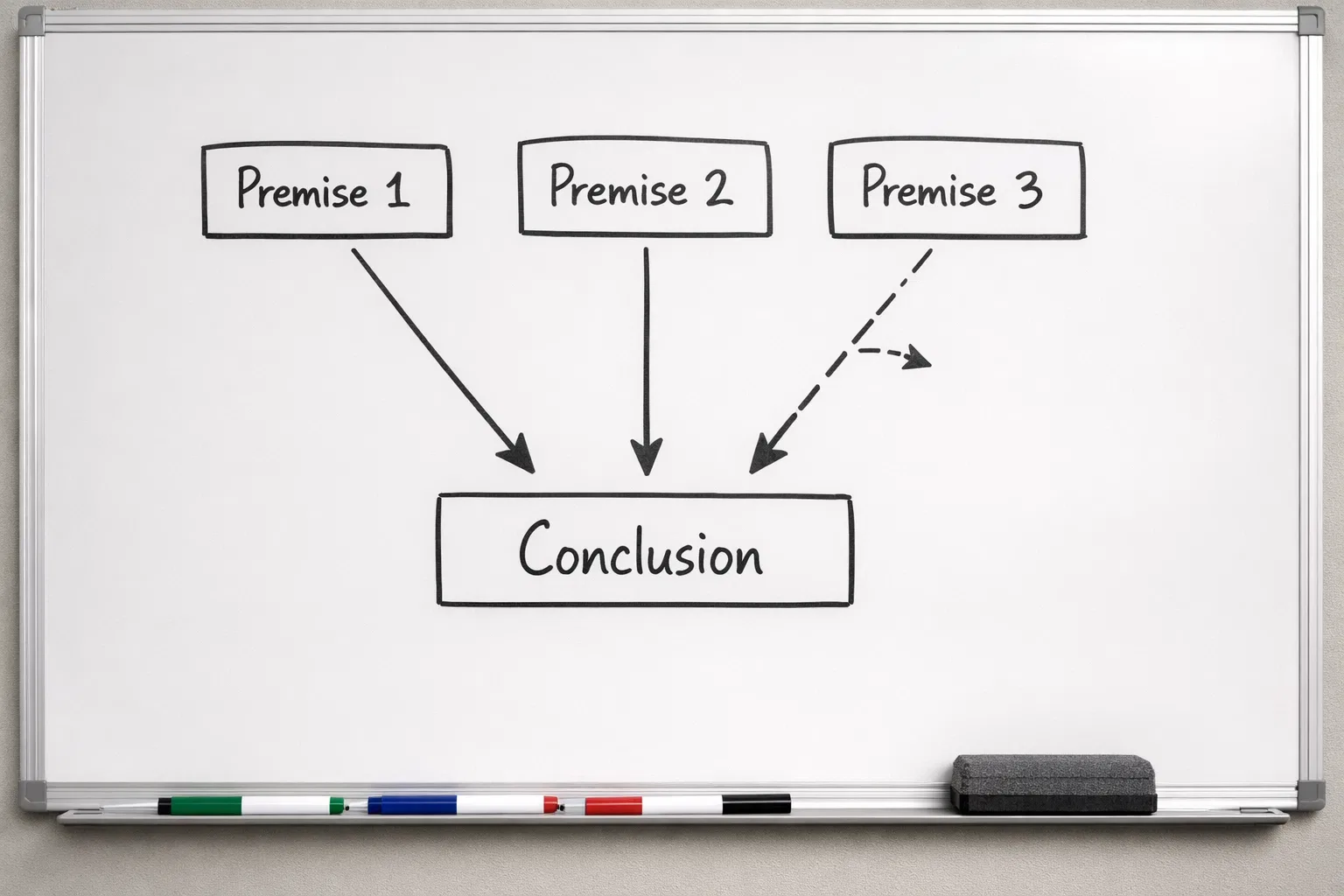
Formal fallacies are reasoning errors caused by an argument’s structure. The individual statements may sound plausible, and the conclusion may even be true, but the conclusion does not follow from the premises in the way the argument claims. That is the key difference: a formal fallacy is not mainly a problem of tone, evidence, wording or relevance. It is a failure in the logical form of the inference itself.
This matters because invalid structure can hide inside very familiar patterns of thought: “If this cause happened, we would see this effect; we see the effect; therefore that cause happened.” Sometimes that guess is reasonable as a hypothesis, but it is not deductive proof. Logic textbooks and philosophy references usually describe validity as the condition in which it is impossible for the premises to be true and the conclusion false; formal fallacies violate that condition.[open.library.okstate.edu]open.library.okstate.eduLogic and the Study of Arguments – Critical ThinkingAn argument is valid if it is impossible for the premises to be true and the conclusion false. To put validity in…Read more…
What Formal Validity Means
A deductive argument is valid when its structure guarantees the conclusion, assuming the premises are true. Validity is therefore not the same as truth. A valid argument can contain false premises, and an invalid argument can contain true premises. What validity tests is the link between premises and conclusion, not the factual accuracy of each sentence.[pimaopen.pressbooks.pub]pimaopen.pressbooks.pub1.2 Arguments – Types of Reasoning - Pima Open Digital Pressby K Eldred · 2024 — A deductive argument is valid when: If all its premises…
Consider this valid pattern:
If a person is in Paris, they are in France.
This person is in Paris.
Therefore, this person is in France.
The structure works because the second premise confirms the condition named in the first premise. In formal logic, this is the valid pattern often called modus ponens: if P then Q; P; therefore Q. The conclusion follows because the premises leave no room, within that structure, for P to be true and Q false.
Now compare it with this invalid pattern:
If a person is in Paris, they are in France.
This person is in France.
Therefore, this person is in Paris.
The conclusion might happen to be true, but the structure does not prove it. France contains many places other than Paris. The argument has moved from “Paris is sufficient for being in France” to “being in France proves Paris”, which is a structural mistake.
This is why formal fallacies can be deceptive. They often resemble valid reasoning closely enough to feel right. The problem is not that the topic is complicated, but that the argument has smuggled in a stronger relationship than the premises actually state.

Classic Invalid Patterns
The most useful formal fallacies to know are not obscure labels. They are recurring ways in which people mishandle conditional claims, categories and quantified statements.
Affirming the Consequent
Affirming the consequent has this form:[fallacies.online]fallacies.onlineaffirming the consequentaffirming the consequent
If P, then Q.
Q.
Therefore, P.
The mistake is treating a consequence as if it proves the one possible cause named in the first premise. A wet pavement may follow from rain, but a wet pavement does not prove rain. It could also follow from a burst pipe, street cleaning or someone emptying a bucket. The Internet Encyclopedia of Philosophy uses affirming the consequent as a standard example of a fallacious argument form, and logic references commonly contrast it with valid conditional forms such as modus ponens and modus tollens.[Internet Encyclopedia of Philosophy]iep.utm.eduSource details in endnotes.
This pattern becomes especially dangerous when the conclusion is emotionally or practically important. “If the accused were guilty, this evidence would be present. This evidence is present. Therefore, the accused is guilty.” That may be a reason to investigate further, but by itself it is not deductive proof. The same evidence may have alternative explanations.
A related probabilistic version appears in discussions of the prosecutor’s fallacy, where people confuse the probability of seeing evidence if a person is innocent with the probability that the person is innocent given the evidence. Oxford’s Centre for Evidence-Based Medicine describes this kind of reversal as a source of miscarriages of justice, including cases where rare evidence was treated as if it directly established guilt.[cebm.ox.ac.uk]cebm.ox.ac.ukthe prosecutors fallacythe prosecutors fallacy
Denying the Antecedent
Denying the antecedent has this form:[answersingenesis.org]answersingenesis.orgformal fallaciesformal fallacies
If P, then Q.
Not P.
Therefore, not Q.
The mistake is assuming that because one sufficient condition is absent, the result cannot occur. “If it rains, the pavement will be wet. It did not rain. Therefore, the pavement is not wet.” Again, the pavement might be wet for other reasons.
This is the mirror image of affirming the consequent. Both errors come from confusing a one-way conditional with a two-way equivalence. “If P, then Q” does not normally mean “P if and only if Q.” It only says that P is enough for Q, not that P is the only route to Q.[pimaopen.pressbooks.pub]pimaopen.pressbooks.pubOpen source on pressbooks.pub.
In everyday reasoning, denying the antecedent often appears as premature dismissal. For example: “If the server had crashed, the website would be down. The server did not crash, so the website cannot be down.” That ignores other possible causes, such as a network failure, expired certificate, DNS problem or deployment error.

Undistributed Middle
The fallacy of the undistributed middle belongs to categorical syllogisms: arguments about classes such as “all”, “some” and “none”. Its classic structure is:
All A are C.
All B are C.
Therefore, all A are B.
The middle term, C, links the two premises but is never used in a way that covers the whole category. For example:
All cats are mammals.
All dogs are mammals.
Therefore, all cats are dogs.
The premises are true, but the conclusion is false. The shared category “mammals” is too broad to prove that cats and dogs are the same group. Stanford’s entry on fallacies names undistributed middle as one of the identifiable invalid forms typical of formal fallacies.[stanford]plato.stanford.eduEncyclopedia of Philosophy FallaciesStanford Encyclopedia of PhilosophyFallacies - Stanford Encyclopedia of Philosophyby H Hansen · 2015 · Cited by 426 — Formal fallacies ar… Encyclopedia of Philosophy
The everyday version is easy to miss: two things can share a feature without being identical, causally connected or morally equivalent. “Both policies reduce costs; therefore they are the same policy” has the same kind of structural weakness unless the argument adds stronger connecting premises.
Quantifier and Existence Errors
Some formal mistakes arise from mishandling words such as “all”, “some”, “none” and “there exists”. A common error is moving too quickly from a universal statement to a particular existence claim. For example, “All unicorns have horns” does not prove that unicorns exist. It only states what would be true if anything belonged to that category.
This kind of problem is sometimes discussed under quantificational or existential fallacies. The general issue is that logical form changes when an argument moves between universal claims and existence claims. “All members of this group have property X” is not the same as “there is at least one member of this group.”[fallacyfiles.org]fallacyfiles.orgSource details in endnotes.
These errors matter in technical, legal and policy contexts because a small shift in quantity can change the claim completely. “All approved applicants met the threshold” does not mean “all applicants who met the threshold were approved.” “Some risks are manageable” does not mean “all risks are manageable.” The structure of the quantifier controls the strength of the conclusion.
Why True Premises May Still Mislead
Formal fallacies are powerful because they show that truth alone is not enough. An argument can begin with true premises and still fail if the conclusion is not forced by those premises.
The Paris example makes this clear. “If someone is in Paris, they are in France” is true. “This person is in France” may also be true. But “therefore, this person is in Paris” does not follow. The argument’s failure lies in the transition, not necessarily in any single statement.
This is why formal logic separates validity from soundness. Soundness requires both valid structure and true premises. Validity alone asks whether the conclusion would have to be true if the premises were true. Soundness adds the further requirement that the premises really are true.[pimaopen.pressbooks.pub]pimaopen.pressbooks.pubOpen source on pressbooks.pub.
That distinction prevents two common mistakes. The first is dismissing an argument as “invalid” merely because one premise is false. A false premise may make an argument unsound, but not necessarily invalid. The second is accepting an argument because its conclusion is true. A true conclusion can be reached by bad reasoning, coincidence or missing premises.
The Mechanism Behind Invalid Structure
Formal fallacies usually happen when an argument treats a weaker relationship as if it were stronger.
The most common upgrades are:[answersingenesis.org]answersingenesis.orgformal fallaciesformal fallacies
- Sufficient becomes necessary. “P is enough for Q” becomes “P is required for Q.”
- One-way implication becomes equivalence. “If P, then Q” becomes “P if and only if Q.”
- Shared category becomes identity. “A and B are both C” becomes “A is B.”
- Universal description becomes existence. “All X would be Y” becomes “some X exists.”
- Possible explanation becomes proven explanation. “P would explain Q” becomes “Q proves P.”
These moves are tempting because they often work in casual situations. If the doorbell rings after a delivery notification, it is reasonable to suspect the courier. But as deductive logic, “if the courier arrives, the bell rings; the bell rang; therefore it was the courier” is still invalid. It becomes stronger only if extra premises rule out other explanations.
That is the practical lesson of formal fallacies: the argument may need additional premises. Sometimes the speaker has not made them explicit; sometimes the missing premise is false; sometimes the reasoning should be reframed as a probability judgement rather than a deduction.
When an Invalid Form Is Still a Useful Clue
Not every argument that resembles a formal fallacy is worthless. In real life, people often reason abductively: they infer the best available explanation rather than claiming deductive certainty. “The lawn is wet, so it probably rained” may be a sensible guess if rain is common and there is no sprinkler, but it should not be presented as a logical proof.
Recent work on human conditional reasoning notes that people often use affirming-the-consequent and denying-the-antecedent patterns pragmatically in daily life, even though the forms are invalid in classical deductive logic. The important distinction is whether the argument is claiming certainty or offering a defeasible, evidence-based hypothesis.[arXiv]arxiv.orgarXiv Human Conditional Reasoning in Answer Set ProgrammingarXiv Human Conditional Reasoning in Answer Set Programming
This distinction helps avoid overcorrecting. A doctor, investigator or engineer may reasonably ask, “What cause would make this effect likely?” That is not automatically a fallacy. It becomes fallacious when the thinker treats one possible cause as the only possible cause without checking alternatives, base rates or background information.
The same issue appears in legal and forensic reasoning. Evidence may be far more likely under one hypothesis than another, but that does not allow the listener to reverse conditional probabilities casually. Modern forensic discussions increasingly emphasise careful expression of likelihood ratios and avoidance of the prosecutor’s fallacy, because the way the conditional is framed can change how strongly evidence appears to support a conclusion.[arXiv]arxiv.orgarXiv Human Conditional Reasoning in Answer Set ProgrammingarXiv Human Conditional Reasoning in Answer Set Programming
How to Test for Invalid Argument Structure
A useful test is to strip the argument down to its form. Replace the topic with letters or neutral placeholders. This removes emotional force and makes the structure easier to inspect.
For a conditional argument, ask:
- Is the argument saying “if P, then Q”?
- Does it then affirm P and conclude Q? That is usually valid.
- Does it deny Q and conclude not-P? That is usually valid. 4. Does it affirm Q and conclude P? That is affirming the consequent.[fallacies.online]fallacies.onlineaffirming the consequentaffirming the consequent 5. Does it deny P and conclude not-Q? That is denying the antecedent.[answersingenesis.org]answersingenesis.orgformal fallaciesformal fallacies
For a category argument, ask whether the middle category truly connects the two groups or merely describes something they share. If two groups are both inside a larger class, that does not prove they are the same group.
For arguments using “all”, “some” or “none”, ask whether the conclusion changes the quantity. A move from “all” to “some”, from “some” to “all”, or from a conditional description to an existence claim often needs an extra premise.
The simplest stress test is this: can the premises be true while the conclusion is false? If yes, the argument is invalid. That single question captures the core of formal validity and explains why formal fallacies are structural failures rather than merely weak rhetoric.[open.library.okstate.edu]open.library.okstate.educhapter 10 propositional logic truth tables and truth treeschapter 10 propositional logic truth tables and truth trees
Why Formal Fallacies Matter in Logical Fallacies
Formal fallacies are the cleanest examples of how reasoning can fail because of structure alone. They do not require deep knowledge of the subject matter to diagnose; the error can often be seen once the argument is reduced to its form.
That makes them especially valuable as a foundation for understanding logical fallacies more broadly. Informal fallacies often depend on context, definitions, evidence or relevance. Formal fallacies show the stricter case: even if the language is clear, the premises sound plausible and the conclusion feels believable, the argument can still fail because the inferential bridge is broken.
The reader’s lasting habit should be structural, not label-driven. Before asking whether a claim is persuasive, ask what form of support is being offered. Does the conclusion genuinely follow, or has the argument quietly converted a clue into proof, a sufficient condition into a necessary one, or a shared feature into an identity? That question is the practical core of recognising formal fallacies.
Amazon book picks
Further Reading
Books and field guides related to When the Structure Makes Reasoning Fail. Use these as the next step if you want deeper reading beyond the article.
A Concise Introduction to Logic
Directly teaches validity, soundness, and formal fallacies.
eBay marketplace picks
Marketplace Samples
Example marketplace items related to this page. Use the search link to explore similar finds on eBay.




Endnotes
1.
Source: open.library.okstate.edu
Title: Logic and the Study of Arguments – Critical Thinking
Link:https://open.library.okstate.edu/criticalthinking/chapter/unknown/
Source snippet
An argument is valid if it is impossible for the premises to be true and the conclusion false. To put validity in...Read more...
2.
Source: plato.stanford.edu
Title: Encyclopedia of Philosophy Fallacies
Link:https://plato.stanford.edu/entries/fallacies/
Source snippet
Stanford Encyclopedia of PhilosophyFallacies - Stanford Encyclopedia of Philosophyby H Hansen · 2015 · Cited by 426 — Formal fallacies ar...
3.
Source: pimaopen.pressbooks.pub
Link:https://pimaopen.pressbooks.pub/introphilosophy/chapter/1-2-arguments-types-of-reasoning/
Source snippet
1.2 Arguments – Types of Reasoning - Pima Open Digital Pressby K Eldred · 2024 — A deductive argument is valid when: If all its premises...
4.
Source: cebm.ox.ac.uk
Title: the prosecutors fallacy
Link:https://www.cebm.ox.ac.uk/news/views/the-prosecutors-fallacy
5.
Source: pimaopen.pressbooks.pub
Link:https://pimaopen.pressbooks.pub/intrologic/chapter/2-2-logical-fallacies/
6.
Source: fallacyfiles.org
Link:https://www.fallacyfiles.org/quanfall.html
7.
Source: arxiv.org
Title: arXiv Human Conditional Reasoning in Answer Set Programming
Link:https://arxiv.org/abs/2311.04412
8.
Source: arxiv.org
Link:https://arxiv.org/abs/2502.03217
9.
Source: pimaopen.pressbooks.pub
Link:https://pimaopen.pressbooks.pub/intrologic/chapter/1-3-types-of-arguments-deductive-and-inductive/
10.
Source: plato.stanford.edu
Title: logic informal
Link:https://plato.stanford.edu/entries/logic-informal/
11.
Source: plato.stanford.edu
Link:https://plato.stanford.edu/archives/fall2025/entries/fallacies/notes.html
12.
Source: plato.stanford.edu
Link:https://plato.stanford.edu/archives/fall1997/entries/logic-informal/
13.
Source: plato.stanford.edu
Link:https://plato.stanford.edu/entries/argument/
14.
Source: plato.stanford.edu
Title: feminism argumentation
Link:https://plato.stanford.edu/entries/feminism-argumentation/
15.
Source: plato.stanford.edu
Title: logic informal
Link:https://plato.stanford.edu/archives/win2004/entries/logic-informal/
16.
Source: plato.stanford.edu
Title: logic informal
Link:https://plato.stanford.edu/archives/sum2002/entries/logic-informal/
17.
Source: arxiv.org
Link:https://arxiv.org/html/2502.03217v1
18.
Source: open.library.okstate.edu
Title: chapter 10 propositional logic [truth tables]({{ ‘truth-table/’ | relative_url }}) and truth trees
Link:https://open.library.okstate.edu/logicandcriticalthinkingexercises/chapter/chapter-10-propositional-logic-truth-tables-and-truth-trees/
19.
Source: open.edu
Link:https://www.open.edu/openlearn/mod/oucontent/view.php?id=170658§ion=7.1
20.
Source: austlii.edu.au
Link:https://www.austlii.edu.au/au/journals/AUJlLegPhil/2011/5.pdf
21.
Source: philosophy.institute
Title: understanding fallacies reasoning errors
Link:https://philosophy.institute/logic/understanding-fallacies-reasoning-errors/
22.
Source: fallacies.online
Link:https://fallacies.online/wiki/logic/formal_fallacies/existential
23.
Source: fallacies.online
Title: affirming the consequent
Link:https://fallacies.online/wiki/logic/formal_fallacies/affirming_the_consequent
24.
Source: encyclopedia.com
Link:https://www.encyclopedia.com/humanities/encyclopedias-almanacs-transcripts-and-maps/fallacies
25.
Source: iep.utm.edu
Link:https://iep.utm.edu/fallacy/
26.
Source: Wikipedia
Title: Affirming the consequent
Link:https://en.wikipedia.org/wiki/Affirming_the_consequent
27.
Source: stat.berkeley.edu
Link:https://www.stat.berkeley.edu/~stark/SticiGui/Text/reasoning.htm
28.
Source: Wikipedia
Title: Modus tollens
Link:https://en.wikipedia.org/wiki/Modus_tollens
29.
Source: Wikipedia
Title: Denying the antecedent
Link:https://en.wikipedia.org/wiki/Denying_the_antecedent
30.
Source: Wikipedia
Link:https://en.wikipedia.org/wiki/Fallacy
31.
Source: askphilosophers.org
Link:https://www.askphilosophers.org/question/26292
32.
Source: answersingenesis.org
Title: formal fallacies
Link:https://answersingenesis.org/logic/formal-fallacies/?srsltid=AfmBOor6h3Lslp-kOqo_1_x_y6G22zL10FByUrIMG-RdwuK-Z58tumJY
33.
Source: answersingenesis.org
Title: formal fallacies
Link:https://answersingenesis.org/logic/formal-fallacies/?srsltid=AfmBOoocXZOXlzBNG_X4tMuID-FNQ3OjSzFmKqniJVu97HgA0AOuK4xR
34.
Source: utminers.utep.edu
Link:https://utminers.utep.edu/omwilliamson/engl1311/fallacies.htm
35.
Source: germanna.edu
Title: Logical Fallacies
Link:https://germanna.edu/sites/default/files/2025-01/Logical%20Fallacies.pdf
36.
Source: scribbr.co.uk
Title: Logical Fallacies | Definition, Types, List & Examples
Link:https://www.scribbr.co.uk/fallacy/logical-fallacies/
37.
Source: owl.purdue.edu
Link:https://owl.purdue.edu/owl/general_writing/academic_writing/logic_in_argumentative_writing/fallacies.html
38.
Source: britannica.com
Link:https://www.britannica.com/topic/fallacy
39.
Source: quillbot.com
Title: denying the antecedent
Link:https://quillbot.com/blog/reasoning/denying-the-antecedent/
40.
Source: quillbot.com
Title: affirming the consequent
Link:https://quillbot.com/blog/reasoning/affirming-the-consequent/
Additional References
41.
Source: pressbooks.openeducationalberta.ca
Title: Pressbooks Validity and Soundness – A Brief
Link:https://pressbooks.openeducationalberta.ca/saitintrophil/chapter/1-7-soundness/
Source snippet
Validity and Soundness – A Brief Introduction to PhilosophyA sound argument is a valid argument that has all true premises. Tha...
42.
Source: youtube.com
Title: Deductive Fallacies
Link:https://www.youtube.com/watch?v=LV1vkT6QrlE
Source snippet
Logic 101 (#48): Affirming the Consequent...
43.
Source: youtube.com
Title: Affirming the Consequent: A Formal Fallacy
Link:https://www.youtube.com/watch?v=85QJZdbgEoc
Source snippet
Philosophy 102 - Week 10 - Chapter 8: Formal Fallacies and Fallacies of Language...
44.
Source: lrcfs-ap2.dundee.ac.uk
Link:https://lrcfs-ap2.dundee.ac.uk/lr_book/prosecutor-fallacy.html
45.
Source: researchgate.net
Link:https://www.researchgate.net/publication/11513471The_Prosecutor%27s_Fallacy-_A_Pitfall_in_Interpreting_Probabilities_in_Forensic_Evidence
46.
Source: logicallyfallacious.com
Link:https://www.logicallyfallacious.com/logicalfallacies/Affirming-the-Consequent
47.
Source: reddit.com
Link:https://www.reddit.com/r/DebateEvolution/comments/wq62lh/affirming_the_consequent/
48.
Source: logicallyfallacious.com
Link:https://www.logicallyfallacious.com/logicalfallacies/Denying-the-Antecedent
49.
Source: smw.ch
Link:https://smw.ch/index.php/smw/article/download/1609/2103?inline=1
50.
Source: changingminds.org
Link:https://changingminds.org/disciplines/argument/fallacies/fallacies_latin.htm
Topic Tree