Within Equivocation
How Can You Tell When a Word Has Shifted?
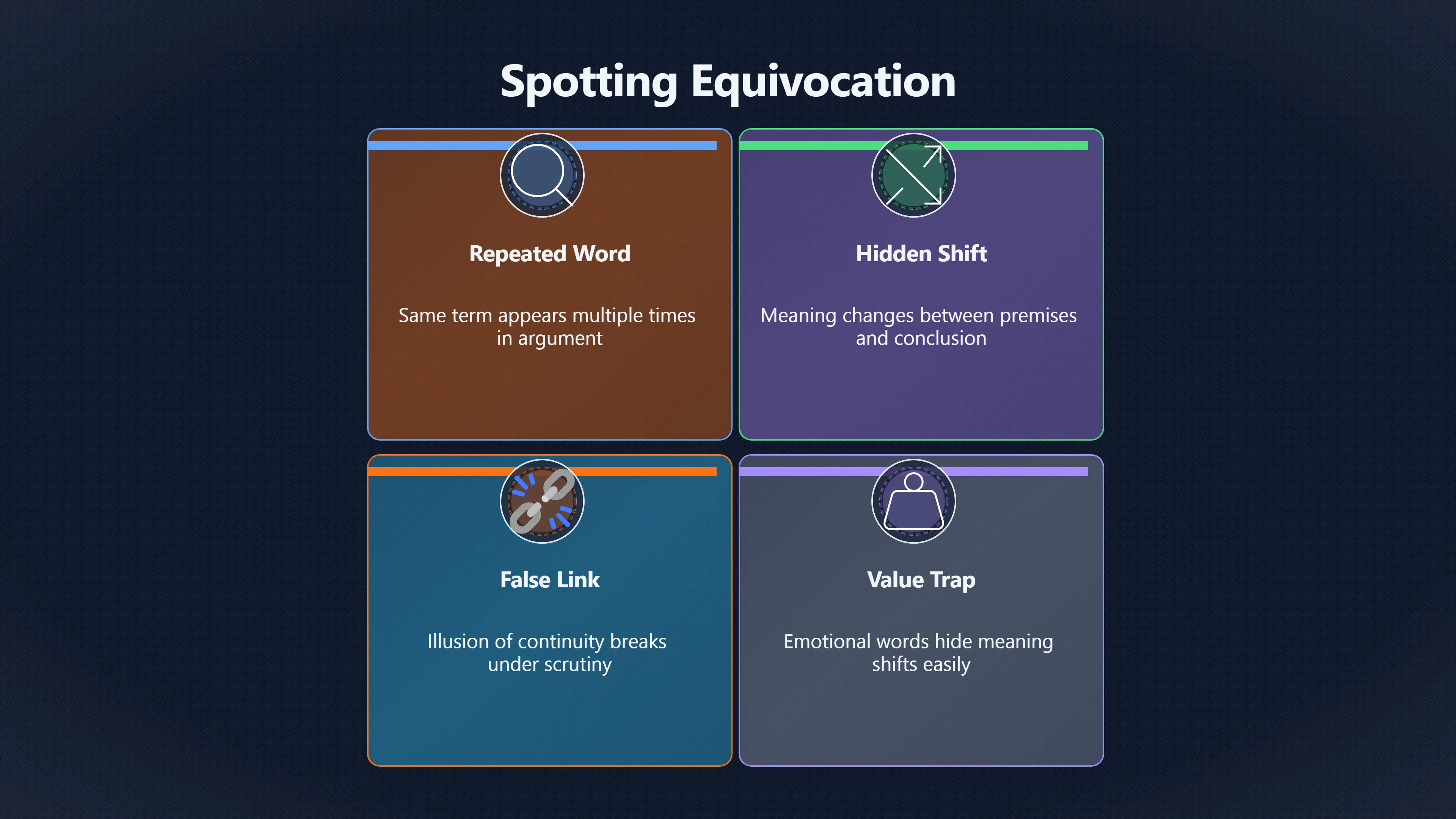
A repeated word can make a weak argument look strong when its meaning quietly changes between premise and conclusion.
On this page
- Track the repeated word through each claim
- Replace the word with its intended meaning
- Check whether the conclusion still follows
Page outline Jump by section
Introduction
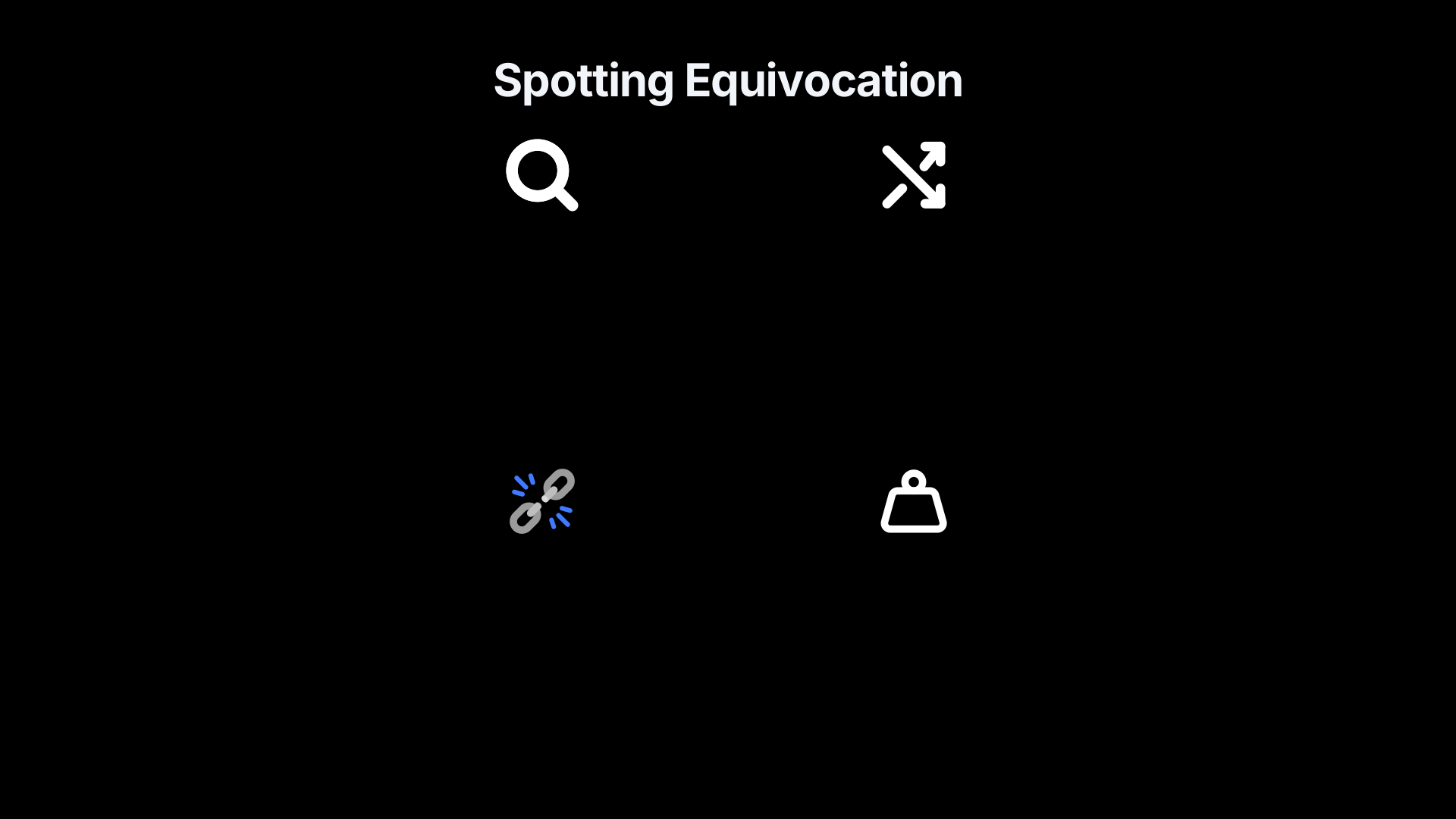
A quick way to spot equivocation is to ask a simple question: does the same word mean the same thing every time it appears in the argument? If the answer is no, the reasoning may be relying on a hidden shift in meaning rather than a genuine logical connection. Equivocation works because a repeated word creates an illusion of continuity. The wording stays the same, so the argument feels consistent, even when the meaning quietly changes underneath it. Philosophers define equivocation as a fallacy that exploits a term appearing more than once in an argument while carrying different meanings in different steps.[stanford]plato.stanford.eduEncyclopedia of Philosophy FallaciesStanford Encyclopedia of PhilosophyFallacies - Stanford Encyclopedia of Philosophyby H Hansen · 2015 · Cited by 427 — The fallacy of equi… Encyclopedia of Philosophy
 In everyday discussions, the most common warning signs appear around flexible words such as “free”, “natural”, “right”, “theory”, “evidence”, “fair”, “real”, or “normal”. The skill is not memorising a list of suspicious words. It is learning to track whether the meaning remains stable from premise to conclusion.
How Can You Tell When a Word Has Shifted?
Equivocation usually hides in plain sight. The repeated word is visible, but the change in meaning is not. Because many ordinary words have multiple legitimate meanings, the listener often fills in the gap without noticing. Ambiguity itself is not a fallacy; the problem arises when the argument’s conclusion depends on treating different meanings as if they were identical.[stanford]plato.stanford.eduEncyclopedia of Philosophy FallaciesStanford Encyclopedia of PhilosophyFallacies - Stanford Encyclopedia of Philosophyby H Hansen · 2015 · Cited by 427 — The fallacy of equi… Encyclopedia of Philosophy
When evaluating an argument, focus less on whether a word is ambiguous and more on whether the argument would still work if every occurrence of that word were forced to keep exactly the same meaning.
Track the Repeated Word Through Each Claim
The most reliable detection method is to follow the key term step by step.
Consider this argument:[fallacyfiles.org]fallacyfiles.orgSource details in endnotes.
- “Rare books are expensive.”
- “Exciting novels are rare.”
- “Therefore, exciting novels are expensive.”
At first glance, the reasoning seems smooth because the word “rare” appears in both premises. But the first statement uses “rare” to mean scarce and valuable in the market, while the second uses it to mean uncommon. Once the meanings are separated, the apparent connection disappears.[philosophypages.com]philosophypages.comFallacies of AmbiguityThe fallacies of ambiguity all involve a confusion of two or more different senses. Equivocation. An equivocation t…
A useful habit is to circle or mentally highlight any repeated term and ask:
- What exactly does this word mean here?
- Does it mean the same thing in the next sentence?
- Is the conclusion relying on those meanings being identical?
If the answer changes from one statement to another, the argument may be equivocating.
Watch for Value-Laden Words
Many real-world examples involve words that carry emotional or political weight.
For example:[philosophicalsociety.com]philosophicalsociety.comFor example, 1. Only man is logical. 2.Read more…
- “People have a right to free speech.”
- “Rights should never be restricted.”
- “Therefore, every form of speech must be allowed everywhere.”
The word “right” may begin as a legal protection against certain government actions and end as an unlimited permission immune from any social or institutional limits. The argument feels persuasive because the same word is repeated, but the meaning may have shifted during the transition.[gwmatthews.github.io]gwmatthews.github.ioWe start out with one meaning of a word like “freedom” and end up with another3.2 Fallacies of Ambiguity | Philosophical EthicsJuly 19, 2022 — Equivocation is using multiple meanings of a word as if they were the same…
The more emotionally loaded the word, the easier it is for the shift to go unnoticed.
Replace the Word With Its Intended Meaning
A powerful diagnostic technique is to substitute the actual meaning intended at each stage.
Take the classic example:
- “The end of life is death.”
- “Happiness is the end of life.”
- “Therefore, death is happiness.”
The argument sounds structured because “end of life” appears twice. However, when rewritten with the intended meanings, the shift becomes obvious:
- “The termination of life is death.”
- “Happiness is the purpose of life.”
- “Therefore, death is happiness.”
The conclusion no longer follows because the shared phrase was carrying two different meanings.[stanford]plato.stanford.eduEncyclopedia of Philosophy FallaciesStanford Encyclopedia of PhilosophyFallacies - Stanford Encyclopedia of Philosophyby H Hansen · 2015 · Cited by 427 — The fallacy of equi… Encyclopedia of Philosophy
This replacement test works well because it removes the camouflage created by repeated wording. If an argument suddenly becomes absurd, disconnected, or obviously incomplete after substitution, equivocation was probably doing the heavy lifting.
Ask Whether the Meaning Could Be Defined Consistently
Another version of the same test is to write a single definition beside the repeated word and force that definition to apply everywhere.
If one definition cannot fit every occurrence naturally, the argument may be switching meanings.
For example:[philosophicalsociety.com]philosophicalsociety.comFor example, 1. Only man is logical. 2.Read more…
- “All banks are beside rivers.”
- “I keep my money in a bank.”
- “Therefore, my money is beside a river.”
No single meaning of “bank” can make both premises work simultaneously. The argument succeeds only because listeners slide between “riverbank” and “financial institution”.[fallacyfiles.org]fallacyfiles.orgLogical Fallacy: EquivocationThe Fallacy of Equivocation occurs when an equivocal word or phrase makes an unsound argument appear sound….
Check Whether the Conclusion Still Follows
The final test is to ask whether the reasoning survives after the meanings have been clarified.
Many equivocal arguments appear strong because the repeated word creates an illusion of transitivity: if A relates to B and B relates to C, then A must relate to C. Once the meanings are separated, that chain breaks. Critical thinking texts often describe equivocation as blocking the normal inferential connection that would otherwise allow the conclusion to follow.[Athabasca University Press]read.aupress.caAthabasca University Press Chapter 14Fallacies of Ambiguity | Critical Thinking, Logic…Equivocation occurs when a key word is used in two or more senses in the same argume…
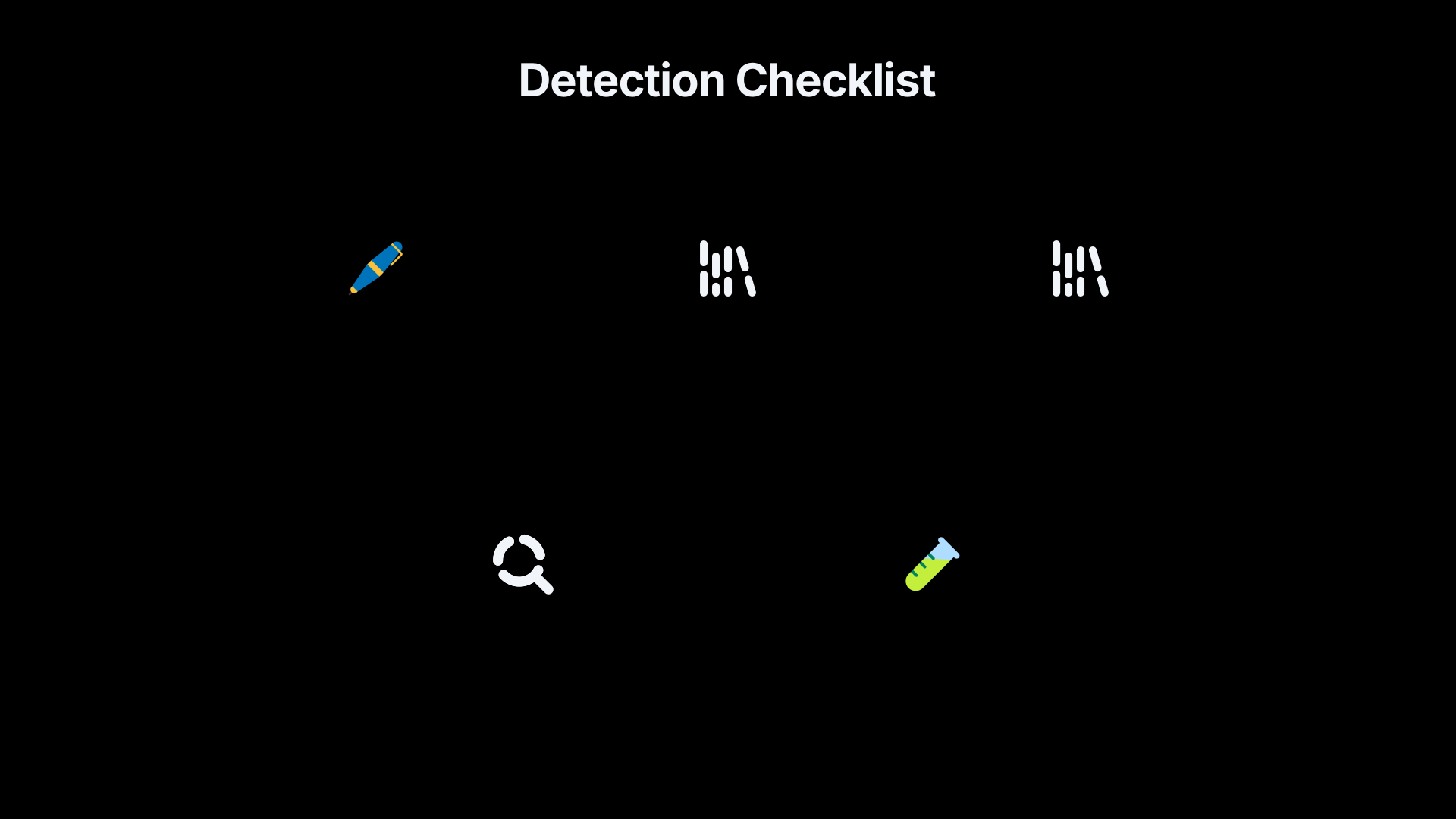
A practical checklist is:
- Identify the repeated word or phrase.
- Define its meaning in each statement.
- Compare those definitions.
- Rewrite the argument using the specific meanings.
- Ask whether the conclusion still follows.
If the conclusion depends on ignoring a difference in meaning, you have likely found equivocation.
Common Mistakes When Looking for Equivocation
One frequent error is assuming that every ambiguous word creates a fallacy. Ordinary language depends on words that have several meanings, and context usually makes the intended sense clear. Ambiguity becomes a problem only when the argument relies on moving from one meaning to another without acknowledging the change.[stanford]plato.stanford.eduEncyclopedia of Philosophy FallaciesStanford Encyclopedia of PhilosophyFallacies - Stanford Encyclopedia of Philosophyby H Hansen · 2015 · Cited by 427 — The fallacy of equi… Encyclopedia of Philosophy[Philosophy Stack Exchange]philosophy.stackexchange.comhow does imprecise and ambiguous natural language relate to the equivocation falPhilosophy Stack Exchangefallacies - How does imprecise and ambiguous natural…21 Nov 2019 — Equivocation is using the same word twice…
Another mistake is focusing only on unusual words. In practice, equivocation often appears in familiar terms that seem too obvious to question. Words such as “natural”, “normal”, “real”, “evidence”, “freedom”, and “theory” can carry different meanings in different contexts. Because they are common, listeners may assume consistency without checking.
A Simple Rule to Remember
When an argument repeats a key word, do not assume the meaning has remained fixed merely because the wording has. Follow the word through every step, replace it with its intended meaning, and then test whether the conclusion still follows. If the argument loses its force once the meanings are made explicit, the repeated word was acting as a bridge between ideas that were never actually connected. That hidden bridge is the hallmark of equivocation.
Amazon book picks
Further Reading
Books and field guides related to How Can You Tell When a Word Has Shifted?. Use these as the next step if you want deeper reading beyond the article.
An Illustrated Book of Bad Arguments
Excellent for learning to spot fallacies quickly.
eBay marketplace picks
Marketplace Samples
Example marketplace items related to this page. Use the search link to explore similar finds on eBay.




Endnotes
1.
Source: plato.stanford.edu
Title: Encyclopedia of Philosophy Fallacies
Link:https://plato.stanford.edu/entries/fallacies/
Source snippet
Stanford Encyclopedia of PhilosophyFallacies - Stanford Encyclopedia of Philosophyby H Hansen · 2015 · Cited by 427 — The fallacy of equi...
2.
Source: plato.stanford.edu
Title: Encyclopedia of Philosophy Ambiguity
Link:https://plato.stanford.edu/entries/ambiguity/
Source snippet
Stanford Encyclopedia of PhilosophyAmbiguity - Stanford Encyclopedia of Philosophyby A Sennet · 2011 · Cited by 295 — Ambiguity is genera...
3.
Source: encyclopedia.com
Link:https://www.encyclopedia.com/humanities/encyclopedias-almanacs-transcripts-and-maps/fallacies
4.
Source: philosophypages.com
Link:https://www.philosophypages.com/lg/e06c.htm
Source snippet
Fallacies of AmbiguityThe fallacies of ambiguity all involve a confusion of two or more different senses. Equivocation. An equivocation t...
5.
Source: gwmatthews.github.io
Title: We start out with one meaning of a word like “freedom” and end up with another
Link:https://gwmatthews.github.io/ethics/3-2-ambiguity.html
Source snippet
3.2 Fallacies of Ambiguity | Philosophical EthicsJuly 19, 2022 — Equivocation is using multiple meanings of a word as if they were the same...
Published: July 19, 2022
6.
Source: fallacyfiles.org
Link:https://www.fallacyfiles.org/equivoqu.html
7.
Source: philosophy.stackexchange.com
Title: how does imprecise and ambiguous natural language relate to the equivocation fal
Link:https://philosophy.stackexchange.com/questions/68561/how-does-imprecise-and-ambiguous-natural-language-relate-to-the-equivocation-fal
Source snippet
Philosophy Stack Exchangefallacies - How does imprecise and ambiguous natural...21 Nov 2019 — Equivocation is using the same word twice...
8.
Source: philosophy.institute
Title: It occurs when a key word is used in two or more senses within the same
Link:https://philosophy.institute/logic/ambiguity-logic-root-fallacies/
Source snippet
Ambiguity in Logic: The Root of Many Fallacies12 Dec 2025 — Equivocation is the most commonly encountered fallacy of ambiguity...
9.
Source: plato.stanford.edu
Link:https://plato.stanford.edu/entries/argument/
Source snippet
and Argumentationby C Dutilh Novaes · 2021 · Cited by 101 — Argumentation can be defined as the communicative activity of producing and e...
10.
Source: plato.stanford.edu
Link:https://plato.stanford.edu/archives/fall2013/entries/ambiguity/
Source snippet
In common parlance, the word '...Read more...
11.
Source: plato.stanford.edu
Link:https://plato.stanford.edu/archives/win2014/entries/ambiguity/
Source snippet
Stanford Encyclopedia of Philosophy16 May 2011 — A standard test for ambiguity is to take two sentences that contain the purportedly ambi...
Published: May 2011
12.
Source: plato.stanford.edu
Title: logic informal
Link:https://plato.stanford.edu/entries/logic-informal/
Source snippet
Logic - Stanford Encyclopedia of Philosophyby L Groarke · 1996 · Cited by 96 — It provides a practical account of good and poor argument...
13.
Source: youtube.com
Title: Equivocation Fallacy
Link:https://www.youtube.com/watch?v=lcR4LruYlGk
Source snippet
Fallacy of Equivocation...
14.
Source: youtube.com
Title: Fallacy of Equivocation
Link:https://www.youtube.com/watch?v=oIqoJgvNiqI
Source snippet
Equivocation (Logical Fallacy)...
15.
Source: seop.illc.uva.nl
Link:https://seop.illc.uva.nl/entries/fallacies/
Source snippet
Stanford Encyclopedia of PhilosophyFallacies29 May 2015 — The fallacy of equivocation is an argument which exploits the ambiguity of a te...
Published: May 2015
16.
Source: read.aupress.ca
Title: Athabasca University Press Chapter 14
Link:https://read.aupress.ca/read/critical-thinking-logic-and-argument/section/f8c8bad3-17e2-4cfd-b50b-6b6880d40052
Source snippet
Fallacies of Ambiguity | Critical Thinking, Logic...Equivocation occurs when a key word is used in two or more senses in the same argume...
17.
Source: iep.utm.edu
Link:https://iep.utm.edu/fallacy/
Source snippet
is a kind of error in reasoning. The list of fallacies below contains 231 names of the most common fallacies, and it provides brief expla...
18.
Source: philosophybytheway.blogspot.com
Link:https://philosophybytheway.blogspot.com/2024/05/equivocation.html
Source snippet
13 May 2024 — A useful tool for determining whether an argument commits the fallacy of equivocation can be applied here: replace the prem...
Published: May 2024
19.
Source: britannica.com
Link:https://www.britannica.com/topic/fallacy/Verbal-fallacies
Source snippet
Ambiguity, [Red Herring]({{ 'red-herring/' | relative_url }}), Straw Man13 May 2026 — These fallacies, called fallacies of ambiguity, arise when the conclusion is achieved thro...
Published: May 2026
20.
Source: britannica.com
Link:https://www.britannica.com/topic/equivocation
Source snippet
Equivocation | logical fallacyWhereas equivocation involves the ambiguity of a single word, amphiboly consists of the ambiguity of a comp...
21.
Source: philpapers.org
Link:https://philpapers.org/rec/MANETF-3
Source snippet
Bertha Alvarez Manninenby BA Manninen · 2018 — Patrick Hurley writes that the fallacy of equivocation “occurs when the conclusion of an a...
22.
Source: inquiresabound.wordpress.com
Link:https://inquiresabound.wordpress.com/2020/12/03/equivocation/
Source snippet
Meta/Inquires - WordPress.com3 Dec 2020 — In, it is a fallacious argument that exploits the ambiguity of a term or phrase whi...
Additional References
23.
Source: khanacademy.org
Link:https://www.khanacademy.org/partner-content/wi-phi/wiphi-critical-thinking/wiphi-fallacies/v/fallacy-of-equivocation
Source snippet
Fallacies: Equivocation (video) | FallaciesEquivocation occurs when the same word is used to express different meanings throughout an arg...
24.
Source: txst.edu
Link:https://www.txst.edu/philosophy/student-resources/informal-fallacies/equivocation.html
Source snippet
Texas State UniversityEquivocation: Department of PhilosophyThis fallacy occurs when a key term or phrase in an argument is used in an a...
25.
Source: study.com
Link:https://study.com/academy/lesson/video/equivocation-fallacy-definition-examples.html
26.
Source: reddit.com
Link:https://www.reddit.com/r/philosophy/comments/59ulm6/logic_short_explanation_of_the_fallacy_of/
Source snippet
fallacy that occurs when the same term is used with different meanings in an...
27.
Source: scribbr.com
Title: Equivocation Fallacy | Definition & Examples
Link:https://www.scribbr.com/fallacies/equivocation-fallacy/
Source snippet
May 17, 2023 — The equivocation fallacy refers to the use of an ambiguous word or phrase in more than one sense within the same argument...
Published: May 17, 2023
28.
Source: iep.utm.edu
Title: arguments the term “Naturalistic Fallacy” legitimately applies to.Read more
Link:https://iep.utm.edu/page/3/?cat=-
Source snippet
Indeterminacy of Translation and Radical Interpretation(2) Accent, Amphiboly and Equivocation are examples of fallacies of ambiguity...
29.
Source: researchgate.net
Link:https://www.researchgate.net/profile/Douglas-Walton/publication/316792512_Fallacies_Arising_from_Ambiguity/links/5fc7d7aea6fdcc697bd379c8/Fallacies-Arising-from-Ambiguity.pdf
Source snippet
ent'. They give the following example [I968, p. 32Il...
30.
Source: philosophicalsociety.com
Link:https://www.philosophicalsociety.com/HTML/LogicalFallacies.html
Source snippet
For example, 1. Only man is logical. 2.Read more...
31.
Source: holisticapologetics.com
Title: the fallacy of equivocation
Link:https://www.holisticapologetics.com/post/the-fallacy-of-equivocation
Source snippet
20 Nov 2021 — Equivocation is a fallacy based on the fact that one word can have different meanings. Consider this interesting fact about...
32.
Source: assignnmentinneed.com
Link:https://www.assignnmentinneed.com/blog/equivocation-fallacy-meaning-definition-examples
Source snippet
Equivocation Fallacy Meaning | Definition & Examples25 Jul 2025 — This equivocation fallacy occurs when a key term or phrase in an argume...
Topic Tree