Within Red Herring
When Whataboutism Becomes a Dodge
Whataboutism can expose real double standards, but it becomes a diversion when it avoids the charge on the table.
On this page
- The difference between comparison and deflection
- How double standards can be genuinely relevant
- Political and online examples to test
Page outline Jump by section
Introduction
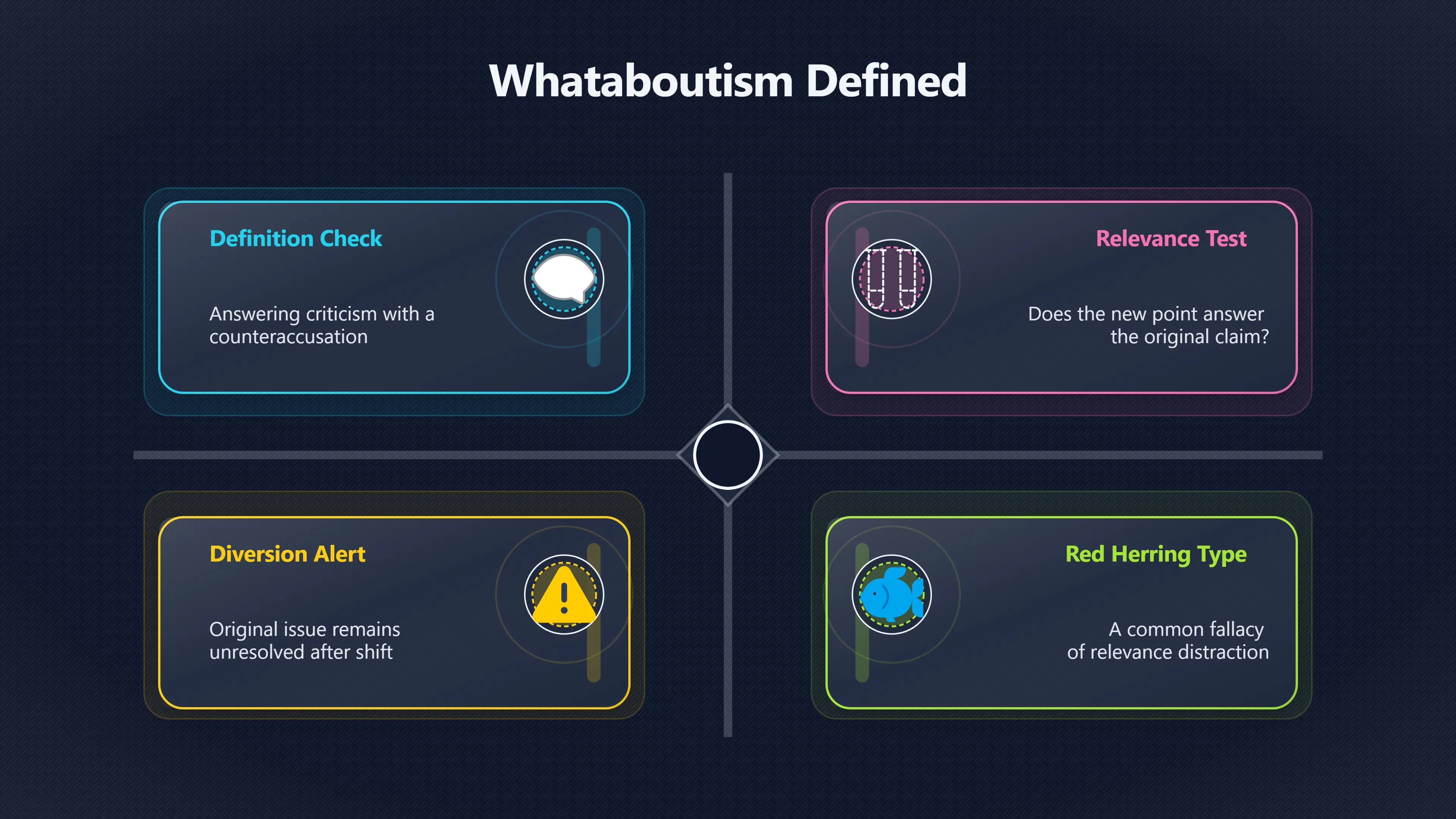
Whataboutism is often described as answering criticism with “But what about them?”. As a test for spotting red herrings, the key question is not whether the comparison is true, but whether it helps answer the issue under discussion. When a speaker responds to a charge by pointing to someone else’s wrongdoing, hypocrisy, or inconsistency, the move may expose a genuine double standard. Yet if it leaves the original criticism unanswered, it functions as a diversion rather than a defence. Encyclopaedia Britannica defines whataboutism as responding to an accusation or difficult question with a counteraccusation or different issue, while discussions of relevance fallacies treat it as a common way of shifting attention away from the claim that needs to be addressed.[Encyclopedia Britannica]britannica.comEncyclopedia Britannica | BritannicaExplore the fact-checked online encyclopedia from Encyclopaedia Britannica with hundreds of thousands…
 Within the broader family of red herrings, whataboutism is especially persuasive because it often relies on facts that are partly or entirely correct. The challenge is therefore not to decide whether the new accusation is true, but to determine whether it is relevant.
The Difference Between Comparison and Deflection
Not every “what about X?” response is fallacious. Comparisons are a normal part of reasoning. The problem arises when comparison replaces evaluation.
Consider these two responses:
- Criticism: “Your company dumped waste into the river.”
- Response A: “Several competitors dumped even more waste.”
Response A may be factually accurate, but it does not answer whether the company acted wrongly.
Now consider:
- Criticism: “Your company is uniquely responsible for river pollution.”
- Response B: “Government data show several competitors contributed similar amounts.”
Here the comparison directly addresses the claim of uniqueness. It is relevant rather than evasive.
The red-herring test is therefore simple: if the comparison helps evaluate the original claim, it may be legitimate. If it merely redirects attention, it is functioning as whataboutism. Philosophical discussions of relevance fallacies and analyses of whataboutery both emphasise that the crucial issue is whether the new point contributes to resolving the original dispute.[PhilPapers]philpapers.orgEoin O'Connell, Whatabouteryby E O’Connell · 2020 · Cited by 16 — If we ought to condemn and do something about A then we shoul…
How Double Standards Can Be Genuinely Relevant
One reason whataboutism is difficult to evaluate is that accusations of hypocrisy are sometimes important.
Imagine a regulator who punishes one industry for behaviour routinely ignored in another. Pointing out the inconsistency could reveal bias, selective enforcement, or unfair treatment. In such cases, the charge of double standards helps assess whether the criticism itself is being applied fairly. Scholars analysing whataboutery have argued that not every “what about” response is fallacious because some comparisons genuinely illuminate fairness, consistency, or policy principles.[PhilPapers]philpapers.orgEoin O'Connell, Whatabouteryby E O’Connell · 2020 · Cited by 16 — If we ought to condemn and do something about A then we shoul…
A useful distinction is between two questions:
- Is the criticised action wrong?
- Is criticism being applied consistently?
Whataboutism becomes a dodge when it treats Question 2 as though it answers Question 1.
For example:
- “You violated the rule.”
- “Others violate it too.”
The second statement may raise a legitimate concern about enforcement, but it does not determine whether the violation occurred. The discussion has shifted from conduct to consistency.
This is why whataboutism frequently overlaps with the tu quoque (“you too”) fallacy. The appeal to hypocrisy attempts to weaken criticism by highlighting inconsistency in the critic rather than addressing the substance of the criticism itself.[stanford]plato.stanford.eduEncyclopedia of Philosophy FallaciesIt involves not accepting a view or a recommendation because the espouser him…Read more… Encyclopedia of Philosophy[Wikipedia]WikipediaTu quoqueTu quoqueTu quoque, literally "you, too", is a rhetorical technique that intends to discredit the opponent's argument by attacking th…

A Practical Relevance Test
When confronted with a possible case of whataboutism, ask four questions.
Does the response answer the original claim?
If the original accusation remains unresolved, diversion is likely occurring.
Would the original criticism still matter if the comparison were true?
If the answer is yes, then the comparison may be irrelevant.
Has the burden of proof moved?
A discussion about one action should not automatically become a discussion about someone else’s action.
Is the new issue evidence or distraction?
Evidence helps evaluate the original claim. Distraction changes the subject.
This test explains why many examples feel persuasive despite being logically weak. People naturally care about fairness and consistency. A speaker can exploit that concern to redirect attention from accountability to comparison.
Political Examples
Political debate provides some of the clearest examples because public criticism often triggers immediate counteraccusations.
A journalist asks whether a government violated civil liberties. A spokesperson replies by listing civil-liberty failures in another country. The comparison may be accurate, but unless it helps determine whether the alleged violation occurred, it functions as a red herring.
The tactic became particularly associated with Cold War propaganda, where criticism of one side was frequently answered by pointing to abuses committed by the other. Commentators have long described this pattern as a defining example of whataboutism. The historical association helps explain why the term is often linked to propaganda and strategic distraction rather than genuine comparative analysis.[The Economist]economist.comThe EconomistWhataboutismJan 31, 2008 — SOVIET propagandists during the cold war were trained in a tactic that their western interlocutor…[KJZZ]kjzz.orgwhataboutism russian propaganda technique popular trump his supportersWhenever criticism was leveled at the Soviet Union, they countered with a similar critique of the West.Read more…
A revealing clue is that the conversation often ends up discussing the comparison instead of the original allegation. Once the audience debates which side is worse, the initial question may disappear entirely.
Online Arguments and Social Media
Online discussions amplify whataboutism because platforms reward quick counterattacks.
A user criticises misinformation from one political faction. Another responds by listing misinformation from a rival faction. A discussion about whether a specific claim is false turns into a debate about partisan balance.
Similarly:
- “This influencer plagiarised content.”
- “What about all the influencers who do the same thing?”
The response may identify a broader problem, but it can also dilute scrutiny of the particular case being discussed.
Researchers studying online discourse note that whataboutism often operates as a form of narrative disruption. Instead of directly contesting a claim, it redirects attention toward another grievance, controversy, or accusation. This makes detection difficult because the new topic is frequently related enough to seem relevant at first glance.[arXiv]arxiv.orgPaying Attention to Deflections: Mining Pragmatic Nuances for Whataboutism Detection in Online DiscourseFebruary 15, 2024…

When Whataboutism Is Not a Fallacy
The strongest criticism of careless fallacy-hunting is that people sometimes label any uncomfortable comparison as whataboutism.
A comparison is not automatically fallacious merely because it broadens the discussion. It may be legitimate when it:
- Reveals inconsistent standards.
- Challenges a claim of uniqueness.
- Provides missing context necessary for evaluation.
- Tests whether a principle is being applied consistently.
For example, if someone argues that a particular punishment is justified because a certain act is exceptionally harmful, evidence that similar acts receive different treatment may be directly relevant.
The decisive question remains relevance. If the comparison helps assess the truth, fairness, or scope of the original claim, it contributes to the argument. If it merely redirects attention, it becomes a red herring. This distinction is central to philosophical discussions of whataboutery and relevance-based fallacies.[PhilPapers]philpapers.orgEoin O'Connell, Whatabouteryby E O’Connell · 2020 · Cited by 16 — If we ought to condemn and do something about A then we shoul…
The Core Takeaway
Whataboutism is best understood not as any mention of another wrongdoing, but as a test of relevance. A comparison can reveal hypocrisy, expose double standards, or supply essential context. Those uses are not necessarily fallacious.
The warning sign appears when the comparison substitutes for an answer. If the original criticism remains standing after the “what about” response, the conversation has probably been diverted. In that moment, whataboutism functions as a classic red herring: attention moves, but the issue on the table has not actually been addressed.[Encyclopedia Britannica]britannica.comEncyclopedia Britannica | BritannicaExplore the fact-checked online encyclopedia from Encyclopaedia Britannica with hundreds of thousands…[Internet Encyclopedia of Philosophy]iep.utm.eduInternet Encyclopedia of PhilosophyFallaciesIf the fallacy is due to claiming the person does not practice what is preached, it is the Tu…
Amazon book picks
Further Reading
Books and field guides related to When Whataboutism Becomes a Dodge. Use these as the next step if you want deeper reading beyond the article.
The Righteous Mind
Explains why people respond to criticism with counter-accusations and tribal comparisons.
The Skeptics' Guide to the Universe
Teaches how to assess relevance rather than rhetorical impact.
A Rulebook for Arguments
Shows how comparisons can be relevant or irrelevant depending on the claim.
An Illustrated Book of Bad Arguments
Covers diversionary reasoning patterns related to whataboutism.
eBay marketplace picks
Marketplace Samples
Example marketplace items related to this page. Use the search link to explore similar finds on eBay.







Endnotes
1.
Source: britannica.com
Link:https://www.britannica.com/topic/whataboutism
Source snippet
Encyclopedia BritannicaWhataboutism | Definition, Examples, Etymology, Logical...Apr 1, 2026 — Whataboutism, the rhetorical practice of...
2.
Source: philpapers.org
Link:https://philpapers.org/rec/OCOWIA
Source snippet
Eoin O'Connell, Whatabouteryby E O’Connell · 2020 · Cited by 16 — If we ought to condemn and do something about A then we shoul...
3.
Source: plato.stanford.edu
Title: Encyclopedia of Philosophy Fallacies
Link:https://plato.stanford.edu/entries/fallacies/
Source snippet
It involves not accepting a view or a recommendation because the espouser him...Read more...
4.
Source: Wikipedia
Title: Tu quoque
Link:https://en.wikipedia.org/wiki/Tu_quoque
Source snippet
Tu quoqueTu quoque, literally "you, too", is a rhetorical technique that intends to discredit the opponent's argument by attacking th...
5.
Source: economist.com
Link:https://www.economist.com/europe/2008/01/31/whataboutism
Source snippet
The EconomistWhataboutismJan 31, 2008 — SOVIET propagandists during the cold war were trained in a tactic that their western interlocutor...
6.
Source: kjzz.org
Title: whataboutism russian propaganda technique popular trump his supporters
Link:https://kjzz.org/content/590934/whataboutism-russian-propaganda-technique-popular-trump-his-supporters
Source snippet
Whenever criticism was leveled at the Soviet Union, they countered with a similar critique of the West.Read more...
7.
Source: arxiv.org
Link:https://arxiv.org/abs/2402.09934
Source snippet
Paying Attention to Deflections: Mining Pragmatic Nuances for Whataboutism Detection in Online DiscourseFebruary 15, 2024...
Published: February 15, 2024
8.
Source: Wikipedia
Title: List of fallacies
Link:https://en.wikipedia.org/wiki/List_of_fallacies
Source snippet
List of fallaciesRed herring fallacies. edit. A red herring fallacy, one of the main subtypes of fallacies of relevance, is an error i...
9.
Source: Wikipedia
Link:https://en.wikipedia.org/wiki/Whataboutism
Source snippet
WhataboutismCommon accusations include double standards, and hypocrisy, but it can also be used to relativize criticism of one's own v...
10.
Source: britannica.com
Link:https://www.britannica.com/topic/propaganda
Source snippet
Definition, History, Techniques, Examples, &...16 May 2026 — Propaganda is the more or less systematic effort to manipulate other people...
Published: May 2026
11.
Source: britannica.com
Link:https://www.britannica.com/
Source snippet
Encyclopedia Britannica | BritannicaExplore the fact-checked online encyclopedia from Encyclopaedia Britannica with hundreds of thousands...
12.
Source: plato.stanford.edu
Title: category mistakes
Link:https://plato.stanford.edu/entries/category-mistakes/
Source snippet
Mistakes - Stanford Encyclopedia of Philosophyby O Magidor · 2019 · Cited by 172 — Category mistakes are sentences such as 'The number tw...
13.
Source: plato.stanford.edu
Title: logic informal
Link:https://plato.stanford.edu/archives/sum2002/entries/logic-informal/
Source snippet
LogicVan Eemeren and Grootendorst explain ad hominem as a violation of their first rule for "critical discussion," which maintains that "...
14.
Source: encyclopedia.pub
Link:https://encyclopedia.pub/entry/35272
Source snippet
Whataboutism | Encyclopedia MDPINov 18, 2022 — Whataboutism is used as Russian propaganda with the goal of obfuscating criticism of the R...
15.
Source: arxiv.org
Link:https://arxiv.org/pdf/2311.09761
Source snippet
2311.09761v2 [cs.CL] 9 Apr 2024by C Helwe · 2023 · Cited by 22 — It aims to systematize and classify the fallacies used in current...
16.
Source: iep.utm.edu
Link:https://iep.utm.edu/fallacy/
Source snippet
Internet Encyclopedia of PhilosophyFallaciesIf the fallacy is due to claiming the person does not practice what is preached, it is the Tu...
Additional References
17.
Source: logicallyfallacious.com
Link:https://www.logicallyfallacious.com/logicalfallacies/Ad-Hominem-Tu-quoque
Source snippet
Ad Hominem (Tu quoque)Description: Claiming the argument is flawed by pointing out that the one making the argument is not acting consist...
18.
Source: reddit.com
Link:https://www.reddit.com/r/changemyview/comments/1sisl9n/cmv_whataboutism_is_a_logical_fallacy_but_it/
Source snippet
Whataboutism is a logical fallacy, but it works extremely wellWhataboutism is a tactic that deflects criticism by pointing to someone els...
19.
Source: ebsco.com
Link:https://www.ebsco.com/research-starters/religion-and-philosophy/ad-hominem
20.
Source: globalchallenges.ch
Title: propaganda and disinformation between east and west a long term perspective
Link:https://globalchallenges.ch/issue/13/propaganda-and-disinformation-between-east-and-west-a-long-term-perspective/
Source snippet
Propaganda and Disinformation between East and WestIn the years following the October Revolution of 1917, the Soviet government sponsored...
21.
Source: youtube.com
Link:https://www.youtube.com/watch?v=BWiMwVqq4rM
Source snippet
Whataboutism in Russian diplomacy | ExplainedWhataboutism is not only a way of shifting blame whenever faced with an accusation — it is a...
22.
Source: yourlogicalfallacyis.com
Link:https://yourlogicalfallacyis.com/tu-quoque
Source snippet
It is commonly employed as an effective red herring because it takes the heat off someone having to...Read more...
23.
Source: markmanson.net
Link:https://markmanson.net/logical-fallacies
Source snippet
Red herring logical fallacy: Hitler was a vegetarian. Red herrings are also...Read more...
24.
Source: russiamatters.org
Title: 2 decades russian whataboutism partial rundown
Link:https://www.russiamatters.org/blog/2-decades-russian-whataboutism-partial-rundown
Source snippet
2 Decades of Russian 'Whataboutism': A Partial RundownOct 21, 2021 — The collection below features statements made between 2000 and 2021...
25.
Source: facebook.com
Link:https://www.facebook.com/MAtalkss/posts/whataboutisma-logical-fallacy-when-instead-of-addressing-the-issue-raised-the-pe/1175665091263489/
Source snippet
ssue raised, the mind diverts attention by shifting the...Read more...
26.
Source: facebook.com
Link:https://www.facebook.com/groups/ffreethinkers/posts/10158808061367188/
Source snippet
le always tend to use it and it’s annoying. They don’t even try...
Topic Tree