Within Formal Logic
When Rare Evidence Misleads a Jury
Rare evidence can be powerful, but reversing the probability question can make it seem far more conclusive than it is.
On this page
- Evidence given innocence versus innocence given evidence
- How the reversal can distort guilt claims
- Simple ways to explain base rates and alternatives
Page outline Jump by section
Introduction
The prosecutor’s fallacy is a specific logical and probabilistic error that occurs when two different probability statements are treated as if they mean the same thing. In legal and forensic settings, the mistake can make evidence appear far more conclusive than it really is. The core confusion is between the probability of observing certain evidence if a person is innocent and the probability that the person is innocent given that evidence. Those are not equivalent questions, and treating them as equivalent can distort judgments about guilt, especially when the evidence is rare. The fallacy is often discussed as a specialised form of reversed conditional probability and has been linked to miscarriages of justice in several high-profile cases. CEBM PubMed Within the broader family of formal reasoning errors[pubmed.ncbi.nlm.nih.gov]pubmed.ncbi.nlm.nih.gova pitfall in interpreting probabilities in forensic evidenceby WC Leung · 2002 · Cited by 37 — This paper highlights the source of…, the prosecutor’s fallacy matters because it creates an invalid inference structure. A low probability attached to one conditional statement is incorrectly transformed into a low probability attached to a different conditional statement, even though the second conclusion does not logically follow from the first.[PhilArchive]philarchive.orgPhil Archive The “prosecutor's fallacy” and the “interrogator'sThe “prosecutor's fallacy” and the “interrogator's…February 14, 2010 — by N Sesardic · 2008 · Cited by 16 — The confusion o…
Evidence Given Innocence Versus Innocence Given Evidence
The simplest way to understand the fallacy is to compare two questions:
- How likely is this evidence if the defendant is innocent?
- How likely is the defendant to be innocent if this evidence exists?
Although the questions sound similar, they ask fundamentally different things.
Suppose a DNA profile found at a crime scene would match an innocent person only once in a million cases. That means the probability of the evidence appearing if the defendant is innocent is very small. It does not automatically mean there is only a one-in-a-million chance that the defendant is innocent. To reach that conclusion, additional information is required, including how many potential people could match and how likely guilt was before the DNA evidence was considered.[Royal Society]royalsociety.orgscience and law statistics primerTo interpret the weight of the evidence (or likelihood ratio (LR)).Read more…[ISHI News]ishinews.comBayes' Theorem: Can Statistics Help Guide a Verdict in the…by CY Boss — The prosecution built a case on the DNA evidence, stating that…
The prosecutor’s fallacy occurs when someone argues:
The evidence would be extremely unlikely if the defendant were innocent; therefore the defendant is almost certainly guilty.
This reasoning reverses the conditional probability. Researchers and legal statisticians have repeatedly identified this reversal as the defining feature of the prosecutor’s fallacy.[PubMed]pubmed.ncbi.nlm.nih.gova pitfall in interpreting probabilities in forensic evidenceby WC Leung · 2002 · Cited by 37 — This paper highlights the source of…[PhilArchive Mathematically]philarchive.orgPhil Archive The “prosecutor's fallacy” and the “interrogator'sThe “prosecutor's fallacy” and the “interrogator's…February 14, 2010 — by N Sesardic · 2008 · Cited by 16 — The confusion o…, the error involves confusing:
- Probability of evidence given innocence.
- Probability of innocence given evidence.
These values can differ dramatically because they depend on different information.[CEBM]cebm.ox.ac.ukthe prosecutors fallacyThe Prosecutor's Fallacy16 Jul 2018 — It's when the probability of innocence given the evidence is wrongly assumed to equal an infini…
How the Reversal Can Distort Guilt Claims
The practical danger emerges when rare evidence is presented to a jury.
Imagine a city with ten million residents. Investigators discover a DNA profile that would randomly match only one person in a million. Even if the defendant matches, statistical reasoning does not automatically identify that person as the offender. Across a population of ten million, roughly ten people could be expected to match purely by chance. The DNA evidence narrows the field substantially, but it does not by itself eliminate alternative possibilities.[joelvelasco.net]joelvelasco.netInterpretation of statistical evidence in criminal trialsNovember 8, 2011 — by WC Thompsont · Cited by 732 — Presenting the data in this manner probably led more subjects to commit the Prosecuto…
This illustrates a broader point: evidence can be highly incriminating without being decisive. The prosecutor’s fallacy converts “strong evidence” into “proof” by ignoring competing explanations and background probabilities.[Royal Society]royalsociety.orgscience and law statistics primerTo interpret the weight of the evidence (or likelihood ratio (LR)).Read more…[The Open University]open.eduBecause the prosecutor's fallacy…Read more…
The error also appears outside DNA evidence. Any forensic test that produces a low false-positive rate can be misunderstood in the same way. A statement such as “only one innocent person in ten thousand would produce this result” may sound overwhelming, but it does not answer the separate question of how likely innocence remains after considering the result.[PubMed]pubmed.ncbi.nlm.nih.gova pitfall in interpreting probabilities in forensic evidenceby WC Leung · 2002 · Cited by 37 — This paper highlights the source of…
Because jurors and lawyers often encounter probabilities in unfamiliar contexts, statistical organisations have produced guidance specifically warning against this reversal. The Royal Statistical Society and other scientific bodies have repeatedly emphasised that experts should describe the weight of evidence without equating it directly with guilt probabilities. RSS[ICCA]icca.ac.ukStatistics and probability for advocatesThe Royal Statistical Society started to work on statistics and the law following a number of cou…
The Sally Clark Case as a Cautionary Example
One of the most frequently cited examples is the case of Sally Clark in England.[Wikipedia]WikipediaSally ClarkSally Clark
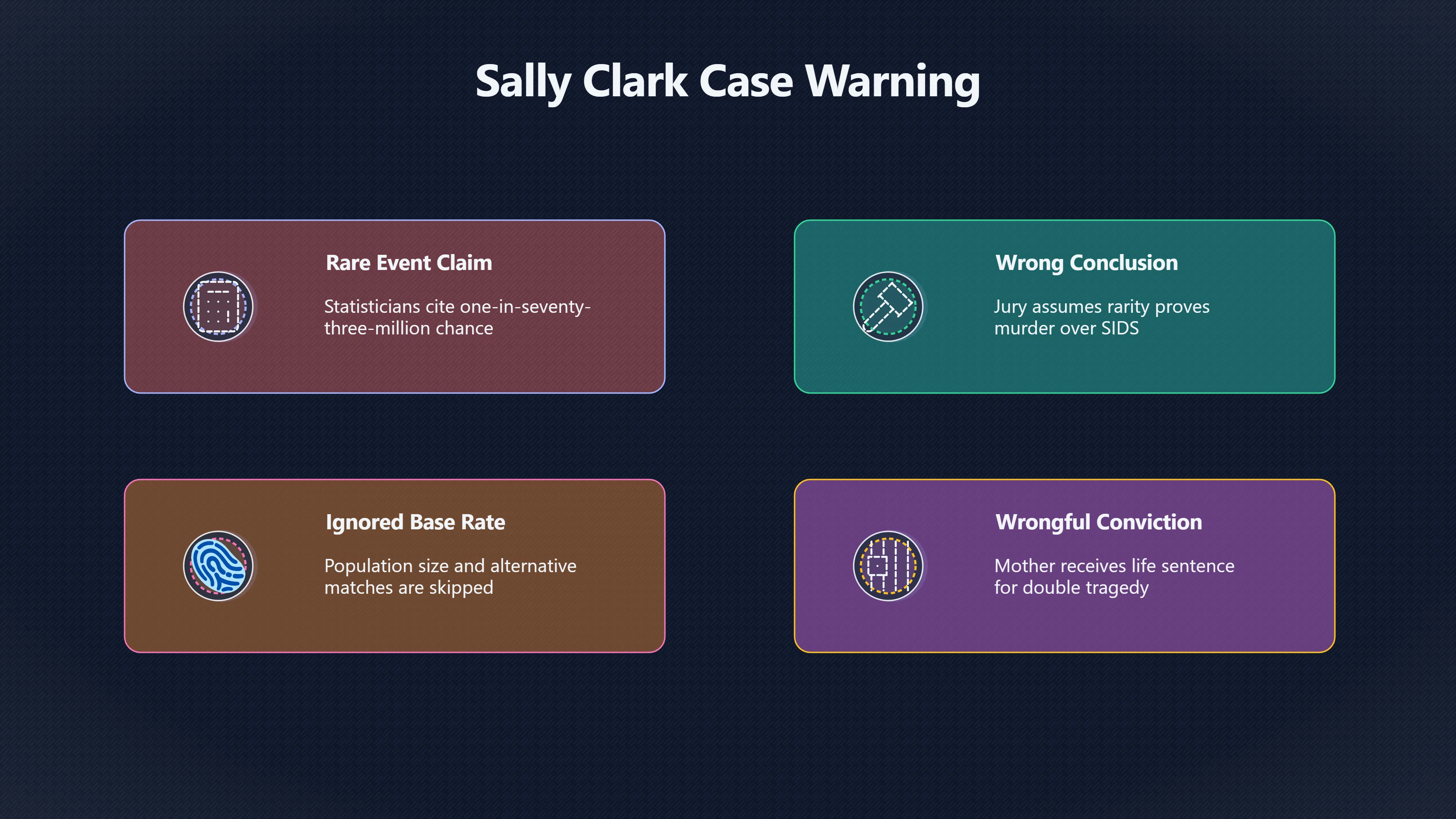
During her 1999 trial for the deaths of her two infant sons, expert testimony suggested that the probability of two sudden infant death syndrome (SIDS) deaths occurring in a family like hers was approximately one in seventy-three million. The figure became highly influential in public discussion and courtroom reasoning. Critics later argued that the statistic was flawed and, more importantly, that it encouraged a prosecutor’s-fallacy interpretation.[Wikipedia]WikipediaSally ClarkSally Clark[Criminal Cases Review Commission]ccrc.gov.ukclark sallyCriminal Cases Review CommissionClark, Sally9 Sept 2024 — Sally Clark was convicted in November 1999 of murder and received a sentence of…
Even if a rare double-SIDS event were extremely unlikely, that would not automatically establish that murder was the more probable explanation. The relevant comparison was not simply “rare event versus guilt.” Instead, the jury needed to compare the likelihood of competing explanations, including the rarity of multiple infant murders. Statisticians subsequently criticised the way the probability evidence was presented and interpreted.[Wikipedia]WikipediaBase rate fallacyBase rate fallacy[CEBM]cebm.ox.ac.ukthe prosecutors fallacyThe Prosecutor's Fallacy16 Jul 2018 — It's when the probability of innocence given the evidence is wrongly assumed to equal an infini…
The case became a landmark example in discussions of statistical evidence because it demonstrated how a striking numerical claim can appear to settle a question that the number alone cannot answer. The Royal Statistical Society publicly expressed concern about the misuse of statistics in court proceedings connected with the case.[Wikipedia]WikipediaSally ClarkSally Clark
Why Base Rates Matter
A key reason the prosecutor’s fallacy is persuasive is that people naturally focus on the rarity of the evidence while overlooking the rarity of alternative explanations.
This is known as neglecting the base rate. The base rate is the background frequency of relevant events before the new evidence is considered.
Consider a medical screening test that incorrectly identifies one healthy person in a thousand as ill. Many people assume a positive result means there is a 99.9% chance of illness. In reality, the answer depends heavily on how common the illness is in the population. If the disease itself is extremely rare, many positive results may still be false positives. The same logic applies to forensic evidence.[Wikipedia]WikipediaBase rate fallacyBase rate fallacy
In criminal cases, relevant base rates may include:
- The size of the population from which a suspect was identified.
- The frequency of a matching DNA profile.
- The prevalence of alternative explanations.
- The prior strength of non-statistical evidence.
Ignoring these background frequencies encourages the mistaken leap from “rare evidence” to “near-certain guilt.”[Royal Society]royalsociety.orgscience and law statistics primerTo interpret the weight of the evidence (or likelihood ratio (LR)).Read more…[ScienceDirect]sciencedirect.comDoes explaining the meaning of likelihood ratios improve…by WC Thompson · 2025 · Cited by 1 — The expert witness explaine…

Simple Ways to Explain Base Rates and Alternatives
One of the most effective ways to avoid the prosecutor’s fallacy is to replace abstract percentages with concrete counts.
Instead of saying:
Only one person in a million would match this DNA profile.
A clearer explanation might be:
In a population of ten million people, around ten individuals might be expected to match this profile by chance.
The second statement encourages consideration of alternative matches rather than implying a single inevitable culprit.[joelvelasco.net]joelvelasco.netInterpretation of statistical evidence in criminal trialsNovember 8, 2011 — by WC Thompsont · Cited by 732 — Presenting the data in this manner probably led more subjects to commit the Prosecuto…
Another useful approach is to ask two separate questions:
- How strongly does the evidence support the prosecution’s explanation?
- What other explanations remain plausible?
Modern forensic guidance often frames evidence in terms of how much more likely it is under one hypothesis than another, rather than presenting a single probability that appears to answer the entire question of guilt. This helps keep the focus on evidential weight rather than on an invalid reversal of conditional probabilities. ScienceDirect[Royal Society]royalsociety.orgscience and law statistics primerTo interpret the weight of the evidence (or likelihood ratio (LR)).Read more…[RSS]rss.org.ukCase Assessment and Interpretation of Expert Evidenceby G Jackson · Cited by 59 — Building on the general introduction to statistic…
Why This Fallacy Remains Important
The prosecutor’s fallacy remains one of the most influential probability errors in legal reasoning because it exploits an intuitive but incorrect shortcut. People naturally assume that if evidence would be very unlikely under innocence, innocence itself must be very unlikely. Logic and probability theory show that this inference does not follow.
Rare evidence can be powerful. DNA matches, forensic traces, and unusual statistical patterns may substantially strengthen a case. The fallacy arises only when the rarity of the evidence is treated as though it directly measures the probability of guilt. Distinguishing between those two claims is essential for fair legal reasoning, accurate interpretation of forensic science, and protection against wrongful convictions.[The Open University]open.eduBecause the prosecutor's fallacy…Read more…[CEBM]cebm.ox.ac.ukthe prosecutors fallacyThe Prosecutor's Fallacy16 Jul 2018 — It's when the probability of innocence given the evidence is wrongly assumed to equal an infini…[PubMed]pubmed.ncbi.nlm.nih.gova pitfall in interpreting probabilities in forensic evidenceby WC Leung · 2002 · Cited by 37 — This paper highlights the source of…
Amazon book picks
Further Reading
Books and field guides related to When Rare Evidence Misleads a Jury. Use these as the next step if you want deeper reading beyond the article.
The Art of Statistics
Explains probability, risk, base rates, and evidence interpretation central to the prosecutor's fallacy.
Thinking, Fast and Slow
Shows how people misjudge probabilities and draw faulty conclusions from evidence.
How to Lie with Statistics
Demonstrates how numerical claims can mislead when interpreted incorrectly.
eBay marketplace picks
Marketplace Samples
Example marketplace items related to this page. Use the search link to explore similar finds on eBay.



Endnotes
1.
Source: cebm.ox.ac.uk
Title: the prosecutors fallacy
Link:https://www.cebm.ox.ac.uk/news/views/the-prosecutors-fallacy
Source snippet
The Prosecutor's Fallacy16 Jul 2018 — It's when the probability of innocence given the evidence is wrongly assumed to equal an infini...
2.
Source: open.edu
Link:https://www.open.edu/openlearn/mod/oucontent/view.php?id=170658§ion=7.1
Source snippet
Because the prosecutor's fallacy...Read more...
3.
Source: philarchive.org
Title: Phil Archive The “prosecutor’s fallacy” and the “interrogator’s
Link:https://philarchive.org/archive/DEMGBS
Source snippet
The “prosecutor's fallacy” and the “interrogator's...February 14, 2010 — by N Sesardic · 2008 · Cited by 16 — The confusion o...
Published: February 14, 2010
4.
Source: joelvelasco.net
Title: Interpretation of statistical evidence in criminal trials
Link:https://joelvelasco.net/teaching/122/thompson%26schumann87-statisticslaw.pdf
Source snippet
November 8, 2011 — by WC Thompsont · Cited by 732 — Presenting the data in this manner probably led more subjects to commit the Prosecuto...
Published: November 8, 2011
5.
Source: sciencedirect.com
Link:https://www.sciencedirect.com/science/article/pii/S1355030625001364
Source snippet
Does explaining the meaning of likelihood ratios improve...by WC Thompson · 2025 · Cited by 1 — The expert witness explaine...
6.
Source: icca.ac.uk
Link:https://www.icca.ac.uk/wp-content/uploads/2019/11/RSS-Guide-to-Statistics-and-Probability-for-Advocates.pdf
Source snippet
Statistics and probability for advocatesThe Royal Statistical Society started to work on statistics and the law following a number of cou...
7.
Source: Wikipedia
Title: Sally Clark
Link:https://en.wikipedia.org/wiki/Sally_Clark
8.
Source: open.edu
Link:https://www.open.edu/openlearn/mod/oucontent/view.php?id=170658§ion=9.2
Source snippet
The Open University7.2 The statistical evidence | OpenLearnA large number of mistakes were committed by the prosecution expert Sir Roy Me...
9.
Source: Wikipedia
Title: Base rate fallacy
Link:https://en.wikipedia.org/wiki/Base_rate_fallacy
10.
Source: sciencedirect.com
Link:https://www.sciencedirect.com/science/article/pii/S135503069872101X
Source snippet
W.C. Thompson, E.L. Schumann. Interpretation of statistical evidence in criminal trials. The prosecutor's fallacy and the defence attorne...
11.
Source: sciencedirect.com
Title: ScienceDirect What is the best way to present likelihood ratios?
Link:https://www.sciencedirect.com/science/article/pii/S1355030625001261
Source snippet
A review...by GS Morrison · 2025 · Cited by 2 — The likelihood-ratio framework is advocated as the logically correct framework for evalu...
12.
Source: pubmed.ncbi.nlm.nih.gov
Link:https://pubmed.ncbi.nlm.nih.gov/11848139/
Source snippet
a pitfall in interpreting probabilities in forensic evidenceby WC Leung · 2002 · Cited by 37 — This paper highlights the source of...
13.
Source: royalsociety.org
Title: science and law statistics primer
Link:https://royalsociety.org/-/media/about-us/programmes/science-and-law/science-and-law-statistics-primer.pdf
Source snippet
To interpret the weight of the evidence (or likelihood ratio (LR)).Read more...
14.
Source: ishinews.com
Link:https://www.ishinews.com/bayes-theorem-can-statistics-help-guide-a-verdict-in-the-courtroom/
Source snippet
Bayes' Theorem: Can Statistics Help Guide a Verdict in the...by CY Boss — The prosecution built a case on the DNA evidence, stating that...
15.
Source: ccrc.gov.uk
Title: clark sally
Link:https://ccrc.gov.uk/decision/clark-sally/
Source snippet
Criminal Cases Review CommissionClark, Sally9 Sept 2024 — Sally Clark was convicted in November 1999 of murder and received a sentence of...
Published: November 1999
Additional References
16.
Source: arxiv.org
Link:https://arxiv.org/html/2502.03217v1
Source snippet
The Prosecutor's Fallacy and Expert Testimony: A Modern...5 Feb 2025 — The prosecutor's fallacy is a fallacy of statistical reasoni...
17.
Source: pmc.ncbi.nlm.nih.gov
Link:https://pmc.ncbi.nlm.nih.gov/articles/PMC1121945/
Source snippet
case of murder and the BMJ - PMC - NIHby R Meadow · 2002 · Cited by 28 — Sally Clark, a 34 year old mother, was convicted in 1999 of the...
18.
Source: pmc.ncbi.nlm.nih.gov
Link:https://pmc.ncbi.nlm.nih.gov/articles/PMC4934658/
Source snippet
and the Law - PMCby N Fenton · 2016 · Cited by 110 — A prosecutor might state, for example, that “the probability the defendant was not t...
19.
Source: dcscience.net
Title: statistics and the law the prosecutors fallacy
Link:https://www.dcscience.net/2016/03/22/statistics-and-the-law-the-prosecutors-fallacy/
Source snippet
DC's Improbable ScienceStatistics and the law: the prosecutor's fallacy22 Mar 2016 — The false positive risk means the proportion of case...
20.
Source: telescoper.blog
Title: In the Dark DNA Profiling and the Prosecutor’s Fallacy
Link:https://telescoper.blog/2010/10/23/the-prosecutors-fallacy/
Source snippet
DNA Profiling and the Prosecutor's Fallacy - In the Dark23 Oct 2010 — If the DNA profile of the suspect or evidence consists of a combina...
21.
Source: rss.org.uk
Link:https://rss.org.uk/RSS/media/File-library/Publications/rss-case-assessment-interpretation-expert-evidence.pdf
Source snippet
Case Assessment and Interpretation of Expert Evidenceby G Jackson · Cited by 59 — Building on the general introduction to statistic...
22.
Source: cherwell.org
Link:https://cherwell.org/2021/05/02/the-prosecutors-fallacy-how-flawed-statistical-evidence-has-been-used-to-jail-innocent-people/
Source snippet
The Prosecutor's Fallacy: How flawed statistical evidence has...2 May 2021 — The prosecution argues that the chance that this blood matc...
Published: May 2021
23.
Source: courtsofnz.govt.nz
Link:https://www.courtsofnz.govt.nz/assets/speechpapers/hjjjh.pdf
Source snippet
Miscarriage by ExpertThe story is about Sally Clark, a British solicitor, married to Stephen, also a lawyer. The couple's first son, Chri...
Published: December 1996
24.
Source: forensicstats.org
Title: misuse of statistics in the courtroom the sally clark case
Link:https://forensicstats.org/blog/misuse-of-statistics-in-the-courtroom-the-sally-clark-case
Source snippet
Misuse of Statistics in the Courtroom: The Sally Clark CaseFeb 16, 2018 — The Sally Clark Case is an infamous criminal case from the Unit...
25.
Source: leightonvw.com
Title: when can we trust the jurys verdict
Link:https://leightonvw.com/2024/08/25/when-can-we-trust-the-jurys-verdict/
Source snippet
When Can We Trust the Jury's Verdict?25 Aug 2024 — The fallacy occurs when the expert witness equates the low probability of winning the...
Topic Tree