Within Social Media
Does Outrage Make Bad Arguments Spread?
Outrage can draw attention to real harms, but it becomes risky when emotional force substitutes for valid reasoning.
On this page
- How social feedback rewards outrage
- Fallacies that outrage makes more persuasive
- How to separate moral concern from weak reasoning
Page outline Jump by section
Introduction
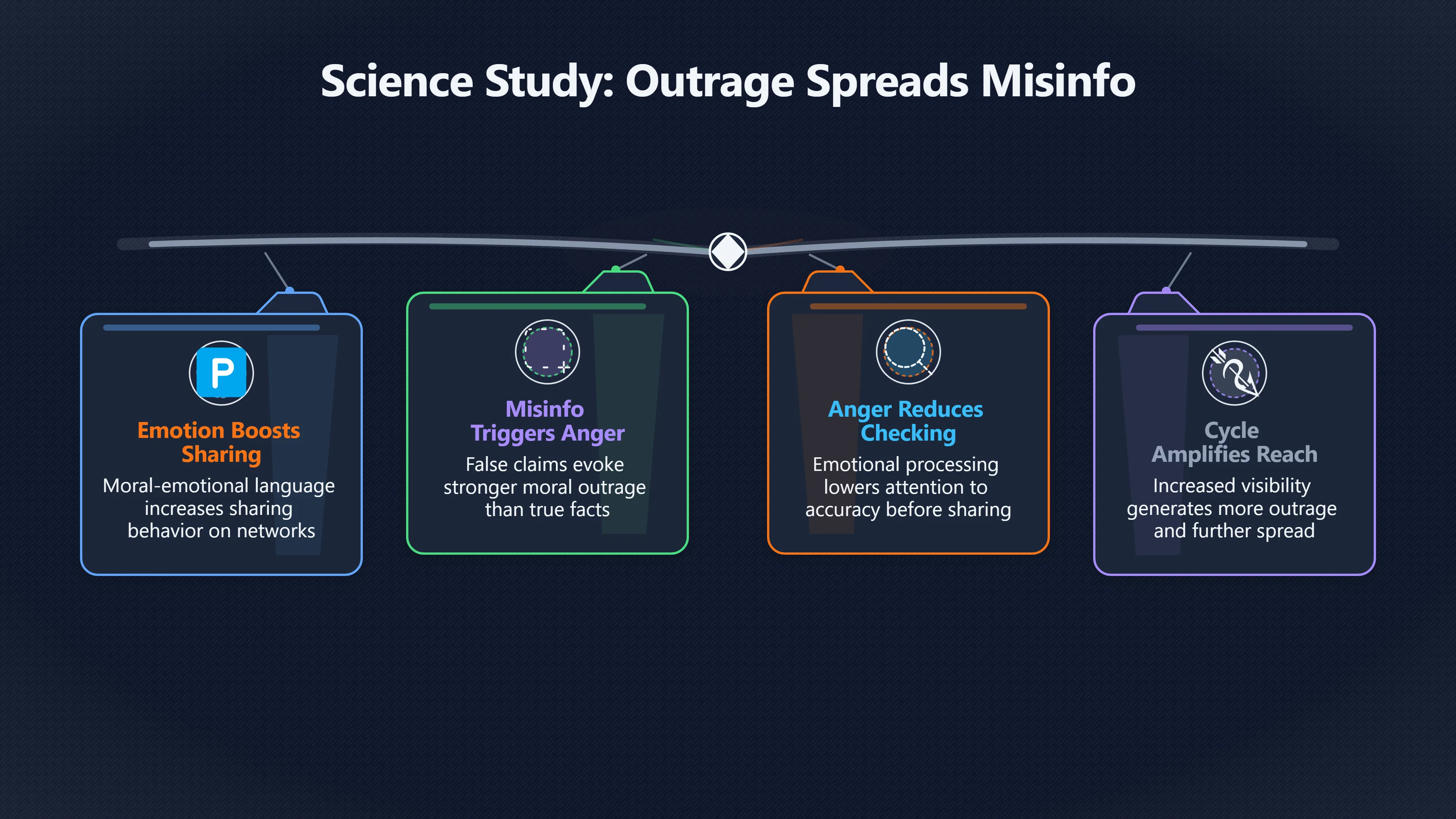
Moral outrage can be a healthy response to genuine wrongdoing. Anger at corruption, discrimination, abuse, or deception often motivates people to pay attention and demand accountability. The problem begins when the emotional force of outrage is treated as evidence. On social media, posts that provoke anger or disgust frequently attract more engagement, making them more visible and more likely to be shared. As a result, misleading claims can spread not because they are well supported, but because they trigger strong moral reactions. Research increasingly suggests that outrage is not merely a response to misinformation; it can be one of the mechanisms that helps misinformation travel.[Science]science.orgMisinformation exploits outrage to spread onlineMisinformation exploits outrage to spread online - ScienceNovember 28, 2024 — We investigated the relationship between misinformat…
 Within the broader topic of logical fallacies and viral claims, this matters because outrage can make weak arguments feel stronger than they are. A claim that inspires thousands of angry reactions may seem persuasive even when its evidence is thin, incomplete, or false. The popularity of the outrage becomes confused with the validity of the argument.
How Social Feedback Rewards Outrage
Social media platforms reward content that captures attention. Moral outrage is particularly effective because it combines emotional intensity with a sense of ethical urgency. People often feel compelled not only to react but also to signal their position publicly.
Research on social networks has found that moral-emotional language increases sharing behaviour. One influential study examining political communication on Twitter found that moral and emotional expressions spread more readily through social networks than less emotionally charged messages. Later work has continued to find evidence of “moral contagion”, where moral-emotional content gains additional shares as it moves through online networks. PNAS[PubMed]pubmed.ncbi.nlm.nih.govthe effect size of moral contagion in online…by WJ Brady · 2025 · Cited by 23 — The estimate of moral contagion in the available popul…
Social reinforcement plays an important role. Users receive likes, reposts, supportive comments, and approval from their community when expressing outrage. Studies suggest that these feedback mechanisms can encourage people to express outrage more frequently over time, creating an environment in which anger becomes a socially rewarded communication style.[PubMed Central]pmc.ncbi.nlm.nih.govPubMed CentralHow social learning amplifies moral outrage expression in…by WJ Brady · 2021 · Cited by 434 — Social reinforcement and n…
Importantly, this does not mean outrage is always artificial or insincere. People may be genuinely angry. The mechanism is that platforms often amplify engagement regardless of whether the underlying claim is accurate. If outrage attracts attention, both true information and false information can benefit from it.
Why Misinformation and Outrage Fit Together So Easily
Recent research has examined whether misinformation has a special relationship with outrage. A large study published in Science found that misinformation posts tended to evoke more moral outrage than trustworthy information and that this outrage helped drive sharing behaviour. Users were also more likely to share outrage-inducing misinformation without first examining it carefully.[Science]science.orgMisinformation exploits outrage to spread onlineMisinformation exploits outrage to spread online - ScienceNovember 28, 2024 — We investigated the relationship between misinformat…[2SMC España]sciencemediacentre.esoutrage facilitates spread misinformation social networksOutrage facilitates the spread of misinformation on social…28 Nov 2024 — According to a study, social media content containing misinfo…
One reason is that misinformation often presents events in morally simplified terms. Complex situations become stories with obvious villains and victims. Uncertainty disappears. Ambiguous evidence is reframed as undeniable proof. Such framing creates immediate emotional clarity, even when factual accuracy suffers.
Consider a typical viral claim:
- A screenshot appears to show a public figure behaving hypocritically.
- The accompanying caption declares the behaviour outrageous.
- Thousands of users condemn the person before the context is verified.
The emotional reaction may be understandable, but the reasoning chain is incomplete. The conclusion is accepted before the evidence has been thoroughly evaluated.
Studies of misinformation psychology suggest that anger and emotional processing can reduce attention to accuracy and increase reliance on intuitive reactions. People may share information because it feels morally important rather than because they have established that it is true.[Springer Nature Link]link.springer.comSpringer Nature LinkReliance on emotion promotes belief in fake newsby C Martel · 2020 · Cited by 780 — In our current work, we assess th…[PubMed Central]pmc.ncbi.nlm.nih.govPubMed CentralHow social learning amplifies moral outrage expression in…by WJ Brady · 2021 · Cited by 434 — Social reinforcement and n…
Fallacies That Outrage Makes More Persuasive
Outrage does not create logical fallacies, but it can make them more convincing.
Appeal to Emotion
The most direct effect is the appeal to emotion. A post generates anger, disgust, or indignation and then relies on those feelings as support for its conclusion.
The reasoning becomes:
- This claim makes me angry.
- Therefore it must be true.
The emotional reaction may be genuine, but emotions alone cannot establish facts.
Hasty Generalisation
Outrage often encourages broad conclusions from limited examples. A single shocking incident is presented as proof that an entire group, institution, or policy is corrupt.
The emotional intensity of the example can discourage readers from asking whether the evidence is representative.
Ad Hominem Attacks
Moral outrage can shift attention away from claims and towards individuals. Instead of evaluating evidence, discussion becomes focused on condemning a person’s character.
Even when criticism of behaviour is justified, exposing hypocrisy or wrongdoing does not automatically prove every factual claim associated with the controversy.
False Dilemmas
Outrage-driven posts frequently present only two options:
- Agree with this interpretation.[sciencedirect.com]sciencedirect.comEmotion detection for misinformation: A reviewby Z Liu · 2024 · Cited by 110 — This article comprehensively reviews emotion-based methods…
- Support the wrongdoing.
This framing pressures readers to choose a side rather than evaluate evidence. Complex issues that allow multiple interpretations are reduced to moral loyalty tests.
Guilt by Association
Viral outrage often spreads through social identity. If an unpopular person, group, or movement appears connected to a claim, that association is treated as proof that the claim itself is false or malicious.
The moral status of the source becomes a substitute for evaluating the argument.
When Outrage Helps People Spread Claims Without Checking Them
One of the most concerning findings in recent research is that outrage can encourage rapid sharing before verification occurs.
Researchers studying misinformation and moral outrage found evidence that users sometimes distribute content as a way of expressing moral identity rather than communicating verified information. Sharing can become a public signal: “I oppose this” or “I stand with these people.” Accuracy becomes secondary to signalling group membership and moral commitment.[EurekAlert!]eurekalert.orgnews releasesEurekAlert!Moral outrage helps misinformation spread through social…Nov 28, 2024 — The researchers found that outrage-evoking posts fa…
This helps explain why corrections often struggle to catch up. The original post may satisfy emotional and social needs. A later fact-check may address factual accuracy, but it does not necessarily provide the same emotional reward.
Research on out-group hostility also suggests that content attacking perceived opponents generates particularly strong engagement. Posts that portray an opposing group as immoral or dangerous are therefore well positioned to trigger outrage-driven sharing.[PNAS]pnas.orgEmotion shapes the diffusion of moralized content in social…by WJ Brady · 2017 · Cited by 1984 — JM Salerno, LC Peter-Hagene, The…
The result is a cycle:
- A claim triggers outrage.
- Outrage increases engagement.[pnas.org]pnas.orgOut-group animosity drives engagement on social mediaby S Rathje · 2021 · Cited by 903 — We expected posts about the out-group to evo…
- Engagement increases visibility.
- Increased visibility generates more outrage.
- The claim spreads further before verification catches up.
None of these steps requires the claim to be true.
How to Separate Moral Concern from Weak Reasoning
The solution is not to suppress moral concern. Many important social issues deserve strong emotional responses. The challenge is distinguishing justified concern from inadequate reasoning.
Several questions help:
What is the actual evidence?
Separate the facts from the emotional framing. Would the argument remain persuasive if the language were calmer?
Does the conclusion exceed the evidence?
A shocking example may demonstrate a problem without proving a sweeping generalisation.
Am I reacting to facts or to presentation?
Images, dramatic wording, and expressions of outrage can influence judgment independently of evidence quality.
Have I checked the claim before sharing it?
Research suggests that even brief prompts encouraging reflection on accuracy can reduce misinformation sharing.[American Psychological Association]apa.orgAmerican Psychological AssociationHow and why does misinformation spread?29 Nov 2023 — Psychological factors contribute significantly to…
Would I apply the same standards to my own side?
Outrage often operates through group identity. Consistent standards help prevent motivated reasoning.
Outrage Is Not Evidence
The key logical lesson is simple: outrage can be justified, informative, and socially valuable, but it is not proof.
A claim does not become true because it angers large numbers of people. Nor does widespread condemnation demonstrate that the reasoning behind a viral post is sound. Social media rewards attention, and outrage is one of the most powerful ways to attract it. Research increasingly indicates that misinformation can exploit this fact by provoking stronger moral reactions and encouraging rapid sharing.[Science]science.orgMisinformation exploits outrage to spread onlineMisinformation exploits outrage to spread online - ScienceNovember 28, 2024 — We investigated the relationship between misinformat…[2EurekAlert!]eurekalert.orgnews releasesEurekAlert!Moral outrage helps misinformation spread through social…Nov 28, 2024 — The researchers found that outrage-evoking posts fa…
Understanding this distinction helps readers preserve two important ideas at once: some issues genuinely deserve moral outrage, and even the most morally charged claim still requires evidence and valid reasoning.
Amazon book picks
Further Reading
Books and field guides related to Does Outrage Make Bad Arguments Spread?. Use these as the next step if you want deeper reading beyond the article.
The Righteous Mind
Explains why moral emotions and outrage shape judgment and persuasion.
The Chaos Machine
Directly addresses how platform dynamics amplify outrage and misinformation.
Thinking, Fast and Slow
Shows how emotion and intuition can overpower careful reasoning.
The Coddling of the American Mind
Explores emotional reasoning, public discourse, and social conflict.
eBay marketplace picks
Marketplace Samples
Example marketplace items related to this page. Use the search link to explore similar finds on eBay.





Endnotes
1.
Source: eurekalert.org
Title: news releases
Link:https://www.eurekalert.org/news-releases/1065965
Source snippet
EurekAlert!Moral outrage helps misinformation spread through social...Nov 28, 2024 — The researchers found that outrage-evoking posts fa...
2.
Source: pnas.org
Link:https://www.pnas.org/doi/10.1073/pnas.1618923114
Source snippet
Emotion shapes the diffusion of moralized content in social...by WJ Brady · 2017 · Cited by 1984 — JM Salerno, LC Peter-Hagene, The...
3.
Source: link.springer.com
Link:https://link.springer.com/article/10.1186/s41235-020-00252-3
Source snippet
Springer Nature LinkReliance on emotion promotes belief in fake newsby C Martel · 2020 · Cited by 780 — In our current work, we assess th...
4.
Source: pnas.org
Link:https://www.pnas.org/doi/10.1073/pnas.2024292118
Source snippet
Out-group animosity drives engagement on social mediaby S Rathje · 2021 · Cited by 903 — We expected posts about the out-group to evo...
5.
Source: nature.com
Link:https://www.nature.com/articles/s41598-024-71263-z
Source snippet
Negative online news articles are shared more to social...by J Watson · 2024 · Cited by 79 — Prior research demonstrates that news-relat...
6.
Source: science.org
Title: Misinformation exploits outrage to spread online
Link:https://www.science.org/doi/10.1126/science.adl2829
Source snippet
Misinformation exploits outrage to spread online - ScienceNovember 28, 2024 — We investigated the relationship between misinformat...
Published: November 28, 2024
7.
Source: pubmed.ncbi.nlm.nih.gov
Link:https://pubmed.ncbi.nlm.nih.gov/41179848/
Source snippet
the effect size of moral contagion in online...by WJ Brady · 2025 · Cited by 23 — The estimate of moral contagion in the available popul...
8.
Source: pmc.ncbi.nlm.nih.gov
Link:https://pmc.ncbi.nlm.nih.gov/articles/PMC8363141/
Source snippet
PubMed CentralHow social learning amplifies moral outrage expression in...by WJ Brady · 2021 · Cited by 434 — Social reinforcement and n...
9.
Source: sciencemediacentre.es
Title: outrage facilitates spread misinformation social networks
Link:https://sciencemediacentre.es/en/outrage-facilitates-spread-misinformation-social-networks
Source snippet
Outrage facilitates the spread of misinformation on social...28 Nov 2024 — According to a study, social media content containing misinfo...
10.
Source: pmc.ncbi.nlm.nih.gov
Title: Pub Med Central Reliance on emotion promotes belief in [fake news]({{ ‘fake-news/’ | relative_url }})
Link:https://pmc.ncbi.nlm.nih.gov/articles/PMC7539247/
Source snippet
PubMed CentralReliance on emotion promotes belief in fake news - PMC - NIHby C Martel · 2020 · Cited by 777 — More specifically within th...
11.
Source: apa.org
Link:https://www.apa.org/topics/journalism-facts/how-why-misinformation-spreads
Source snippet
American Psychological AssociationHow and why does misinformation spread?29 Nov 2023 — Psychological factors contribute significantly to...
12.
Source: pubmed.ncbi.nlm.nih.gov
Link:https://pubmed.ncbi.nlm.nih.gov/39607912/
Source snippet
exploits outrage to spread online - PubMedNovember 29, 2024 — We tested a hypothesis that misinformation exploits outrage to spread onlin...
Published: November 29, 2024
13.
Source: Wikipedia
Link:https://en.wikipedia.org/wiki/Anger
Source snippet
Angeran intense emotional state involving a strong, uncomfortable and non-cooperative response to a perceived provocation, hurt, or th...
14.
Source: pubmed.ncbi.nlm.nih.gov
Link:https://pubmed.ncbi.nlm.nih.gov/28652356/
Source snippet
shapes the diffusion of moralized content in social...by WJ Brady · 2017 · Cited by 1995 — We show that the expression of moral emotion...
15.
Source: concepto.de
Link:https://concepto.de/moral/
Source snippet
Moral - Qué es, tipos, ejemplos y relación con la éticaLa moral es un conjunto de normas, costumbres, creencias y valores que forman part...
16.
Source: sciencedirect.com
Link:https://www.sciencedirect.com/science/article/pii/S1566253524000782
Source snippet
Emotion detection for misinformation: A reviewby Z Liu · 2024 · Cited by 110 — This article comprehensively reviews emotion-based methods...
17.
Source: sciencedirect.com
Link:https://www.sciencedirect.com/science/article/abs/pii/S2352250X23002154
Source snippet
misinformation exploits users' impulses to share moral outrage [52]. A combination of anger and disgust, moral outrage is typically exper...
18.
Source: sciencedirect.com
Link:https://www.sciencedirect.com/science/article/pii/S2451958825003082
Source snippet
anger, or anxiety—can increase sharing because they heighten user activation.... For misinformation interventions, this study offers a c...
Additional References
19.
Source: ssrc.org
Link:https://www.ssrc.org/grantees/investigating-digital-outrage-as-an-engine-of-disinformation/
Source snippet
Social Science Research Council (SSRC)Investigating Digital Outrage as an Engine of DisinformationWe propose a psychological process mode...
20.
Source: csh.ac.at
Link:https://csh.ac.at/news/do-emotions-make-us-more-susceptible-to-misinformation-not-per-se-according-to-a-new-study/
Source snippet
Do Emotions Make Us More Susceptible to Misinformation...12 Mar 2025 — A new study out of the Complexity Science Hub challenges the beli...
21.
Source: datasociety.net
Link:https://datasociety.net/library/re-experimental-evidence-of-massive-scale-emotional-contagion-through-social-networks/
Source snippet
Re: “Experimental evidence of massive-scale emotional...Jul 9, 2014 — Data & Society community members wrote individually about “Experim...
22.
Source: facebook.com
Title: why does everything feel worse negative behavior spreads faster social media rew
Link:https://www.facebook.com/VICE/posts/why-does-everything-feel-worse-negative-behavior-spreads-faster-social-media-rew/1244941207498861/
Source snippet
Why does everything feel worse? Negative behavior...The numbers are frightening: A 2024 Yale study found that posts expressing moral out...
23.
Source: csmapnyu.org
Title: emotion shapes the diffusion of moralized content in social networks
Link:https://csmapnyu.org/research/academic-research/emotion-shapes-the-diffusion-of-moralized-content-in-social-networks
Source snippet
Emotion Shapes the Diffusion of Moralized Content in...Jul 11, 2017 — We show that the expression of moral emotion is key for the spread...
24.
Source: dl.acm.org
Link:https://dl.acm.org/doi/10.1145/3706598.3713909
Source snippet
Fact-Checks Trigger Moral Outrage in Replies to...Particularly, users' reliance on emotions can promote their belief in misinformation [75]...
25.
Source: tandfonline.com
Link:https://www.tandfonline.com/doi/full/10.1080/0267257X.2025.2570739
Source snippet
Emotional contagion on social media: pathways, effects...by DCH Wilkie · 2025 · Cited by 3 — This study examines three discrete negativ...
26.
Source: facebook.com
Title: Social media posts containing misinformation evoke more moral
Link:https://www.facebook.com/ScienceMagazine/posts/social-media-posts-containing-misinformation-evoke-more-moral-outrage-than-posts/957029976288972/
Source snippet
December 4, 2024 — Social media posts containing misinformation evoke more moral outrage than posts with trustworthy information, and tha...
Published: December 4, 2024
27.
Source: researchgate.net
Title: Emotion shapes the diffusion of moralized content in social
Link:https://www.researchgate.net/publication/317947723_Emotion_shapes_the_diffusion_of_moralized_content_in_social_networks
Source snippet
Studies of online outrage highlight how moral-emotional expression can be preferentially amplified and rapidly escalated through sharing...
28.
Source: news.yale.edu
Title: likes and shares teach people express more outrage online
Link:https://news.yale.edu/2021/08/13/likes-and-shares-teach-people-express-more-outrage-online
Source snippet
yale.edu'Likes' and 'shares' teach people to express more outrage onlineAug 13, 2021 — Yale researchers looked at 12.7 million tweets fro...
Topic Tree