Within Anecdotes
Can a Patient Story Warn US Early?
Patient reports and case stories can reveal possible harms, but they need follow-up evidence before becoming proof.
On this page
- Why case reports matter for rare harms
- The difference between signal and proof
- What stronger follow up evidence looks like
Page outline Jump by section
Introduction
Anecdotes are often treated with suspicion in discussions of evidence, and for good reason: a single story cannot establish that a treatment works or that a risk is common. Yet medicine would be less safe if it ignored patient stories altogether. Individual reports of unexpected symptoms, unusual side effects, or rare harms frequently act as early warning signals. They alert clinicians and regulators to possibilities that were not recognised during clinical trials and suggest questions that deserve urgent investigation.
 The key distinction is between a signal and proof. A patient story can indicate that a problem may exist. It cannot, by itself, demonstrate that a medicine caused the problem, how often it occurs, or which patients are at risk. In evidence-based medicine, anecdotes are most valuable when they trigger stronger forms of evidence gathering rather than replace them.[Uppsala Monitoring Centre]who-umc.orgUppsala Monitoring CentrePharmacovigilance in Perspective[4] After approval is granted for a medicine, case reports of suspected adverse…
Can a Patient Story Warn Us Early?
Medicine has long relied on observations from individual patients and clinicians to identify dangers that formal research initially missed. This is especially important because pre-approval clinical trials have limits. Trials may involve only a few thousand participants, run for a limited time, and often exclude groups such as pregnant women, people with multiple illnesses, or those taking many medicines simultaneously. Rare adverse effects may therefore remain invisible until a treatment reaches millions of people.[BMJ Blogs]stg-blogs.bmj.comrare adverse events clinical trials understanding rule threeBMJ BlogsRare adverse events in clinical trialsNov 14, 2017 —… drug manufacturers, especially in cases where the reported harms are se…
When a doctor notices an unusual reaction, or when patients independently report a similar problem, those reports can be collected through pharmacovigilance systems—the organised monitoring of medicine safety after approval. International systems such as the World Health Organization’s monitoring network gather millions of reports and look for patterns that appear repeatedly across countries and populations. A single anecdote is weak evidence, but many similar anecdotes can form a meaningful signal.[Uppsala Monitoring Centre]who-umc.orgUppsala Monitoring CentrePharmacovigilance in Perspective[4] After approval is granted for a medicine, case reports of suspected adverse…
This is one reason the simple dismissal of all anecdotes as “mere stories” can be misleading. In medicine, some of the most important safety discoveries began with isolated observations that later proved significant.[BMJ]stg-blogs.bmj.comrare adverse events clinical trials understanding rule threeBMJ BlogsRare adverse events in clinical trialsNov 14, 2017 —… drug manufacturers, especially in cases where the reported harms are se…
Why Case Reports Matter for Rare Harms
Rare harms present a special challenge. If a serious side effect occurs once in every 50,000 patients, even a well-designed trial may never encounter it. Case reports therefore fill an important gap.
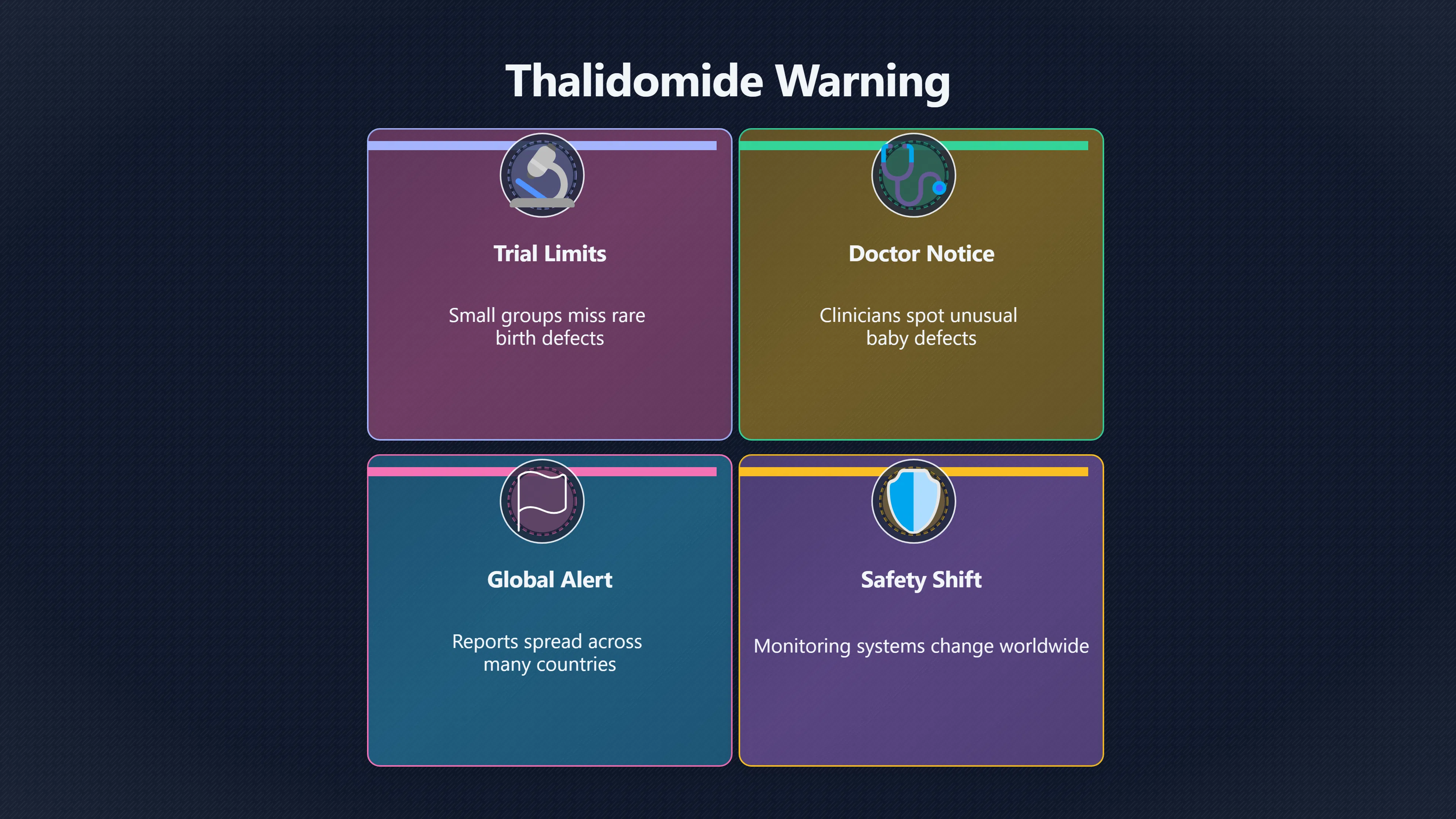
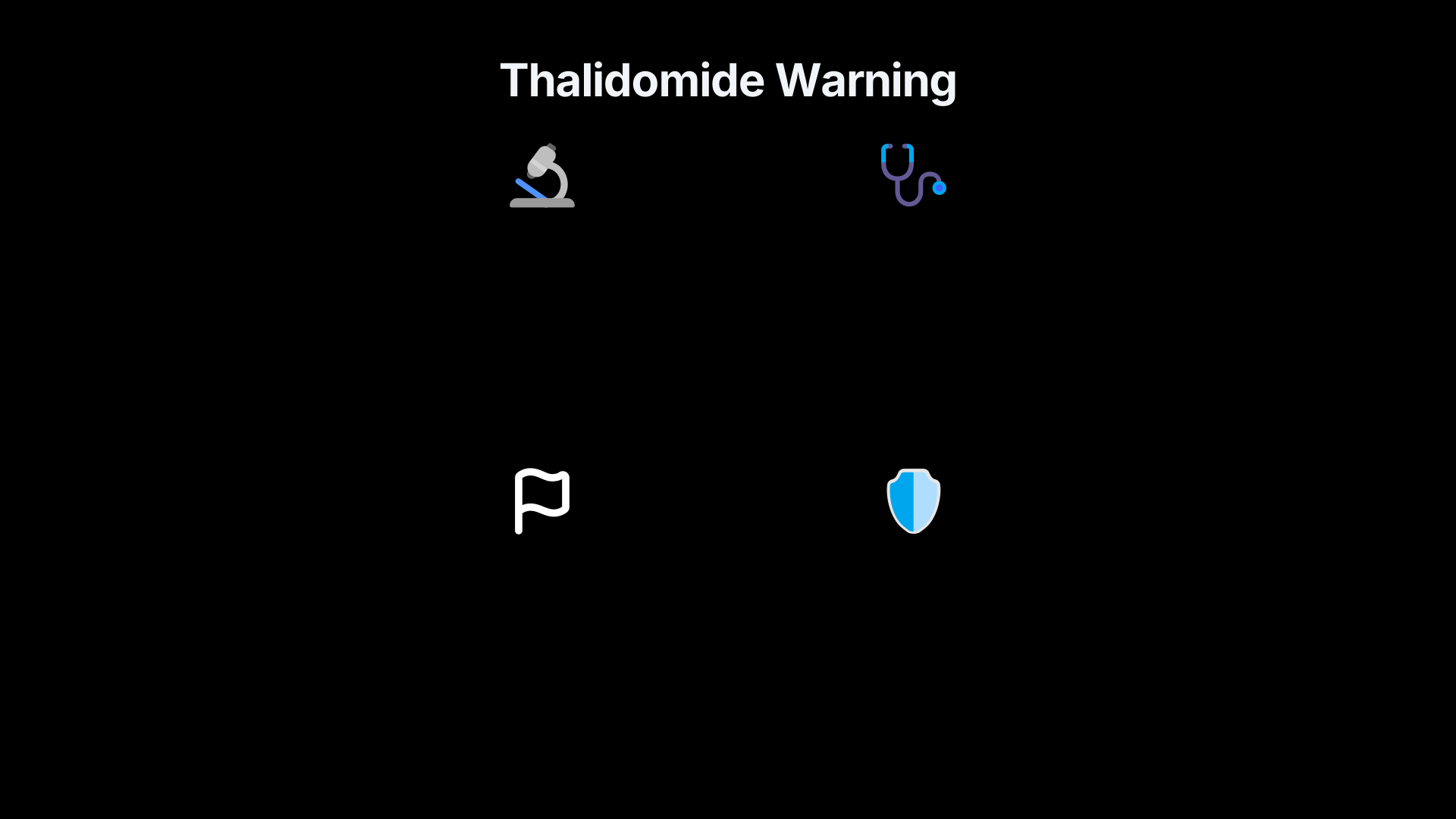
The most famous example is thalidomide. In the late 1950s and early 1960s, clinicians began noticing an unusual rise in severe birth defects among babies whose mothers had taken the drug during pregnancy. These early observations were not definitive proof, but they provided the first warning that something was wrong. Subsequent investigation confirmed the association, and the tragedy transformed drug-safety monitoring worldwide. PMC[2ctdt.co.in]ctdt.co.inbirth defects became permanently linked as a result of…Read more…
Other serious drug-related harms have also first appeared in case reports or small case series before being confirmed through larger investigations. Reviews of pharmacovigilance history note that reports of congenital abnormalities linked to valproate, for example, emerged initially through case reports before stronger evidence accumulated.[Springer]link.springer.comImportance of Publishing Adverse Drug Reaction Case Reportsby RR Shah · 2017 · Cited by 23 — However, strong evidence suggesting…
Case reports are particularly valuable when they contain features that make coincidence less likely, such as:
- A clear timeline between treatment and harm.
- Repeated occurrence in multiple unrelated patients.
- Improvement after stopping the treatment.
- Recurrence after re-exposure, when such re-exposure occurs unintentionally and safely.
- A biologically plausible mechanism.[Ovid]ovid.combmj.k4051~adverse drug reactionsAdverse drug reactionsby RE Ferner · 2018 · Cited by 53 — Rechallenge is not generally advised if the suspected adverse drug reaction…
These features do not prove causation, but they strengthen the case that further investigation is warranted.
The Difference Between a Signal and Proof
A common misunderstanding is that identifying a signal means a causal relationship has already been established. In reality, a signal is best understood as a hypothesis generated from observation.
A patient may develop a serious illness after taking a medicine. The timing might be suggestive, but many illnesses occur naturally, and some events happen by chance alone. Without comparison groups, researchers cannot determine whether the event occurred more often than would normally be expected.
This is where the logic of evidence becomes important. Anecdotes can show that an event is possible. They cannot reliably show that it is typical, frequent, or caused by the treatment. Treating a signal as proof is a version of the same evidential mistake that underlies many anecdotal fallacies: drawing a broad conclusion from insufficient evidence.
Research examining adverse-drug-reaction signals has repeatedly found that some early warnings are later confirmed, while others are not. The fact that many signals fail to hold up under further scrutiny is not a weakness of the system; it is the expected outcome of a process designed to detect potential problems early.[BMJ]bmj.comCase reports of suspected adverse drug reactionsby JP Vandenbroucke · 2006 · Cited by 19 — Case reports of suspected adverse drug reac…
The goal is sensitivity rather than certainty. Regulators would rather investigate a number of false alarms than miss a genuine danger that could harm large numbers of patients.
What Stronger Follow-Up Evidence Looks Like
Once a signal emerges, researchers seek stronger forms of evidence.
The first step is often to determine whether similar reports exist elsewhere. Pharmacovigilance databases can reveal whether clinicians and patients in different places are reporting the same pattern. Statistical methods can then assess whether the reported event appears unusually often in association with a particular medicine.[Uppsala Monitoring Centre]who-umc.orgUppsala Monitoring CentrePharmacovigilance in Perspective[4] After approval is granted for a medicine, case reports of suspected adverse…
Further investigation may include:
- Case-control studies comparing affected patients with similar unaffected patients.
- Cohort studies tracking outcomes among people who did and did not receive the treatment.
- Reanalysis of clinical-trial data.
- Mechanistic research exploring how the harm might occur biologically.
- Regulatory review of accumulated evidence from multiple sources. BMJ[Uppsala Monitoring Centre]who-umc.orgUppsala Monitoring CentrePharmacovigilance in Perspective[4] After approval is granted for a medicine, case reports of suspected adverse…
Only after evidence converges from several directions can a suspected association move from a warning signal towards a well-supported causal conclusion.
Why This Matters for Understanding Anecdotal Evidence
The role of anecdotes in medicine illustrates an important lesson about evidence more generally. A story does not need to be strong evidence to be useful evidence.
When someone reports an unexpected reaction to a medicine, the report should neither be accepted as conclusive proof nor dismissed as irrelevant. Its proper role is to raise a question. Medicine advances by turning such observations into testable hypotheses and then subjecting them to more rigorous scrutiny.
This balanced approach avoids two opposite errors. One is the anecdotal fallacy: assuming that a vivid personal experience proves a general claim. The other is ignoring potentially important observations simply because they come from individuals. Medical safety systems work precisely because they treat anecdotes as clues—valuable enough to investigate, but not strong enough to settle the matter on their own. BMJ[Uppsala Monitoring Centre]who-umc.orgUppsala Monitoring CentrePharmacovigilance in Perspective[4] After approval is granted for a medicine, case reports of suspected adverse…
Amazon book picks
Further Reading
Books and field guides related to Can a Patient Story Warn US Early?. Use these as the next step if you want deeper reading beyond the article.
Trick or Treatment?
Shows why personal recovery stories are weak evidence for effectiveness.
Testing Treatments
Explains why case reports generate signals but do not establish proof.
The Skeptics' Guide to the Universe
Covers scientific skepticism, medical claims, and cognitive pitfalls.
eBay marketplace picks
Marketplace Samples
Example marketplace items related to this page. Use the search link to explore similar finds on eBay.







Endnotes
1.
Source: pmc.ncbi.nlm.nih.gov
Title: PMCCase reports of suspected adverse drug reactions
Link:https://pmc.ncbi.nlm.nih.gov/articles/PMC1363912/
Source snippet
by YK Loke · 2006 · Cited by 141 — Abstract. Objective To determine whether anecdotal reports of suspected adverse drug reactions are...
2.
Source: stg-blogs.bmj.com
Title: rare adverse events clinical trials understanding rule three
Link:https://stg-blogs.bmj.com/bmjebmspotlight/2017/11/14/rare-adverse-events-clinical-trials-understanding-rule-three/
Source snippet
BMJ BlogsRare adverse events in clinical trialsNov 14, 2017 —... drug manufacturers, especially in cases where the reported harms are se...
3.
Source: pmc.ncbi.nlm.nih.gov
Title: PMCAdverse drug reactions – no farewell to harms
Link:https://pmc.ncbi.nlm.nih.gov/articles/PMC2000567/
Source snippet
drug reactions – no farewell to harms - PMC - NIHby JK Aronson · 2007 · Cited by 34 — Adverse drug reactions – no farewell to harms · The...
4.
Source: bmj.com
Link:https://www.bmj.com/content/332/7539/488.1
Source snippet
Case reports of suspected adverse drug reactionsby JP Vandenbroucke · 2006 · Cited by 19 — Case reports of suspected adverse drug reac...
5.
Source: bmj.com
Link:https://www.bmj.com/content/332/7539/488.2
Source snippet
Case reports of suspected adverse drug reactionsby S Russmann · 2006 · Cited by 12 — Yes, in rare instances case reports do more harm...
6.
Source: pmc.ncbi.nlm.nih.gov
Title: PMCAn historical overview over Pharmacovigilance
Link:https://pmc.ncbi.nlm.nih.gov/articles/PMC6132952/
Source snippet
NIHby G Fornasier · 2018 · Cited by 315 — The tragedy of thalidomide brought to light many problems and critical issues, in particu...
7.
Source: ctdt.co.in
Link:https://www.ctdt.co.in/abstractArticleContentBrowse/CTDT/10744/JPJ/fullText
Source snippet
birth defects became permanently linked as a result of...Read more...
8.
Source: link.springer.com
Link:https://link.springer.com/article/10.1007/s40800
Source snippet
Importance of Publishing Adverse Drug Reaction Case Reportsby RR Shah · 2017 · Cited by 23 — However, strong evidence suggesting...
9.
Source: ovid.com
Title: bmj.k4051~adverse drug reactions
Link:https://www.ovid.com/journals/bmjd/pdf/10.1136/bmj.k4051~adverse-drug-reactions
Source snippet
Adverse drug reactionsby RE Ferner · 2018 · Cited by 53 — Rechallenge is not generally advised if the suspected adverse drug reaction...
10.
Source: bmj.com
Title: bmj 2022 071752
Link:https://www.bmj.com/content/379/bmj-2022-071752
Source snippet
Characterization and corroboration of safety signals...by MM Dhodapkar · 2022 · Cited by 81 — A study demonstrating a significant ass...
11.
Source: bmj.com
Link:https://www.bmj.com/content/332/7537/335/rapid-responses
Source snippet
adverse drug reaction (ADR) is by performing a controlled follow-up study.... -making which play a significant role in...Read more...
12.
Source: bmj.com
Title: bmj 2021 068983
Link:https://www.bmj.com/content/377/bmj-2021-068983
Source snippet
Better reporting of harms in randomized trials: an extension of the CONSORT...Read more...
13.
Source: bmj.com
Link:https://www.bmj.com/
14.
Source: bmj.com
Link:https://www.bmj.com/content/377/bmj.o1055
Source snippet
Better measuring and reporting of adverse events are...by CA Shaheed · 2022 · Cited by 5 — The CONSORT extension for harms3 provides gui...
15.
Source: casereports-corporate.bmj.com
Link:https://casereports-corporate.bmj.com/
Source snippet
Includes information on adverse reactions and drug effectiveness, aimed at pharmaceutical...
16.
Source: casereports.bmj.com
Link:https://casereports.bmj.com/content/13/8/e238555
Source snippet
bmj.comStevens-Johnson syndrome-toxic epidermal necrolysisby SS Sen · 2020 · Cited by 11 — We hereby report a fatal case of SJS and toxic...
17.
Source: bmj.com
Title: case reports vital pharmacovigilance
Link:https://www.bmj.com/rapid-response/2011/10/31/case-reports-vital-pharmacovigilance
Source snippet
Case reports vital for pharmacovigilanceFeb 9, 2006 — Case reports of suspected adverse drug reactions—systematic literature survey of fo...
18.
Source: bmjopen.bmj.com
Link:https://bmjopen.bmj.com/content/13/1/e068127
Source snippet
mining techniques for detecting signals of adverse...by Y Guan · 2023 · Cited by 6 — This study aimed to analyse cardiac therapy drug-re...
19.
Source: researchgate.net
Link:https://www.researchgate.net/publication/366028801_Signals_of_Adverse_Drug_Reactions_Communicated_by_Pharmacovigilance_Stakeholders_A_Scoping_Review_of_the_Global_Literature
Source snippet
(PDF) Signals of Adverse Drug Reactions Communicated...We shall hand-search the websites of 35 regulatory agencies/authorities, restrict...
20.
Source: iris.who.int
Title: int SAFET Y MONITORING
Link:https://iris.who.int/bitstreams/5967e7fc-c971-46b7-9bd7-6689b26ea3aa/download
Source snippet
MONITORING - IRISby World Health Organization · 2012 · Cited by 54 — The aim of spontaneous reporting systems is to detect new signals, a...
21.
Source: link.springer.com
Link:https://link.springer.com/article/10.1007/s40264-022-01258-0
Source snippet
of Adverse Drug Reactions Communicated by...by D Sartori · 2023 · Cited by 38 — Signals of adverse drug reactions (ADRs) can be supporte...
22.
Source: who-umc.org
Link:https://who-umc.org/media/1777/25297.pdf
23.
Source: who-umc.org
Title: Uppsala Monitoring Centre Viewpoint Part 2 Uppsala Monitoring Centre
Link:https://who-umc.org/media/mswlqbsc/viewpoint-part-2-uppsala-monitoring-centre.pdf
Source snippet
World Health Organization, receives reports of adverse drug reactions from more than 70 countries and...
24.
Source: repository.ubn.ru.nl
Title: mmubn000001 270541349
Link:https://repository.ubn.ru.nl/bitstream/handle/2066/93699/mmubn000001_270541349.pdf?sequence=3
Source snippet
ADVERSE DRUG REACTIONSby RHB Meyboom · 1998 · Cited by 23 — sified case reports in the database of the Uppsala Monitoring Centre, cases t...
25.
Source: d-nb.info
Link:https://d-nb.info/1299173055/34
Source snippet
Uppsala Monitoring Centre retrieved the dates of the reports of ADRs to calculate the TTC. All data were charted and...
Additional References
26.
Source: cioms.ch
Link:https://cioms.ch/wp-content/uploads/2018/03/WG8-Signal-Detection.pdf
Source snippet
Practical Aspects of Signal Detection in PharmacovigilancePharmacovigilance is defined as “the science and activities relating to the det...
27.
Source: southcarolina.himss.org
Link:https://southcarolina.himss.org/node/293131
Source snippet
Detection Innovation Boosts Safety and Uncovers...Safety signal monitoring has barely changed in 70 years, from when the practice was fi...
28.
Source: uppsalareports.org
Title: underreporting in pharmacovigilance where do we go from here
Link:https://uppsalareports.org/articles/underreporting-in-pharmacovigilance-where-do-we-go-from-here/
Source snippet
Underreporting in pharmacovigilance: Where do we go...18 Feb 2026 — Uppsala Monitoring Centre recommends that a healthy national pharmac...
29.
Source: pubrica.com
Link:https://pubrica.com/academy/medical-device/post-marketing-surveillance-drug-safety/
Source snippet
[6]. Case Study 2: Thalidomide. Thalidomide was originally approved for use as...Read more...
30.
Source: asianjpr.com
Link:https://asianjpr.com/HTML_Papers/Asian%20Journal%20of%20Pharmaceutical%20Research__PID__2024-14-2-14.html
Source snippet
safety and efficacy of medicinal product but there was a need of a common...Read more...
31.
Source: researchgate.net
Title: (PDF) Real-world pharmacovigilance study on neonatal
Link:https://www.researchgate.net/publication/396360043_Real-world_pharmacovigilance_study_on_neonatal_congenital_anomalies_associated_with_maternal_drug_exposure_using_the_FDA_Adverse_Event_Reporting_System
Source snippet
reports were categorized as drug-related. neonatal congenital anomaly reports (see Figure 1... signals indicate potential risks. of spec...
32.
Source: redalyc.org
Link:https://www.redalyc.org/journal/5705/570569642003/570569642003.pdf
Source snippet
Thalidomide surveillance and pharmacovigilance in Brazilby LF Leal · 2021 · Cited by 1 — Results: New cases of congenital abnormalities w...
33.
Source: ijprems.com
Link:https://www.ijprems.com/ijprems-paper/a-review-article-on-pharmacovigilence
Source snippet
s (phocomelia) in 46 countries worldwide. This highlighted...Read more...
34.
Source: repub.eur.nl
Title: ‘a new potentially causal association,
Link:https://repub.eur.nl/pub/106001/Thesis-APacurariu.pdf
Source snippet
role of signal detection in Pharmacovigilanceby A Păcurariu · 2018 · Cited by 1 — The first step, signal detection, is the process of mon...
35.
Source: linical.com
Title: the new world of pharmacovigilance
Link:https://www.linical.com/articles-research/the-new-world-of-pharmacovigilance
Source snippet
Nov 25, 2025 — It was later recognized that thalidomide use in pregnancy resulted in severe congenital malformations in thousands of infa...
Topic Tree