Within Context
When Is Fear a Fair Warning?
Fear appeals are not automatically manipulative when the emotion points to a real danger and the conclusion stays proportionate.
On this page
- Real risk versus manufactured panic
- Proportionate emotion and practical action
- Safety campaigns as borderline cases
Page outline Jump by section
Introduction
Fear is not automatically a sign of bad reasoning. In discussions of logical fallacies, an appeal to fear becomes problematic when fear is used as a substitute for evidence or when the danger is exaggerated beyond what the facts support. However, many warnings are not fallacious at all. If a genuine threat exists, the evidence for that threat is strong, and the recommended response is proportionate, then fear can be a rational emotional response rather than a manipulation.[Informal Logic]informallogic.caEven within a public health context, much is now.Read moreInformal LogicFear Appeal Arguments In Public Health Reasoningby L Cummings · 2012 · Cited by 35 — Abstract: The study of threat and fear…
 This distinction matters because public safety, health, security, and disaster communication often depend on alerting people to serious risks. The key question is not whether fear is present. The key question is whether the fear tracks a real danger and whether the conclusion follows from the available evidence.
Real Risk Versus Manufactured Panic
The classic appeal-to-fear fallacy attempts to secure agreement by making people anxious rather than by providing relevant reasons. A speaker may imply catastrophe without demonstrating that the danger is likely, significant, or connected to the conclusion being promoted.[Logically Fallacious]logicallyfallacious.comLogically FallaciousAppeal to FearDescription: When fear, not based on evidence or reason, is being used as the primary motivator to get…
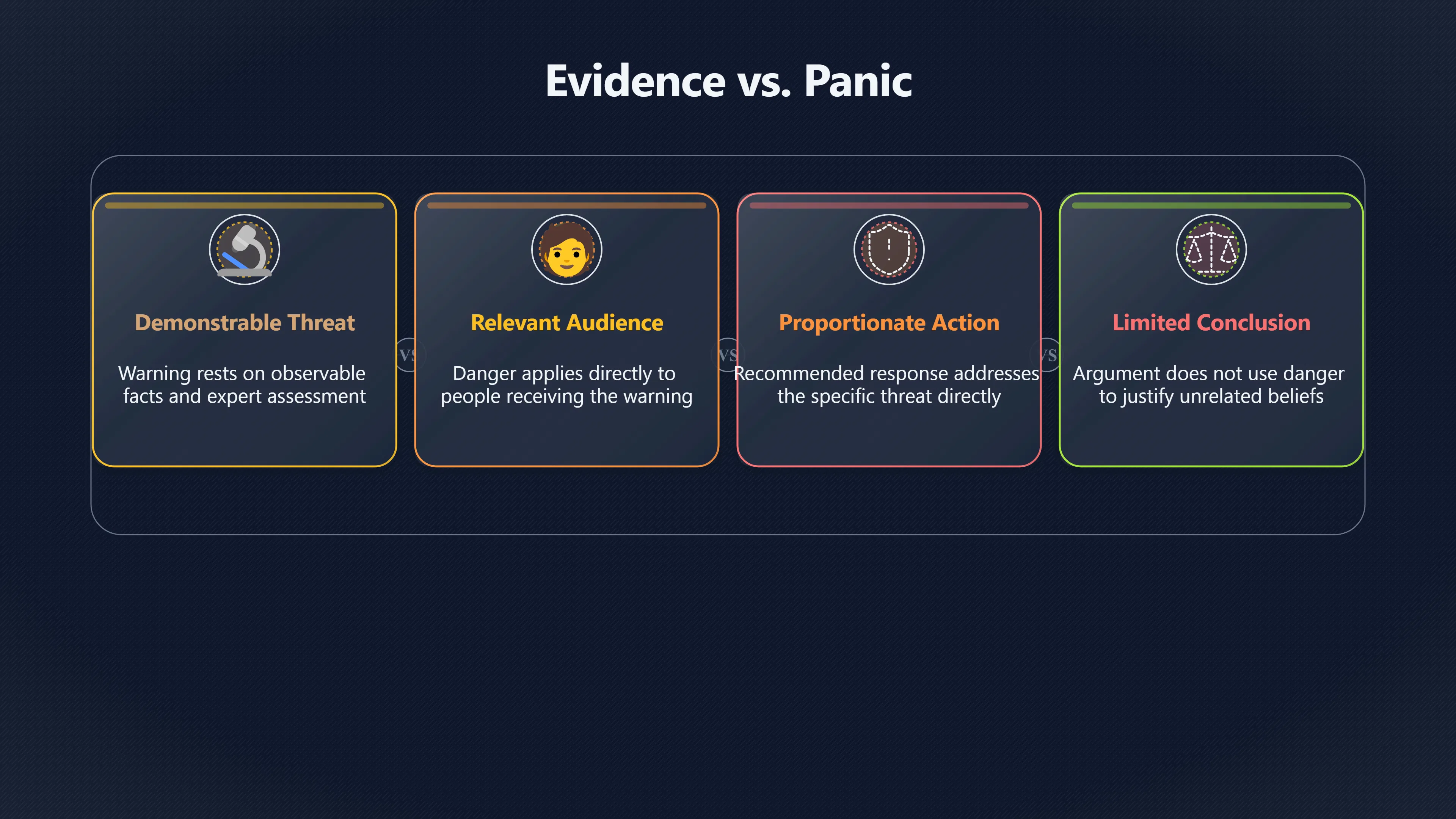
A legitimate warning works differently. It links three elements:
- A demonstrable threat.
- Evidence that the threat is relevant to the audience.
- A conclusion or recommendation that addresses the threat in a reasonable way.
Consider two contrasting examples.
Fallacious version: “Support this policy or society will collapse.” The warning relies on fear but provides little evidence that the predicted disaster will occur.
Non-fallacious version: “Evacuate because a rapidly approaching wildfire has entered the area and emergency services have issued evacuation orders.” Here, the warning points to a documented danger and recommends a response directly related to that danger.
The emotional force of the second message does not make it irrational. In fact, ignoring the danger would be less rational than recognising it. Informal logic therefore evaluates fear appeals by asking whether the threat claim is supported and whether the proposed action genuinely follows from the risk.[Informal Logic]informallogic.caEven within a public health context, much is now.Read moreInformal LogicFear Appeal Arguments In Public Health Reasoningby L Cummings · 2012 · Cited by 35 — Abstract: The study of threat and fear…[stanford]plato.stanford.eduEncyclopedia of Philosophy Informal LogicThe scheme Argument from Authority (“Appeal to Authority,” “Appeal…Read more… Encyclopedia of Philosophy
When Is Fear a Fair Warning?
Fear becomes a reasonable part of argumentation when it reflects reality rather than distorting it. Several features help distinguish fair warnings from manipulative scare tactics.
The threat is evidence-based. The warning rests on observable facts, credible research, expert assessment, or documented experience rather than speculation.[Informal Logic]informallogic.caEven within a public health context, much is now.Read moreInformal LogicFear Appeal Arguments In Public Health Reasoningby L Cummings · 2012 · Cited by 35 — Abstract: The study of threat and fear…
The severity matches the evidence. Serious risks are described as serious, moderate risks as moderate. The communicator does not inflate uncertainty into certainty or possibility into inevitability.
The audience is genuinely vulnerable. A warning is stronger when the danger actually applies to the people receiving it. Risk communication research repeatedly emphasises that people respond differently depending on whether they believe the threat is relevant to them personally.[Communication Cache]communicationcache.computting the fear back into fear appeals the extended parallel process modelYou're at-risk for AIDS because you share needles while using…Read more…[Lumina Corps]communicatehealth.comLumina Corps Useful Theory: Extended Parallel Process ModelLumina CorpsUseful Theory: Extended Parallel Process ModelMay 20, 2021 — The EPPM, developed by Dr. Kim Witte, explains that health risk…
The conclusion remains limited. A legitimate warning supports actions related to the threat itself. It does not use the danger as a pretext to justify unrelated beliefs or policies.
Under these conditions, fear functions as a signal about risk rather than a replacement for reasoning.

Proportionate Emotion and Practical Action
Research on fear appeals helps explain why some warnings are persuasive without being manipulative. Studies in health communication consistently find that fear-based messages are most effective when they combine information about a threat with clear, practical steps that people can take to reduce the danger. Merely frightening people is often ineffective and can even provoke avoidance or denial.[PMC]pmc.ncbi.nlm.nih.govPMCAn application of the extended parallel process modelby H Yoon · 2022 · Cited by 33 — The EPPM explains that danger control and fear control are mutually exclusive responses based on an i…[Sage Journals]journals.sagepub.comSage JournalsA Meta-Analysis of Fear Appeals: Implications for Effective…by K Witte · 2000 · Cited by 4977 — The meta-analysis suggest…
The influential Extended Parallel Process Model (EPPM) proposes that people evaluate both:[pmc.ncbi.nlm.nih.gov]pmc.ncbi.nlm.nih.govPMCAn application of the extended parallel process modelby H Yoon · 2022 · Cited by 33 — The EPPM explains that danger control and fear control are mutually exclusive responses based on an i…
- Threat: How serious and personally relevant the danger appears.
- Efficacy: Whether effective protective actions exist and whether they seem achievable.[Communication Cache]communicationcache.computting the fear back into fear appeals the extended parallel process modelYou're at-risk for AIDS because you share needles while using…Read more…[Lumina Corps]communicatehealth.comLumina Corps Useful Theory: Extended Parallel Process ModelLumina CorpsUseful Theory: Extended Parallel Process ModelMay 20, 2021 — The EPPM, developed by Dr. Kim Witte, explains that health risk…
When people perceive a real threat and believe they can respond effectively, fear tends to promote constructive action. When they perceive danger but feel powerless, they may reject the message, avoid thinking about it, or become defensive.[PMC]pmc.ncbi.nlm.nih.govPMCAn application of the extended parallel process modelby H Yoon · 2022 · Cited by 33 — The EPPM explains that danger control and fear control are mutually exclusive responses based on an i…[Communication Cache]communicationcache.computting the fear back into fear appeals the extended parallel process modelYou're at-risk for AIDS because you share needles while using…Read more…
This insight is important for evaluating arguments. A warning that says, “This risk is real, and here is how you can reduce it,” is fundamentally different from a warning that simply amplifies anxiety. The former aims at problem-solving; the latter may aim only at emotional pressure.
Safety Campaigns as Borderline Cases
Public safety campaigns provide some of the clearest borderline examples.
Anti-smoking advertisements often depict severe illness, damaged organs, or premature death. These messages deliberately evoke fear. Yet the health consequences of smoking are extensively documented, and the recommended action—avoiding or quitting smoking—directly addresses the risk. Whether a particular advertisement is effective can be debated, but the mere presence of fear does not make the argument fallacious. OUP Academic[PMC]pmc.ncbi.nlm.nih.govPMCAn application of the extended parallel process modelby H Yoon · 2022 · Cited by 33 — The EPPM explains that danger control and fear control are mutually exclusive responses based on an i…
Road-safety campaigns offer another example. Graphic depictions of crashes can appear emotionally manipulative at first glance. However, when they are based on well-established accident risks and paired with practical advice such as wearing seat belts, avoiding impaired driving, or reducing speed, they are warning about documented dangers rather than inventing them. Studies of threat-based road-safety messaging have found that high-threat messages can influence behaviour when accompanied by strong efficacy information.[UCL Discovery]discovery.ucl.ac.ukUCL DiscoveryThreat appeals in health communication: messages that elicit…RESULTS: Study 1 findings indicated that a high threat messa…
Public health emergencies frequently raise the same issue. Communicators may need to warn about infectious disease, environmental hazards, or natural disasters. Such warnings can create fear, but if the risk assessments are evidence-based and the guidance is proportionate, the appeal is not merely emotional. It is grounded in the realities of risk management.[Informal Logic]informallogic.caEven within a public health context, much is now.Read moreInformal LogicFear Appeal Arguments In Public Health Reasoningby L Cummings · 2012 · Cited by 35 — Abstract: The study of threat and fear…[Sage Journals]journals.sagepub.comSage JournalsA Meta-Analysis of Fear Appeals: Implications for Effective…by K Witte · 2000 · Cited by 4977 — The meta-analysis suggest…

A Practical Test for Evaluating Fear-Based Arguments
When deciding whether a fear appeal is fallacious or reasonable, a useful set of questions is:
- Is the danger real and supported by credible evidence?
- Is the level of fear proportionate to the actual risk?
- Does the argument explain why the audience should regard the threat as relevant?
- Is the recommended action connected to reducing that threat?
- Would the argument still have force if the emotional language were reduced?
If the warning survives these questions, it is likely functioning as a legitimate risk argument rather than a fallacious appeal to fear.
The central lesson is that fear itself is not the problem. In borderline cases, the decisive issue is whether fear tracks reality. When evidence shows that a danger is genuine and the proposed response is sensible, fear can serve as a rational guide to action rather than a tool of manipulation.[Informal Logic]informallogic.caEven within a public health context, much is now.Read moreInformal LogicFear Appeal Arguments In Public Health Reasoningby L Cummings · 2012 · Cited by 35 — Abstract: The study of threat and fear…[PMC]pmc.ncbi.nlm.nih.govPMCAn application of the extended parallel process modelby H Yoon · 2022 · Cited by 33 — The EPPM explains that danger control and fear control are mutually exclusive responses based on an i…
eBay marketplace picks
Marketplace Samples
Example marketplace items related to this page. Use the search link to explore similar finds on eBay.







Endnotes
1.
Source: plato.stanford.edu
Title: Encyclopedia of Philosophy Informal Logic
Link:https://plato.stanford.edu/archives/fall2022/entries/logic-informal/
Source snippet
The scheme Argument from Authority (“Appeal to Authority,” “Appeal...Read more...
2.
Source: pmc.ncbi.nlm.nih.gov
Title: PMCAn application of the extended parallel process model
Link:https://pmc.ncbi.nlm.nih.gov/articles/PMC8903272/
Source snippet
by H Yoon · 2022 · Cited by 33 — The EPPM explains that danger control and fear control are mutually exclusive responses based on an i...
3.
Source: academic.oup.com
Title: Academic Fear Arousal and Health and Risk Messaging
Link:https://academic.oup.com/edited-volume/61798/chapter/546204722?searchresult=1
Source snippet
OUP AcademicFear Arousal and Health and Risk Messaging - Oxford AcademicA fear appeal, then, can be defined as a message that intends to...
4.
Source: pmc.ncbi.nlm.nih.gov
Title: Unresolved issues include possible mediation [mechanisms]({{ ‘mechanisms/’ | relative_url }}). Read more
Link:https://pmc.ncbi.nlm.nih.gov/articles/PMC8266257/
Source snippet
Fear appeals to promote better health behaviors - PMCby LS Moussaoui · 2021 · Cited by 54 — Fear appeals are widely used in health com...
5.
Source: informallogic.ca
Title: Even within a public health [context]({{ ‘context/’ | relative_url }}), much is now.Read more
Link:https://informallogic.ca/index.php/informal_logic/article/view/3146/2764
Source snippet
Informal LogicFear Appeal Arguments In Public Health Reasoningby L Cummings · 2012 · Cited by 35 — Abstract: The study of threat and fear...
6.
Source: logicallyfallacious.com
Link:https://www.logicallyfallacious.com/logicalfallacies/Appeal-to-Fear
Source snippet
Logically FallaciousAppeal to FearDescription: When fear, not based on evidence or reason, is being used as the primary motivator to get...
7.
Source: communicationcache.com
Title: putting the fear back into fear appeals the extended parallel process model
Link:https://www.communicationcache.com/uploads/1/0/8/8/10887248/putting_the_fear_back_into_fear_appeals-_the_extended_parallel_process_model.pdf
Source snippet
"You're at-risk for AIDS because you share needles while using...Read more...
8.
Source: communicatehealth.com
Title: Lumina Corps Useful Theory: Extended Parallel Process Model
Link:https://www.communicatehealth.com/wehearthealthliteracy/useful-theory-extended-parallel-process-model/
Source snippet
Lumina CorpsUseful Theory: Extended Parallel Process ModelMay 20, 2021 — The EPPM, developed by Dr. Kim Witte, explains that health risk...
Published: May 20, 2021
9.
Source: journals.sagepub.com
Link:https://journals.sagepub.com/doi/10.1177/109019810002700506
Source snippet
Sage JournalsA Meta-Analysis of Fear Appeals: Implications for Effective...by K Witte · 2000 · Cited by 4977 — The meta-analysis suggest...
10.
Source: discovery.ucl.ac.uk
Link:https://discovery.ucl.ac.uk/1517289/
Source snippet
UCL DiscoveryThreat appeals in health communication: messages that elicit...RESULTS: Study 1 findings indicated that a high threat messa...
11.
Source: journals.sagepub.com
Link:https://journals.sagepub.com/doi/10.1177/08901171231218689
Source snippet
Sage JournalsUnderstanding the Design of Fear Appeals by Applying...Nov 28, 2023 — Understanding the Design of Fear Appeals by Applying...
12.
Source: db.arabpsychology.com
Title: appeal to fear
Link:https://db.arabpsychology.com/appeal-to-fear/
Source snippet
to Fear: Fallacy, Definition & ExamplesAn appeal to fear (also called argumentum ad metum or argumentum in terrorem) is a fallacy in whic...
13.
Source: Wikipedia
Title: Extended parallel process model
Link:https://en.wikipedia.org/wiki/Extended_parallel_process_model
Source snippet
Extended parallel process modelThis is also the first fear appeal model that outlines the relationship between threat and efficacy in...
Additional References
14.
Source: researchgate.net
Link:https://www.researchgate.net/publication/364302746_Examining_the_persuasion_process_of_narrative_fear_appeals_on_health_misinformation_correction
Source snippet
(PDF) Examining the persuasion process of narrative fear...10 Oct 2022 — Results revealed that narrative fear appeal messages are effect...
15.
Source: contensis.uwaterloo.ca
Link:https://contensis.uwaterloo.ca/sites/courses-archive/1185/PHS-617/lecture-content/module-5/5c.aspx/1000
Source snippet
uwaterloo.ca5c. Fear Appeals in Health Communication CampaignsA fear appeal is a persuasive message that attempts to arouse fear in order...
16.
Source: researchgate.net
Link:https://www.researchgate.net/publication/345737608_Extended_Parallel_Process_Model
Source snippet
Extended Parallel Process ModelA fear appeal should convince the message recipient to engage in danger control behaviors to avert the thr...
17.
Source: socialactionlab.org
Link:https://socialactionlab.org/wp-content/uploads/2024/01/Tannenbaum_Appealing-to-Fear-A-Meta-Analysis-of-Fear-Appeal-Effectiveness-and-Theories_2015.pdf
Source snippet
A Meta-Analysis of Fear Appeal Effectiveness and Theoriesby MB Tannenbaum · Cited by 1644 — Fear appeals are persuasive messages that att...
18.
Source: researchgate.net
Link:https://www.researchgate.net/publication/228297479_Why_Fallacies_Appear_to_be_Better_Arguments_Than_They_Are
Source snippet
Why Fallacies Appear to be Better Arguments Than They AreThree informal fallacies, argumentum ad verecundiam, argumentum ad ignorantiam a...
19.
Source: read.aupress.ca
Link:https://read.aupress.ca/read/critical-thinking-logic-and-argument/section/d25311a8-3222-4d6a-97da-2797dfecbabf
Source snippet
15. Fallacies of Emotional BiasIn this chapter we identify seven fallacies: three ad hominem arguments, the appeal to pity, the appeal to...
20.
Source: global.comminit.com
Link:https://global.comminit.com/content/message-effectiveness-fear-appeals-vaccination-communication-campaigns-systematic-review
Source snippet
Effectiveness of Fear Appeals in Vaccination...29 Oct 2024 — For example, fear appeals attempt to motivate receivers to reduce the commu...
21.
Source: ovid.com
Link:https://www.ovid.com/journals/hedb/fulltext/10.1177/1090198111418108~the-extended-parallel-process-model-illuminating-the-gaps-in
Source snippet
The Extended Parallel Process Modelby L Popova · 2012 · Cited by 560 — This model posited that people have to first learn to fear a threa...
22.
Source: socialsci.libretexts.org
Title: Social Sci Libre Texts5.1: Fear Appeals- The Extended Parallel Process Model
Link:https://socialsci.libretexts.org/Bookshelves/Communication/Argument_and_Debate/Persuasion_Theory_in_Action_%28Worthington%29/05%3A_Emotional_Appeals/5.01%3A_Fear_Appeals-_The_Extended_Parallel_Process_Model
Source snippet
Social Sci LibreTexts5.1: Fear Appeals- The Extended Parallel Process ModelMay 10, 2023 — The Extended Parallel Process Model specifies t...
Published: May 10, 2023
23.
Source: philosophy.lander.edu
Link:https://philosophy.lander.edu/logic/force.html
Source snippet
Philosophy Home PageArgumentum ad Baculum: The Appeal to ForceThe argumentum ad baculum is based upon the appeal to threat or force in or...
Topic Tree