Within Fallacy Lab
How Ads Make Weak Claims Persuasive
Advertising often uses fallacy-like shortcuts that make products feel better supported than the evidence allows.
On this page
- Popularity cues
- Authority cues
- Missing evidence in claims
Page outline Jump by section
Introduction
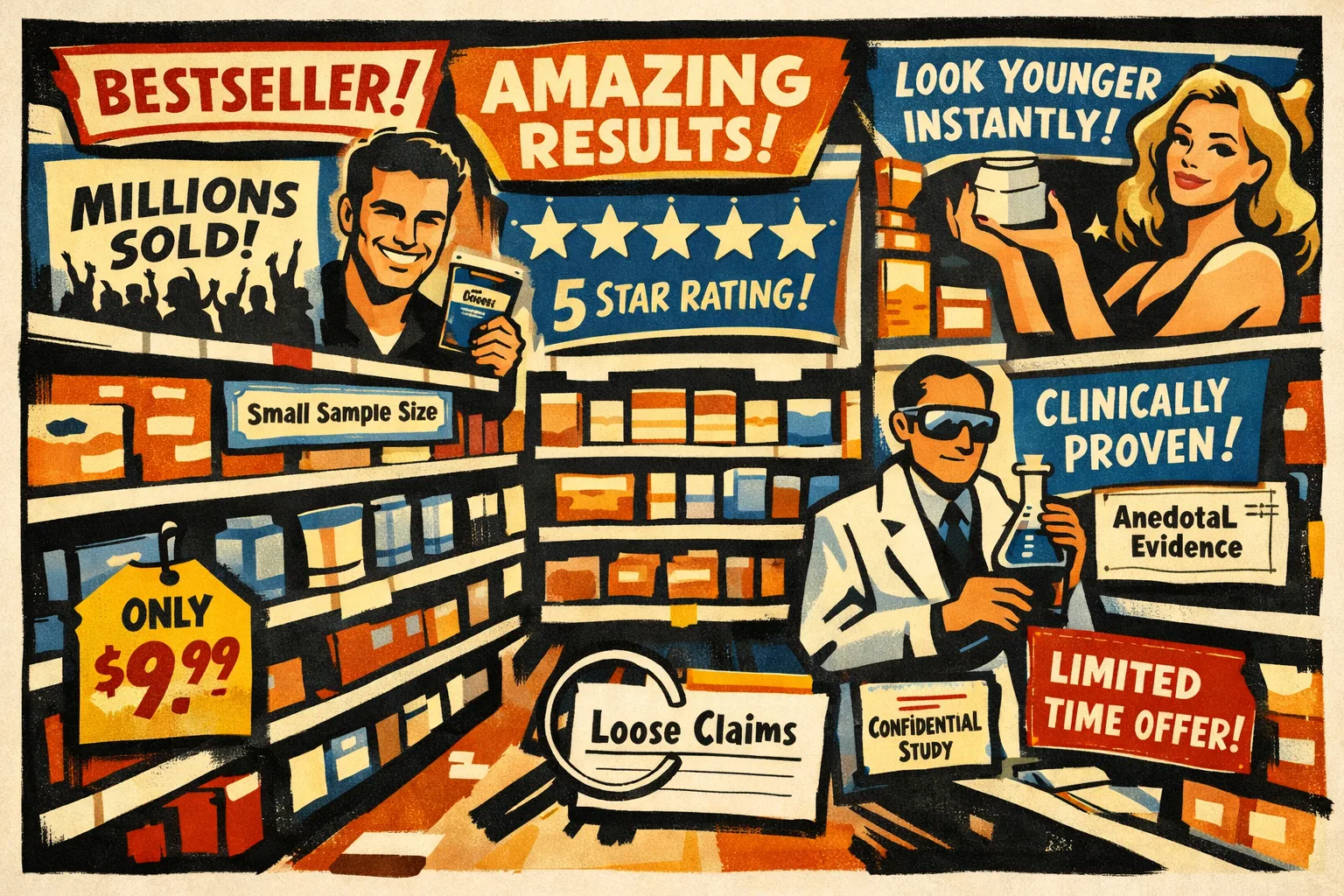
Advertising fallacies are persuasive shortcuts that make a product, service or brand feel better supported than the evidence actually allows. In logical terms, the weakness is not always that the advert is false; it is that the advert nudges the audience to accept a stronger conclusion than the stated reasons justify. “Millions sold” does not prove quality. A celebrity’s approval does not prove effectiveness. A scientific-sounding phrase does not prove scientific backing. These techniques matter because advertising is designed for quick judgement, not slow argument, and consumers often have little time to check what is being implied.
The useful question is not “Is this advert emotional?” Emotion is part of ordinary persuasion. The sharper question is: “What claim am I being invited to believe, and what evidence would actually support it?” Regulators use a similar distinction. The US Federal Trade Commission says advertising must be truthful, not misleading and, where appropriate, supported by evidence; UK advertising rules require marketers to hold evidence for objective claims before publishing them.[Federal Trade Commission]ftc.govFederal Trade CommissionTruth In AdvertisingFederal law says that ad must be truthful, not misleading, and, when appropriate, backed by s…
How weak claims become persuasive
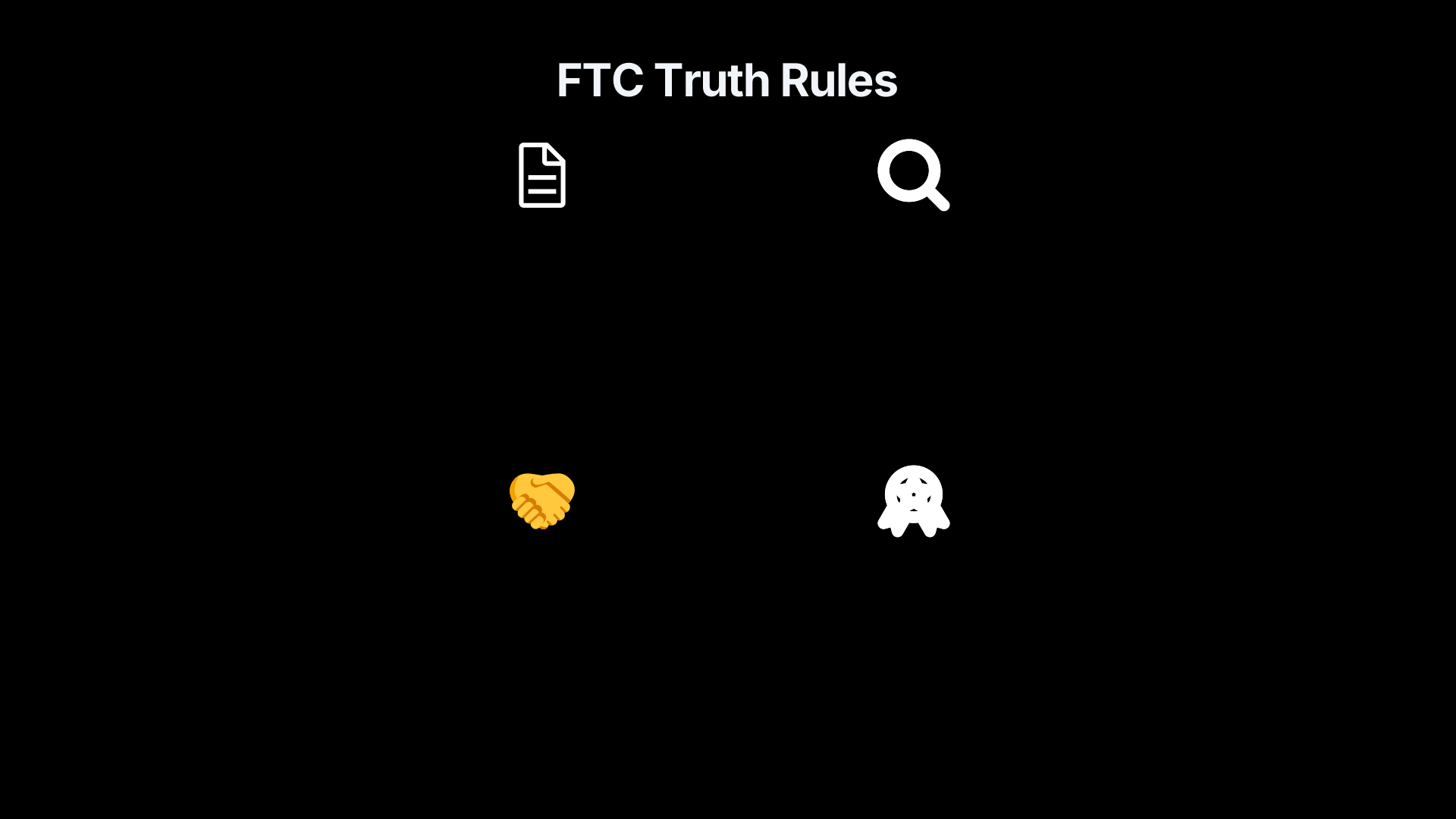
Advertising often works by compressing an argument into a cue: a star rating, a lab coat, a queue outside a shop, a smiling influencer, a “clinically proven” phrase, or a claim that “everyone is switching”. Each cue can be relevant in the right setting, but each can also become fallacy-like when it replaces evidence rather than pointing to it.
A fallacy in advertising is therefore usually an informal fallacy: its flaw depends on context, wording, implication and audience interpretation. A statement such as “our most popular formula” may be harmless if it simply reports sales. It becomes misleading if the advert encourages consumers to infer that popularity proves superiority, safety or suitability without evidence. Likewise, an expert endorsement can help when the expert is genuinely qualified, independent and speaking within their field. It becomes weak reasoning when authority is borrowed for a claim the endorser cannot substantiate.
This is why advertising law and fallacy analysis overlap but are not identical. A fallacy lens asks whether the reasoning is strong. A regulatory lens asks whether the overall message is likely to mislead consumers. Both lenses are useful because many adverts do not make one explicit false statement; they assemble cues that lead the audience towards an unsupported conclusion. The FTC’s advertising guidance stresses that advertisers need proof not only for direct claims but also for implied claims that reasonable consumers take from the advert.[Federal Trade Commission]ftc.govFederal Trade CommissionTruth In AdvertisingFederal law says that ad must be truthful, not misleading, and, when appropriate, backed by s…
Popularity cues: when “everyone loves it” stands in for evidence
Popularity is one of the most common advertising shortcuts because it feels like public proof. A product with thousands of reviews, a long queue, a “bestseller” badge or a line such as “the nation’s favourite” invites the consumer to think: if many people choose it, it must be good. That inference can be reasonable when popularity reflects repeated, informed satisfaction. It becomes a bandwagon-style fallacy when the advert treats popularity as if it proves quality, value, safety or truth.
Social advertising research shows why this cue is powerful. In large field experiments, ads that displayed peer affiliations with a brand increased responses, and influence effects were stronger when the social cue came from stronger social ties. The cue did not need to be a detailed recommendation; even a minimal sign that a peer was connected with the advertised entity could affect behaviour.[arXiv]arxiv.orgarXiv Social Influence in Social Advertising: Evidence from Field ExperimentsSocial Influence in Social Advertising: Evidence from Field ExperimentsJune 19, 2012…
The risk is that popularity information is easy to manipulate or over-read. “Trending” may mean heavily promoted. A five-star average may hide a small sample, cherry-picked reviews, suppressed negative feedback or incentivised ratings. A “most bought” label may say more about distribution, discounting or platform ranking than product merit. In logical terms, the advert is asking the consumer to move from “many people appeared to choose this” to “this is the better choice”. That conclusion needs more than popularity.
Online reviews make the problem especially visible. The UK Competition and Markets Authority has treated fake and misleading reviews as a consumer-protection priority, publishing guidance on fake reviews in 2025 and later reviewing more than 100 businesses for practices such as policies on fake and incentivised reviews.[GOV.UK]GOV.UKOnline consumer reviewsOnline consumer reviews The concern is not abstract: reviews are often read as ordinary consumer evidence, so fake, filtered or poorly labelled reviews can turn a popularity cue into manufactured proof.
A practical way to test the cue is to separate social evidence from product evidence:
- Popularity tells you that attention or uptake exists. It does not, by itself, tell you why.
- Reviews are more useful when they are specific. Detail about use, limits and context is stronger than repeated praise.
- Star ratings need a denominator. A 4.9 average from 18 reviews is not the same kind of evidence as a 4.5 average from 18,000 verified purchases.
- Negative and mixed reviews matter. If every visible reaction is glowing, the review environment itself may need scrutiny.
Authority cues: expertise, celebrity and borrowed credibility
Authority cues persuade by transferring trust from a person, institution or symbol onto a product. The cue may be explicit, as with a doctor or engineer endorsing a product, or indirect, as with scientific imagery, white coats, academic-looking charts or phrases such as “expert approved”. The underlying reasoning can be legitimate: expertise is often a good guide when consumers cannot evaluate a technical claim themselves. The fallacy appears when the authority does not actually support the claim being implied.
Celebrity endorsement is a clear example. A performer, athlete or influencer may be admired, attractive, familiar or trusted, but that does not make them qualified to judge a skincare ingredient, financial product, health device or environmental claim. A meta-analysis of celebrity endorsements found that such endorsements can have persuasive effects, but their force depends on factors such as fit between the celebrity and the promoted object rather than mere fame alone.[ResearchGate]researchgate.netResearch Gate The effectiveness of celebrity endorsements: a meta-analysisResearch Gate The effectiveness of celebrity endorsements: a meta-analysis More recent influencer research similarly finds that perceived credibility and influencer type affect persuasion, with social media influencers often outperforming brand-only advertising.[Sage Journals]journals.sagepub.comSource details in endnotes.
The logical risk is an appeal to inappropriate authority. The advert encourages the audience to treat the endorser’s status as evidence for the product claim. That may be weak for three reasons. First, the endorser may not have relevant expertise. Second, the endorser may be paid or otherwise connected to the brand. Third, even a genuine personal experience does not prove typical results for other consumers.
Regulators focus heavily on this problem because hidden payment or incentive changes how an audience interprets praise. The FTC’s endorsement guidance says endorsements must be truthful and not misleading, and its FAQ stresses that disclosure depends on context, including whether a material connection would affect how consumers evaluate the endorsement.[Federal Trade Commission]ftc.govFederal Trade CommissionTruth In AdvertisingFederal law says that ad must be truthful, not misleading, and, when appropriate, backed by s… The US electronic Code of Federal Regulations also states that the Endorsement Guides address how endorsement and testimonial practices relate to Section 5 of the FTC Act.[eCFR]ecfr.govSource details in endnotes.
UK rules take a similar approach. The ASA’s advice says testimonials and endorsements must be genuine, relate to the advertised product and be supported by documentary evidence; its substantiation guidance adds that testimonials alone are unlikely to be enough to prove objective claims.[ASA]asa.org.ukOpen source on asa.org.uk. That matters because a consumer story can be persuasive without being representative.
A useful warning sign is a mismatch between the authority and the claim. A dentist discussing fluoride toothpaste is different from an actor praising a supplement. A mechanic explaining a tyre test is different from a lifestyle influencer saying a car “feels safer”. A university logo, laboratory image or “doctor recommended” line should prompt the reader to ask: which expert, what expertise, what test, what result, and who paid?
Missing evidence in claims
Some of the most persuasive advertising fallacies depend less on what is said than on what is left unsaid. An advert may offer a claim that sounds factual but omit the evidence needed to judge it: compared with what, tested on whom, by whom, for how long, and with what result? These omissions are powerful because they let the audience complete the argument in the brand’s favour.
The FTC’s small-business advertising guidance gives a simple version of this issue: even when an advert does not state a stronger claim literally, advertisers must have proof for the express and implied claims consumers reasonably take from it.[Federal Trade Commission]ftc.govFederal Trade CommissionTruth In AdvertisingFederal law says that ad must be truthful, not misleading, and, when appropriate, backed by s… UK CAP rules likewise require marketers to hold documentary evidence for objective claims consumers are likely to regard as capable of substantiation.[ASA]asa.org.uktestimonials and endorsementstestimonials and endorsements
Common missing-evidence patterns include:
Unclear comparison. “Works better” is incomplete unless the audience knows better than what. A previous version? A competitor? No treatment? A placebo? A category average?
Vague measurement. “Helps improve appearance” may sound meaningful, but it does not reveal the size of the effect, how it was measured, or whether consumers could notice it.
Selective statistics. “Up to 70% faster” may describe the best observed case, not the typical user’s experience.
Scientific theatre. Words such as “research-backed”, “advanced formula” or “clinically tested” can create an aura of evidence while revealing little about the quality, independence or relevance of the research.
Testimonial substitution. A dramatic before-and-after story may be memorable, but it does not show typicality, causation or safety.
Health and beauty advertising illustrates the problem especially clearly because consumers are often asked to infer efficacy from technical language. The FTC’s Health Products Compliance Guidance says claims about health-related products should be truthful, not misleading and supported by science; it also notes that the same principles apply broadly to health-related marketing beyond dietary supplements.[Federal Trade Commission]ftc.govFederal Trade CommissionTruth In AdvertisingFederal law says that ad must be truthful, not misleading, and, when appropriate, backed by s… A study reported in Time found that, in a sample of 289 cosmetics adverts, only 18% of claims were rated generally trustworthy, with many claims judged vague, omissive or false.[Time]time.comThat Makeup Ad Is Probably Lying to YouThat Makeup Ad Is Probably Lying to You
Puffery sits at the edge of this issue. Advertising law has often tolerated vague, subjective praise such as “the ultimate experience” because it is thought not to be the kind of claim consumers can verify or rely on literally. But research on exaggerated advertising claims challenges the simple assumption that consumers never take puffery seriously. One study on processing exaggerated advertising claims notes that regulators often allow puffery because it is considered vague, fanciful or not meant to be treated as factual, while researchers continue to examine how consumers actually process such claims.[ScienceDirect]sciencedirect.comSource details in endnotes.
The fallacy risk is that vague praise can act like evidence without becoming evidence. “Premium”, “natural”, “trusted”, “smart”, “clean”, “professional-grade” and “scientifically inspired” may all be meaningful in some contexts, but each needs a concrete definition before it can support a consumer decision.
How social media intensifies advertising fallacies
Social media makes advertising fallacies harder to spot because persuasion often arrives as ordinary content. A product recommendation may appear inside a routine, tutorial, unboxing, review, travel diary or personal story. The ad-like claim is softened by intimacy: the audience feels that a person they follow is sharing a discovery rather than delivering a commercial message.
Disclosure is supposed to restore context, but research suggests it often fails in practice. A large empirical study of affiliate marketing disclosures on YouTube and Pinterest examined more than 500,000 YouTube videos and 2.1 million Pinterest pins, then tested user understanding with 1,791 participants. It found that only about 10% of affiliate marketing content on both platforms contained any disclosure, and that users often failed to understand shorter, non-explanatory disclosures.[arXiv]arxiv.orgarXiv Social Influence in Social Advertising: Evidence from Field ExperimentsSocial Influence in Social Advertising: Evidence from Field ExperimentsJune 19, 2012…
This matters for logical fallacies because hidden sponsorship strengthens weak appeals. A popularity cue looks more organic when the audience does not realise it has been engineered. An authority cue looks more sincere when the commercial relationship is invisible. A testimonial looks more independent when incentives are not disclosed. The missing premise is: “this person may have a financial reason to present the product favourably.”
The problem is not that influencers can never make good recommendations. Many can, especially when they have relevant experience, test products carefully and disclose relationships clearly. The problem is that the platform format blurs three roles that used to be easier to separate: friend, reviewer and advertiser. Once those roles blend, consumers need to ask not only “Do I trust this person?” but also “What is this content doing commercially?”
A simple test for fallacy-like ads
A consumer does not need to name every fallacy to think more clearly about advertising. The practical skill is to reconstruct the argument the advert is asking you to accept.
Start with the conclusion. Is the advert trying to make you believe the product is safer, more effective, better value, more ethical, more popular, more expert-approved or more suitable for you? Then identify the support. Is the support a statistic, testimonial, celebrity, expert, review score, scientific phrase, emotional scene or comparison? Finally, ask whether that support is strong enough for the conclusion.
The most useful checks are direct:
- What exactly is being claimed? Separate measurable claims from mood, design and slogan.
- What evidence would prove it? A health claim needs better support than a fashion preference.
- Who is speaking? Look for payment, affiliation, expertise and independence.
- What is the comparison? “Better”, “faster” and “cleaner” are incomplete without a baseline.
- Is the cue being overextended? Popularity can show uptake; it cannot prove quality by itself.
- What information is missing? Watch for absent sample sizes, test methods, timeframes and typical results.
This approach avoids cynicism. Some adverts are well-supported. Some endorsements are honest. Some popularity claims are useful. The aim is not to reject persuasion, but to refuse the extra leap from “this feels convincing” to “this has been proved”.
Why the issue is bigger than bad slogans
Advertising fallacies matter because they shape decisions under uncertainty. Consumers cannot personally test every product, audit every claim or inspect every supply chain. They rely on signals. Advertising becomes risky when those signals imitate evidence while withholding the conditions that would make them reliable.
The strongest consumer protection therefore comes from both sides: better rules for advertisers and better questions from audiences. Regulators can require substantiation, disclosure and honest presentation of reviews. The CMA’s 2025 fake-review guidance, the ASA’s rules on substantiation and testimonials, and the FTC’s endorsement and advertising substantiation guidance all reflect the same basic principle: persuasion should not depend on consumers mistaking weak cues for strong evidence.[GOV.UK]GOV.UKOnline consumer reviewsOnline consumer reviews[ASA]asa.org.uk03 Misleading advertisingSubjective claims must not mislead the consumer; marketing communications must not mislead by implying that e…
For the reader, the key habit is to notice the gap between a cue and a claim. A queue is not a test. A star is not a study. A celebrity is not a specialist. A testimonial is not a representative sample. A scientific phrase is not scientific evidence. Once that gap is visible, many advertising fallacies lose their force: the advert may still be appealing, but it no longer gets to borrow certainty it has not earned.
eBay marketplace picks
Marketplace Samples
Example marketplace items related to this page. Use the search link to explore similar finds on eBay.



Endnotes
1.
Source: ftc.gov
Link:https://www.ftc.gov/news-events/topics/truth-advertising
Source snippet
Federal Trade CommissionTruth In AdvertisingFederal law says that ad must be truthful, not misleading, and, when appropriate, backed by s...
2.
Source: ftc.gov
Title: The FTC looks at what the ad does not say
Link:https://www.ftc.gov/business-guidance/resources/advertising-faqs-guide-small-business
Source snippet
Federal Trade CommissionAdvertising FAQ's: A Guide for Small BusinessUnder the law, advertisers must have proof to back up express and im...
3.
Source: ftc.gov
Link:https://www.ftc.gov/legal-library/browse/ftc-policy-statement-regarding-advertising-substantiation
Source snippet
Federal Trade CommissionFTC Policy Statement Regarding Advertising SubstantiationAdvertisers substantiate express and implied claims, how...
4.
Source: arxiv.org
Title: arXiv Social Influence in Social Advertising: Evidence from Field Experiments
Link:https://arxiv.org/abs/1206.4327
Source snippet
Social Influence in Social Advertising: Evidence from Field ExperimentsJune 19, 2012...
Published: June 19, 2012
5.
Source: GOV.UK
Title: Online consumer reviews
Link:https://www.gov.uk/cma-cases/online-consumer-reviews
6.
Source: researchgate.net
Title: Research Gate The effectiveness of celebrity endorsements: a meta-analysis
Link:https://www.researchgate.net/publication/309089731_The_effectiveness_of_celebrity_endorsements_a_meta-analysis
7.
Source: ftc.gov
Link:https://www.ftc.gov/news-events/topics/truth-advertising/advertisement-endorsements
8.
Source: ftc.gov
Title: s endorsement guides what people are asking
Link:https://www.ftc.gov/business-guidance/resources/ftcs-endorsement-guides-what-people-are-asking
9.
Source: ecfr.gov
Link:https://www.ecfr.gov/current/title-16/chapter-I/subchapter-B/part-255
10.
Source: ftc.gov
Title: health products compliance guidance
Link:https://www.ftc.gov/business-guidance/resources/health-products-compliance-guidance
11.
Source: time.com
Title: That Makeup Ad Is Probably Lying to You
Link:https://time.com/3973031/cosmetic-ads/
12.
Source: sciencedirect.com
Link:https://www.sciencedirect.com/science/article/abs/pii/S0148296306000257
13.
Source: arxiv.org
Link:https://arxiv.org/abs/1809.00620
14.
Source: researchgate.net
Title: 393842851 The role of bandwagon effect and FoMo in viral marketing
Link:https://www.researchgate.net/publication/393842851_The_role_of_bandwagon_effect_and_FoMo_in_viral_marketing
15.
Source: researchgate.net
Link:https://www.researchgate.net/publication/280172517_When_Do_Consumers_Believe_Puffery_Claims_The_Moderating_Role_of_Brand_Familiarity_and_Repetition
16.
Source: researchgate.net
Link:https://www.researchgate.net/publication/268284164_Aggregate_Bandwagon_Effects_of_Popularity_Information_on_Audiences%27_Movie_Selections
17.
Source: sciencedirect.com
Link:https://www.sciencedirect.com/science/article/pii/S2666784325000282
18.
Source: sciencedirect.com
Link:https://www.sciencedirect.com/science/article/pii/S2405844023043542
19.
Source: accc.gov.au
Link:https://www.accc.gov.au/business/advertising-and-promotions/online-reviews-for-product-and-services
20.
Source: assets.publishing.service.gov.uk
Link:https://assets.publishing.service.gov.uk/media/67eeb64fe9c76fa33048c790/CMA208_-_Fake_reviews_guidance.pdf
21.
Source: youtube.com
Link:https://www.youtube.com/watch?v=TSLnCtbUcQk
22.
Source: youtube.com
Title: 5 Fallacies in Ads
Link:http://www.youtube.com/watch?v=ZNWCDh1XRN0
Source snippet
Logical Fallacies in Advertisement YouTube...
23.
Source: youtube.com
Title: Logical Fallacies in Advertisement You Tube
Link:http://www.youtube.com/watch?v=DD3BQwY_qCs
Source snippet
Influence & Persuasion: Crash Course Media Literacy #6...
24.
Source: youtube.com
Title: Influence & Persuasion: Crash Course Media Literacy #6
Link:http://www.youtube.com/watch?v=VXhLmkrN0-I
Source snippet
Ethos, Pathos, and Logos in Persuasion/Advertising/Writing...
25.
Source: youtube.com
Title: Ethos, Pathos, and Logos in Persuasion/Advertising/Writing
Link:http://www.youtube.com/watch?v=rFcCFEeOEeg
Source snippet
Hasty generalization - Logical Fallacy in advertisement...
26.
Source: youtube.com
Title: Hasty generalization
Link:http://www.youtube.com/watch?v=WfuHuFx31rE
Source snippet
Logical fallacies in advertising Hasty generalization - Logical Fallacy in advertisement Radical Apathy...
27.
Source: journals.sagepub.com
Link:https://journals.sagepub.com/doi/10.1177/20563051241269269
28.
Source: asa.org.uk
Link:https://www.asa.org.uk/advice-online/substantiation.html
29.
Source: asa.org.uk
Title: testimonials and endorsements
Link:https://www.asa.org.uk/advice-online/testimonials-and-endorsements.html
30.
Source: utminers.utep.edu
Link:https://utminers.utep.edu/omwilliamson/engl1311/fallacies.htm
Additional References
31.
Source: asa.org.uk
Link:https://www.asa.org.uk/type/non_broadcast/code_section/03.html
Source snippet
03 Misleading advertisingSubjective claims must not mislead the consumer; marketing communications must not mislead by implying that e...
32.
Source: federalregister.gov
Title: guides concerning the use of endorsements and testimonials in advertising
Link:https://www.federalregister.gov/documents/2023/07/26/2023-14795/guides-concerning-the-use-of-endorsements-and-testimonials-in-advertising
33.
Source: clutch.co
Link:https://clutch.co/resources/logical-fallacies-advertising
34.
Source: academyofphysicalmedicine.co.uk
Link:https://academyofphysicalmedicine.co.uk/wp-content/uploads/2017/04/ASA-Guidance.pdf
35.
Source: asa.org.uk
Link:https://www.asa.org.uk/type/broadcast/code_section/03.html
36.
Source: publisher-collective.com
Link:https://www.publisher-collective.com/blog/ads-with-fallacies
37.
Source: procopywriters.co.uk
Link:https://www.procopywriters.co.uk/guidance/advertising-standards/
38.
Source: kelleydrye.com
Link:https://www.kelleydrye.com/advertising-and-privacy-law/advertising-and-marketing-standards
39.
Source: bundeskartellamt.de
Link:https://www.bundeskartellamt.de/SharedDocs/Publikation/EN/Schriftenreihe_Digitales_VIII.pdf?__blob=publicationFile&v=2
40.
Source: ftcdefenselawyer.com
Link:https://ftcdefenselawyer.com/advertising-claim-substantiation/
Topic Tree