Within Evidence Gaps
Did It Work, Or Just Happen After?
Improvement after a change is not enough to prove the change caused it unless rival explanations are addressed.
On this page
- Why timing alone does not prove cause
- Comparison groups and alternative explanations
- Questions to ask before accepting a causal claim
Page outline Jump by section
Introduction
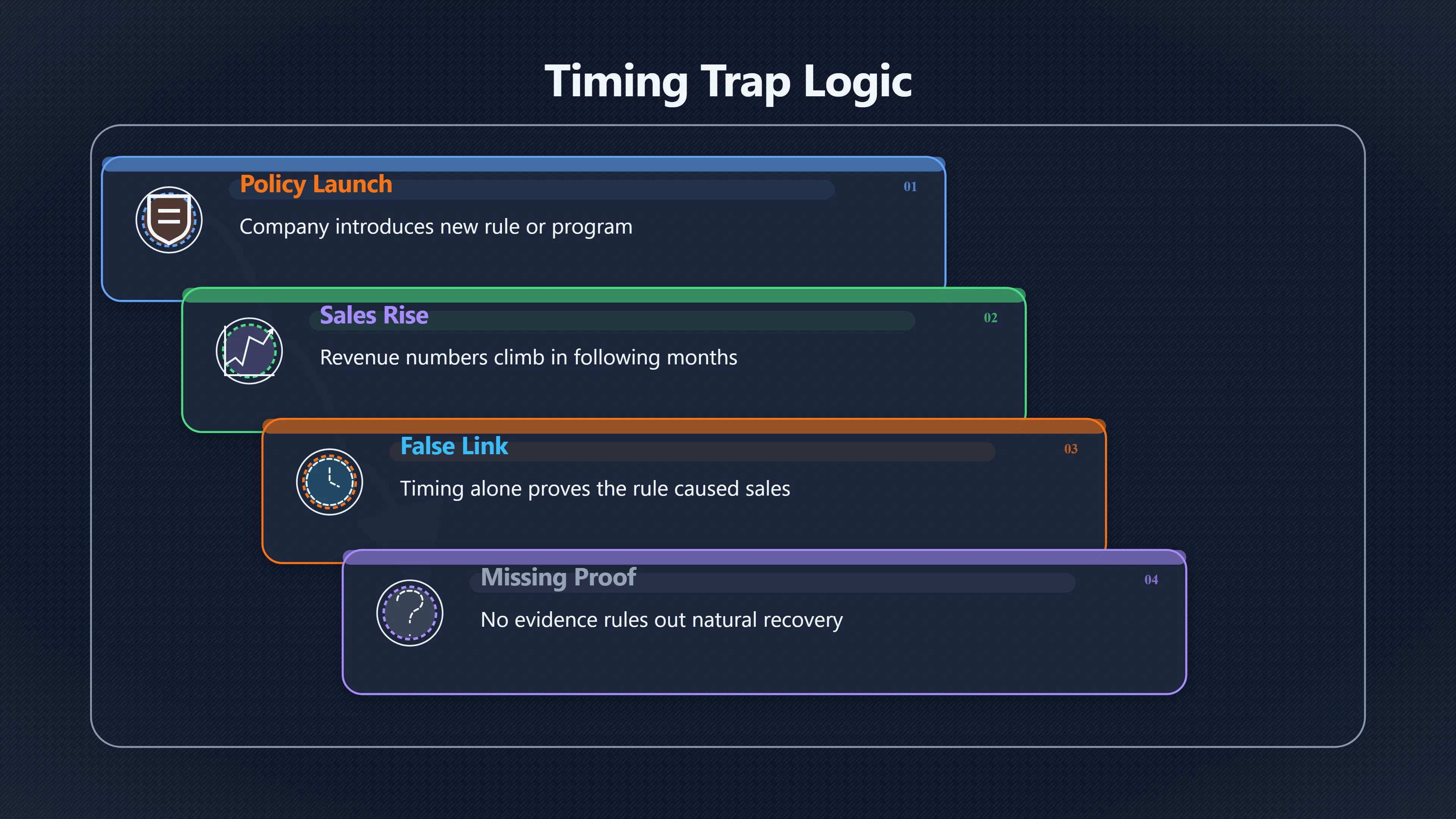
A common persuasive move is simple: something changed, then an improvement followed, so the change is presented as the cause. A company launches a new policy and sales rise. A person starts a supplement and feels better. A government introduces a programme and unemployment falls. The timeline is real, but the conclusion may not be. This is a form of the false-cause fallacy often called post hoc ergo propter hoc—“after this, therefore because of this”. The mistake is not noticing that one event happened before another; it is treating timing alone as proof of causation. Causation requires evidence that the change actually produced the outcome and that rival explanations have been addressed. Encyclopedia Britannica[PMC]pmc.ncbi.nlm.nih.govPMCPost hoc ergo propter hocNIHby L Grouse · 2016 · Cited by 10 — This faulty reasoning is the most common cause of false and misleading conclusions of researc…
 Within evidence gaps behind persuasive claims, before-and-after arguments are especially powerful because they feel intuitive. People naturally search for causes, and a clear sequence of events often feels like an explanation even when important evidence is missing.[quillbot.com]quillbot.comWhat Is Post Hoc Fallacy?Examples & DefinitionJune 26, 2024 — 26 Jun 2024 — The post hoc fallacy is a common error in reasoning in which one event is assumed to…
Why Timing Alone Does Not Prove Cause
The fact that an outcome occurred after an intervention is a necessary condition for causation, but it is not a sufficient one. If a treatment appears before recovery, that timing is compatible with the treatment causing recovery. It is also compatible with coincidence, natural recovery, measurement error, or some other factor producing the improvement.[PMC]pmc.ncbi.nlm.nih.govPMCPost hoc ergo propter hocNIHby L Grouse · 2016 · Cited by 10 — This faulty reasoning is the most common cause of false and misleading conclusions of researc…[scribbr]scribbr.compost hoc fallacyDefinition & Examples8 May 2023 — The post hoc fallacy is the assumption that because one event preceded another event, they must be caus… The core pattern looks like this:
- Condition A is introduced.
- Outcome B occurs afterwards.
- Therefore, A caused B.
The weakness lies in step three. The conclusion arrives before competing explanations have been tested. Britannica describes the post hoc fallacy as mistaking temporal sequence for causal connection.[Encyclopedia Britannica]britannica.compost hoc ergo propter hocEncyclopedia BritannicaPost hoc ergo propter hoc | fallacy13 May 2026 — Version of this fallacy, called post hoc ergo propter hoc (“after…
Consider a patient who begins a new remedy during the worst phase of an illness and improves a week later. Improvement after treatment is compatible with the remedy working. But it is also compatible with the illness following its normal course. Without additional evidence, the timeline alone cannot distinguish between these possibilities.[quillbot.com]quillbot.comWhat Is Post Hoc Fallacy?Examples & DefinitionJune 26, 2024 — 26 Jun 2024 — The post hoc fallacy is a common error in reasoning in which one event is assumed to…
This is why many dramatic testimonials are weaker evidence than they appear. A sincere report of “I did X and then I got better” demonstrates sequence, not necessarily causation.
Comparison Groups and Alternative Explanations
The strongest antidote to before-and-after reasoning is comparison. Instead of asking only what happened after a change, ask what would likely have happened without it.
The Missing Comparison Problem
Suppose a school adopts a new teaching method and average scores rise. The increase may reflect the new method. But it could also reflect an easier exam, a stronger cohort of students, changes in grading practices, additional tutoring, or broader educational trends.
A comparison group helps separate these possibilities. If similar students who did not receive the new method improved by the same amount, the case for causation becomes much weaker. If they did not improve, the causal claim becomes more credible.
The key question is not whether improvement occurred. The key question is whether improvement exceeded what would reasonably have happened anyway.
Regression Towards the Mean
One of the most overlooked alternative explanations is regression towards the mean. Extreme results often move closer to average on subsequent measurements even when no effective intervention occurs.[Wikipedia]WikipediaRegression toward the meanRegression toward the mean
Imagine a sports team changes coaches immediately after an unusually poor run of performances. Results improve soon afterwards. The improvement may be attributed to the new coach. Yet teams are most likely to replace coaches when performance is exceptionally bad, and exceptionally bad periods are often followed by less extreme ones regardless. The timing creates an attractive story, but the statistical tendency itself may explain part or all of the improvement.[Wikipedia]WikipediaRegression fallacyRegression fallacy
The same problem appears in medicine, education, business performance, and personal productivity. People often intervene when conditions are at their worst. Natural movement away from an extreme state can then be mistaken for evidence that the intervention worked.
Multiple Causes and Hidden Variables
Many outcomes have several contributing causes. Sales may increase because of advertising, seasonal demand, competitor problems, pricing changes, and economic conditions all at once. Health may improve because of treatment, rest, natural recovery, lifestyle changes, or inaccurate initial measurement.
A before-and-after claim often focuses on the most visible change while ignoring less obvious influences. Researchers describe this broader family of mistakes as questionable-cause reasoning: identifying a cause without sufficient justification.[Wikipedia]WikipediaQuestionable causeQuestionable cause
Why These Arguments Are So Persuasive
Before-and-after stories succeed because they match how people naturally understand the world. Humans are pattern-seeking. When two events occur in sequence, the mind readily constructs a narrative linking them.[quillbot.com]quillbot.comWhat Is Post Hoc Fallacy?Examples & DefinitionJune 26, 2024 — 26 Jun 2024 — The post hoc fallacy is a common error in reasoning in which one event is assumed to…
Several factors strengthen the illusion:
- Personal experience feels convincing. First-hand observation often seems more trustworthy than abstract statistics.
- Simple stories are memorable. “I changed one thing and everything improved” is easier to remember than a complex explanation involving several causes.
- Success receives more attention than failure. People often hear from those who improved after an intervention, not from those whose outcomes stayed the same.
- Coincidences are easy to overinterpret. When a positive result follows a deliberate action, the action naturally receives credit.[centerforinquiry.org]centerforinquiry.orgWhat Is The Post Hoc FallacyVaccine Fears, Correlation…6 Apr 2015 — The appearance of causation may simply be coincidence; or A may have caused B, or B may have c…
Importantly, the conclusion may occasionally be correct. The fallacy concerns the quality of the reasoning, not whether the outcome ultimately turns out to be true. A policy may genuinely have caused improvement, yet the evidence offered may still be insufficient to demonstrate that fact.[Wikipedia]WikipediaCorrelation does not imply causationCorrelation does not imply causation
Questions to Ask Before Accepting a Causal Claim
When confronted with a persuasive before-and-after argument, several questions help reveal whether the evidence supports causation.
What Else Changed?
Rarely does only one thing change. Ask whether other developments occurred around the same time that could explain the outcome.
Is There a Comparison Group?
A comparison group provides a benchmark. Without one, it is difficult to know whether the observed change was unusual or expected.
Was the Starting Point Extreme?
If the intervention occurred immediately after an exceptionally good or bad result, regression towards the mean may explain part of the apparent effect.[Wikipedia]WikipediaPost hoc ergo propter hocPost hoc ergo propter hocPost hoc ergo propter hoc is an informal fallacy that states "Because event Y followed event X, event Y must…
Could the Outcome Have Happened Anyway?
Some conditions improve naturally. Some markets recover naturally. Some trends reverse naturally. The relevant question is not whether improvement occurred but whether it occurred because of the claimed cause.
What Evidence Connects Cause to Effect?
A credible causal claim usually offers more than chronology. It may provide controlled comparisons, repeated observations, a plausible mechanism, or evidence that alternative explanations have been tested and found inadequate.[PMC]pmc.ncbi.nlm.nih.govPMCPost hoc ergo propter hocNIHby L Grouse · 2016 · Cited by 10 — This faulty reasoning is the most common cause of false and misleading conclusions of researc…
The Critical Takeaway
Before-and-after claims often sound persuasive because they provide a neat story: change first, improvement second. Yet timing alone establishes sequence, not causation. The central evidence gap is the absence of proof that the outcome would not have occurred without the intervention.
A stronger causal argument must go beyond chronology. It must address comparison groups, natural variation, regression towards the mean, competing explanations, and the possibility of coincidence. When those questions remain unanswered, “it happened after” is not the same as “it happened because of.” Encyclopedia Britannica[PMC]pmc.ncbi.nlm.nih.govPMCPost hoc ergo propter hocNIHby L Grouse · 2016 · Cited by 10 — This faulty reasoning is the most common cause of false and misleading conclusions of researc…
eBay marketplace picks
Marketplace Samples
Example marketplace items related to this page. Use the search link to explore similar finds on eBay.


Endnotes
1.
Source: britannica.com
Title: post hoc ergo propter hoc
Link:https://www.britannica.com/topic/post-hoc-ergo-propter-hoc
Source snippet
Encyclopedia BritannicaPost hoc ergo propter hoc | fallacy13 May 2026 — Version of this fallacy, called post hoc ergo propter hoc (“after...
Published: May 2026
2.
Source: pmc.ncbi.nlm.nih.gov
Title: PMCPost hoc ergo propter hoc
Link:https://pmc.ncbi.nlm.nih.gov/articles/PMC4958779/
Source snippet
NIHby L Grouse · 2016 · Cited by 10 — This faulty reasoning is the most common cause of false and misleading conclusions of researc...
3.
Source: scribbr.com
Title: post hoc fallacy
Link:https://www.scribbr.com/fallacies/post-hoc-fallacy/
Source snippet
Definition & Examples8 May 2023 — The post hoc fallacy is the assumption that because one event preceded another event, they must be caus...
Published: May 2023
4.
Source: quillbot.com
Title: What Is Post Hoc Fallacy?
Link:https://quillbot.com/blog/reasoning/post-hoc-fallacy/
Source snippet
Examples & DefinitionJune 26, 2024 — 26 Jun 2024 — The post hoc fallacy is a common error in reasoning in which one event is assumed to...
Published: June 26, 2024
5.
Source: centerforinquiry.org
Title: What Is The Post Hoc Fallacy
Link:https://centerforinquiry.org/blog/what-is-the-post-hoc-fallacy-vaccine-fears-correlation-vs-causation/
Source snippet
Vaccine Fears, Correlation...6 Apr 2015 — The appearance of causation may simply be coincidence; or A may have caused B, or B may have c...
6.
Source: Wikipedia
Title: Regression toward the mean
Link:https://en.wikipedia.org/wiki/Regression_toward_the_mean
7.
Source: Wikipedia
Title: Regression fallacy
Link:https://en.wikipedia.org/wiki/Regression_fallacy
8.
Source: Wikipedia
Title: Questionable cause
Link:https://en.wikipedia.org/wiki/Questionable_cause
9.
Source: Wikipedia
Title: Correlation does not imply causation
Link:https://en.wikipedia.org/wiki/Correlation_does_not_imply_causation
10.
Source: Wikipedia
Title: Post hoc ergo propter hoc
Link:https://en.wikipedia.org/wiki/Post_hoc_ergo_propter_hoc
Source snippet
Post hoc ergo propter hocPost hoc ergo propter hoc is an informal fallacy that states "Because event Y followed event X, event Y must...
11.
Source: study.com
Title: Post Hoc Fallacy | Definition & Examples
Link:https://study.com/learn/lesson/video/post-hoc-fallacy-overview-examples.html
Source snippet
VideoThe post hoc fallacy is a fallacy that assumes a cause-and-effect relationship without evidence. It is an argument that one event di...
12.
Source: legal-resources.uslegalforms.com
Title: post hoc ergo propter hoc
Link:https://legal-resources.uslegalforms.com/p/post-hoc-ergo-propter-hoc
Source snippet
Hoc Ergo Propter Hoc: Understanding the FallacyThe term "post hoc ergo propter hoc" is a Latin phrase that translates to "after this, the...
Additional References
13.
Source: facebook.com
Link:https://www.facebook.com/groups/ffreethinkers/posts/10157549772972188/
Source snippet
Correlation does not imply causationPost hoc ergo propter hoc fallacy: A fallacy commonly made of correlation: Causation does not necessa...
14.
Source: study.com
Link:https://study.com/learn/lesson/post-hoc-fallacy.html
Source snippet
Post Hoc, Oversimplification & Correlation Causation FallacyPost hoc is a fallacy because it suggests that one event happening before ano...
15.
Source: abi.org
Link:https://www.abi.org/feed-item/logical-fallacy-and-the-law-post-hoc-ergo-propter-hoc
Source snippet
Latin for the fallacy of reasoning of "after this, therefore because of this." This episode from West Wing assumes that at...Read more...
16.
Source: afterall.net
Title: The fallacy is committed when it is assumed that
Link:https://afterall.net/illogic/causal/post-hoc/
Source snippet
Post Hoc, or Correlation Ain't Causation | Illogic at Afterall.net1 Jan 2026 — The name in Latin, post hoc ergo propter hoc, means “after...
17.
Source: reddit.com
Title: Anyway, I am having trouble differentiating
Link:https://www.reddit.com/r/askphilosophy/comments/rzyky4/difference_between_non_causa_pro_causa_post_hoc/
Source snippet
Difference between non causa pro causa & post hoc ergo...Hello, I am in the process of reviewing [logical fallacies]({{ 'logical-fallacies/' | relative_url }}) as a reminder to find...
18.
Source: facebook.com
Link:https://www.facebook.com/ThinkingPowers/posts/fallacy-of-the-day-false-causeaka-mistaking-correlation-for-causation-post-hoc-e/498215735234044/
Source snippet
correlation equals causation. Oftentimes, correlations happen by...
19.
Source: youtube.com
Title: CRITICAL THINKING
Link:https://www.youtube.com/watch?v=5A7hSaoRv0g
Source snippet
Post Hoc Ergo Propter Hoc (Easiest 3-Minute Explanation)...
20.
Source: youtube.com
Title: Fallacies: Post Hoc Ergo Propter Hoc
Link:https://www.youtube.com/watch?v=UNuWpJODsYg
Source snippet
Correlation vs Causation Explained: Why Patterns Can Mislead Us...
21.
Source: youtube.com
Title: Correlation vs Causation Explained: Why Patterns Can Mislead Us
Link:https://www.youtube.com/watch?v=ofweqU0Lz4I
Source snippet
False Cause Fallacy Example...
22.
Source: youtube.com
Title: Post Hoc Ergo Propter Hoc (Easiest 3-Minute Explanation)
Link:https://www.youtube.com/watch?v=c9TyRXd_S7U
Source snippet
Fallacies: Post Hoc Ergo Propter Hoc...
Topic Tree