Within Informal Logic
When One Word Quietly Changes the Argument
A small change in meaning can make a weak argument look much stronger than it is.
On this page
- How equivocation makes conclusions appear to follow
- Everyday examples using natural, freedom and fairness
- Questions that pin down the operative meaning
Page outline Jump by section
Introduction
Equivocation is one of the most common language-based fallacies in everyday argument. It occurs when a key word or phrase quietly changes meaning during the course of reasoning, making a conclusion seem to follow when it does not. Rather than adding new evidence, the argument gains its force from ambiguity. Philosophers and logicians typically define equivocation as the exploitation of a term’s multiple meanings within a single argument.[stanford]plato.stanford.eduEncyclopedia of Philosophy FallaciesThe fallacy of equivocation is an argument which exploits the ambiguity of a term or phrase which has occurred at least twice in an argum… Encyclopedia of Philosophy
 This matters because many of the words people use when discussing politics, ethics, health, law, and ordinary life are flexible rather than precise. Terms such as “natural”, “freedom”, “fairness”, “choice”, and “rights” often carry several related but distinct meanings. When those meanings slide unnoticed, people can feel as though a conclusion has been proven even though the argument has merely shifted linguistic ground.[stanford]plato.stanford.eduEncyclopedia of Philosophy FallaciesThe fallacy of equivocation is an argument which exploits the ambiguity of a term or phrase which has occurred at least twice in an argum… Encyclopedia of Philosophy
How equivocation makes conclusions appear to follow
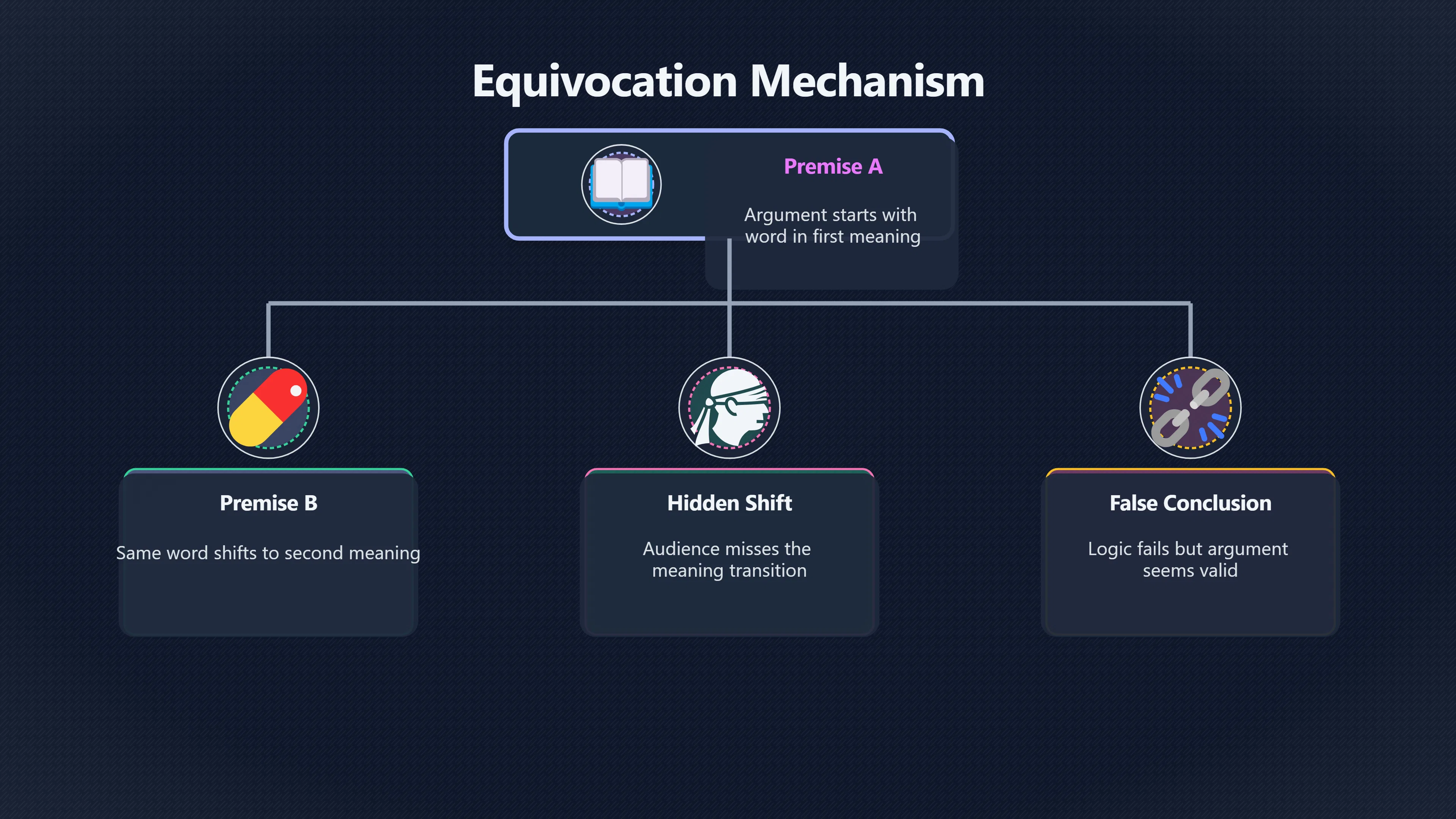
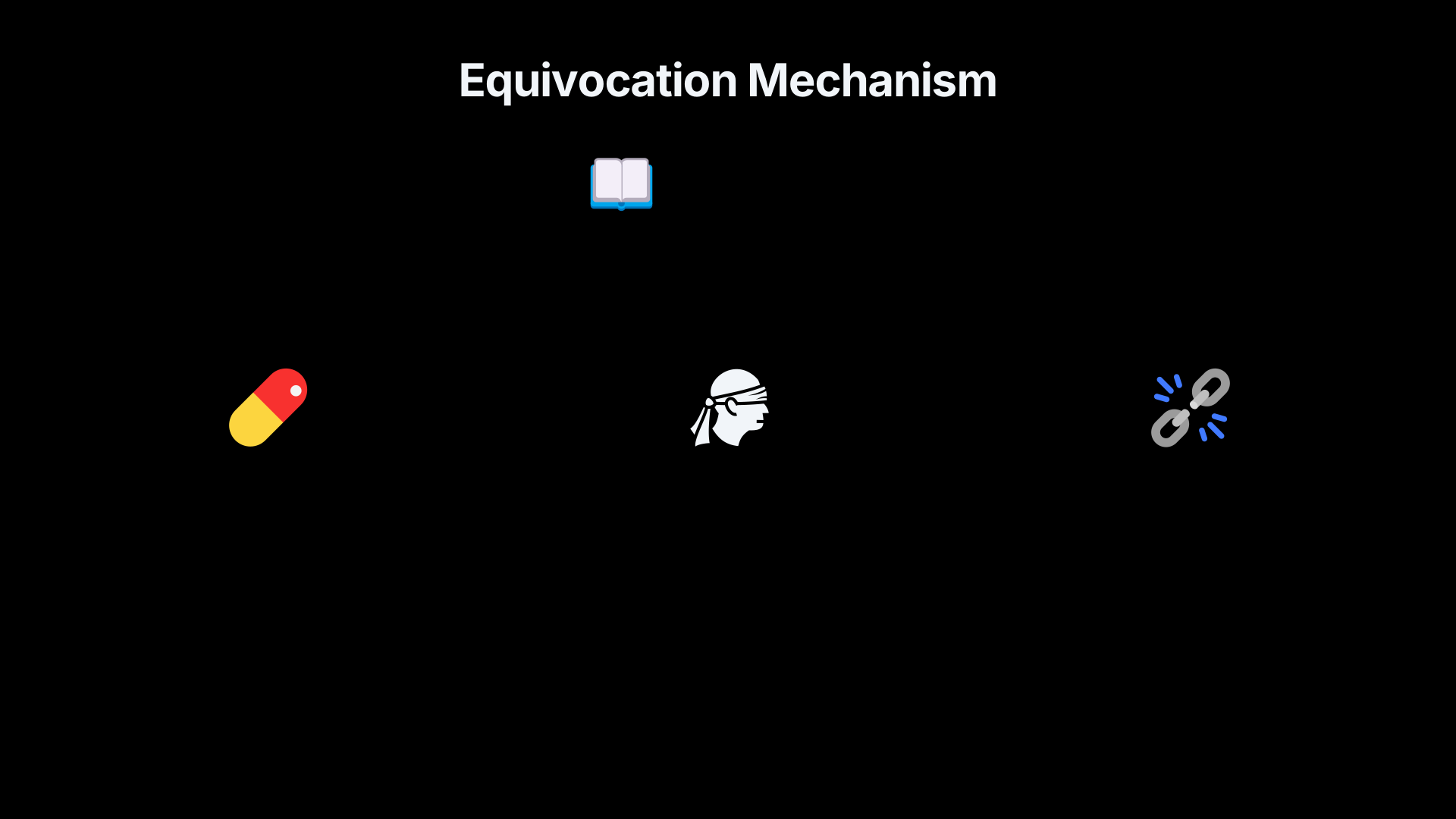
The mechanism is simple. An argument begins with a word used in one sense and ends with the same word used in another sense. Because the wording remains constant, the change can be difficult to detect.
A simplified structure looks like this:
- Premise A uses a word in Meaning 1.
- Premise B uses the same word in Meaning 2.
- The conclusion appears to connect the two premises.
- The connection succeeds only because the shift goes unnoticed.
The classic examples used in logic textbooks rely on obvious double meanings, but everyday cases are usually subtler. The meanings are often related rather than completely different. That makes the shift feel natural even when it is doing most of the argumentative work. Philosophers of language note that ambiguity and meaning variation are normal features of natural language; the problem arises when an argument depends on those variations without acknowledging them.[stanford]plato.stanford.eduEncyclopedia of Philosophy FallaciesThe fallacy of equivocation is an argument which exploits the ambiguity of a term or phrase which has occurred at least twice in an argum… Encyclopedia of Philosophy
Importantly, ambiguity itself is not a fallacy. A word can have multiple meanings without causing any reasoning error. Equivocation occurs only when the argument’s apparent validity depends on moving between those meanings.[Encyclopedia.com]encyclopedia.comFallaciesAmbiguity or vagueness is not in itself a fallacy, but it may lead to fallacy. For example, someone may move invalidly from one…
The word “natural”: from description to approval
“Natural” is a particularly fertile source of equivocation because it can mean several different things.
Consider this argument:[fallacyfiles.org]fallacyfiles.orgThe Fallacy FilesLogical Fallacy: EquivocationThe Fallacy of Equivocation occurs when an equivocal word or phrase makes an unsound argume…
- This remedy is natural.
- Natural things are safe.
- Therefore, this remedy is safe.
The first use of “natural” may simply mean “not manufactured” or “derived from plants”. The second use treats “natural” as if it means “harmless” or “beneficial”. The conclusion seems persuasive because the same word appears in both premises, but the meaning has shifted. The argument has moved from a descriptive claim about origin to an evaluative claim about safety.
Many poisonous substances are natural, while many safe medicines are synthetic. Once the two meanings are separated, the logical support disappears.
This example illustrates why equivocation is often persuasive in advertising, wellness discussions, and environmental debates. The ambiguity allows positive associations attached to one meaning of a word to migrate into another meaning without additional evidence.
The word “freedom”: different freedoms, different conclusions
Arguments about freedom frequently involve multiple concepts hidden under a single label.
Imagine the claim:
- A free society lets people make their own choices.
- This regulation limits some choices.
- Therefore, the regulation is against freedom.
At first glance the reasoning may seem straightforward. However, “freedom” can refer to many different ideas:
- Freedom from government interference.
- Freedom from coercion by private actors.
- Freedom to pursue opportunities.
- Freedom from harm or domination.
A person may begin by invoking one conception of freedom and then conclude something about another. Two speakers can therefore appear to disagree about facts when they are actually using different meanings of the same word.
The resulting debate often becomes frustrating because both sides keep appealing to “freedom” while talking about different underlying concepts. The disagreement is partly linguistic rather than purely factual.
The word “fairness”: a common source of talking past each other
Equivocation is especially common in discussions of fairness because fairness has several legitimate interpretations.
One person might mean:
- Everyone follows the same rules.
Another might mean:
- Outcomes are distributed equally.
A third might mean:
- People receive rewards proportional to effort or contribution.
Consider the argument:
- A fair system treats everyone fairly.
- This policy produces unequal outcomes.
- Therefore, the policy is unfair.
The conclusion may or may not follow depending on which meaning of fairness is being used. If fairness means equal treatment under the rules, unequal outcomes do not automatically show unfairness. If fairness means equal outcomes, the conclusion may seem stronger.
The crucial point is that the argument cannot be evaluated properly until the operative meaning of “fair” is identified. Otherwise participants may unknowingly switch between different standards of judgement.
Why equivocation often goes unnoticed
Related meanings hide the shift
The strongest cases of equivocation rarely involve completely unrelated meanings. Instead, they involve meanings that overlap.
For example, “fair” as equal treatment and “fair” as equal outcomes are connected ideas. “Freedom from interference” and “freedom to achieve goals” are also related. Because the meanings share a conceptual family resemblance, listeners may not notice the transition.[stanford]plato.stanford.eduEncyclopedia of Philosophy FallaciesThe fallacy of equivocation is an argument which exploits the ambiguity of a term or phrase which has occurred at least twice in an argum… Encyclopedia of Philosophy
Emotional associations travel with the word
Words such as “freedom”, “justice”, “science”, “common sense”, and “rights” carry emotional and cultural weight. Once a positive meaning becomes attached to a word, arguments can borrow that positive association when the meaning shifts.
The persuasive force comes not from evidence but from the audience’s favourable reaction to the term itself.

Everyday conversation rewards speed
Ordinary discussions are not conducted like formal debates. People rarely stop to define every important term. As a result, meanings can drift gradually during a conversation without attracting attention.
Research on fallacy detection in natural-language arguments highlights how difficult it can be to identify such reasoning errors precisely because they are embedded in ordinary language and context rather than explicit logical formulas.[arXiv]arxiv.orgRobust and Explainable Identification of Logical Fallacies in Natural Language ArgumentsDecember 12, 2022…
Questions that pin down the operative meaning
A practical way to expose equivocation is not to accuse someone of committing a fallacy immediately. Instead, ask clarifying questions that force the key term to become more precise.
For arguments involving “natural”:[arxiv.org]arxiv.orgRobust and Explainable Identification of Logical Fallacies in Natural Language ArgumentsDecember 12, 2022…
- Do you mean naturally occurring or inherently safe?
- How does the product’s origin establish its safety?
For arguments involving “freedom”:
- Which freedom is being discussed?
- Freedom from what, or freedom to do what?
For arguments involving “fairness”:
- Fair according to equal rules, equal opportunities, or equal outcomes?
- What standard of fairness is being applied?
More generally, useful questions include:
- What exactly does this word mean here?
- Is the word being used in the same sense throughout the argument?[khanacademy.org]khanacademy.orgFallacies: Equivocation (video) | FallaciesEquivocation occurs when the same word is used to express different meanings throughout an arg…
- Would the conclusion still follow if we replaced the ambiguous term with a more precise phrase?
Once the meanings are stated explicitly, many apparent disagreements become easier to analyse. Sometimes the argument survives clarification. Sometimes the conclusion weakens dramatically because the hidden word shift is revealed.
Spotting equivocation in everyday reasoning
Equivocation is not merely a technical mistake found in logic textbooks. It is a recurring feature of public debate, advertising, workplace discussions, family disagreements, and online arguments. The fallacy works because language is flexible and because important social concepts often have multiple legitimate meanings.[stanford]plato.stanford.eduEncyclopedia of Philosophy FallaciesThe fallacy of equivocation is an argument which exploits the ambiguity of a term or phrase which has occurred at least twice in an argum… Encyclopedia of Philosophy Wikipedia The key diagnostic question is simple: has the central word kept the same meaning throughout the argument[Wikipedia]WikipediaInformal fallacyInformal fallacyInformal fallacies are a type of incorrect argument in natural language…. Fallacies of ambiguity are perhaps best e… If the answer is no, the reasoning may owe more to a shift in language than to a genuine logical connection. Identifying that shift often reveals that what looked like a strong argument was actually two different ideas sharing the same word.[stanford]plato.stanford.eduEncyclopedia of Philosophy FallaciesThe fallacy of equivocation is an argument which exploits the ambiguity of a term or phrase which has occurred at least twice in an argum… Encyclopedia of Philosophy[2khanacademy.org]khanacademy.orgFallacies: Equivocation (video) | FallaciesEquivocation occurs when the same word is used to express different meanings throughout an arg…
Amazon book picks
Further Reading
Books and field guides related to When One Word Quietly Changes the Argument. Use these as the next step if you want deeper reading beyond the article.
Asking the Right Questions
Teaches readers to identify shifts in meaning and definitions.
eBay marketplace picks
Marketplace Samples
Example marketplace items related to this page. Use the search link to explore similar finds on eBay.

Endnotes
1.
Source: plato.stanford.edu
Title: Encyclopedia of Philosophy Fallacies
Link:https://plato.stanford.edu/entries/fallacies/
Source snippet
The fallacy of equivocation is an argument which exploits the ambiguity of a term or phrase which has occurred at least twice in an argum...
2.
Source: plato.stanford.edu
Title: Encyclopedia of Philosophy Ambiguity
Link:https://plato.stanford.edu/entries/ambiguity/
Source snippet
Stanford Encyclopedia of PhilosophyAmbiguity - Stanford Encyclopedia of Philosophyby A Sennet · 2011 · Cited by 291 — Ambiguity is import...
3.
Source: Wikipedia
Title: Informal fallacy
Link:https://en.wikipedia.org/wiki/Informal_fallacy
Source snippet
Informal fallacyInformal fallacies are a type of incorrect argument in natural language.... Fallacies of ambiguity are perhaps best e...
4.
Source: plato.stanford.edu
Title: Encyclopedia of Philosophy Ambiguity
Link:https://plato.stanford.edu/archives/spr2015/entries/ambiguity/
Source snippet
Stanford Encyclopedia of PhilosophyAmbiguity - Stanford Encyclopedia of PhilosophyMay 16, 2011 — Philosophers interest in ambiguity has l...
Published: May 16, 2011
5.
Source: encyclopedia.com
Link:https://www.encyclopedia.com/humanities/encyclopedias-almanacs-transcripts-and-maps/fallacies
6.
Source: arxiv.org
Link:https://arxiv.org/abs/2212.07425
Source snippet
Robust and Explainable Identification of [Logical Fallacies]({{ 'logical-fallacies/' | relative_url }}) in Natural Language ArgumentsDecember 12, 2022...
Published: December 12, 2022
7.
Source: arxiv.org
Link:https://arxiv.org/abs/2406.12402
8.
Source: khanacademy.org
Link:https://www.khanacademy.org/partner-content/wi-phi/wiphi-critical-thinking/wiphi-fallacies/v/fallacy-of-equivocation
Source snippet
Fallacies: Equivocation (video) | FallaciesEquivocation occurs when the same word is used to express different meanings throughout an arg...
9.
Source: Wikipedia
Link:https://en.wikipedia.org/wiki/Internet
Source snippet
InternetThe Internet carries a vast range of information services and resources, such as the interlinked hypertext documents and appli...
10.
Source: Wikipedia
Link:https://en.wikipedia.org/wiki/Equivocation
Source snippet
EquivocationIn logic, equivocation is an informal fallacy resulting in the failure to define one's terms, or knowingly and deliberatel...
11.
Source: Wikipedia
Title: List of fallacies
Link:https://en.wikipedia.org/wiki/List_of_fallacies
Source snippet
List of fallaciesA fallacy is the use of invalid or otherwise faulty reasoning in the construction of an argument. All forms of human...
12.
Source: Wikipedia
Link:https://en.wikipedia.org/wiki/Fallacy
Source snippet
FallacyA fallacy is the use of invalid or otherwise faulty reasoning in the construction of an argument that may appear to be well-rea...
13.
Source: philosophy.institute
Title: ambiguity logic root fallacies
Link:https://philosophy.institute/logic/ambiguity-logic-root-fallacies/
Source snippet
Ambiguity in Logic: The Root of Many FallaciesDec 12, 2025 — The Internet Encyclopedia of Philosophy places accent, amphiboly, and equivo...
14.
Source: philosophy.institute
Title: definitions in logic
Link:https://philosophy.institute/logic/definitions-in-logic/
Source snippet
Unraveling the Nature of Definitions in Logic14 Nov 2025 — According to the Stanford Encyclopedia of Philosophy, Aristotle directly linke...
15.
Source: web.stanford.edu
Title: Logical Fallacies
Link:https://web.stanford.edu/~jonahw/PWR1/LogicalFallacies.htm
Source snippet
FallaciesFallacies of Ambiguity · Equivocation: the same term is used with two different meanings · Amphiboly: the structure of a sentenc...
16.
Source: plato.stanford.edu
Title: category mistakes
Link:https://plato.stanford.edu/entries/category-mistakes/
Source snippet
Mistakes - Stanford Encyclopedia of Philosophyby O Magidor · 2019 · Cited by 169 — Category mistakes are sentences such as 'The number tw...
17.
Source: youtube.com
Title: Equivocation (Logical Fallacy)
Link:https://www.youtube.com/watch?v=kXlIAXx5TXE
Source snippet
Logical Fallacies - Equivocation...
18.
Source: youtube.com
Title: Logical Fallacies
Link:https://www.youtube.com/watch?v=x_8xKrKw19M
Source snippet
Learning Logic The Equivocation Fallacy..............#46...
19.
Source: seop.illc.uva.nl
Title: word meaning
Link:https://seop.illc.uva.nl/entries/word-meaning/
Source snippet
Stanford Encyclopedia of PhilosophyWord Meaningby L Gasparri · 2015 · Cited by 64 — This entry provides an overview of the way issues rel...
20.
Source: inquiresabound.wordpress.com
Link:https://inquiresabound.wordpress.com/2020/12/03/equivocation/
Source snippet
Meta/Inquires - WordPress.comDecember 3, 2020 — In, it is a fallacious argument that exploits the ambiguity of a term or phra...
Published: December 3, 2020
21.
Source: iep.utm.edu
Link:https://iep.utm.edu/fallacy/
Source snippet
utm.eduFallacies(2) Accent, Amphiboly and Equivocation are examples of fallacies of ambiguity. (3) The fallacies of illegitimate presumpt...
22.
Source: britannica.com
Link:https://www.britannica.com/topic/fallacy/Verbal-fallacies
Source snippet
Ambiguity, [Red Herring]({{ 'red-herring/' | relative_url }}), Straw ManApr 1, 2026 — These fallacies, called fallacies of ambiguity, arise when the conclusion is achieved thro...
23.
Source: britannica.com
Link:https://www.britannica.com/topic/fallacy
Source snippet
Logic, Definition & Examples13 May 2026 — An argument may be fallacious in three ways: in its material content, through a misstatement of...
Published: May 2026
24.
Source: philosophybytheway.blogspot.com
Link:https://philosophybytheway.blogspot.com/2024/05/equivocation.html
Source snippet
May 13, 2024 — The only fallacy of ambiguity I discussed is the conjunction fallacy, while I mentioned the sorites fallacy only in passin...
Published: May 13, 2024
Additional References
25.
Source: philosophypages.com
Link:https://www.philosophypages.com/lg/e06c.htm
Source snippet
Fallacies of AmbiguityThe fallacies of ambiguity all involve a confusion of two or more different senses. Equivocation. An equivocation t...
26.
Source: fallacyfiles.org
Link:https://www.fallacyfiles.org/equivoqu.html
Source snippet
The Fallacy FilesLogical Fallacy: EquivocationThe Fallacy of Equivocation occurs when an equivocal word or phrase makes an unsound argume...
27.
Source: britannica.com
Link:https://www.britannica.com/topic/equivocation
Source snippet
Encyclopedia BritannicaEquivocation | logical fallacyWhereas equivocation involves the ambiguity of a single word, amphiboly consists of...
28.
Source: youtube.com
Link:https://www.youtube.com/watch?v=t_OOqjsN36A
Source snippet
Episode 28: Ambiguity and EquivocationIn this episode, April explains linguistic ambiguity, equivocation, and the equivocation fallacy. S...
29.
Source: study.com
Title: Equivocation Fallacy | Definition & Examples
Link:https://study.com/academy/lesson/video/equivocation-fallacy-definition-examples.html
Source snippet
VideoEquivocation fallacy happens when a phrase or a word is applied with varying meanings at varying times within an argument, hence gen...
30.
Source: facebook.com
Link:https://www.facebook.com/groups/argumentativeatheists/posts/3016592855304480/
Source snippet
is used in an ambiguous way, with one meaning in one portion of the...
31.
Source: askphilosophers.org
Title: I would really like to know what logic is
Link:https://www.askphilosophers.org/question/26292
Source snippet
The Stanford...2 Mar 2017 — I would really like to know what logic is. The Stanford Encyclopedia of Philosophy has TOO MANY articles on...
32.
Source: philosophicalsociety.com
Link:https://www.philosophicalsociety.com/HTML/LogicalFallacies.html
Source snippet
For example, 1. Only man is logical. 2.Read more...
33.
Source: philosophyalevel.com
Title: informal fallacies examples
Link:https://philosophyalevel.com/posts/informal-fallacies-examples/
Source snippet
Informal Fallacies: 15 Common Examples of Faulty...31 May 2023 — The Equivocation fallacy occurs when a key term or phrase is used with...
Published: May 2023
34.
Source: quillbot.com
Title: equivocation fallacy
Link:https://quillbot.com/blog/reasoning/equivocation-fallacy/
Source snippet
What Is Equivocation Fallacy? | Examples & Definition25 Jun 2024 — The equivocation fallacy occurs when an argument's persuasiveness reli...
Topic Tree