Within Ignorance
When Does No Evidence Actually Count?
A missing trace matters only when the claim would normally leave evidence that a fair search could find.
On this page
- Expected traces and fair searches
- Weak silence versus strong silence
- Everyday examples from rain, records, and reports
Page outline Jump by section
Introduction
A common warning in discussions of logical fallacies is that “absence of evidence is not evidence of absence”. That warning is often correct, but it is incomplete. Sometimes silence really does count against a claim. The crucial question is whether the claim, if true, would normally leave traces that a fair and competent search could detect. When expected evidence fails to appear, the silence itself becomes evidence. The reasoning is not “we have not found it, therefore it is false”. Rather, it is “if this were true, we would reasonably expect to find signs of it, and those signs are missing”. Philosophers of argumentation often treat this as a legitimate, though revisable, form of reasoning rather than a simple fallacy.[Informal Logic]informallogic.caInformal Logic On Arguments from IgnoranceInformal LogicOn Arguments from Ignorance - Informal LogicMay 30, 2018 — by MD Hinton · 2018 · Cited by 15 — Abstract: The purpose of thi…
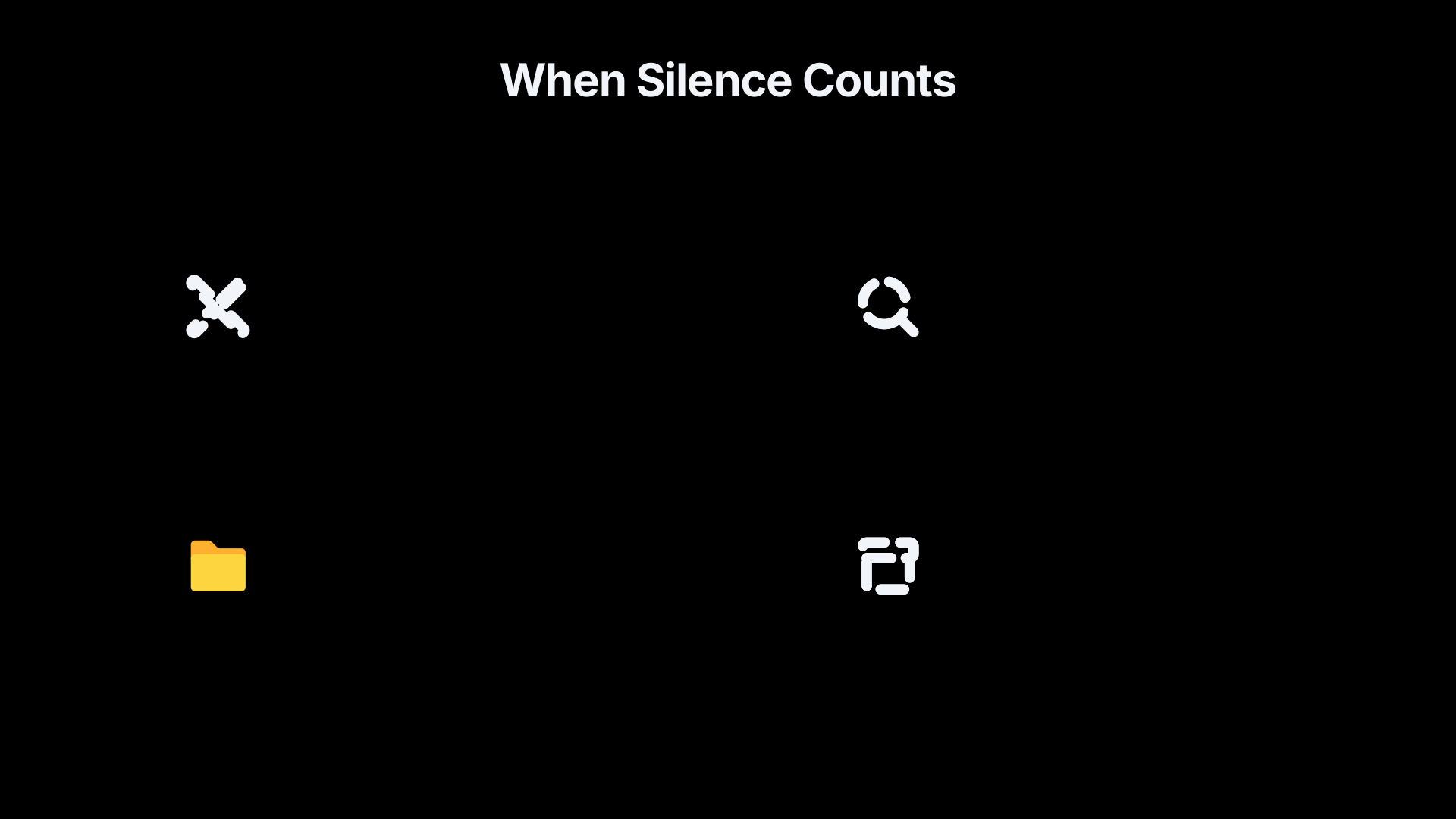 This distinction matters because appeal to ignorance becomes persuasive precisely when people fail to separate weak silence from meaningful silence.
Expected Traces and Fair Searches
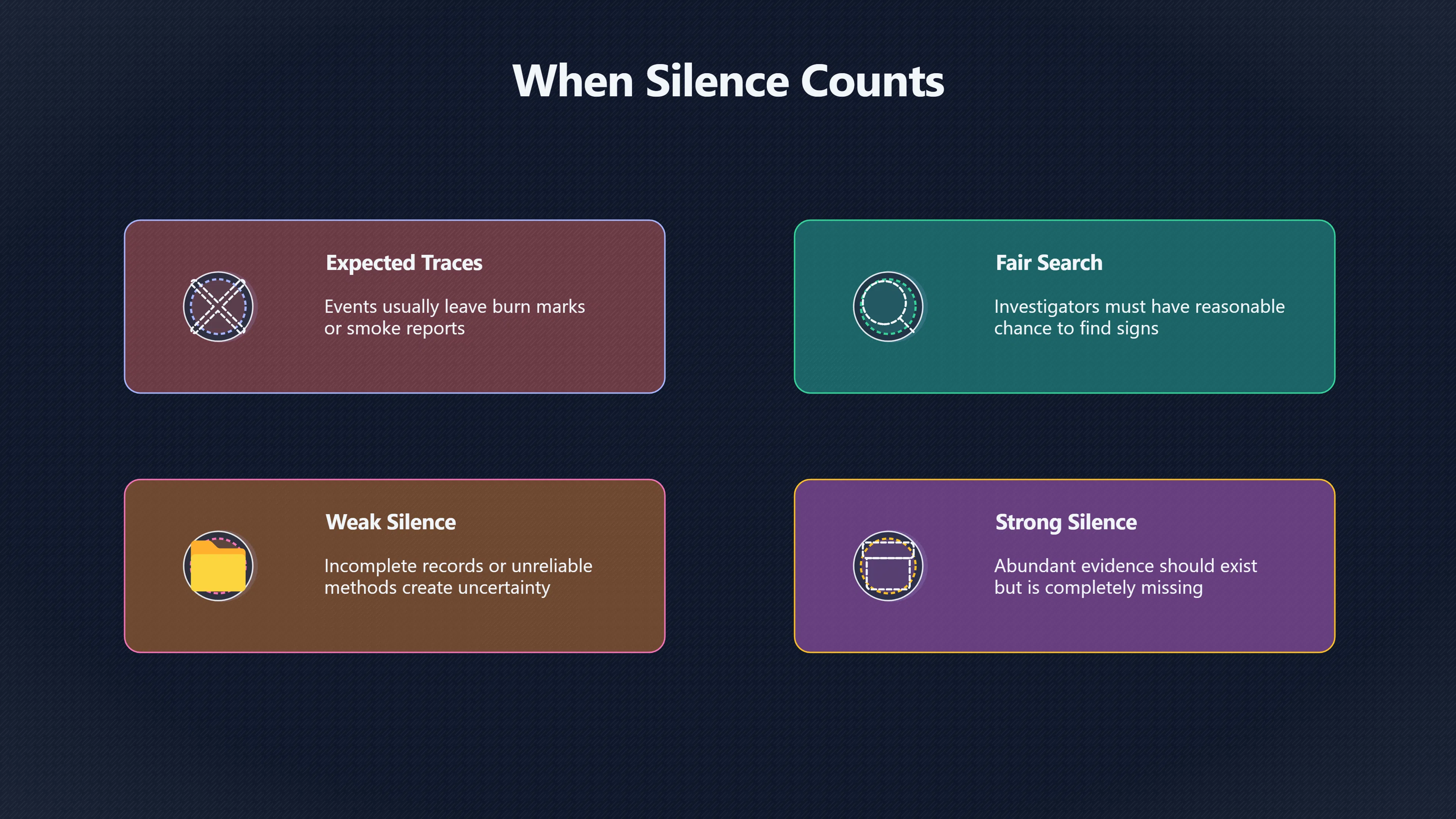
The key mechanism is simple: events, objects, and processes usually leave evidence behind.
If someone claims that a large fire swept through a neighbourhood last night, we would expect burn marks, emergency calls, smoke reports, insurance claims, photographs, or eyewitness accounts. If a thorough check finds none of these, the absence of expected traces lowers the credibility of the claim.
The reasoning depends on two conditions:
- The claim would normally generate observable evidence.
- The search had a reasonable chance of finding that evidence.
Only when both conditions are met does silence become informative.
Philosophical analyses of arguments from ignorance often describe this in terms of the completeness of the relevant evidence base. A conclusion drawn from missing evidence becomes stronger when investigators have good reason to believe that the available records, observations, or detection methods would have revealed the evidence if it existed.[Informal Logic]informallogic.caInformal Logic On Arguments from IgnoranceInformal LogicOn Arguments from Ignorance - Informal LogicMay 30, 2018 — by MD Hinton · 2018 · Cited by 15 — Abstract: The purpose of thi… PhilPapers This is why the same absence can mean very different things in different situations. No fossils from a particular period might be weak eviden[philpapers.org]philpapers.orgMartin David Hinton, On Arguments from Ignoranceby MD Hinton · 2018 · Cited by 15 — The purpose of this paper is twofold: to gi… ce if preservation conditions were poor, but much stronger evidence if the geological record is unusually complete and heavily studied. Research in philosophy of science has examined exactly this issue, asking when a missing trace should genuinely count against a hypothesis.[cambridge]cambridge.orgCambridge University Press & AssessmentWhen Should Absence of Evidence Be…by M Brewer — A common aphorism says that “absence of eviden… University Press & Assessment
Why Some Silence Matters More Than Others
Many discussions stop at the slogan that absence of evidence is not evidence of absence. Yet even advocates of that warning acknowledge an important qualification: failure to find evidence becomes significant when the evidence should have been detectable.[PMC]pmc.ncbi.nlm.nih.govPMCAbsence of evidence is not evidence of absenceNIHby M FERES · 2023 · Cited by 35 — “Absence of Evidence is not Evidence of Absence” is a quote by Carl Sagan, an American astrono…
Consider the difference between these situations:
- A rare animal is thought to live deep within a vast, unexplored rainforest.
- A rare animal is thought to live in a small, continuously monitored wildlife reserve.
Failure to find the animal in the first case tells us little. Failure to find it in the second case tells us much more.
The difference is not the claim itself. The difference is the expected visibility of the evidence.
This idea appears in scientific reasoning, legal reasoning, historical research, and everyday decision-making. The strength of the inference comes from the gap between what should be observable and what is actually observed. When that gap becomes large, silence gains evidential force.[Law Explores]lawexplores.comLaw Explores On the Absence of EvidenceLaw ExploresOn the Absence of Evidence | - Law Explorer26 Oct 2015 — Arguing from ignorance is usually taken to be a fallacy, but it can…
Weak Silence Versus Strong Silence
Not all missing evidence deserves the same weight.
Weak Silence
Silence is weak evidence when:
- Records are incomplete.
- Witnesses may be unavailable.
- Detection methods are unreliable.
- The search has been limited or superficial.
- The event might leave few traces even if it occurred.
In these circumstances, the correct conclusion is often uncertainty rather than rejection.
This is one reason scientists are cautious about interpreting null results. A study that fails to detect an effect may simply lack the power or sensitivity required to find it. Researchers have repeatedly warned that non-significant findings do not automatically demonstrate the absence of an effect.[arXiv]arxiv.orgReplication of "null results" – Absence of evidence or evidence of absence?May 8, 2023…
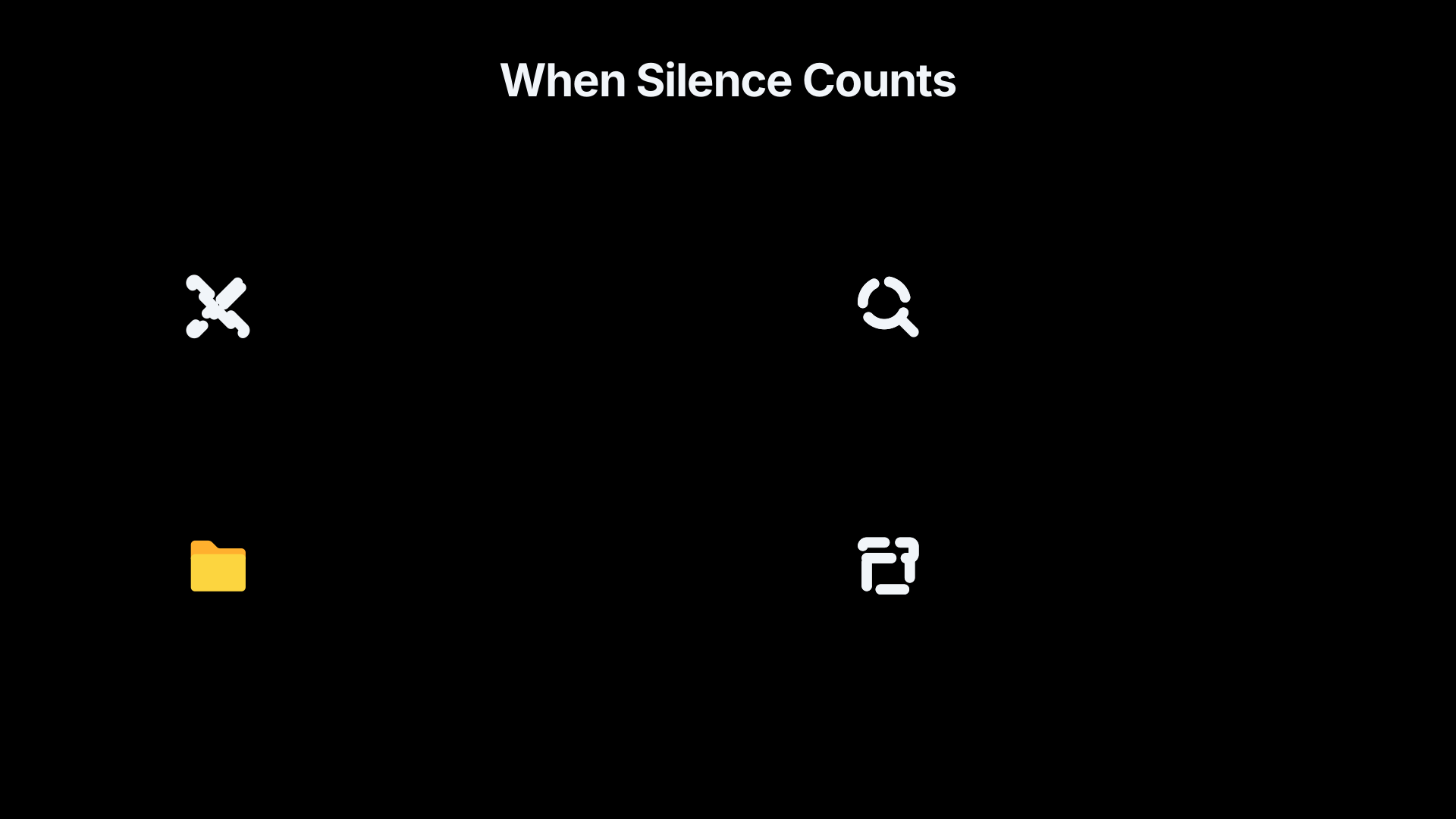
Strong Silence
Silence becomes stronger evidence when:
[evidence]iep.utm.eduepistemology, evidence is often taken to be relevant to justified belief, where the latter, in turn, is typically thought to be necessary… ce should be abundant.
- Reliable detection methods exist.
- Multiple independent searches have been conducted.
- Relevant records are expected to be complete.
- Comparable events consistently leave visible traces.
In such cases, the absence of evidence can reasonably reduce confidence in a claim.[Wikipedia]WikipediaEvidence of absenceEvidence of absenceEvidence of absence is evidence of any kind that suggests something is missing or that it does not exist…
The reasoning remains defeasible, meaning it can be overturned by new evidence, but it is no longer fallacious. Instead, it becomes a rational assessment of what the world would look like if the claim were true.[Informal Logic]informallogic.caInformal Logic On Arguments from IgnoranceInformal LogicOn Arguments from Ignorance - Informal LogicMay 30, 2018 — by MD Hinton · 2018 · Cited by 15 — Abstract: The purpose of thi…
Everyday Examples from Rain, Records, and Reports
The Rain Test
Suppose someone says that heavy rain fell overnight.
Heavy rain normally leaves puddles, wet roads, damp vegetation, drainage activity, and weather measurements. If the roads are dry, weather stations recorded nothing, and local observers noticed no rain, the silence across multiple sources becomes evidence against the claim.
The reasoning works because heavy rain is expected to leave traces.
The Missing Record
Imagine a company claims that it performed extensive safety inspections every month for years.
If such inspections occurred, there would normally be schedules, reports, signatures, emails, or archived records. When a thorough audit finds none of these, the missing paperwork becomes evidence that the inspections may not have happened.
The absence matters because the activity should have generated a documentary trail.
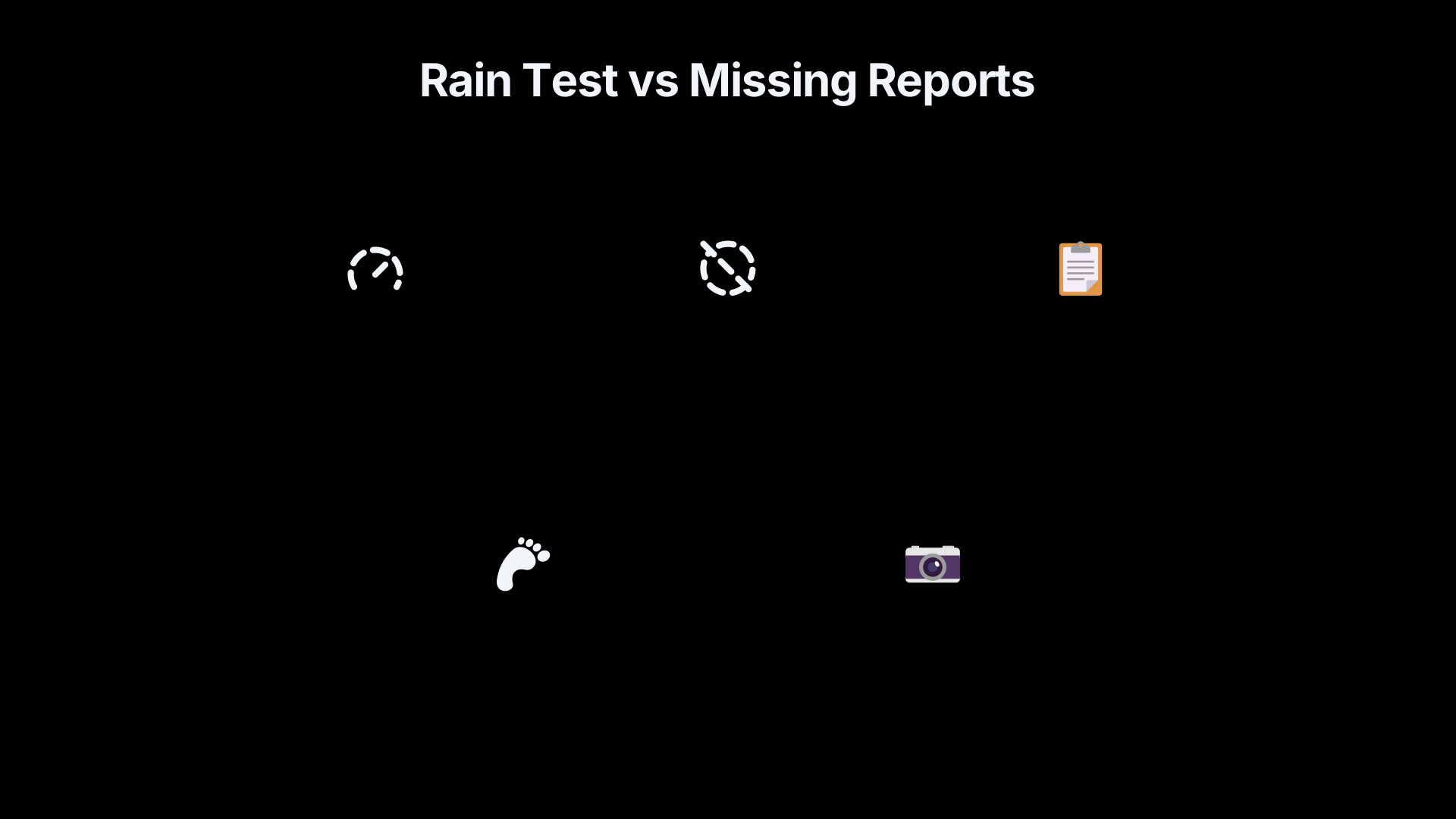
The Missing Reports
Now consider a different situation. A manager argues that there is no workplace harassment because no complaints were filed.
This silence may be weak evidence if workers fear retaliation, reporting channels are unclear, or complaints routinely disappear. In that case, the lack of reports may reveal problems with the reporting system rather than the absence of misconduct.
The same pattern of silence can therefore support very different conclusions depending on whether evidence was genuinely likely to appear.
The Silence Test
A useful way to evaluate claims is to ask four questions:
- What evidence should exist if the claim is true?
- How visible would that evidence normally be?
- Has a competent and fair search been conducted?
- Would the search probably have detected the evidence?[linkedin.com]linkedin.comPaul Crick's PostIt is evidence of absence only when the evidence, if present, would have been detected.” ~ Carl Sagan, The Demon-Haunted…
The more confidently these questions can be answered, the more informative silence becomes.
This approach avoids both extremes. It avoids the appeal to ignorance, which treats every lack of evidence as decisive. But it also avoids the opposite mistake of treating all missing evidence as irrelevant. Sometimes the world should leave footprints. When careful searching reveals none, that silence is not merely a gap in knowledge—it is part of the evidence itself.[Informal Logic]informallogic.caInformal Logic On Arguments from IgnoranceInformal LogicOn Arguments from Ignorance - Informal LogicMay 30, 2018 — by MD Hinton · 2018 · Cited by 15 — Abstract: The purpose of thi…[Law Explores]lawexplores.comLaw Explores On the Absence of EvidenceLaw ExploresOn the Absence of Evidence | - Law Explorer26 Oct 2015 — Arguing from ignorance is usually taken to be a fallacy, but it can…
Amazon book picks
Further Reading
Books and field guides related to When Does No Evidence Actually Count?. Use these as the next step if you want deeper reading beyond the article.
The Skeptics' Guide to the Universe
Explains when missing evidence should and should not influence belief.
The Art of Statistics
Discusses evidence quality and inference from incomplete information.
A Rulebook for Arguments
Useful for understanding legitimate arguments from missing evidence.
eBay marketplace picks
Marketplace Samples
Example marketplace items related to this page. Use the search link to explore similar finds on eBay.




Endnotes
1.
Source: philpapers.org
Link:https://philpapers.org/rec/HINOAF
Source snippet
Martin David Hinton, On Arguments from Ignoranceby MD Hinton · 2018 · Cited by 15 — The purpose of this paper is twofold: to gi...
2.
Source: cambridge.org
Link:https://www.cambridge.org/core/journals/philosophy-of-science/article/when-should-absence-of-evidence-be-evidence-of-absence-a-case-study-from-paleogeology/D6C43B5292B649163DE577B634CCB1AE
Source snippet
Cambridge University Press & AssessmentWhen Should Absence of Evidence Be...by M Brewer — A common aphorism says that “absence of eviden...
3.
Source: pmc.ncbi.nlm.nih.gov
Title: PMCAbsence of evidence is not evidence of absence
Link:https://pmc.ncbi.nlm.nih.gov/articles/PMC10065758/
Source snippet
NIHby M FERES · 2023 · Cited by 35 — “Absence of Evidence is not Evidence of Absence” is a quote by Carl Sagan, an American astrono...
4.
Source: arxiv.org
Link:https://arxiv.org/abs/2305.04587
Source snippet
Replication of "null results" -- Absence of evidence or evidence of absence?May 8, 2023...
Published: May 8, 2023
5.
Source: informallogic.ca
Title: [Informal Logic]({{ ‘informal-logic/’ | relative_url }}) On Arguments from Ignorance
Link:https://informallogic.ca/index.php/informal_logic/article/view/4697/4356
Source snippet
Informal LogicOn Arguments from Ignorance - Informal LogicMay 30, 2018 — by MD Hinton · 2018 · Cited by 15 — Abstract: The purpose of thi...
Published: May 30, 2018
6.
Source: lawexplores.com
Title: Law Explores On the Absence of Evidence
Link:https://lawexplores.com/on-the-absence-of-evidence/
Source snippet
Law ExploresOn the Absence of Evidence | - Law Explorer26 Oct 2015 — Arguing from ignorance is usually taken to be a fallacy, but it can...
7.
Source: plato.stanford.edu
Link:https://plato.stanford.edu/entries/fallacies/
Source snippet
Stanford Encyclopedia of Philosophyby H Hansen · 2015 · Cited by 422 — Two competing conceptions of fallacies are that they are false but...
8.
Source: plato.stanford.edu
Title: knowledge how
Link:https://plato.stanford.edu/entries/knowledge-how/
Source snippet
How - Stanford Encyclopedia of Philosophyby C Pavese · 2021 · Cited by 144 — One possesses this knowledge when one can be truly described...
9.
Source: Wikipedia
Title: Evidence of absence
Link:https://en.wikipedia.org/wiki/Evidence_of_absence
Source snippet
Evidence of absenceEvidence of absence is evidence of any kind that suggests something is missing or that it does not exist...
10.
Source: semanticscholar.org
Title: Informal Logic On Arguments from Ignorance Martin Hinton; Philosophy
Link:https://www.semanticscholar.org/paper/Informal-Logic-On-Arguments-from-Ignorance-Hinton/df9b4d3919e4d9e363f9692ac2b79467a66632db
Source snippet
The purpose of this paper is twofold: to give a good account of the argument from ignorance, with a presumptive argumentation scheme.Read...
11.
Source: scribd.com
Link:https://www.scribd.com/document/512490552/Evidence-Stanford-Encyclopedia-of-Philosophy
Source snippet
Evidence (Stanford Encyclopedia of Philosophy) | PDFAug 11, 2006 — evidence frequently depends upon one's awareness that one thing is ind...
12.
Source: quoteinvestigator.com
Link:https://quoteinvestigator.com/2019/09/17/absence/
Source snippet
Quote Origin: Absence of Evidence Is Not...17 Sept 2019 — Absence of evidence is not evidence of absence. This saying has been attribute...
13.
Source: revolutionmagik.wordpress.com
Title: the absence of evidence
Link:https://revolutionmagik.wordpress.com/2009/04/02/the-absence-of-evidence/
Source snippet
Sagan Quotes… - The Revolution is Within2 Apr 2009 — “Absence of evidence is not evidence of absence”, if you look at it simply in terms...
14.
Source: brainyquote.com
Title: Carl Sagan
Link:https://www.brainyquote.com/quotes/carl_sagan_589698
Source snippet
Absence of evidence is not evidence of..."Absence of evidence is not evidence of absence." - Carl Sagan quotes from BrainyQuote.com...
15.
Source: informallogic.ca
Link:https://informallogic.ca/index.php/informal_logic/article/view/9435/6184
Source snippet
Two-Tier Fallacy Theory: A New Approach to Assessing...by M Hinton · 2025 — The two-tier procedure reflects our point of view that a fal...
16.
Source: iep.utm.edu
Link:https://iep.utm.edu/evidence/
Source snippet
epistemology, evidence is often taken to be relevant to justified belief, where the latter, in turn, is typically thought to be necessary...
Additional References
17.
Source: logicallyfallacious.com
Link:https://www.logicallyfallacious.com/logicalfallacies/Argument-from-Ignorance
Source snippet
Argument from IgnoranceThe assumption of a conclusion or fact based primarily on lack of evidence to the contrary. Usually best described...
18.
Source: slideserve.com
Link:https://www.slideserve.com/pmcclure/on-arguments-from-ignorance-martin-hinton-university-of-d-philang-12-th-may-2017-powerpoint-ppt-presentation
Source snippet
Arguments from Ignorance: Fallacies and PresumptionsExplore the various interpretations of the argument from ignorance, including deducti...
19.
Source: azquotes.com
Link:https://www.azquotes.com/author/12883-Carl_Sagan/tag/evidence
Source snippet
Carl Sagan Quotes About EvidenceMy view is that if there is no evidence for it, then forget about it. An agnostic is somebody who doesn't...
20.
Source: medium.com
Link:https://medium.com/%40mnemko/carl-sagan-albert-einstein-and-neil-degrasse-tyson-in-conversation-eed5504f5daa
Source snippet
Carl Sagan, Albert Einstein, and Neil deGrasse Tyson in “...Sagan: Extraordinary claims require extraordinary evidence…Absence of eviden...
21.
Source: linkedin.com
Link:https://www.linkedin.com/posts/paulcrick_absence-of-evidence-is-not-evidence-of-absence-activity-7337158953690099712-zuDJ
Source snippet
Paul Crick's PostIt is evidence of absence only when the evidence, if present, would have been detected.” ~ Carl Sagan, The Demon-Haunted...
22.
Source: facebook.com
Title: absence of evidence is not evidence of absence carl sagan the dragons of eden 19
Link:https://www.facebook.com/TheUniverseofCarl/posts/absence-of-evidence-is-not-evidence-of-absence-carl-sagan-the-dragons-of-eden-19/1547102566362036/
Source snippet
Carl Sagan, The Dragons of Eden (1977)"My view is that if there is no evidence for it, then forget about it. An agnostic is somebody who...
23.
Source: ora.ox.ac.uk
Title: ox.ac.uk Stanford Encyclopedia of Philosophy
Link:https://ora.ox.ac.uk/objects/uuid%3A81c457fb-231d-4836-8afd-7e0ce1cbc1d5/files/m1773d2e599b4517d74a3899f82626f2e
Source snippet
Encyclopedia of Philosophy - Conscienceby A Giubilini · 2016 · Cited by 109 — b) The “argument from ignorance”, which might be better lab...
24.
Source: merriam-webster.com
Title: ABSENC E Definition & Meaning6 days ago — 1
Link:https://www.merriam-webster.com/dictionary/absence
Source snippet
a state or condition in which something expected, wanted, or looked for is not present or does not exist: a state or condition in which...
25.
Source: blog.blueprintprep.com
Title: flawctober the absence of evidence fallacy
Link:https://blog.blueprintprep.com/lsat/flawctober-the-absence-of-evidence-fallacy/
Source snippet
Carl Sagan's quote, “Absence of Evidence does not mean Evidence of Absence” can be simplified to mean that the lack of evidence for the e...
26.
Source: plato.stanford.edu
Link:https://plato.stanford.edu/archives/win2011/entries/epistemology/
Source snippet
Stanford Encyclopedia of PhilosophyDec 14, 2005 — Defined narrowly, epistemology is the study of knowledge and justified belief...
Topic Tree