Within Fallacy Lab
When Personal Attacks Replace Reasons
Ad hominem arguments shift attention from the claim to the person, often making disagreement less rational.
On this page
- Relevant character evidence
- Irrelevant insults
- Online debate examples
Page outline Jump by section
Introduction
Ad hominem attacks are arguments that move attention away from the claim and towards the person making it. The basic error is not simply being rude. It is treating some personal fact, insult, motive or association as if it settles the truth of the disputed point. In a debate about evidence, policy, science or ethics, that shift can make disagreement less rational because the audience is invited to judge the speaker instead of testing the reasons.
This matters because personalised debate is often persuasive even when it is logically weak. A claim may be false, but it is not false because the person making it is irritating, hypocritical, unpopular, badly dressed, young, old, rich, poor or politically disliked. At the same time, not every reference to a person is fallacious: credibility, expertise, conflicts of interest and testimony can sometimes be relevant. The practical skill is to ask whether the personal information genuinely bears on the argument, or merely distracts from it.
What an ad hominem attack does to an argument
An ad hominem move changes the subject. Instead of answering “Is this claim well supported?”, it answers a different question: “What do we think of the person making it?” The Stanford Encyclopedia of Philosophy describes ad hominem fallacies as cases where negative aspects of an arguer or their situation are brought to bear on the view they are advancing, while the Internet Encyclopedia of Philosophy classifies common variants as abusive, circumstantial and guilt-by-association attacks.[stanford]plato.stanford.eduEncyclopedia of Philosophy FallaciesThe ad hominem fallacy involves bringing negative aspects of an arguer, or their situation, to bear on the view they are advancing. There… Encyclopedia of Philosophy
The pattern is easy to miss because the personal remark may feel connected to the topic. For example: “You cannot trust her view on housing policy; she owns several properties.” That may raise a legitimate question about interests or bias, but it does not by itself show that her figures are wrong, her inference is invalid or her policy proposal would fail. To become a sound objection, the criticism must connect the personal circumstance to a specific weakness in the evidence or reasoning.
The clearest fallacious form looks like this:
- Person A makes claim X.
- Person B points to a disliked trait, motive, past action or association of A.
- Person B concludes that X is false, unserious or not worth answering.
The failure is in step three. Even an untrustworthy person can make a true claim. Even a hypocrite can give good advice. Even a biased source can cite accurate data. The personal criticism may affect how carefully we check the claim, but it does not replace checking the claim.
Relevant character evidence is not the same as an irrelevant insult
A common misunderstanding is that “ad hominem” means “any personal criticism”. That is too crude. Argumentation scholars have long noted that personal facts can be relevant when the discussion depends on trust, expertise, testimony or role-specific judgement. Stanford’s entry on informal logic gives ad hominem as a case where criticism of an arguer can, in principle, be a reasonable way to cast doubt on a view, depending on the critical questions asked.[stanford]plato.stanford.eduEncyclopedia of Philosophy FallaciesThe ad hominem fallacy involves bringing negative aspects of an arguer, or their situation, to bear on the view they are advancing. There… Encyclopedia of Philosophy
The difference is easiest to see in testimony. If a witness is giving evidence, their reliability may matter. Legal evidence rules often allow credibility to be attacked or supported in limited ways, especially where the evidence concerns truthfulness rather than general dislike. For instance, Minnesota’s Rule 608 states that witness credibility may be attacked or supported by opinion or reputation evidence, but only as it relates to character for truthfulness or untruthfulness.[MN Revisor's Office]revisor.mn.govRevisor's Office Rule 608Evidence of Character and Conduct of WitnessAugust 6, 2025 — Rule 608. Evidence of Character and Conduct of Witness. (a) Opinion and rep…
That logic does not transfer automatically to every debate. A scientist’s funding source, a politician’s financial interest or an expert’s disciplinary competence may be relevant because they bear on possible bias, access to evidence or reliability. But “this person is arrogant”, “that speaker is ugly”, “she once made a mistake in another context” or “he belongs to a group I dislike” usually does no argumentative work. It may change the mood of the debate, but it does not test the claim.
A useful distinction is:
- Relevant credibility challenge: “This witness has a documented history of falsifying evidence in similar cases, so their testimony needs corroboration.”
- Irrelevant personal attack: “This witness is an unpleasant person, so their account is false.”
- Relevant conflict-of-interest question: “This expert is paid by the company whose product they are defending, so we should examine independent evidence too.”
- Fallacious dismissal: “This expert is paid by the company, so everything they say is automatically false.”
The first and third examples invite closer scrutiny. The second and fourth try to end scrutiny.
The main forms of personalised fallacy
Ad hominem attacks come in several forms, and each fails in a slightly different way. The Internet Encyclopedia of Philosophy’s taxonomy is useful because it separates insults, circumstances and associations rather than treating all personal attacks as one thing.[Internet Encyclopedia of Philosophy]iep.utm.eduInternet Encyclopedia of PhilosophyFallaciesIf the fallacious attack points out some despicable trait of the arguer, it also may be calle…
Abusive ad hominem attacks a person’s character or qualities instead of answering the claim. “Only an idiot would support that tax proposal” is not an argument against the proposal. It may signal contempt, but it supplies no reason about revenue, fairness, incentives or consequences.
Circumstantial ad hominem points to the person’s circumstances, interests or position. This is not always irrelevant, but it becomes fallacious when the circumstance is used as a shortcut to rejection. “You work for a teachers’ union, so your argument about school funding is wrong” does not address the data or reasoning. A better version would be: “Because you represent a group affected by this policy, we should compare your figures with independent sources.”
Tu quoque, often summarised as “you too”, rejects advice or criticism because the speaker does not live up to it. Stanford gives the example of rejecting advice to exercise because the person giving it does not exercise; the adviser may be inconsistent, but that does not show the advice is bad.[stanford]plato.stanford.eduEncyclopedia of Philosophy FallaciesThe ad hominem fallacy involves bringing negative aspects of an arguer, or their situation, to bear on the view they are advancing. There… Encyclopedia of Philosophy
Guilt by association dismisses a claim because the speaker is linked, loosely or strongly, to a disliked person or group. This can be rhetorically powerful because it lets an audience import a whole set of negative feelings without examining whether the association is meaningful. It is especially weak when the link is vague, old, involuntary, exaggerated or unrelated to the argument.
Why personal attacks can feel persuasive
Ad hominem attacks work because they exploit a real feature of human judgement: we often rely on source credibility when we cannot personally verify every claim. In everyday life that shortcut is necessary. We do not independently test every medical, legal, scientific or technical statement we hear. We ask whether the source seems competent, honest and accountable.
The problem is that the shortcut can be hijacked. A personal attack offers the emotional satisfaction of a verdict without the work of analysis. It can make the speaker look exposed, suspect or ridiculous before their evidence has been considered. Experimental research on science communication found that ad hominem attacks against scientists can reduce evaluations of scientific claims, with effects comparable to attacks on the empirical basis of the claims themselves.[PMC]pmc.ncbi.nlm.nih.govSource details in endnotes.
That finding is important because it shows why the fallacy is not merely a classroom mistake. If a personal attack can lower confidence in a claim as much as a substantive critique, then audiences may leave a debate feeling that “something has been answered” when the actual evidence remains untouched.
The effect is especially strong when the attack fits an existing suspicion: “the expert is corrupt”, “the activist is hysterical”, “the journalist is biased”, “the opponent is elitist”, “the critic is jealous”. These labels reduce a complex argument to a social identity. Once that happens, the audience may stop asking whether the claim is true and start asking which side the person belongs to.
Online debate makes ad hominem easier to spread
Personalised debate is not new, but online platforms make it faster, cheaper and more visible. A short insult travels more easily than a careful rebuttal. A quote-post can frame a person as foolish before readers click through. A pile-on can turn one weak personal remark into a social signal: “everyone knows this person is not worth taking seriously.”
Empirical work on web argumentation has tried to measure this pattern rather than merely complain about it. A 2018 NAACL paper on “Before Name-calling” used large-scale annotation studies to examine the dynamics and triggers of ad hominem fallacies in web argumentation, noting that people lapse into personal attacks even in debate settings where fallacies are formally punished.[ACL Anthology]aclanthology.orgSource details in endnotes.
Later research on CreateDebate, an online debate forum, used machine-learning detection and manual validation across 265,000 arguments. The authors reported that 31.23% of the analysed content contained ad hominem fallacy, and that highly active users posted significantly more ad hominem content in ways the paper associated with suppressing opposing views.[arXiv]arxiv.orgSource details in endnotes.
These studies should not be read as proving that every heated online comment is an ad hominem fallacy. Detection depends on definitions, annotation choices and platform context. But they do support a practical point: online debate environments can reward personalised moves because they are brief, emotionally legible and socially contagious.
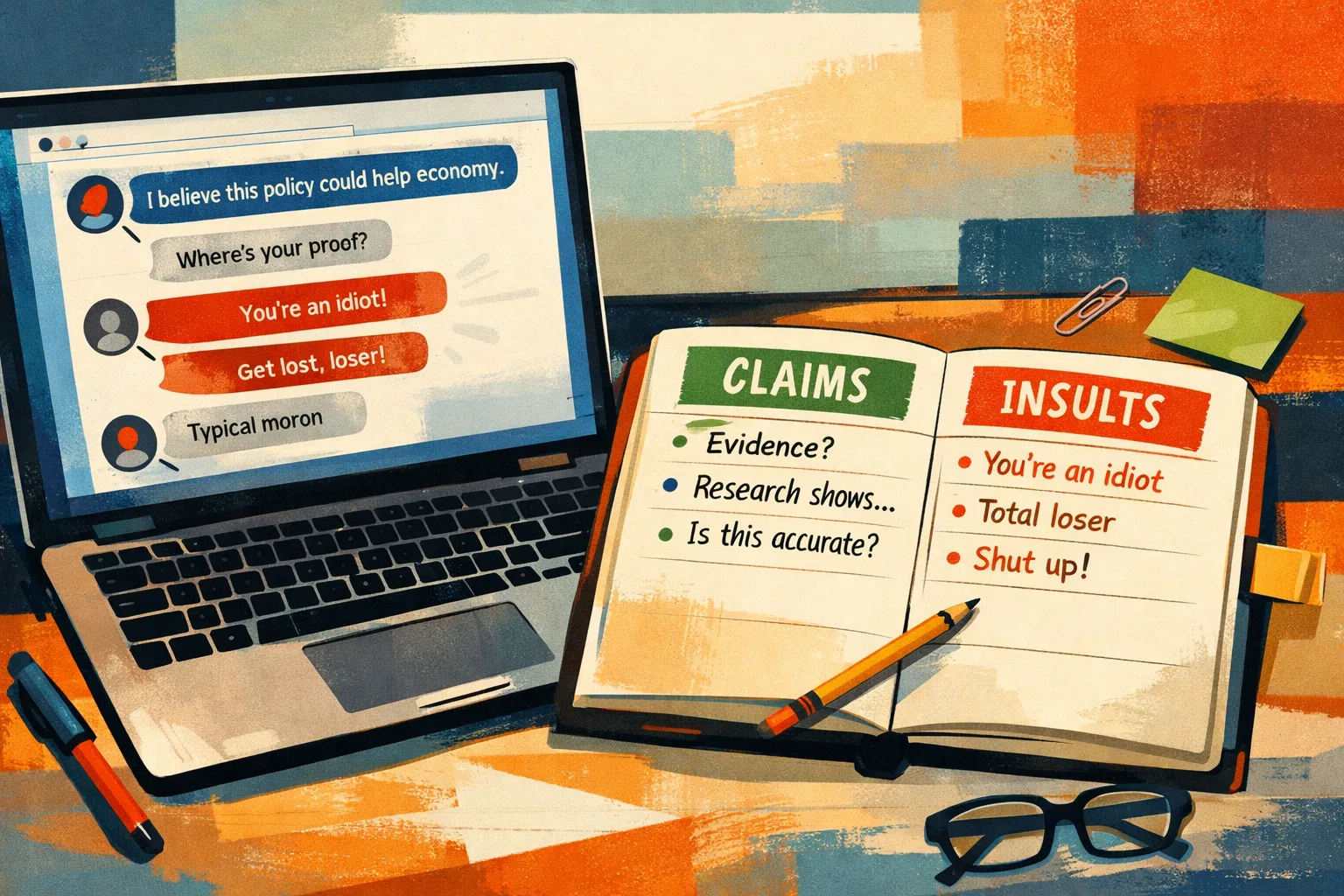
Online debate examples: what changes when the attack becomes personal
A good test is to rewrite a personalised reply into a claim-focused reply and notice what becomes clearer.
Example 1: Expertise without argument
Personalised version: “You are not a doctor, so your view on the vaccine is worthless.”
Better version: “This is a medical claim, so we should rely on clinical trial data, regulator summaries and qualified medical expertise rather than unsupported personal interpretation.”
The first version may sometimes point towards a real issue of expertise, but it overstates the case. Non-doctors can accurately report evidence, and doctors can be wrong outside their competence. The improved version names the standard of evidence.
Example 2: Hypocrisy without refutation
Personalised version: “You say people should fly less, but you flew to a conference last year. Hypocrite.”
Better version: “Your own behaviour may weaken your moral authority, but the emissions argument still depends on the climate evidence and the policy trade-offs.”
Here the hypocrisy point may matter to trust or leadership, but it does not settle the factual claim about emissions.
Example 3: Bias without evidence
Personalised version: “Of course you support rent controls; you are a tenant.”
Better version: “Because tenants have a direct interest in this policy, let us compare tenant testimony with landlord data, housing supply research and evidence from cities that have used rent controls.”
The better version does not pretend interests are irrelevant. It prevents interests from becoming a substitute for analysis.
Example 4: Insult as dismissal
Personalised version: “Only a fool would think that.”
Better version: “The problem with that argument is that the conclusion does not follow from the evidence you gave.”
This is the cleanest case: the insult adds nothing. It merely raises the temperature.
The climate debate shows why character attacks can distort public reasoning
Public science debates offer a concrete example of how ad hominem tactics can move attention from evidence to identity. Research on climate misinformation has found that attacks on scientists’ motives, competence or character are a recurring strategy in efforts to undermine climate science. A 2024 Climate Policy article by Sergei Samoilenko and John Cook developed a typology for classifying climate-related ad hominem attacks and found that bias attacks, such as accusing climate scientists of ideological or political agendas, were especially common.[Taylor & Francis Online]tandfonline.comSource details in endnotes.
This matters because the target is not just an individual reputation. If the audience is persuaded that a scientist is corrupt or politically motivated, they may dismiss the evidence before asking what the measurements show, whether the method is sound or whether independent studies agree. A related article in American Behavioral Scientist describes ad hominem attacks against climate scientists as including personal attacks on character, competence or motives, and treats them as a central contrarian strategy in contemporary climate debates.[Sage Journals]journals.sagepub.comSource details in endnotes.
The same pattern appears in journalism about online abuse of climate scientists and environmental defenders. Reports have described personal attacks, denigration, harassment and threats directed at people communicating climate information, with concern that such hostility can discourage public participation and distort understanding of the science.[The Guardian]theguardian.comStudies noted that this abuse impacts public perception, particularly of Spain's state meteorological agency (Aemet), and can dissuade sc…
The fallacy here is not that scientists are beyond criticism. Scientific claims should be challenged through evidence, methods, replication, uncertainty and peer review. The fallacy occurs when personal suspicion is used to bypass that work.
How to respond without making the debate even more personal
The most effective response to an ad hominem attack is usually not a counter-insult. A counter-insult confirms the new frame: the debate is now about personalities. A better response is to separate any relevant credibility issue from the claim itself.
A practical reply can use three moves:
- Acknowledge only what is relevant. “My background may be relevant to potential bias, so it is fair to ask for sources.”
- Return to the claim. “The specific claim is that the policy reduced waiting times by 12%; here is the dataset.”
- Ask for a reasoned objection. “Which part of the evidence or inference do you think is wrong?”
This works because it does not deny that people can have biases, motives or credibility problems. It simply refuses to let those issues replace the argument. It also avoids the trap of treating “ad hominem” as a magic word that automatically wins the exchange. Sometimes the other person has raised a fair concern about expertise, conflict of interest or reliability; the answer is to clarify relevance, not to shut down scrutiny.
A useful rule for readers is: if the personal information is true, would it still show that the claim is false? If not, it may justify caution, corroboration or further questioning, but not dismissal.
The real risk is not offence, but lost reasons
Ad hominem attacks are often discussed as a problem of civility, and civility does matter. Personal attacks can humiliate participants, polarise groups and make people less willing to speak. But the deeper logical risk is that they replace reasons with reputational shortcuts.
A debate can be polite and still fallacious if it quietly invites readers to distrust a person instead of examining a claim. A debate can also be blunt and still rational if the criticism is tied to relevant evidence. The question is not “Was someone offended?” but “Did the personal point help us evaluate the argument?”
That distinction keeps fallacy-spotting from becoming another personalised weapon. The aim is not to accuse opponents of “doing ad hominem” as a way to silence them. The aim is to protect the central task of argument: giving reasons that actually bear on the conclusion.
Amazon book picks
Further Reading
Books and field guides related to When Personal Attacks Replace Reasons. Use these as the next step if you want deeper reading beyond the article.
A Rulebook for Arguments
Directly addresses keeping arguments focused on reasons rather than people.
eBay marketplace picks
Marketplace Samples
Example marketplace items related to this page. Use the search link to explore similar finds on eBay.





Endnotes
1.
Source: plato.stanford.edu
Title: Encyclopedia of Philosophy Fallacies
Link:https://plato.stanford.edu/entries/fallacies/
Source snippet
The ad hominem fallacy involves bringing negative aspects of an arguer, or their situation, to bear on the view they are advancing. There...
2.
Source: plato.stanford.edu
Title: Encyclopedia of Philosophy Informal Logic
Link:https://plato.stanford.edu/entries/logic-informal/
Source snippet
Stanford Encyclopedia of PhilosophyInformal Logic - Stanford Encyclopedia of Philosophyby L Groarke · 1996 · Cited by 97 — Ad hominem is...
3.
Source: pmc.ncbi.nlm.nih.gov
Link:https://pmc.ncbi.nlm.nih.gov/articles/PMC5790247/
4.
Source: arxiv.org
Link:https://arxiv.org/abs/2209.02062
5.
Source: plato.stanford.edu
Title: logic informal
Link:https://plato.stanford.edu/archives/sum2002/entries/logic-informal/
6.
Source: web.stanford.edu
Title: [Logical Fallacies]({{ ‘logical-fallacies/’ | relative_url }})
Link:https://web.stanford.edu/~jonahw/PWR1/LogicalFallacies.htm
7.
Source: arxiv.org
Link:https://arxiv.org/abs/1802.06613
8.
Source: philosophy.institute
Title: understanding fallacies reasoning errors
Link:https://philosophy.institute/logic/understanding-fallacies-reasoning-errors/
9.
Source: iep.utm.edu
Link:https://iep.utm.edu/fallacy/
Source snippet
Internet Encyclopedia of PhilosophyFallaciesIf the fallacious attack points out some despicable trait of the arguer, it also may be calle...
10.
Source: revisor.mn.gov
Title: Revisor’s Office Rule 608
Link:https://www.revisor.mn.gov/court_rules/rule/ev-608/pdf/
Source snippet
Evidence of Character and Conduct of WitnessAugust 6, 2025 — Rule 608. Evidence of Character and Conduct of Witness. (a) Opinion and rep...
Published: August 6, 2025
11.
Source: aclanthology.org
Link:https://aclanthology.org/N18-1036/
12.
Source: tandfonline.com
Link:https://www.tandfonline.com/doi/abs/10.1080/14693062.2023.2245792
13.
Source: journals.sagepub.com
Link:https://journals.sagepub.com/doi/abs/10.1177/00027642241240352?amp%3Baf=R%2Fsergei+a.+samoilenko%2F&mi=ehikzz
14.
Source: theguardian.com
Link:https://www.theguardian.com/world/2026/jan/15/spain-climate-scientists-subjected-alarming-rise-hate-speech-minister-warns
Source snippet
Studies noted that this abuse impacts public perception, particularly of Spain's state meteorological agency (Aemet), and can dissuade sc...
15.
Source: theguardian.com
Link:https://www.theguardian.com/environment/2025/jul/16/death-threats-online-abuse-land-climate-defenders
16.
Source: Wikipedia
Title: Ad hominem
Link:https://en.wikipedia.org/wiki/Ad_hominem
17.
Source: ebsco.com
Link:https://www.ebsco.com/research-starters/religion-and-philosophy/ad-hominem
18.
Source: informallogic.ca
Link:https://informallogic.ca/index.php/informal_logic/article/view/2990/2442
19.
Source: legal-resources.uslegalforms.com
Title: ad hominem
Link:https://legal-resources.uslegalforms.com/a/ad-hominem
20.
Source: britannica.com
Link:https://www.britannica.com/topic/ad-hominem
21.
Source: philosophy.lander.edu
Link:https://philosophy.lander.edu/logic/person.html
22.
Source: psychologyfanatic.com
Title: ad hominem attacks
Link:https://psychologyfanatic.com/ad-hominem-attacks/
23.
Source: rpmministries.org
Title: ad hominem attacks
Link:https://rpmministries.org/2025/07/ad-hominem-attacks/
24.
Source: finmasters.com
Title: ad hominem fallacy
Link:https://finmasters.com/ad-hominem-fallacy/
Additional References
25.
Source: youtube.com
Link:http://www.youtube.com/watch?v=-gm-GMIjNpo
Source snippet
How to handle ad hominem attacks debate fallacies Mastering the Ad Hominem: Defend Against Logical Fallacies Dre “DreAllDay” Baldwin...
26.
Source: youtube.com
Title: Mastering the Ad Hominem: Defend Against Logical Fallacies
Link:http://www.youtube.com/watch?v=oEtWVduI1UE
Source snippet
What is an Ad Hominem Attack? | Argument Clinic | WIRED...
27.
Source: youtube.com
Title: What is an Ad Hominem Attack? | Argument Clinic | WIRED
Link:http://www.youtube.com/watch?v=F5CMW2XBH6I
Source snippet
CRITICAL THINKING - Fallacies: Ad Hominem [HD]...
28.
Source: academia.edu
Link:https://www.academia.edu/33339443/Ad_Hominem_Argument
29.
Source: researchgate.net
Link:https://www.researchgate.net/publication/379375006_Developing_a_Critical_Response_to_Ad_Hominem_Attacks_Against_Climate_Science
30.
Source: researchgate.net
Link:https://www.researchgate.net/publication/234742765_Use_of_Ad_Hominem_Argument_in_Political_Discourse
31.
Source: crankyuncle.com
Link:https://crankyuncle.com/wp-content/uploads/2023/08/Samoilenko_2023_ad_hom.pdf
32.
Source: fee.org
Link:https://fee.org/articles/5-reasons-to-avoid-ad-hominem-arguments/
33.
Source: facebook.com
Link:https://www.facebook.com/chescaleigh/posts/a-straw-man-argument-is-a-logical-fallacy-where-someone-misrepresents-exaggerate/1414033030078701/
34.
Source: amazon.co.uk
Link:https://www.amazon.co.uk/Hominem-Arguments-Studies-Rhetoric-Communication/dp/0817355618
Topic Tree