Within Wet Pavement
Why If P Then Q Does Not Reverse
A conditional promise only runs one way unless the statement also says the outcome cannot happen any other way.
On this page
- What a conditional statement actually guarantees
- How reversing the arrow changes the claim
- Simple tests for spotting the invalid move
Page outline Jump by section
Introduction
A conditional statement such as “if P, then Q” makes a specific promise: whenever P is true, Q will also be true. What it does not automatically promise is the reverse. The reasoning pattern “Q is true, therefore P is true” commits the logical fallacy known as affirming the consequent. This mistake sits at the heart of many examples of flawed reasoning, including the familiar wet-pavement argument: “If it rains, the pavement gets wet. The pavement is wet. Therefore it rained.” The conclusion may be correct, but it does not logically follow from the premises because there may be other ways for the pavement to become wet. In formal logic, this is a recognised invalid argument form.[Encyclopedia Britannica]britannica.comEncyclopedia BritannicaAffirmation of the consequent | logicIn applied logic: Formal fallacies …B; not-A; therefore, not-B”) and affirmin…[Wikipedia]WikipediaAffirming the consequentAffirming the consequent
What a Conditional Statement Actually Guarantees
The key to understanding this fallacy is recognising that a conditional statement points in only one direction.
A statement of the form:[quizlet.com]quizlet.comCh 3 FlashcardsAffirming the Consequent. An invalid argument form: If p, then q. q. Therefore, p. Antecedent. The first part of a conditi…
- If P, then Q[quillbot.com]quillbot.comaffirming the consequentQ. Therefore, P. Affirming the consequent fallacy… This means the argument is invalid and commits a formal logical fallacy.Read more…
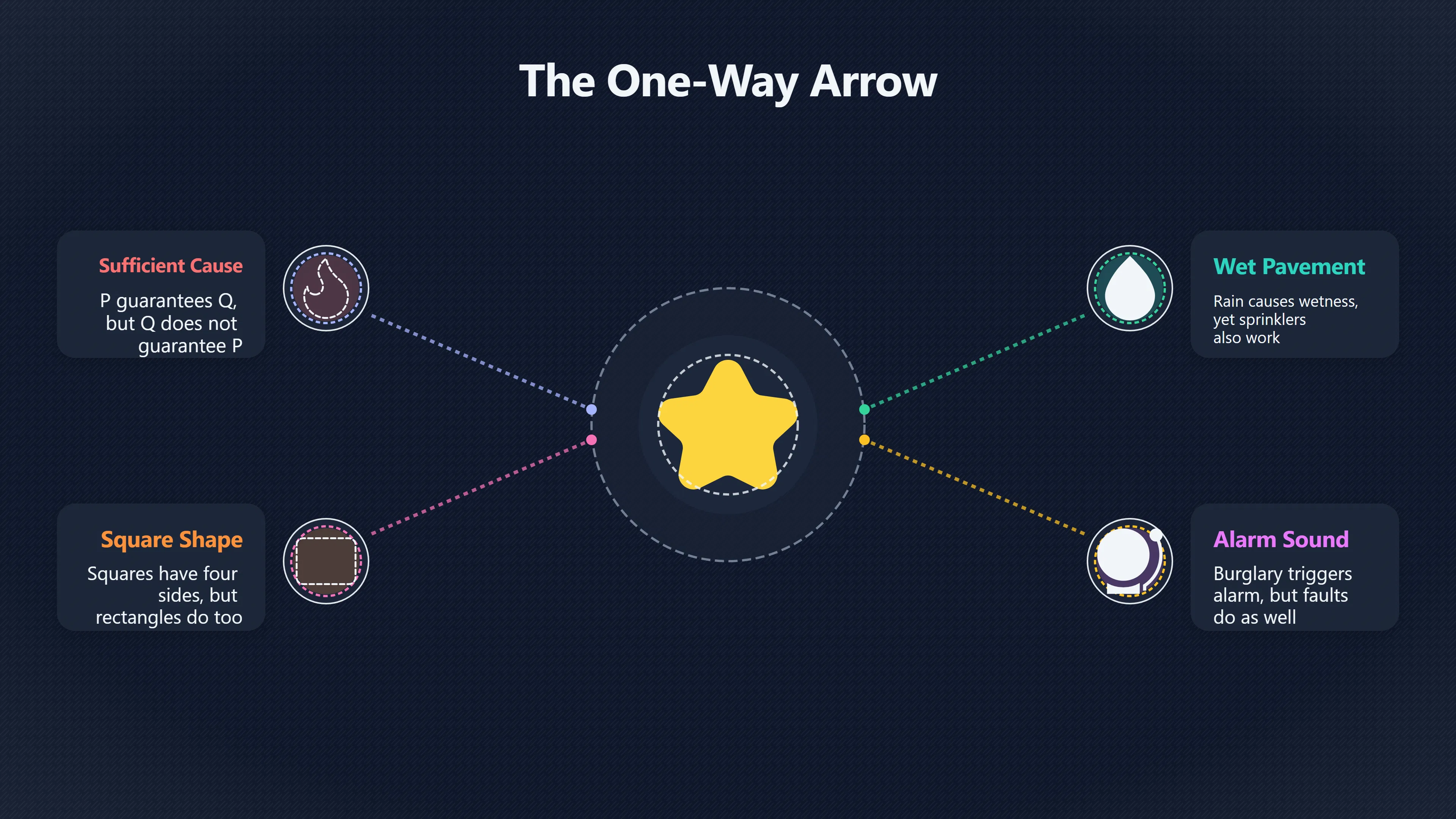
means that P is sufficient for Q. Whenever P occurs, Q must occur as well. It does not state that P is the only possible route to Q. Logic textbooks describe this relationship as an implication, written as P → Q.[stanford]plato.stanford.eduStanford Encyclopedia of PhilosophyArgument and Argumentationby C Dutilh Novaes · 2021 · Cited by 101 — For example, deductively invalid… Encyclopedia of Philosophy
Consider:
- If a match is lit, there is a flame.
This guarantees that a lit match produces a flame. It does not guarantee that every flame comes from a lit match. A candle, gas hob, or campfire could also produce a flame.
The conditional therefore establishes one pathway from P to Q. It does not automatically establish a pathway from Q back to P. Confusing those two claims is the mechanism behind affirming the consequent.[Wikipedia]WikipediaFormal fallacyFormal fallacy… formal fallacies covered by particular terms (e.g., affirming the consequent). In other words, in practice, "non seq…
How Reversing the Arrow Changes the Claim
The original conditional and its reversal are different statements.
Compare:
- If P, then Q.[quillbot.com]quillbot.comaffirming the consequentQ. Therefore, P. Affirming the consequent fallacy… This means the argument is invalid and commits a formal logical fallacy.Read more…
- If Q, then P.
These may look similar, but they express different relationships.
For example:
- If a figure is a square, then it has four sides.
- If a figure has four sides, then it is a square.
The first statement is true. The second is false because rectangles, trapeziums, and many other shapes also have four sides.
The mistake occurs when someone starts with the first statement and then reasons as though the second statement had been established. In logical notation, the invalid pattern is:
- If P, then Q.[quillbot.com]quillbot.comaffirming the consequentQ. Therefore, P. Affirming the consequent fallacy… This means the argument is invalid and commits a formal logical fallacy.Read more…
- Q.
- Therefore P.
This pattern is formally invalid because the truth of Q does not eliminate alternative explanations for Q. Logic authorities identify this structure as the fallacy of affirming the consequent, sometimes called the converse error because it incorrectly treats the converse of a conditional as established.[Encyclopedia Britannica]britannica.comEncyclopedia BritannicaAffirmation of the consequent | logicIn applied logic: Formal fallacies …B; not-A; therefore, not-B”) and affirmin…[Wikipedia]WikipediaAffirming the consequentAffirming the consequent
Why the Outcome Can Be True Without the Original Cause
The most important mechanism is that a consequence often has multiple possible causes.
Suppose:
- If a burglar entered the house, the alarm would sound.
Now imagine:
- The alarm is sounding.
The alarm may have been triggered by a burglar, but it might also have been triggered by a fault, a family member entering, a power issue, or a maintenance test.
The original conditional only tells us that burglary would produce the alarm. It does not tell us that burglary is the only possible explanation. Therefore the observation of the alarm does not logically prove burglary.[Wikipedia]WikipediaFormal fallacyFormal fallacy… formal fallacies covered by particular terms (e.g., affirming the consequent). In other words, in practice, "non seq…
This is exactly what happens in wet-pavement reasoning. Rain is one sufficient cause of wet pavement, but not necessarily the only one. The observed effect does not uniquely identify the cause.
When the Reverse Does Work
People often wonder whether “Q, therefore P” is always wrong.
The answer is no. The inference becomes valid when the relationship is genuinely two-way.
For example:
- If a number is divisible by 4 and leaves no remainder, then it is even.
- If a number is even and also satisfies the relevant definition, the reverse may hold in a specially defined system.
More clearly:
- If a shape is a square, then it is a rectangle.
- If a shape is a rectangle, then it is a square.
This reverse statement is false, so the inference fails.
By contrast, if a statement explicitly establishes equivalence:
- P if and only if Q
then each side implies the other. In that special case, moving from Q back to P is legitimate because the original claim includes both directions. Logic distinguishes these biconditional relationships from ordinary one-way conditionals.[Wikipedia]WikipediaFormal fallacyFormal fallacy… formal fallacies covered by particular terms (e.g., affirming the consequent). In other words, in practice, "non seq…

Simple Tests for Spotting the Invalid Move
A quick way to detect affirming the consequent is to ask whether the observed outcome could happen for any reason other than the proposed cause.
If the answer is yes, the inference is not deductively valid.
Useful checks include:
- Look for alternative causes. Could something else produce Q?
- Ask whether the original statement claimed exclusivity. Did it say P is the only way Q can occur?
- Try reversing the sentence explicitly. Does “If Q, then P” actually follow from what was stated?
- Search for counterexamples. Can you imagine a case where Q is true but P is false?
If even one plausible counterexample exists, the move from Q to P has not been established. This reflects the basic requirement of deductive validity: the conclusion must follow necessarily from the premises, not merely seem plausible.[stanford]plato.stanford.eduStanford Encyclopedia of PhilosophyArgument and Argumentationby C Dutilh Novaes · 2021 · Cited by 101 — For example, deductively invalid… Encyclopedia of Philosophy[Encyclopedia Britannica]britannica.comEncyclopedia BritannicaAffirmation of the consequent | logicIn applied logic: Formal fallacies …B; not-A; therefore, not-B”) and affirmin…
Why the Error Feels So Persuasive
The fallacy persists because everyday reasoning is often probabilistic rather than strictly deductive. Observing an effect can legitimately increase confidence in a particular cause. Seeing wet pavement may make rain more likely; seeing smoke may make fire more likely.
However, increased likelihood is not the same as logical proof. Philosophers and logicians have long noted that some argument forms classified as deductively invalid may still provide evidential support in practical reasoning, depending on context and background knowledge. The crucial point is that support is not certainty. The observation of Q may make P more plausible, but it does not allow the conclusion “therefore P” to be treated as logically guaranteed.[stanford]plato.stanford.eduStanford Encyclopedia of PhilosophyArgument and Argumentationby C Dutilh Novaes · 2021 · Cited by 101 — For example, deductively invalid… Encyclopedia of Philosophy[2arXiv]arxiv.orgarXiv Human Conditional Reasoning in Answer Set ProgrammingarXiv Human Conditional Reasoning in Answer Set Programming
The Core Lesson of One-Way Logic
The distinction between “if P then Q” and “Q therefore P” is simple but fundamental. A conditional statement guarantees that P leads to Q. It does not automatically guarantee that Q can only come from P. When the outcome is treated as proof of the original condition, the reasoning has reversed the direction of the implication without justification.
Remembering that conditional statements are normally one-way claims helps prevent a common logical mistake: confusing a possible cause with the only possible cause.[Encyclopedia Britannica]britannica.comEncyclopedia BritannicaAffirmation of the consequent | logicIn applied logic: Formal fallacies …B; not-A; therefore, not-B”) and affirmin…[Wikipedia]WikipediaFormal fallacyFormal fallacy… formal fallacies covered by particular terms (e.g., affirming the consequent). In other words, in practice, "non seq…
Amazon book picks
Further Reading
Books and field guides related to Why If P Then Q Does Not Reverse. Use these as the next step if you want deeper reading beyond the article.
A Rulebook for Arguments
Clarifies conditional reasoning and valid inference patterns.
An Illustrated Book of Bad Arguments
Visual explanations help readers grasp invalid logical forms.
The Thinker's Guide to Analytic Thinking
Develops careful evaluation of assumptions and implications.
eBay marketplace picks
Marketplace Samples
Example marketplace items related to this page. Use the search link to explore similar finds on eBay.
Endnotes
1.
Source: britannica.com
Link:https://www.britannica.com/topic/affirmation-of-the-consequent
Source snippet
Encyclopedia BritannicaAffirmation of the consequent | logicIn applied logic: Formal fallacies …B; not-A; therefore, not-B”) and affirmin...
2.
Source: Wikipedia
Title: Affirming the consequent
Link:https://en.wikipedia.org/wiki/Affirming_the_consequent
3.
Source: britannica.com
Title: Encyclopedia Britannicaformal and informal fallacy
Link:https://www.britannica.com/summary/fallacy
Source snippet
summaryFormal fallacies are types of deductive argument that instantiate an invalid inference pattern (see deduction; validity); an examp...
4.
Source: plato.stanford.edu
Title: Encyclopedia of Philosophy The Logic of Conditionals
Link:https://plato.stanford.edu/entries/logic-conditionals/
Source snippet
We review the problems of a two-valued analysis and examine logics based on...
5.
Source: britannica.com
Link:https://www.britannica.com/sitemap/a/137
Source snippet
Encyclopedia BritannicaAlphabetical Browseapplied logic: Formal fallacies: Among the best known are denying the antecedent (“If A, then B...
6.
Source: plato.stanford.edu
Title: Encyclopedia of Philosophy Logical Consequence
Link:https://plato.stanford.edu/entries/logical-consequence/
Source snippet
Stanford Encyclopedia of PhilosophyLogical Consequence - Stanford Encyclopedia of Philosophyby J Beall · 2005 · Cited by 93 — A good argu...
7.
Source: britannica.com
Link:https://www.britannica.com/topic/fallacy
Source snippet
Encyclopedia BritannicaFallacy | Logic, Definition & ExamplesFeb 13, 2026 — Fallacy, in logic, erroneous reasoning that has the appearanc...
8.
Source: plato.stanford.edu
Link:https://plato.stanford.edu/entries/argument/
Source snippet
Stanford Encyclopedia of PhilosophyArgument and Argumentationby C Dutilh Novaes · 2021 · Cited by 101 — For example, deductively invalid...
9.
Source: arxiv.org
Title: arXiv Human Conditional Reasoning in Answer Set Programming
Link:https://arxiv.org/abs/2311.04412
10.
Source: plato.stanford.edu
Title: Encyclopedia of Philosophy [Informal Logic]({{ ‘informal-logic/’ | relative_url }})
Link:https://plato.stanford.edu/entries/logic-informal/
Source snippet
Stanford Encyclopedia of PhilosophyInformal Logic - Stanford Encyclopedia of Philosophyby L Groarke · 1996 · Cited by 96 — They include f...
11.
Source: plato.stanford.edu
Link:https://plato.stanford.edu/entries/fallacies/
Source snippet
The fallacy of secundum...
12.
Source: plato.stanford.edu
Title: logic classical
Link:https://plato.stanford.edu/entries/logic-classical/
Source snippet
Logic - Stanford Encyclopedia of Philosophyby S Shapiro · 2000 · Cited by 195 — A logic consists of a formal or informal language togethe...
13.
Source: plato.stanford.edu
Link:https://plato.stanford.edu/entries/conditionals/
Source snippet
Stanford Encyclopedia of Philosophyby D Edgington · 2001 · Cited by 148 — A theory of conditionals aims to give an account of the conditi...
14.
Source: britannica.com
Link:https://www.britannica.com/topic/thought/Expert-thinking-and-novice-thinking
Source snippet
Expert, Novice, ThinkingApr 2, 2026 — In one such fallacy, “affirming the consequent,” the categorical proposition affirms the consequent...
15.
Source: britannica.com
Link:https://www.britannica.com/topic/thought/Algorithms-and-heuristics
Source snippet
Algorithms, Heuristics, Problem-SolvingApr 2, 2026 — In one such fallacy, “affirming the consequent,” the categorical proposition affirms...
16.
Source: britannica.com
Link:https://www.britannica.com/topic/fallacy/Verbal-fallacies
Source snippet
Ambiguity, [Red Herring]({{ 'red-herring/' | relative_url }}), Straw Man5 days ago — These fallacies, called fallacies of ambiguity, arise when the conclusion is achieved throu...
17.
Source: britannica.com
Link:https://www.britannica.com/topic/logic-of-questions
Source snippet
the following examples: Explore...Read more...
18.
Source: britannica.com
Link:https://www.britannica.com/topic/affirming-the-consequent
Source snippet
Affirming the consequent | logicIn thought: Deduction. In one such fallacy, “affirming the consequent,” the categorical proposition affir...
19.
Source: britannica.com
Title: denial of the antecedent
Link:https://www.britannica.com/topic/denial-of-the-antecedent
Source snippet
logicFeb 13, 2026 — Among the best known are denying the antecedent (“If A, then B; not-A; therefore, not-B”) and affirming the consequen...
20.
Source: britannica.com
Link:https://www.britannica.com/topic/rationality
Source snippet
Definition & FactsMar 6, 2026 — A common departure from formal logic is the fallacy of affirming the consequent, or leaping from “p impli...
21.
Source: britannica.com
Link:https://www.britannica.com/topic/applied-logic
Source snippet
Applied logic | Fallacies, Varieties, & FactsAmong the best known are denying the antecedent (“If A, then B; not-A; therefore, not-B”) an...
22.
Source: britannica.com
Title: Ritual | Religious, Cultural, & Social Practices
Link:https://www.britannica.com/topic/ritual
Source snippet
logical fallacy of affirming the consequent. To assert that the need is satisfied “if and only if” ritual is present is a tautology and a...
23.
Source: Wikipedia
Title: Formal fallacy
Link:https://en.wikipedia.org/wiki/Formal_fallacy
Source snippet
Formal fallacy... formal fallacies covered by particular terms (e.g., affirming the consequent). In other words, in practice, "non seq...
24.
Source: dictionary.cambridge.org
Link:https://dictionary.cambridge.org/dictionary/english/logical
Source snippet
English meaning - Cambridge Dictionary6 days ago — LOGICAL definition: 1. using reason: 2. using reason: 3. reasonable and based on goo...
25.
Source: iep.utm.edu
Link:https://iep.utm.edu/fallacy/
Source snippet
Hominem, Appeal to Pity, and Affirming the Consequent are all fallacies of [relevance]({{ 'relevance/' | relative_url }}). (2) Accent, Amphiboly and Equivocation are examples...
26.
Source: fallacies.online
Title: affirming the consequent
Link:https://fallacies.online/wiki/logic/formal_fallacies/affirming_the_consequent
Source snippet
Jan 23, 2025 — Formal logical fallacy, in which it is (falsely) assumed that a logical consequence can be the premise of a converse propo...
27.
Source: fallacyfiles.org
Title: Affirming the Consequent
Link:https://www.fallacyfiles.org/afthecon.html
Source snippet
Logical FallacyJun 22, 2023 — This is easy to see: Suppose that an argument of the form of affirming the consequent―that is, an argument...
28.
Source: quillbot.com
Title: affirming the consequent
Link:https://quillbot.com/blog/reasoning/affirming-the-consequent/
Source snippet
Q. Therefore, P. Affirming the consequent fallacy... This means the argument is invalid and commits a formal logical fallacy.Read more...
Additional References
29.
Source: merriam-webster.com
Link:https://www.merriam-webster.com/dictionary/affirming
Source snippet
AFFIRMING Definition & MeaningThe meaning of AFFIRMING is providing affirmation: showing or expressing recognition of worthiness or vali...
30.
Source: quizlet.com
Link:https://quizlet.com/49831174/ch-3-flash-cards/
Source snippet
Ch 3 FlashcardsAffirming the Consequent. An invalid argument form: If p, then q. q. Therefore, p. Antecedent. The first part of a conditi...
31.
Source: logicallyfallacious.com
Link:https://www.logicallyfallacious.com/logicalfallacies/Affirming-the-Consequent
Source snippet
Affirming the ConsequentDescription: An error in formal logic where if the consequent is said to be true, the antecedent is said to be tr...
32.
Source: reasoninglab.com
Link:https://www.reasoninglab.com/rationale2.0/ib/exercises/tok/modus_ponens.htm
Source snippet
Modus ponensThe pattern of argument of the form 'If P then Q; Q; therefore P' is known as affirming the consequent (meaning affirming wha...
33.
Source: quizlet.com
Link:https://quizlet.com/533648741/phil-120-chapter-3-section-flash-cards/
Source snippet
PHIL 120 Chapter 3 Section FlashcardsThe invalid argument form known as affirming the consequent has this pattern: If p, then q. q. There...
34.
Source: logicallyfallacious.com
Link:https://www.logicallyfallacious.com/logicalfallacies/Denying-the-Antecedent
35.
Source: reddit.com
Link:https://www.reddit.com/r/philosophy/comments/3wxz64/logical_fallacy_affirming_the_consequent/
36.
Source: study.com
Link:https://study.com/academy/lesson/affirming-the-consequent-fallacy-definition-examples.html
Source snippet
Affirming the Consequent Overview, Fallacy & ExamplesThe fallacy of affirming the consequent is a formal fallacy in which a reasoner make...
37.
Source: study.com
Link:https://study.com/learn/lesson/denying-antecedent-fallacy-examples.html
Source snippet
Denying the Antecedent Fallacy | Overview & ExamplesAffirming the antecedent and denying the consequent are two different but equally cor...
38.
Source: philosophyalevel.com
Link:https://philosophyalevel.com/posts/if-p-then-q-modus-ponens-modus-tollens/
Source snippet
May 28, 2023 — Affirming the consequent is a logical fallacy that occurs when someone assumes that if the consequent of a conditional sta...
Published: May 28, 2023
Topic Tree