Within Emotion
Why Threats Are Not Evidence
Threats may give people a reason to act, but they do not provide evidence that the threatened claim is true.
On this page
- The difference between reasons to act and reasons to believe
- Workplace, political, and personal pressure examples
- How to respond when pressure replaces proof
Page outline Jump by section
Introduction
An ad baculum argument, often translated as an “appeal to the stick” or “appeal to force”, occurs when a threat is used to secure acceptance of a claim instead of providing evidence for it. The threat may be physical, economic, social, professional, or psychological. The central mistake is not that threats can influence behaviour—they often can—but that pressure is treated as if it proves a conclusion. A person may have a strong reason to comply with a demand in order to avoid harm, yet still have no reason to believe that the accompanying claim is true. This distinction between belief and compliance lies at the heart of the fallacy.[stanford]plato.stanford.eduEncyclopedia of Philosophy FallaciesSo, for example.Read more… Encyclopedia of Philosophy[Oxford University Press]global.oup.comoup.comSupplement: A Summary of the FallaciesAppeal to force (argumentum ad baculum, literally “argument from the stick”) A… force or…
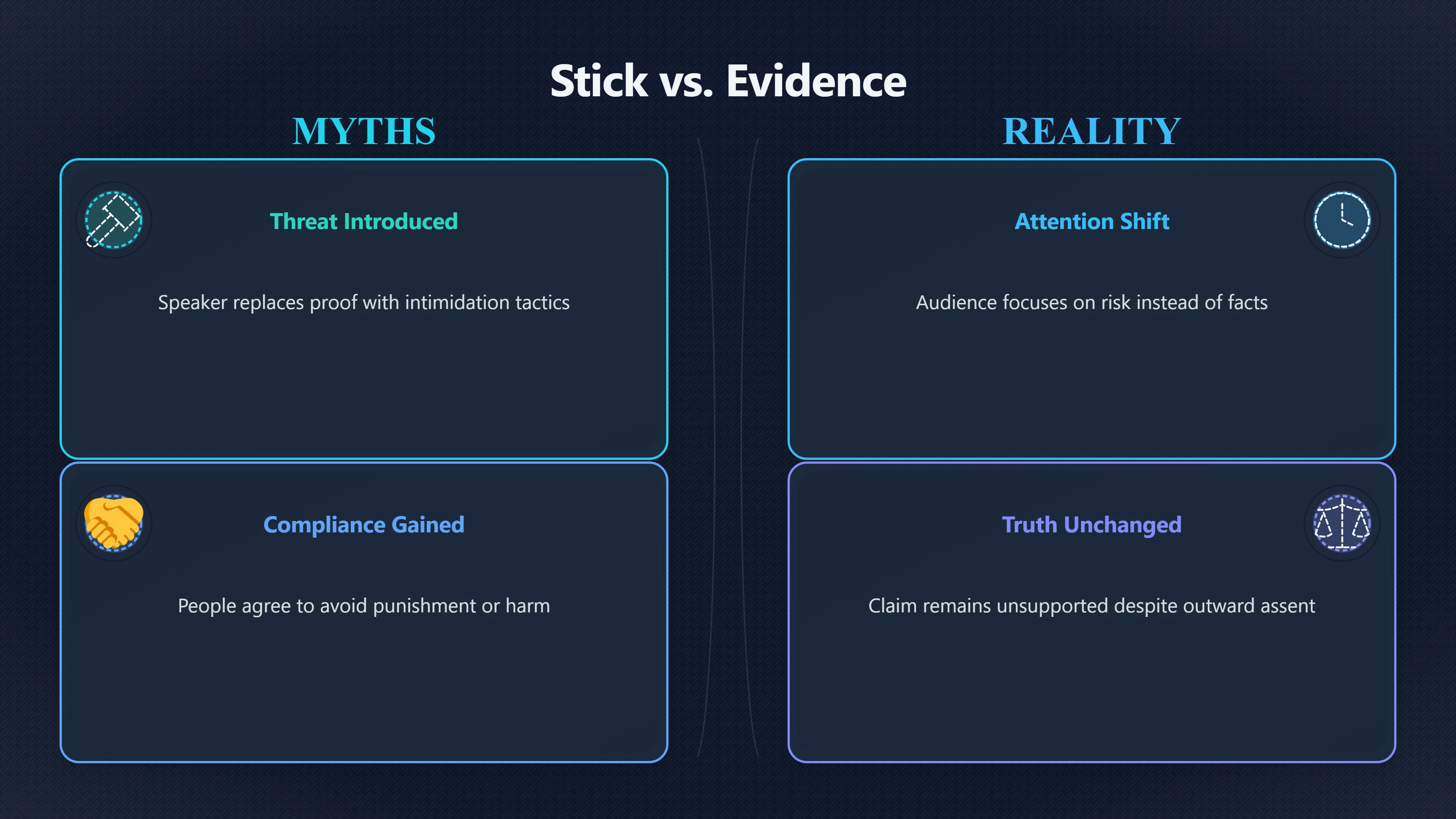
 Within the broader family of appeals to emotion and persuasive pressure, ad baculum is distinctive because it replaces evidence with intimidation. Instead of answering the question “What reasons support this claim?”, it shifts attention to “What will happen to me if I refuse?”[Logically Fallacious]logicallyfallacious.comLogically FallaciousAppeal to ForceWhen force, coercion, or even a threat of force is used in place of a reason in an attempt to justify…[2fallacyfiles.org]fallacyfiles.orgLogical Fallacy: Appeal to ForceAttempts to change people's minds by threats of punishment are appeals… When force or the threat of fo…
The Difference Between Reasons to Act and Reasons to Believe
Understanding ad baculum requires separating two kinds of reasons that are often confused.
A reason to believe concerns whether a proposition is true. Evidence, observation, reliable testimony, and sound inference belong in this category. A reason to act concerns what consequences may follow from a decision. Fear of punishment can be a powerful reason to act in a certain way, even when it provides no information about truth.[ThoughtCo]thoughtco.comThought Co Appeal to Force/FearAppeal to Force/Fear - Argumentum ad Baculum4 Aug 2019 — The Appeal to Force or Fear occurs whenever someone makes an implicit o…
Consider the statement:
“Agree that my proposal is correct, or you will lose your job.”
The threatened consequence may be real. If the speaker has authority, compliance may be prudent. Yet the possibility of dismissal tells us nothing about whether the proposal is actually correct. The threat changes incentives, not facts.[Logically Fallacious]logicallyfallacious.comLogically FallaciousAppeal to ForceWhen force, coercion, or even a threat of force is used in place of a reason in an attempt to justify…
Philosophers and argumentation theorists have long noted this distinction. An appeal to force may successfully alter behaviour, but success in obtaining agreement is not the same as establishing truth. The threatened person may publicly assent while privately remaining unconvinced.[stanford]plato.stanford.eduEncyclopedia of Philosophy FallaciesSo, for example.Read more… Encyclopedia of Philosophy[2uwindsor.scholaris.ca]uwindsor.scholaris.caKeywords: Ad…Read more…
How Threats Create the Illusion of Proof
The persuasive power of ad baculum does not come from evidence. It comes from psychological pressure.
When people face threats, attention often shifts from evaluating a claim to managing risk. The immediate concern becomes avoiding punishment rather than examining reasons. This can make weak arguments appear stronger than they are because the audience’s mental resources are directed towards consequences instead of evidence. Researchers examining appeal-to-force arguments have argued that intimidation can impede recognition of missing premises or unsupported assumptions.[MDPI]mdpi.com2226 471XBeliefs, Commitments, and Ad Baculum Argumentsby J Casey · 2022 · Cited by 7 — The appeal to force fallacy usually accomplishes its p…
The mechanism typically follows a pattern:
- A claim is presented.
- A negative consequence is attached to rejecting it.
- Attention shifts from evidence to self-protection.
- Compliance is mistaken for rational agreement.
Because the threatened person often stops challenging the claim, observers may incorrectly assume that the claim has been successfully defended. In reality, the pressure has merely silenced opposition.[fallacyfiles.org]fallacyfiles.orgLogical Fallacy: Appeal to ForceAttempts to change people's minds by threats of punishment are appeals… When force or the threat of fo…
Workplace, Political, and Personal-Pressure Examples
Workplace pressure
A manager says:
“Anyone who questions this strategy should reconsider their future here.”
The statement may discourage criticism and produce apparent consensus. Yet employee silence does not demonstrate that the strategy is sound. The threat influences behaviour, not the quality of the evidence supporting the proposal.[Logical Fallacy]logical-fallacy.comLogical Fallacy Argumentum Ad Baculumappeal to the force” symbolizing the use of force or threat. This… ad baculum fallacy by threatening to end the relationship unless…
Such cases are especially important because organisations often depend on honest disagreement to identify mistakes. When threats replace argument, decision-making quality can deteriorate even while conformity increases.
Political pressure
Political history provides many examples in which governments, parties, or powerful groups discourage dissent through threats of punishment, exclusion, or retaliation. The resulting appearance of agreement may reflect fear rather than genuine persuasion. Argumentation scholars note that suppressing criticism can create a one-sided public discussion in which alternative evidence is never heard.[fallacyfiles.org]fallacyfiles.orgLogical Fallacy: Appeal to ForceAttempts to change people's minds by threats of punishment are appeals… When force or the threat of fo…
The logical issue remains the same regardless of ideology: the existence of penalties for disagreement does not make the favoured claim more likely to be true.
Personal relationships
The fallacy also appears in everyday life:
“If you really cared about me, you would agree with me—or our relationship is over.”
The threatened loss may be emotionally significant. It may even influence behaviour. However, the threat contributes nothing to determining whether the disputed claim is accurate.[Logical Fallacy]logical-fallacy.comLogical Fallacy Argumentum Ad Baculumappeal to the force” symbolizing the use of force or threat. This… ad baculum fallacy by threatening to end the relationship unless…
Personal examples often reveal the structure most clearly because the pressure is easier to see once separated from the emotional stakes.
When Threats Are Not Fallacious
Not every mention of consequences is an ad baculum fallacy.
A police officer who says, “If you exceed the speed limit, you may receive a fine,” is not attempting to prove a factual claim through intimidation. The officer is describing a real consequence connected to a legal rule. Similarly, a doctor who warns that smoking increases health risks is presenting evidence about likely outcomes rather than using fear as a substitute for evidence.[Wikipedia]WikipediaArgumentum ad baculumNovember 19, 2025 —… argument may not always be fallacious, and cite instances where appealing to force or threat or fear could be rea…
The key question is whether the consequence is offered as evidence for the conclusion.
A statement becomes fallacious when it takes the form:
“This claim is true because rejecting it will lead to punishment.”
A legitimate warning takes the form:
“If certain facts are true, these consequences may follow.”
The first confuses coercion with proof. The second discusses consequences while still leaving the factual question to evidence.[Psych Scales Database]db.arabpsychology.comPsych Scales DatabaseArgumentum Ad Baculum: Appeal to Force FallacyWhile threats and consequences are common elements in human interactio…[ThoughtCo]thoughtco.comThought Co Appeal to Force/FearAppeal to Force/Fear - Argumentum ad Baculum4 Aug 2019 — The Appeal to Force or Fear occurs whenever someone makes an implicit o…
Why Compliance Is Often Mistaken for Belief
One reason ad baculum remains effective is that observers frequently confuse outward agreement with genuine conviction.
People under pressure may nod, sign documents, repeat slogans, or remain silent. These actions can create the impression that a claim has been accepted on its merits. Yet compliance often reflects a calculation about costs and benefits rather than a change in belief.[uwindsor.scholaris.ca]uwindsor.scholaris.caKeywords: Ad…Read more…
This distinction has historical significance. Systems that rely heavily on coercion may generate visible conformity while masking private disagreement. The resulting consensus can appear stronger than it really is because people have incentives to conceal their true views. In this sense, ad baculum arguments can distort not only reasoning but also perceptions of public opinion.[fallacyfiles.org]fallacyfiles.orgLogical Fallacy: Appeal to ForceAttempts to change people's minds by threats of punishment are appeals… When force or the threat of fo…
How to Respond When Pressure Replaces Proof
The most effective response is often to separate the threat from the claim.
Instead of debating the threatened consequence, ask questions such as:
- What evidence supports the conclusion?
- Would the claim still be true if the threat disappeared?
- Does the punishment provide information about the facts, or merely about the speaker’s power?
- Am I being given reasons to believe, or reasons to comply?
These questions redirect attention to the logical issue. They expose the gap between coercion and justification.[stanford]plato.stanford.eduEncyclopedia of Philosophy FallaciesSo, for example.Read more… Encyclopedia of Philosophy Logically It is also useful to recognise that a prudent response and a rational belief need not be the same. A person may decide to comply with a deman[logicallyfallacious.com]logicallyfallacious.comLogically FallaciousAppeal to ForceWhen force, coercion, or even a threat of force is used in place of a reason in an attempt to justify… d because the threatened consequences are severe while still recognising that the threat does not establish the truth of the accompanying claim. That distinction preserves clear thinking even under pressure.[ThoughtCo]thoughtco.comThought Co Appeal to Force/FearAppeal to Force/Fear - Argumentum ad Baculum4 Aug 2019 — The Appeal to Force or Fear occurs whenever someone makes an implicit o…

Why Threats Are Not Evidence
The enduring lesson of ad baculum is simple: power and truth are different things. A threat may change what people say, what they do, or what they publicly endorse. It may alter incentives, silence criticism, and create apparent agreement. What it cannot do is supply evidence for a factual claim. The fear of punishment may explain belief-like behaviour, but it does not make a proposition more likely to be true. That is why appeal to force remains a classic logical fallacy: it substitutes coercion for proof and pressure for reason.[stanford]plato.stanford.eduEncyclopedia of Philosophy FallaciesSo, for example.Read more… Encyclopedia of Philosophy[Oxford University Press]global.oup.comoup.comSupplement: A Summary of the FallaciesAppeal to force (argumentum ad baculum, literally “argument from the stick”) A… force or…
Amazon book picks
Further Reading
Books and field guides related to Why Threats Are Not Evidence. Use these as the next step if you want deeper reading beyond the article.
Crucial Conversations
Addresses communication under pressure rather than intimidation.
eBay marketplace picks
Marketplace Samples
Example marketplace items related to this page. Use the search link to explore similar finds on eBay.






Endnotes
1.
Source: plato.stanford.edu
Title: Encyclopedia of Philosophy Fallacies
Link:https://plato.stanford.edu/entries/fallacies/
Source snippet
So, for example.Read more...
2.
Source: thoughtco.com
Title: Thought Co Appeal to Force/Fear
Link:https://www.thoughtco.com/appeal-to-force-fear-250346
Source snippet
Appeal to Force/Fear - Argumentum ad Baculum4 Aug 2019 — The Appeal to Force or Fear occurs whenever someone makes an implicit o...
3.
Source: fallacyfiles.org
Link:https://www.fallacyfiles.org/adbacula.html
Source snippet
Logical Fallacy: Appeal to ForceAttempts to change people's minds by threats of punishment are appeals... When force or the threat of fo...
4.
Source: uwindsor.scholaris.ca
Link:https://uwindsor.scholaris.ca/bitstreams/983e088b-3f28-48bd-abb2-3ebb46696ba8/download
Source snippet
Keywords: Ad...Read more...
5.
Source: mdpi.com
Title: 2226 471X
Link:https://www.mdpi.com/2226-471X/7/2/107
Source snippet
Beliefs, Commitments, and Ad Baculum Argumentsby J Casey · 2022 · Cited by 7 — The appeal to force fallacy usually accomplishes its p...
6.
Source: logical-fallacy.com
Title: Logical Fallacy Argumentum Ad Baculum
Link:https://www.logical-fallacy.com/articles/argumentum-ad-baculum/
Source snippet
appeal to the force” symbolizing the use of force or threat. This... ad baculum fallacy by threatening to end the relationship unless...
7.
Source: Wikipedia
Title: Argumentum ad baculum
Link:https://en.wikipedia.org/wiki/Argumentum_ad_baculum
Source snippet
November 19, 2025 —... argument may not always be fallacious, and cite instances where appealing to force or threat or fear could be rea...
Published: November 19, 2025
8.
Source: plato.stanford.edu
Title: logic informal
Link:https://plato.stanford.edu/entries/logic-informal/
Source snippet
Logic - Stanford Encyclopedia of Philosophyby L Groarke · 1996 · Cited by 97 — Different [informal logics]({{ 'informal-logic/' | relative_url }}) support this aim by providing va...
9.
Source: plato.stanford.edu
Link:https://plato.stanford.edu/entries/fallacies/notes.html
Source snippet
> Notes (Stanford Encyclopedia of Philosophy)The scheme that Walton prefers is much more complicated (2010, 168) but the present abbrevia...
10.
Source: plato.stanford.edu
Title: logic informal
Link:https://plato.stanford.edu/archives/fall2025/entries/logic-informal/
Source snippet
fallacy ad baculum. Walton 2007 accommodates the different goals associated with real life arguments by distinguishing between different...
11.
Source: plato.stanford.edu
Link:https://plato.stanford.edu/archives/fall2022/entries/argument/
Source snippet
and ArgumentationJul 16, 2021 — The ad hominem fallacy, which involves bringing negative aspects of an arguer, or their situation, to arg...
12.
Source: Wikipedia
Title: [Tu quoque]({{ ‘tu-quoque/’ | relative_url }})
Link:https://en.wikipedia.org/wiki/Tu_quoque
Source snippet
Tu quoqueTu quoque, literally "you, too", is a rhetorical technique that intends to discredit the opponent's argument by attacking th...
13.
Source: Wikipedia
Title: List of fallacies
Link:https://en.wikipedia.org/wiki/List_of_fallacies
Source snippet
List of fallaciesA fallacy is the use of invalid or otherwise faulty reasoning in the construction of an argument. All forms of human...
14.
Source: Wikipedia
Title: Ad hominem
Link:https://en.wikipedia.org/wiki/Ad_hominem
Source snippet
Ad hominemTu quoque · A makes a claim a. · B attacks the character of A by claiming they hold negative property x. · A defends themsel...
15.
Source: thoughtco.com
Title: appeal to force fallacy 1689121
Link:https://www.thoughtco.com/appeal-to-force-fallacy-1689121
Source snippet
Understanding the Appeal to Force Fallacy4 May 2019 — The appeal to force fallacy is a rhetorical fallacy that relies on force or intimid...
Published: May 2019
16.
Source: global.oup.com
Link:https://global.oup.com/us/companion.websites/9780199331864/stu/supplement/
Source snippet
oup.comSupplement: A Summary of the FallaciesAppeal to force (argumentum ad baculum, literally “argument from the stick”) A... force or...
17.
Source: logicallyfallacious.com
Link:https://www.logicallyfallacious.com/logicalfallacies/Appeal-to-Force
Source snippet
Logically FallaciousAppeal to ForceWhen force, coercion, or even a threat of force is used in place of a reason in an attempt to justify...
18.
Source: db.arabpsychology.com
Link:https://db.arabpsychology.com/argumentum-ad-baculum/
Source snippet
Psych Scales DatabaseArgumentum Ad Baculum: Appeal to Force FallacyWhile threats and consequences are common elements in human interactio...
19.
Source: philosophy.lander.edu
Title: force ex
Link:https://philosophy.lander.edu/logic/force_ex.html
Source snippet
Baculum - Argument from ForceThe fallacy of ad baculum occurs. The threat to investigators was a defensive, reflexive, but empty threat...
20.
Source: philosophy.lander.edu
Link:https://philosophy.lander.edu/logic/force.html
Source snippet
Others restrict the fallacy to cases where the threat is made ineffectively or vacuously. E.g., John Woods, “Threats and Intimidation,”...
21.
Source: philosophy.lander.edu
Link:https://philosophy.lander.edu/logic/person.html
Source snippet
HominemThe ad hominem fallacy occurs whenever the character or circumstances of an individual who is advancing an argument is criticized...
22.
Source: iep.utm.edu
Link:https://iep.utm.edu/fallacy/
Source snippet
reasoning contains this fallacy if you make an irrelevant attack on the person arguing and suggest that this attack undermines the argume...
23.
Source: logicallyfallacious.com
Link:https://www.logicallyfallacious.com/logicalfallacies/Ad-Hominem-Tu-quoque
Source snippet
ently with the claims of the argument.Read more...
Additional References
24.
Source: philpapers.org
Link:https://philpapers.org/rec/WALSTA-23
Source snippet
Scare Tactics: Arguments That Appeal to Fear and Threats.Such arguments come under the heading of the argumentum ad baculum, the `argumen...
25.
Source: rephrasely.com
Link:https://rephrasely.com/usage/argumentum-ad-baculum-fallacy
26.
Source: elearning.newgateuniversityminna.edu.ng
Title: newgateuniversityminna.edu.ng KNO W THE ELEMENTARY RULES OF REASONING | NUEL1
Link:https://elearning.newgateuniversityminna.edu.ng/mod/book/tool/print/index.php?id=2633
Source snippet
Argumentum ad baculum, is a logical fallacy that occurs when someone uses a threat of force or negative consequences to persuade others t...
27.
Source: researchgate.net
Title: 226349867 The Nature of the Argumentum ad baculum
Link:https://www.researchgate.net/publication/226349867_The_Nature_of_the_Argumentum_ad_baculum
Source snippet
All the examples involve threats. But in (a)... Instances of the ad baculum argument (also known as the threat appeal argument...Read more...
28.
Source: study.com
Link:https://study.com/academy/lesson/appeal-to-force-fallacy-definition-examples.html
Source snippet
because it uses force or the threat of force to coerce others to accept an...Read more...
29.
Source: biblicalunitarian.com
Title: Believe What I Say or Else!
Link:https://www.biblicalunitarian.com/articles/logic/believe-what-i-say-or-else-argumentum-ad-baculum
Source snippet
Argumentum ad BaculumThis fallacy is usually committed by those who have failed to persuade others by any other means and who finally r...
30.
Source: siue.edu
Title: SIU Edwardsville Fallacies
Link:https://www.siue.edu/~wlarkin/teaching/PHIL106/fallacies.html
Source snippet
Fallacies - PHIL 106: Critical ThinkingAppeal to Force. 1. Fallacious: One tries to get someone to accept a conclusion not by providing r...
31.
Source: de.scribd.com
Title: Appeal to Force Examples Google Search
Link:https://de.scribd.com/document/629412504/Appeal-to-Force-Examples-Google-Search
Source snippet
of Appeal to Force Fallacy | PDFAn appeal to force is categorized as a logical fallacy because it replaces logical reasoning with coercio...
32.
Source: youtube.com
Title: STAR TREK Logical Thinking #8
Link:https://www.youtube.com/watch?v=vVQvmy1rx4c
Source snippet
Critical Thinking: The Fallacy of Appeal to Fear...
33.
Source: finmasters.com
Title: Tu Quoque Fallacy
Link:https://finmasters.com/tu-quoque-fallacy/
Source snippet
Definition and ExamplesTu quoque is a fallacy in which someone asserts that their opponent's argument must be invalid because it is incon...
Topic Tree