Within Argument Map
Which Part of the Argument Actually Fails?
Systematic checks can reveal whether a problem lies in a premise, inference, assumption, or objection.
On this page
- Checking premises
- Checking inferences
- Checking objections and qualifiers
Page outline Jump by section
Introduction
Weak-link checks are the diagnostic stage of argument mapping. Once an argument has been broken into premises, conclusions, assumptions, objections and inference links, the next question is simple: which specific part fails? Rather than treating an argument as entirely sound or entirely flawed, a weak-link test examines each component separately. The method helps identify whether a problem lies in a doubtful premise, an unsupported inference, a hidden assumption, or an ineffective objection. This is one of the main advantages of argument mapping: it turns a vague sense that “something is wrong” into a precise diagnosis. Argument-mapping frameworks are designed to expose claims, support relationships, objections and implicit warrants so that each element can be evaluated independently.[Wikipedia]WikipediaArgument mapArgument map[Reasoninglab]reasoninglab.comArgument MappingWhat is argument mapping? Argument maps are box-and-line diagrams that lay out visually reasoning and evidenc…

Which Part of the Argument Actually Fails?
A common mistake in fallacy analysis is attacking the wrong part of an argument. Someone may challenge a premise when the real weakness is the inference, or reject a conclusion because an objection seems persuasive even though the objection itself is defective.
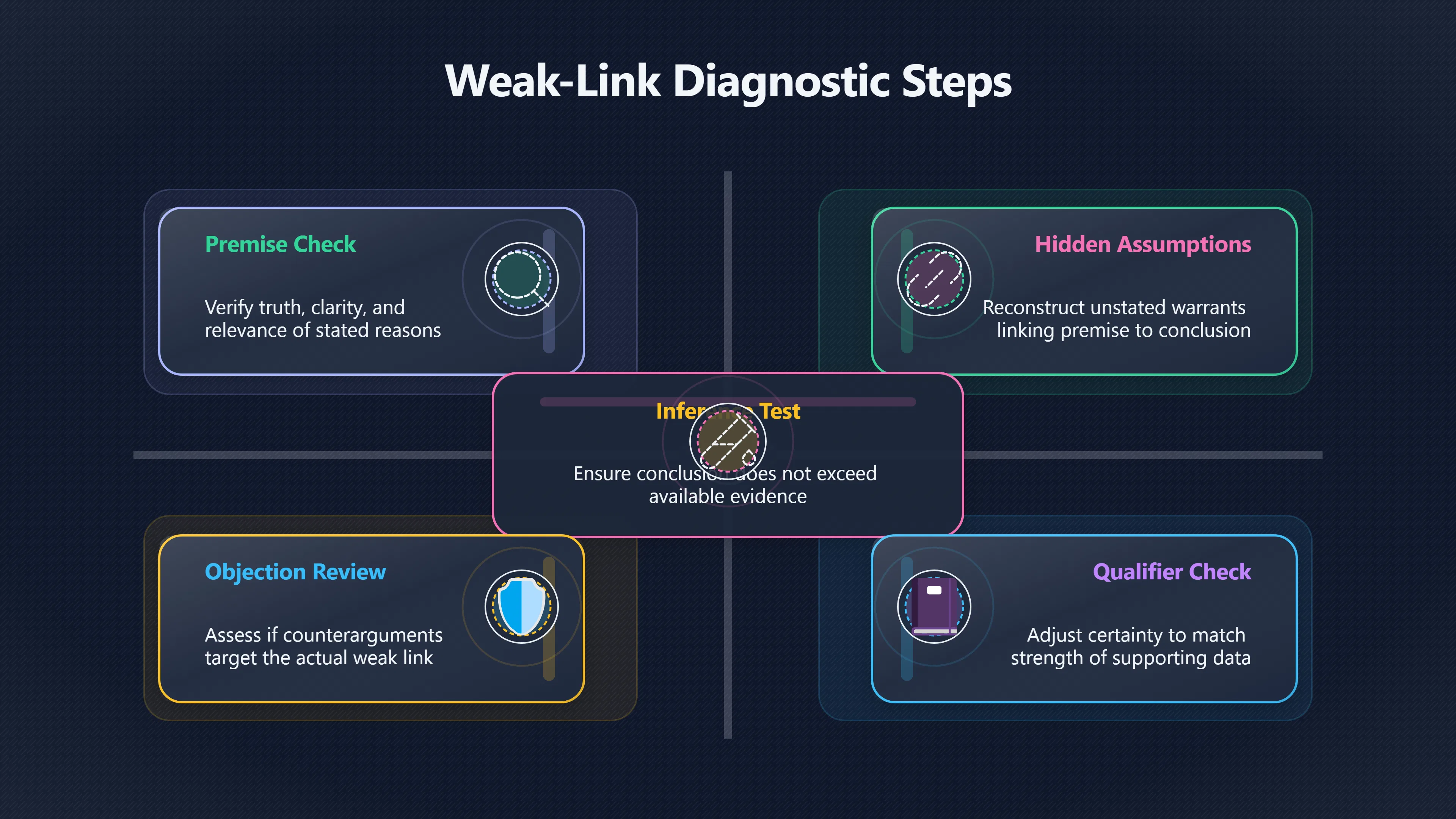
Weak-link testing avoids this confusion by isolating components. The argument is treated as a chain of support relations. Each link is examined separately:
- Are the premises true, credible, or adequately supported?
- If the premises were true, would they actually support the conclusion?
- Does the argument rely on hidden assumptions?
- Have objections genuinely weakened the argument?
- Do qualifiers and exceptions change the strength of the conclusion?
Because argument maps visually separate these elements, weaknesses become easier to locate than they are in ordinary prose. Researchers and critical-thinking educators consistently describe argument maps as tools for evaluating support relations rather than merely listing claims.[Wikipedia]WikipediaArgument mapArgument map[Psychology Today]psychologytoday.comimproving critical thinking through argument mapping9 Nov 2018 — To clarify, an argument map is a visual representation of a logically structured network of reasoning, in which the argument…
Checking Premises
The first weak-link test asks whether the stated reasons deserve acceptance.
A premise can fail in several ways:
- False premise: the claim is factually incorrect.
- Unsupported premise: evidence is missing or inadequate.
- Ambiguous premise: key terms are unclear or shift meaning.
- Irrelevant premise: even if true, the statement does not contribute to the conclusion.
Consider the argument:
The city should ban electric scooters because several riders were injured last year.
Mapping separates the premise from the conclusion. The premise may be true, but a weak-link check asks whether the reported injuries are sufficient evidence for a ban. The issue may not be factual accuracy but evidential adequacy.
Argument-mapping practice also emphasises linked premises. Some reasons work only together. If one member of a linked set fails, the entire support structure may collapse. For example:
- All licensed surgeons have completed accredited medical training.
- Dr Smith is a licensed surgeon.
- Therefore, Dr Smith completed accredited medical training.
Neither premise independently establishes the conclusion. Weakening either premise damages the whole inference. Mapping makes these dependencies visible.[Wikipedia]WikipediaArgument mapArgument map
Hidden Premises as Potential Weak Links
Many arguments appear persuasive because an important premise remains unstated.
For example:
This policy worked in another country, so it will work here.
The visible premise is about success elsewhere. The hidden premise is that the relevant conditions are sufficiently similar. If that assumption is weak, the argument’s weakness lies there rather than in the explicit premise.
Studies of argument comprehension and warrant reconstruction highlight that natural-language arguments often depend on implicit warrants—unstated propositions that explain why a premise supports a conclusion. Reconstructing these warrants is therefore a crucial weak-link test.[arXiv]arxiv.orgThe Argument Reasoning Comprehension Task: Identification and Reconstruction of Implicit WarrantsAugust 4, 2017…
Checking Inferences
A premise may be true and yet fail to justify the conclusion. In such cases the weak link is the inference itself.
Argument-mapping traditions increasingly distinguish objections to premises from objections to inference links. Some mapping systems even allow inference boxes so that the connection between reason and conclusion can be evaluated directly.[Reasoninglab]reasoninglab.comits constituent claims, and use lines, boxes…
Does the Conclusion Go Beyond the Evidence?
One common inference failure occurs when the conclusion claims more than the premises establish.
For example:
A survey of fifty customers found positive reviews. Therefore, everyone likes the product.
The premise may be accurate, but the conclusion exceeds what the evidence supports. The weakness lies in the leap from a limited sample to a universal claim.
Many familiar informal fallacies emerge at this stage:
- Hasty generalisation
- Weak analogy
- Non sequitur
- False cause
- Appeal to authority without adequate warrant
The advantage of weak-link testing is that the analyst need not begin with a fallacy label. The immediate question is simply whether the support relationship is strong enough.

Counterfactual Testing
A useful inference check is to imagine the premises as unquestionably true.
Then ask:
If these premises were true, would I still have reason to doubt the conclusion?
If the answer is yes, the problem is likely the inference rather than the premises.
For example:
- Premise: A famous actor supports the policy.
- Conclusion: The policy is effective.
Even granting the premise completely, the conclusion does not follow. The weak link is therefore inferential.
Checking Objections and Qualifiers
Arguments rarely consist only of reasons supporting a conclusion. Strong maps also include objections, rebuttals and qualifications. These components require their own weak-link checks. Argument-mapping systems commonly represent objections and counterarguments explicitly because evaluating opposition is part of evaluating the overall argument.[Deakin University]deakin.edu.auDeakin UniversityArgument mappingObjections to claims (or 'counterarguments') can be mapped, and so can rebuttals of those objections. Fi…[Wikipedia]WikipediaArgument mapArgument map
Is the Objection Relevant?
An objection may appear forceful while attacking a point that is not essential.
Suppose an argument contains five independent reasons supporting a conclusion. An objection successfully defeats one of them but leaves the remaining four untouched.
The objection is not worthless, but its overall impact may be limited. Mapping helps reveal whether the challenged premise is central or peripheral.
Does the Objection Attack the Right Target?
Good objections target the actual weak link.
Poor objections often:
- Attack a side issue.
- Misrepresent the conclusion.
- Challenge a premise that is not required.
- Ignore the key inference.
Because the map displays support relations explicitly, analysts can ask whether the objection connects to the element it is supposed to challenge.

Testing Qualifiers
Many arguments contain implicit or explicit qualifiers:
- Usually
- Probably
- In most cases
- Under these conditions
A weak-link check asks whether the strength of the conclusion matches the strength of the evidence.
For example:
The treatment improved outcomes in several studies, so it will probably help many patients.
This may be reasonable.
Changing the conclusion to:
Therefore the treatment will help every patient
creates a much stronger claim that may no longer be justified.
One useful diagnostic question is whether adding a modest qualifier repairs the argument. If it does, the problem may be excessive certainty rather than fundamentally defective reasoning.
A Practical Weak-Link Sequence
When analysing an argument map, a systematic order prevents confusion:
- Identify the conclusion being tested.
- Examine each premise for truth, clarity and relevance.
- Look for hidden assumptions or warrants.
- Test whether the inference would remain convincing if all premises were true.
- Examine objections separately from supporting reasons.
- Check whether qualifiers accurately reflect the available evidence.
- Locate the single point whose failure most damages the argument.
This approach often reveals that the decisive weakness is not where readers first expect it to be.
Why Weak-Link Testing Matters
Weak-link checks transform argument mapping from a descriptive exercise into a critical one. A map alone only displays structure. The real analytical value comes from testing each component independently and determining exactly where support breaks down. By separating premises, inferences, assumptions and objections, the method reduces the temptation to dismiss an argument wholesale or to rely on superficial fallacy labels. Instead, it answers a more useful question: which part of the reasoning actually fails, and why? Reasoninglab[Psychology Today]psychologytoday.comimproving critical thinking through argument mapping9 Nov 2018 — To clarify, an argument map is a visual representation of a logically structured network of reasoning, in which the argument…
Amazon book picks
Further Reading
Books and field guides related to Which Part of the Argument Actually Fails?. Use these as the next step if you want deeper reading beyond the article.
Asking the Right Questions
Directly teaches systematic testing of premises and conclusions.
eBay marketplace picks
Marketplace Samples
Example marketplace items related to this page. Use the search link to explore similar finds on eBay.






Endnotes
1.
Source: Wikipedia
Title: Argument map
Link:https://en.wikipedia.org/wiki/Argument_map
2.
Source: reasoninglab.com
Link:https://www.reasoninglab.com/argument-mapping/
Source snippet
Argument MappingWhat is argument mapping? Argument maps are box-and-line diagrams that lay out visually reasoning and evidenc...
3.
Source: reasoninglab.com
Link:https://www.reasoninglab.com/wp-content/uploads/2013/10/Argument-Maps-the-Rules.pdf
Source snippet
its constituent claims, and use lines, boxes...
4.
Source: arxiv.org
Link:https://arxiv.org/abs/1708.01425
Source snippet
The Argument Reasoning Comprehension Task: Identification and Reconstruction of Implicit WarrantsAugust 4, 2017...
Published: August 4, 2017
5.
Source: reasoninglab.com
Link:https://www.reasoninglab.com/wp-content/uploads/2013/10/What-is-a-good-Argument-Map.pdf
Source snippet
What is a good Argument Map?An inference objection is a rebuttal that shows that the objection above it, regardless of whethe...
6.
Source: reasoninglab.com
Link:https://www.reasoninglab.com/wp-content/uploads/2013/10/Argument-Mapping-at-Work-2013.pdf
Source snippet
Argument Mapping at WorkWhat is Argument Mapping? Argument mapping is a way of laying out visually reasoning and evidence for and against...
7.
Source: reasoninglab.com
Title: Argument Mapping Start at the top and working down in levels
Link:https://www.reasoninglab.com/wp-content/uploads/2013/10/One-minute-mapper.pdf
Source snippet
Argument MappingStart at the top and working down in levels - add evidence to support (reasons – green) or oppose (objections – red) any...
8.
Source: psychologytoday.com
Title: improving critical thinking through argument mapping
Link:https://www.psychologytoday.com/gb/blog/thoughts-thinking/201811/improving-critical-thinking-through-argument-mapping
Source snippet
9 Nov 2018 — To clarify, an argument map is a visual representation of a logically structured network of reasoning, in which the argument...
9.
Source: deakin.edu.au
Link:https://www.deakin.edu.au/__data/assets/pdf_file/0030/86772/Argument-mapping_Deakin-Study-Support.pdf
Source snippet
Deakin UniversityArgument mappingObjections to claims (or 'counterarguments') can be mapped, and so can rebuttals of those objections. Fi...
10.
Source: drcharlesmrusso.substack.com
Title: argument mapping
Link:https://drcharlesmrusso.substack.com/p/argument-mapping
Source snippet
Mapping - by Dr. Charles M. Russo, PhDPre/post rubrics can track clarity, balance of support/objection, explicitness of assumptions, and...
11.
Source: ddd.uab.cat
Title: cat Argument map
Link:https://ddd.uab.cat/pub/expbib/2009/34875/oratoria09/Argument_map
Source snippet
map - Wikipedia, the free encyclopedia5 Jul 2016 — Critical thinking concepts: In learning to argument map, students master such key crit...
12.
Source: figma.com
Link:https://www.figma.com/templates/argument-mapping/
Source snippet
Argument Mapping | Free Template | FigJamAn argument map is a box-and-line flowchart that helps you develop any argument. These maps star...
13.
Source: mindonmap.com
Title: argument mapping
Link:https://www.mindonmap.com/blog/argument-mapping/
Source snippet
Furthermore, this map reveals the argument's unseen composition, displaying how to lift the support claim.Read more...
Additional References
14.
Source: open.ac.uk
Link:https://www.open.ac.uk/blogs/rrimap/index.php/4-argument-map/
Source snippet
A4 argument map – Knowledge CartographyArgument mapping is a technique to develop evidence-based thinking using arguments and counterargu...
15.
Source: researchgate.net
Link:https://www.researchgate.net/publication/228188551_Visualization_Tools_Argumentation_Schemes_and_Expert_Opinion_Evidence_in_Law
Source snippet
(PDF) Visualization Tools, Argumentation Schemes and...9 Feb 2026 — The visualization of argumentation schemes is illustrated using a ne...
16.
Source: researchgate.net
Link:https://www.researchgate.net/publication/28763750_Argument_Maps_Improve_Critical_Thinking
Source snippet
Argument maps; An argument map is a two-dimensional representation of argument structure. It is. usually a box-and-...Read more...
17.
Source: youtube.com
Link:https://www.youtube.com/watch?v=W91qk_3NiVE
Source snippet
Arguments and Claims Mini LessonHere's a quick video to help you how to break down an author's argument and identify their claim. This vi...
18.
Source: oddrops.blog
Title: It is aimed largely at education and is intended to help teach
Link:https://oddrops.blog/2015/09/24/argument-mapping-with-rationale/
Source snippet
Argument Mapping with Rationale | oddrops24 Sept 2015 — It is a web-based tool for diagramming the structure of an argument: building an...
19.
Source: cliffsnotes.com
Link:https://www.cliffsnotes.com/study-notes/33664324
Source snippet
can be used to display objections to the logic of reasoning rather than the...Read more...
20.
Source: gsis.scholasticahq.com
Title: 125995 argument mapping in intelligence analysis
Link:https://gsis.scholasticahq.com/article/125995-argument-mapping-in-intelligence-analysis.pdf
Source snippet
Mapping in Intelligence Analysisby L Johansson — One way to systemize critical, logical thinking is by using a technique or method called...
21.
Source: researchgate.net
Link:https://www.researchgate.net/figure/A-simple-Rationale-reasoning-map-illustrating-how-pre-attentive-processing-can-help_fig2_236017238
Source snippet
A simple Rationale reasoning map, illustrating how pre-...Software-supported argument mapping may be able to help lawyers reason and arg...
22.
Source: open.edu
Link:https://www.open.edu/openlearn/mod/oucontent/view.php?id=95869§ion=2.2
Source snippet
Digital thinking tools for better decision making: Session 4This is a diagram that displays the claims you have collected so far and the...
23.
Source: rationaleonline.com
Link:https://rationaleonline.com/docs/en/rationale-help/quick-start
Source snippet
xes); Show evaluation of claims through colour and icons (...
Topic Tree