Within Informal Logic
When Personal Criticism Actually Matters
Criticising a person is not automatically fallacious; the question is whether the criticism affects the claim.
On this page
- Why insults usually miss the argument
- Witness credibility and relevant bias
- A checklist for separating character attacks from evidence
Page outline Jump by section
Introduction
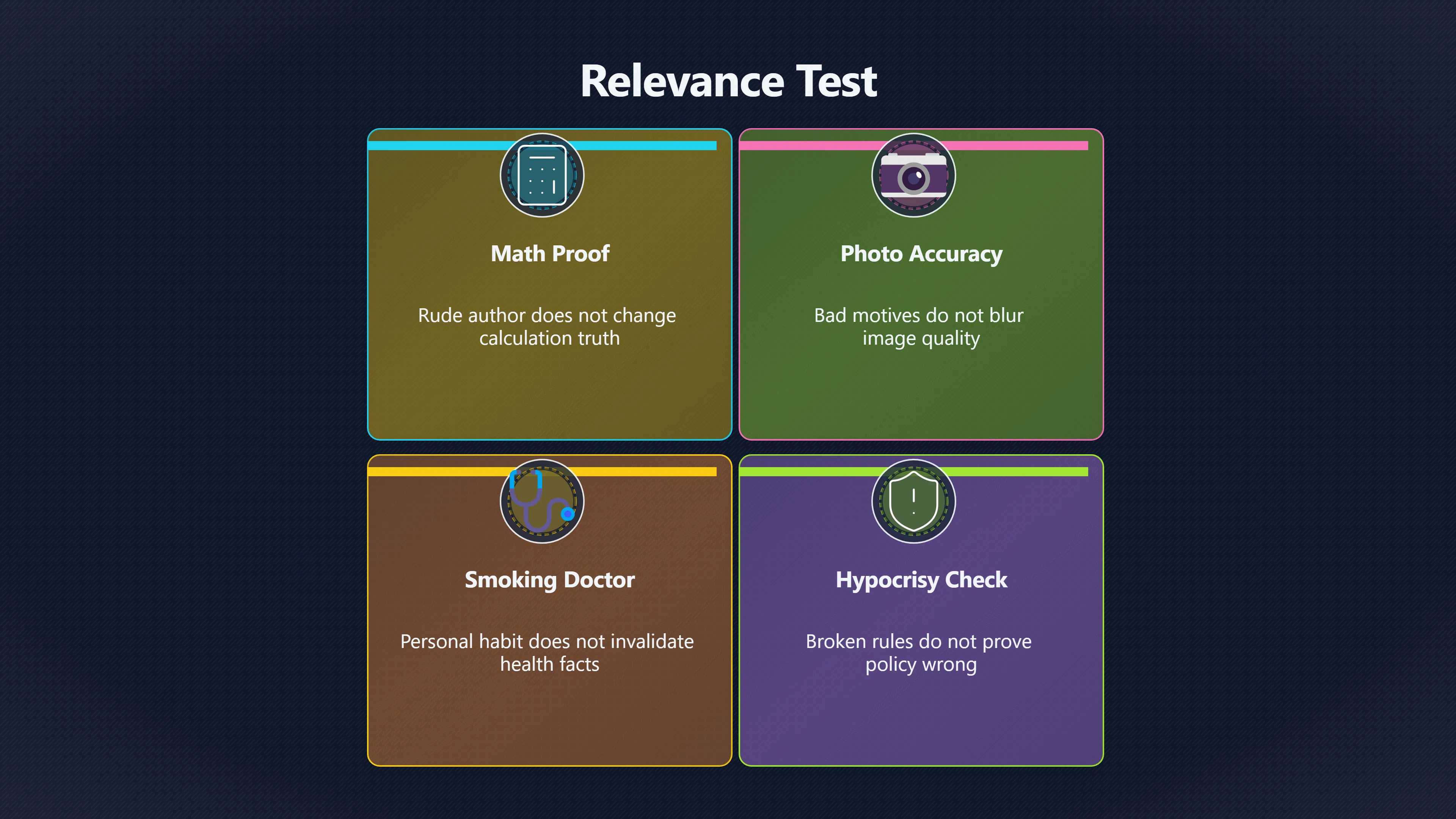
An ad hominem argument is often described as “attacking the person instead of the argument”. That is broadly correct, but it leaves out an important distinction. Not every criticism of a person is fallacious. The key question is whether the personal information is relevant to assessing the claim being made. If someone dismisses a mathematical proof because its author is rude, the criticism misses the argument entirely. If someone questions a witness’s testimony because that witness has a documented history of dishonesty, the criticism may be directly relevant to how much trust the testimony deserves. Informal logic therefore treats ad hominem reasoning as a problem of relevance, not merely of tone or politeness.[Internet Encyclopedia of Philosophy]iep.utm.eduInternet Encyclopedia of PhilosophyFallaciesThe major difficulty with labeling a piece of reasoning an Ad Hominem Fallacy is deciding whe…[Stanford Encyclopedia of Philosophy]plato.stanford.eduStanford Encyclopedia of PhilosophyFallacies - Stanford Encyclopedia of Philosophyby H Hansen · 2015 · Cited by 421 — The ad hominem fall…
 Understanding this distinction matters because many everyday arguments depend partly on trust, expertise, credibility and testimony. In those cases, facts about the speaker can sometimes count as evidence. The challenge is separating legitimate credibility assessment from an irrelevant personal attack.
Why insults usually miss the argument
The classic ad hominem fallacy occurs when criticism of a person is used as a substitute for examining the reasons they have offered.
Consider these examples:
- “Your proposal to reduce traffic is wrong because you’re an arrogant person.”
- “Her analysis of the budget must be false because she went bankrupt years ago.”
- “Don’t listen to him about climate data; he’s annoying.”
In each case, the criticism may or may not be true, but it does not address the evidence supporting the claim. The argument attempts to move from a fact about a person to a conclusion about the truth of a proposition without showing a relevant connection. Philosophers and argumentation theorists commonly identify this irrelevance as the central defect of the fallacy.[stanford]plato.stanford.edufeminism argumentationThe Stanford Encyclopedia of Philosophy is copyright © 2025 by The… Encyclopedia of Philosophy[Encyclopedia Britannica]britannica.comEncyclopedia BritannicaAd hominem | Definition, Fallacy, Bias, Examples, & FactsAd hominem, type of argument or attack that appeals to pr…
This is why merely pointing out hypocrisy often fails as a rebuttal. A doctor who smokes may still be correct that smoking damages health. A politician who violates their own principles may still advocate a sound policy. Exposing inconsistency may reveal something about the speaker, but it does not automatically show that the underlying claim is false.[Wikipedia]WikipediaAd hominemAd hominem
A useful rule is that objective evidence does not usually change because of who presents it. A calculation remains correct even if performed by an unpleasant person. A photograph does not become less accurate because the photographer has bad motives. When the evidence can stand independently, personal attacks rarely add anything relevant.
Witness credibility and relevant bias
The picture changes when a claim depends heavily on testimony, expertise or trustworthiness.
In a courtroom, lawyers routinely examine a witness’s credibility. If a witness has previously lied under oath, has a strong financial interest in the outcome, or has given contradictory accounts, those facts may affect how much weight a jury should place on the testimony. In such cases, the issue is not whether the witness is a good person. The issue is whether there are reasons to doubt the reliability of the evidence being offered. Argumentation scholars have long noted that credibility challenges of this kind can be legitimate rather than fallacious.[Informal Logic]informallogic.caInformal LogicAd Hominem Arguments as Legitimate Rebuttals to Appeals to…by M Mizrahi · 2010 · Cited by 20 — One such legitimate case… Wikipedia The same principle applies outside courts:[Wikipedia]WikipediaAd hominemAd hominem
- A pharmaceutical researcher who owns stock in the company producing a drug may have a conflict of interest.
- A product reviewer secretly paid by a manufacturer may not be independent.
- A journalist who fabricated stories in the past may face justified scrutiny regarding new reporting.
None of these facts automatically prove that the person’s current claims are false. They do, however, provide relevant information about reliability, incentives or possible bias. The proper conclusion is usually not “therefore the claim is wrong”, but “therefore the claim requires closer verification”.[Internet Encyclopedia of Philosophy]iep.utm.eduInternet Encyclopedia of PhilosophyFallaciesThe major difficulty with labeling a piece of reasoning an Ad Hominem Fallacy is deciding whe… Wikipedia This distinction is crucial. Relevant credibility concerns affect the strength of evidence. Fallacious ad hominem arguments attempt to replac[Wikipedia]WikipediaAd hominemAd hominem e evidence with personal criticism.
When personal facts become evidence
One reason this topic creates confusion is that some arguments are about facts in the world, while others are about whether a source should be trusted.
Suppose someone claims that a bridge can safely carry a certain weight and provides engineering calculations. The calculations can be checked independently. The engineer’s personal life is largely irrelevant.
Now suppose someone claims, “I personally witnessed the accident and saw the driver run the red light.” Here the testimony itself is the evidence. Questions about eyesight, honesty, memory and possible bias become directly relevant because they bear on the reliability of the source.[Informal Logic]informallogic.caInformal LogicAd Hominem Arguments as Legitimate Rebuttals to Appeals to…by M Mizrahi · 2010 · Cited by 20 — One such legitimate case…
This explains why the same personal fact can be irrelevant in one context and highly important in another. A history of deception may have little bearing on a mathematical theorem but substantial bearing on eyewitness testimony. Informal logic therefore asks not whether a personal criticism occurred, but whether it helps evaluate the evidence actually being offered.[Internet Encyclopedia of Philosophy]iep.utm.eduInternet Encyclopedia of PhilosophyFallaciesThe major difficulty with labeling a piece of reasoning an Ad Hominem Fallacy is deciding whe…
Common mistakes when raising credibility concerns
Even legitimate concerns about credibility can slide into fallacious reasoning.
One common mistake is treating evidence of bias as proof of falsehood. A person may have a financial interest in a position and still be correct. Bias can justify additional scrutiny, but it does not automatically refute a claim.[Logically Fallacious]logicallyfallacious.comLogically FallaciousAd Hominem (Circumstantial)Suggesting that the person who is making the argument is biased or predisposed to take a p…
Another mistake is guilt by association. Someone’s argument is not automatically wrong because they belong to a disliked group or share a view with controversial figures. The association must be shown to have a genuine connection to the claim under discussion. Otherwise the reasoning remains an irrelevant attack.[Wikipedia]WikipediaList of fallaciesAd hominem – attacking the arguer instead of the argument. (Note that "ad hominem " can also refer to the dialectical…
A third error is moving from credibility concerns to certainty. Discovering that a witness has lied before may justify caution, but it rarely proves every statement by that witness is false. Credibility assessment is usually about adjusting confidence rather than reaching absolute conclusions.
A checklist for separating character attacks from evidence
When evaluating a personal criticism in an argument, ask the following questions:
- What is the actual claim being debated? Separate the conclusion from opinions about the speaker.
- Does the criticism affect the truth of the claim or the reliability of the evidence? If not, it is likely irrelevant.
- Is the argument based on testimony, expertise or trust? If so, credibility may matter more than it would for independently verifiable evidence.
- Does the criticism identify a specific source of unreliability? Conflicts of interest, deception, lack of expertise and inconsistent testimony can be relevant. Mere dislike, social identity or personal flaws often are not.
- What conclusion follows? Relevant credibility concerns usually justify caution or further checking. They do not automatically establish that the claim is false.
The most reliable test is to imagine that the same evidence had been presented by someone else. If the evidence would remain equally strong, the personal criticism is probably irrelevant. If the evidence depends substantially on the speaker’s honesty, expertise or impartiality, then questions about credibility may be an important part of evaluating the argument.

The central distinction
The difference between an ad hominem fallacy and a legitimate credibility concern is not whether a person has been criticised. It is whether the criticism bears on the evidential value of what they are saying. Personal attacks become fallacious when they distract from the argument. They become potentially relevant when the person’s reliability, expertise, honesty or bias forms part of the evidence itself. Informal logic therefore asks a more precise question than “Was someone criticised?” It asks: “Does this fact about the person help us judge the claim, or is it merely a distraction?” [Wikipedia+3Internet Encyclopedia of Philosophy+3Stanford Encyclopedia of Philosophy]
Amazon book picks
Further Reading
Books and field guides related to When Personal Criticism Actually Matters. Use these as the next step if you want deeper reading beyond the article.
Asking the Right Questions
Helps distinguish relevant credibility concerns from irrelevant attacks.
Mistakes Were Made (but Not by Me)
Explores self-justification and attacks on critics.
eBay marketplace picks
Marketplace Samples
Example marketplace items related to this page. Use the search link to explore similar finds on eBay.




Endnotes
1.
Source: plato.stanford.edu
Link:https://plato.stanford.edu/entries/fallacies/
Source snippet
Stanford Encyclopedia of PhilosophyFallacies - Stanford Encyclopedia of Philosophyby H Hansen · 2015 · Cited by 421 — The ad hominem fall...
2.
Source: plato.stanford.edu
Link:https://plato.stanford.edu/entries/argument/
Source snippet
Stanford Encyclopedia of PhilosophyArgument and Argumentationby C Dutilh Novaes · 2021 · Cited by 105 — The ad hominem fallacy, which inv...
3.
Source: britannica.com
Link:https://www.britannica.com/topic/ad-hominem
Source snippet
Encyclopedia BritannicaAd hominem | Definition, Fallacy, Bias, Examples, & FactsAd hominem, type of argument or attack that appeals to pr...
4.
Source: Wikipedia
Title: Ad hominem
Link:https://en.wikipedia.org/wiki/Ad_hominem
5.
Source: Wikipedia
Link:https://en.wikipedia.org/wiki/List_of_fallacies
Source snippet
List of fallaciesAd hominem – attacking the arguer instead of the argument. (Note that "ad hominem " can also refer to the dialectical...
6.
Source: plato.stanford.edu
Title: logic informal
Link:https://plato.stanford.edu/entries/logic-informal/
Source snippet
Logic - Stanford Encyclopedia of Philosophyby L Groarke · 1996 · Cited by 97 — Different [informal logics]({{ 'informal-logic/' | relative_url }}) support this aim by providing va...
7.
Source: plato.stanford.edu
Title: logic informal
Link:https://plato.stanford.edu/archives/fall2020/entries/logic-informal/
Source snippet
Traditionally, emotional appeals have been seen as fallacious moves in argument. This is too simple a view of the...
8.
Source: plato.stanford.edu
Title: logic informal
Link:https://plato.stanford.edu/archives/win2004/entries/logic-informal/
Source snippet
LogicOne attempt to use traditional fallacies as a way to define good argument schema (by treating ad hominem, guilt by association, appe...
9.
Source: plato.stanford.edu
Title: feminism argumentation
Link:https://plato.stanford.edu/entries/feminism-argumentation/
Source snippet
The Stanford Encyclopedia of Philosophy is copyright © 2025 by The...
10.
Source: plato.stanford.edu
Title: logic informal
Link:https://plato.stanford.edu/archives/fall2003/entries/logic-informal/
Source snippet
Logic11 Nov 2002 — In assessing ordinary arguments, it may more simply be said that fallacies are common patterns of poor reasoning which...
11.
Source: plato.stanford.edu
Title: testimony episprob
Link:https://plato.stanford.edu/entries/testimony-episprob/
Source snippet
Problems of Testimonyby N Leonard · 2021 · Cited by 103 — Testimony is clearly an indispensable source of knowledge, specifying exactly h...
12.
Source: plato.stanford.edu
Link:https://plato.stanford.edu/archives/spr2024/entries/fallacies/notes.html
Source snippet
to Fallacies - Stanford Encyclopedia of Philosophy9. At (2010, 179) Walton says that a fallacy is an argument that seems to be correct bu...
13.
Source: plato.stanford.edu
Title: reasoning analogy
Link:https://plato.stanford.edu/archives/fall2013/entries/reasoning-analogy/
Source snippet
and Analogical Reasoning25 Jun 2013 — An analogy is a comparison between two objects, or systems of objects, that highlights respects in...
14.
Source: Wikipedia
Title: Argument from authority
Link:https://en.wikipedia.org/wiki/Argument_from_authority
Source snippet
Argument from authorityAn argument from authority is a form of argument in which the opinion of an authority figure (or figures) is us...
15.
Source: philosophy.institute
Link:https://philosophy.institute/logic/understanding-fallacies-reasoning-errors/
Source snippet
Understanding Fallacies: Errors in Reasoning9 Dec 2025 — The fallacy arises when personal characteristics are used as a substitute for en...
16.
Source: iep.utm.edu
Link:https://iep.utm.edu/fallacy/
Source snippet
Internet Encyclopedia of PhilosophyFallaciesThe major difficulty with labeling a piece of reasoning an Ad Hominem Fallacy is deciding whe...
17.
Source: logicallyfallacious.com
Link:https://www.logicallyfallacious.com/logicalfallacies/Ad-Hominem-Circumstantial
Source snippet
Logically FallaciousAd Hominem (Circumstantial)Suggesting that the person who is making the argument is biased or predisposed to take a p...
18.
Source: informallogic.ca
Link:https://informallogic.ca/index.php/informal_logic/article/view/2990/2442
Source snippet
Informal LogicAd Hominem Arguments as Legitimate Rebuttals to Appeals to...by M Mizrahi · 2010 · Cited by 20 — One such legitimate case...
19.
Source: seop.illc.uva.nl
Title: evidence legal
Link:https://seop.illc.uva.nl/entries/evidence-legal/
Source snippet
Stanford Encyclopedia of PhilosophyThe Legal Concept of Evidenceby HL Ho · 2015 · Cited by 102 — This entry focuses on the modern concept...
20.
Source: philosophy.lander.edu
Link:https://philosophy.lander.edu/logic/person.html
Source snippet
HominemAd Hominem Fallacy: (abusive and circumstantial): the fallacy of attacking the character or circumstances of an individual who is...
21.
Source: sk.sagepub.com
Title: ad hominem argument
Link:https://sk.sagepub.com/ency/edvol/the-sage-encyclopedia-of-corporate-reputation/chpt/ad-hominem-argument
Source snippet
Hominem ArgumentAd hominem criticism is innately deceptive as it defies the principle of an ethical argument as an attempt to offer legit...
22.
Source: ebsco.com
Link:https://www.ebsco.com/research-starters/religion-and-philosophy/ad-hominem
23.
Source: logicallyfallacious.com
Link:https://www.logicallyfallacious.com/blog/how-to-spot-the-ad-hominem-fallacy-in-arguments
Source snippet
If you want to argue more clearly, evaluate...Read more...
Additional References
24.
Source: labxchange.org
Link:https://www.labxchange.org/library/pathway/lx-pathway%3Ae14a306c-99b2-4ae8-9d59-b2169c30b54b/items/lb%3ALabXchange%3A4fc53430%3Ahtml%3A1/178800
Source snippet
6. The Ad Hominem FallacyThe criticism made by an ad hominem fallacy could often be used to construct a good argument that the speaker is...
25.
Source: ecampusontario.pressbooks.pub
Link:https://ecampusontario.pressbooks.pub/wsia062018/chapter/13/
Source snippet
The Social Epistemology of ArgumentIn the abusive ad hominem, an attack is made on the arguer's character or background and this attack i...
26.
Source: finmasters.com
Link:https://finmasters.com/circumstantial-ad-hominem/
Source snippet
May 23, 2023 — Circumstantial ad hominem occurs when someone argues that their opponent's argument must be invalid because his or her pos...
Published: May 23, 2023
27.
Source: researchgate.net
Link:https://www.researchgate.net/publication/279807512_Discounting_Testimony_with_the_Argument_Ad_Hominem_and_a_Bayesian_Congruent_Prior_Model
Source snippet
violation of the rules of evidence, are jurors' beliefs still affected?Read more...
28.
Source: facebook.com
Link:https://www.facebook.com/groups/968580683281312/posts/1076238102515569/
Source snippet
's position on the basis of something about the person and...Read more...
29.
Source: lawexplores.com
Title: Ad Hominem Fallacies and Epistemic Credibility
Link:https://lawexplores.com/ad-hominem-fallacies-and-epistemic-credibility/
Source snippet
Law ExplorerOct 26, 2015 — An ad hominem fallacy is an error in logical reasoning in which an interlocutor attacks the person making the...
30.
Source: philsci-archive.pitt.edu
Title: Ad Hominem Arguments in Scientific Discourses
Link:https://philsci-archive.pitt.edu/27835/1/Ad%20Hominem%20Arguments%20in%20Scientific%20Discourses.pdf
Source snippet
Hominem Arguments in Scientific Discoursesby LP Schäfer · 2025 — Instead, witness testimonies can be checked in terms of internal consist...
31.
Source: youtube.com
Link:https://www.youtube.com/watch?v=TJ09OchTiZo
Source snippet
What Is The Fallacy of Ad Hominem? How People Get It Wrong Online | Greg Sadler's Advice...
32.
Source: cambridge.org
Link:https://www.cambridge.org/core/journals/journal-of-the-american-philosophical-association/article/three-puzzles-with-ad-hominem-arguments/3EA1126C7081C468F4D03C9870852C96
Source snippet
Three Puzzles with Ad Hominem Argumentsby S AIKIN · 2025 · Cited by 2 — The ad hominem appears to be the simplest fallacy form—one critic...
33.
Source: sciencedirect.com
Link:https://www.sciencedirect.com/science/article/pii/S1570868308000384
Source snippet
Formalization of the ad hominem argumentation schemeby D Walton · 2010 · Cited by 22 — For example in a case of witness testimony, it is...
Topic Tree