Within Fallacy Lab
When Is It Really a Fallacy?
The same argument form can be reasonable in one setting and misleading in another because context changes the support.
On this page
- Reasonable exceptions
- Context clues
- Judgment calls
Page outline Jump by section
Introduction
The same argument form can be fair in one setting and fallacious in another. That is why borderline fallacy cases cannot be judged by label alone. An appeal to expert opinion, an emotional warning, a criticism of a speaker’s credibility, or a generalisation from examples may be reasonable when the context makes that kind of evidence relevant. The same move becomes misleading when it asks the audience to accept more than the evidence can support.
This matters because many real arguments are not clean textbook specimens. They happen in courts, classrooms, public health advice, family decisions, political debate, scientific disagreement and online conversations, where evidence is incomplete and time is limited. Informal logic therefore treats many fallacies as context-sensitive failures of support rather than as automatically bad sentence patterns. The central question is not “Which fallacy name fits?” but “In this situation, does this reason actually justify that conclusion?”[stanford]plato.stanford.eduEncyclopedia of Philosophy Informal LogicStanford Encyclopedia of PhilosophyInformal Logic - Stanford Encyclopedia of Philosophyby L Groarke · 1996 · Cited by 97 — Different info… Encyclopedia of Philosophy[Stanford Encyclopedia of Philosophy]plato.stanford.eduEncyclopedia of Philosophy Informal LogicStanford Encyclopedia of PhilosophyInformal Logic - Stanford Encyclopedia of Philosophyby L Groarke · 1996 · Cited by 97 — Different info…
Why the Same Move Can Change Status
A useful way to understand borderline cases is to separate an argument’s form from its job. “An expert says this” has a recognisable form, but its job might be to summarise specialised evidence, defer to professional competence, intimidate a lay audience, or shut down a question. Only some of those uses are faulty. Informal logic developed partly because everyday reasoning often depends on evidence, language, audience, purpose and burden of proof, not just on whether an argument has a valid deductive structure.[stanford]plato.stanford.eduEncyclopedia of Philosophy Informal LogicStanford Encyclopedia of PhilosophyInformal Logic - Stanford Encyclopedia of Philosophyby L Groarke · 1996 · Cited by 97 — Different info… Encyclopedia of Philosophy
Argumentation theorists often describe these recurring patterns as argumentation schemes: common forms of presumptive reasoning such as appeal to expert opinion, analogy, cause, sign, consequences or popular opinion. A scheme is not automatically good or bad. It is tested by critical questions: Is the expert genuinely qualified? Is the sample representative? Are there relevant alternatives? Has contrary evidence been considered? Walton, Reed and Macagno’s work on argumentation schemes treats the scheme and its critical questions together, so that an argument is evaluated in the particular dialogue in which it occurs.[PagePlace]api.pageplace.dePage Place Argumentation SchemesPage Place Argumentation Schemes
This is why fallacy labels can be too blunt. A warning about danger may be an “appeal to fear” if it substitutes panic for evidence, but it may be a sound practical argument if the fear tracks a real risk. A personal criticism may be an ad hominem diversion if it avoids the issue, but relevant if a person’s reliability is itself part of the evidence being offered. A lack of proof may be a weak excuse in science but decisive in a criminal trial, where the prosecution bears the burden of proof.[Persée]persee.frPersée Chapitre 17. Conversational Logic and Appeals to EmotionPersée Chapitre 17. Conversational Logic and Appeals to Emotion[Informal Logic]informallogic.caOpen source on informallogic.ca.
Reasonable Exceptions Are Not Loopholes
Calling an argument “not always fallacious” does not mean anything goes. It means that some argument forms are defeasible: they provide provisional support that can be defeated by stronger evidence, missing qualifications or a better explanation. The reasonableness of the move depends on what the arguer is trying to prove, what evidence is available, and what standards apply in that setting.
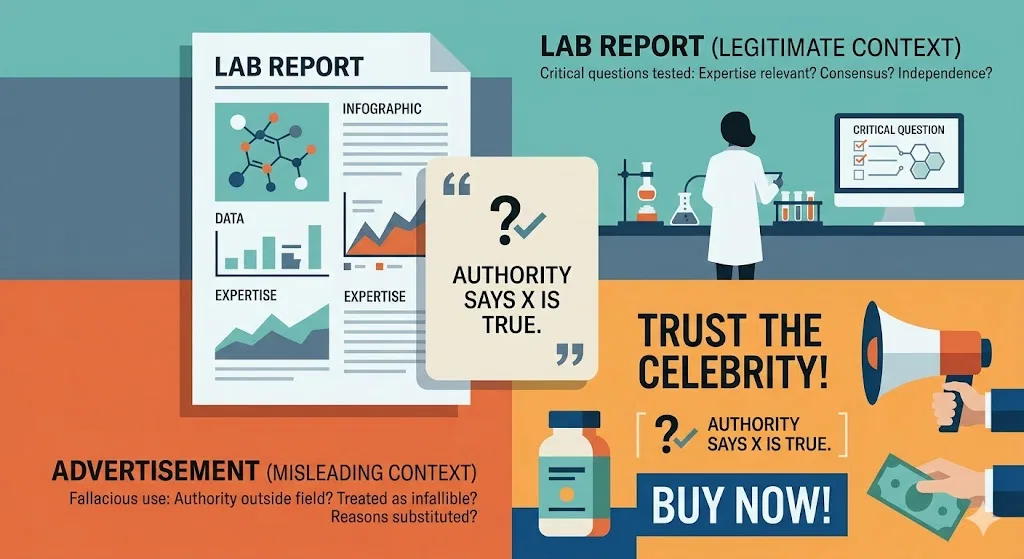
Appeal to authority is the clearest example. It is often sensible to rely on a doctor about treatment, an engineer about load-bearing design, or a specialist historian about a primary source. Modern societies depend on distributed expertise; no one can personally verify every technical claim. The fallacy appears when the authority is outside their field, treated as infallible, quoted without the supporting evidence, or used where the audience needs reasons rather than mere status.[Athabasca University Press]read.aupress.caSource details in endnotes.
Appeal to ignorance is another classic borderline case. “No one has proved it false, so it is true” is usually weak. But in legal and procedural contexts, lack of proof can matter because the burden of proof is allocated in advance. If the prosecution has not proved guilt to the required standard, “not guilty” is the correct legal outcome; that does not mean the defendant’s innocence has been scientifically demonstrated. Walton’s work on non-fallacious arguments from ignorance makes this point by tying correctness to burden of proof within a dialogue.[JSTOR]jstor.orgSource details in endnotes. PhilPapers Emotional appeals also sit on this border. Pity[philpapers.org]philpapers.orgOpen source on philpapers.org., fear, anger or sympathy can be manipulative when they replace evidence. Yet emotions can also draw attention to morally relevant facts: suffering, danger, injustice, vulnerability or urgency. A safety campaign that describes the consequences of drink-driving is not fallacious merely because it evokes fear; it becomes fallacious if the fear is disproportionate, unsupported, or used to smuggle in a conclusion that the evidence does not justify. Walton’s work on emotion in argument explicitly rejects the simple textbook view that emotional appeals are always fallacious.[Persée]persee.frPersée Chapitre 17. Conversational Logic and Appeals to EmotionPersée Chapitre 17. Conversational Logic and Appeals to Emotion[Google Books]books.google.comBooks The Place of Emotion in ArgumentBooks The Place of Emotion in Argument
Context Clues That Decide the Case
The best clues are not decorative details around the argument; they are features that change how much support the reason provides. A reader can usually test a borderline case by asking what kind of conversation is happening, what claim is being made, and what standard of evidence would be fair for that claim.
The size of the conclusion matters. A small claim needs less support than a sweeping one. “This restaurant was slow on Saturday night” can rest on one visit. “This restaurant is always badly managed” needs broader evidence. Hasty generalisation occurs when the arguer stretches a small or unrepresentative sample beyond what it can bear.[Excelsior OWL]owl.excelsior.eduOpen source on excelsior.edu.
The role of the speaker matters when credibility is evidence. If a scientist presents data, attacking their personality is usually irrelevant to whether the data are sound. If a paid spokesperson claims to be an independent witness, their financial interest may be relevant. The difference is not whether the comment concerns a person; it is whether that personal fact bears on the specific support being offered. Research on ad hominem argument has therefore distinguished illegitimate personal attacks from credibility challenges that can be relevant in practical reasoning.[Informal Logic]informallogic.caStanford Encyclopedia of PhilosophyInformal Logic - Stanford Encyclopedia of Philosophyby L Groarke · 1996 · Cited by 97 — Different info…[University of Saarland]uni-saarland.deSource details in endnotes.
The available alternatives matter. A false dilemma presents too few options as if they exhaust the field. But not every two-option framing is false. In an exam, “submit by the deadline or receive a penalty” may genuinely describe the rule. In a policy debate, “accept this plan or you hate progress” is likely a false dilemma because it excludes compromise, revision, delay or rival plans. The clue is whether the omitted alternatives are live options in the situation.[Excelsior OWL]owl.excelsior.eduOWLFalse Dilemma FallacyOWLFalse Dilemma Fallacy
The burden of proof matters. In science, a lack of disproof rarely establishes a positive claim. In law, administration, risk management and ordinary decision-making, the burden may fall on one side for practical reasons. “We have no evidence this bridge is safe, so we should not open it” is not the same as “No one has proved ghosts do not exist, so they exist.” The first is a precautionary decision under responsibility; the second turns absence of disproof into positive proof.
The purpose of the exchange matters. A classroom explanation, a public debate, a negotiation, a scientific inquiry and a criminal trial have different norms. Pragma-dialectical theory treats fallacies as moves that violate rules for resolving a difference of opinion at the stage where they occur. That means an interruption, challenge, burden shift or refusal to answer can be legitimate in one stage of discussion and obstructive in another.[Springer]link.springer.comOpen source on springer.com.[PhilPapers]philpapers.orgOpen source on philpapers.org.
Four Borderline Patterns Worth Recognising
Appeal to expertise: shortcut or substitute?
A good appeal to expertise is a rational shortcut through a complex evidence field. It says, in effect: “This claim is supported by someone with relevant competence, using methods recognised in the field, and there is no stronger contrary reason at hand.” It is especially reasonable when the audience cannot independently inspect all the evidence, as in medicine, engineering, law, climatology or specialist history.
The fallacious version changes the function of expertise. It treats a title as proof, ignores disagreement among qualified experts, cites someone outside their area, or asks the audience to stop asking for reasons. A Nobel Prize winner in physics is not thereby an authority on nutrition policy. A celebrity’s confidence does not become evidence because they sound sincere. In borderline cases, the deciding questions are practical: relevant expertise, independence, field consensus, access to evidence, and whether the expert’s claim is being used as provisional support or as a conversation-stopper.[Athabasca University Press]read.aupress.caSource details in endnotes.[2eecs.qmul.ac.uk]eecs.qmul.ac.ukHarris et al 2016 Cognitive ScienceHarris et al 2016 Cognitive Science
Personal criticism: diversion or credibility evidence?
The standard warning about ad hominem is sound: do not reject an argument merely because of the person making it. A rude, hypocritical or unlikeable speaker can still make a valid point. In scientific contexts, for example, a personal attack normally does nothing to establish whether a theory, measurement or model is true.[Springer]link.springer.comOpen source on springer.com.
But there are cases where credibility is not a distraction. If the argument is “trust this witness”, “take my advice”, “accept my independent judgement” or “believe my testimony”, facts about honesty, competence, conflict of interest or first-hand access may affect the strength of the evidence. The mistake is not mentioning the person; the mistake is using irrelevant personal features to avoid the issue. A useful test is: would this fact still matter if the claim were restated calmly and the speaker were not disliked? If yes, it may be relevant credibility evidence. If no, it is probably a diversion.
Emotion: evidence of stakes or pressure tactic?
Emotional language becomes fallacious when it tries to make the audience feel their way to a conclusion that has not been supported. “Think of the children” can be a way to avoid policy details; outrage can hide weak evidence; pity can be used to excuse a claim that does not follow.[Scribbr]scribbr.comhasty generalization fallacyhasty generalization fallacy
Yet emotion is not automatically opposed to reason. In moral and practical argument, feelings often register what is at stake. Fear may be appropriate when evidence shows danger. Pity may be relevant when the policy question concerns unnecessary suffering. Anger may be rational when the issue is exploitation or abuse. The borderline turns on whether the emotion is connected to a relevant fact and proportionate to the evidence, or whether it is being used to bypass the evidence altogether.[Persée]persee.frPersée Chapitre 17. Conversational Logic and Appeals to EmotionPersée Chapitre 17. Conversational Logic and Appeals to Emotion
Generalisation: useful pattern or overreach?
Generalisation is not a fallacy by itself. Much everyday and scientific reasoning depends on moving from observed cases to broader conclusions. The problem is overreach: a sample that is too small, too unusual, too self-selected or too poorly measured for the conclusion drawn.
A single bad customer-service experience may justify “I had a bad experience”. Several independent reports across branches might justify “there may be a management problem”. A representative survey or audit could support a stronger claim about a company’s overall performance. The same sentence pattern — “these cases show a pattern” — moves from reasonable to fallacious when the population, sample and conclusion no longer fit.[Excelsior OWL]owl.excelsior.eduOpen source on excelsior.edu.[Scribbr]scribbr.comAppeal to Pity Fallacy | Definition & ExamplesAppeal to Pity Fallacy | Definition & Examples
Judgment Calls Need More Than Fallacy Names
Borderline cases are uncomfortable because they resist instant classification. That is not a weakness in fallacy theory; it reflects the way real evidence works. A reason can be relevant but weak, strong but incomplete, legitimate but overstated, or fair in one dialogue and unfair in another. The task is to grade support, not merely stamp an argument as guilty or innocent.
A practical judgement can use four questions:
- What exactly is the conclusion? A narrow conclusion may be supported where a broad one is not.
- What kind of evidence is being offered? Testimony, expertise, statistics, analogy, emotion and absence of evidence each have different standards.
- What has the arguer left out? Missing alternatives, contrary cases, uncertainty, conflicts of interest and burden of proof often decide the case.
- What is the setting? Legal proof, scientific inquiry, emergency action, public persuasion and private advice do not use identical norms.
This approach also helps avoid a common misuse of fallacies: treating labels as insults. Saying “that is an appeal to authority” or “that is emotional” is not yet an analysis. The useful work begins when the label is connected to the support actually available in the case. Computational research on fallacy detection has reached a similar caution: fallacy identification is difficult because models and annotators need structure, context and explanation, not just surface phrases.[arXiv]arxiv.orgSource details in endnotes.

The Best Test Is Support, Not Suspicion
Context does not excuse bad reasoning; it explains how to judge it fairly. A borderline argument is reasonable when the context makes its evidence relevant, its conclusion modest enough, and its assumptions open to challenge. It becomes fallacious when it uses a familiar argumentative move to exaggerate support, hide missing evidence, block criticism or push the audience past what the reasons justify.
That is the practical value of context in borderline fallacy cases. It moves fallacy-spotting away from memorised names and towards better questions: What is being proved? Who carries the burden? What would count against it? Are the examples representative? Is the emotion tied to real stakes? Is the authority relevant? Are alternatives being suppressed? In real argument, those questions usually reveal more than the label alone.
eBay marketplace picks
Marketplace Samples
Topic-anchored marketplace searches for visual, collectible, or second-hand items related to this page.


Endnotes
1.
Source: plato.stanford.edu
Title: Encyclopedia of Philosophy Informal Logic
Link:https://plato.stanford.edu/entries/logic-informal/
Source snippet
Stanford Encyclopedia of PhilosophyInformal Logic - Stanford Encyclopedia of Philosophyby L Groarke · 1996 · Cited by 97 — Different info...
2.
Source: plato.stanford.edu
Title: Encyclopedia of Philosophy Fallacies
Link:https://plato.stanford.edu/entries/fallacies/
Source snippet
Formal fallacies are those readily seen to be instances of...Read more...
3.
Source: plato.stanford.edu
Link:https://plato.stanford.edu/entries/argument/
4.
Source: api.pageplace.de
Title: Page Place Argumentation Schemes
Link:https://api.pageplace.de/preview/DT0400.9781316040607_A25932937/preview-9781316040607_A25932937.pdf
5.
Source: philpapers.org
Link:https://philpapers.org/rec/WALATE
6.
Source: jstor.org
Link:https://www.jstor.org/stable/20014433
7.
Source: eecs.qmul.ac.uk
Title: Harris et al 2016 Cognitive Science
Link:https://eecs.qmul.ac.uk/~ahsu/papers/Harris_et_al-2016-Cognitive_Science.pdf
8.
Source: philpapers.org
Title: WALAFI 3
Link:https://philpapers.org/rec/WALAFI-3
9.
Source: books.google.com
Title: Books The Place of Emotion in Argument
Link:https://books.google.com/books/about/The_Place_of_Emotion_in_Argument.html?id=J_jWAAAAMAAJ
10.
Source: philpapers.org
Title: WALTPO 38
Link:https://philpapers.org/rec/WALTPO-38
11.
Source: owl.excelsior.edu
Link:https://owl.excelsior.edu/argument-and-critical-thinking/logical-fallacies/logical-fallacies-hasty-generalization/
12.
Source: scribbr.com
Title: hasty generalization fallacy
Link:https://www.scribbr.com/fallacies/hasty-generalization-fallacy/
13.
Source: owl.excelsior.edu
Title: OWLFalse Dilemma Fallacy
Link:https://owl.excelsior.edu/argument-and-critical-thinking/logical-fallacies/logical-fallacies-false-dilemma/
14.
Source: link.springer.com
Link:https://link.springer.com/article/10.1007/s10503-023-09605-w
15.
Source: philpapers.org
Title: Phil Papers Frans H. Van Eemeren
Link:https://philpapers.org/rec/VANFIP-2
16.
Source: link.springer.com
Link:https://link.springer.com/article/10.1007/s13194-025-00707-8
17.
Source: scribbr.com
Title: Appeal to Pity Fallacy | Definition & Examples
Link:https://www.scribbr.com/fallacies/appeal-to-pity/
18.
Source: arxiv.org
Link:https://arxiv.org/abs/2406.12402
19.
Source: arxiv.org
Link:https://arxiv.org/abs/2212.07425
20.
Source: arxiv.org
Title: arXiv Theme Aspect Argumentation Model for Handling Fallacies
Link:https://arxiv.org/abs/2205.15141
21.
Source: books.google.com
Title: Argumentation Communication and Fallacie
Link:https://books.google.com/books/about/Argumentation_Communication_and_Fallacie.html?id=PB23DAAAQBAJ
22.
Source: philpapers.org
Title: AUTF 2
Link:https://philpapers.org/rec/AUTF-2
23.
Source: philpapers.org
Title: A Pragmatic Theory of Fallacy
Link:https://philpapers.org/rec/WALAPT-2
24.
Source: scribbr.com
Title: ad hominem fallacy
Link:https://www.scribbr.com/fallacies/ad-hominem-fallacy/
25.
Source: scribbr.com
Title: false dilemma fallacy
Link:https://www.scribbr.com/fallacies/false-dilemma-fallacy/
26.
Source: plato.stanford.edu
Title: logic informal
Link:https://plato.stanford.edu/archives/sum2002/entries/logic-informal/
27.
Source: plato.stanford.edu
Link:https://plato.stanford.edu/archives/fall1997/entries/logic-informal/
28.
Source: plato.stanford.edu
Title: logic informal
Link:https://plato.stanford.edu/archives/fall2025/entries/logic-informal/
29.
Source: plato.stanford.edu
Title: logic informal
Link:https://plato.stanford.edu/archives/fall2021/entries/logic-informal/
30.
Source: plato.stanford.edu
Title: logic informal
Link:https://plato.stanford.edu/archives/win2004/entries/logic-informal/
31.
Source: plato.stanford.edu
Title: logic informal
Link:https://plato.stanford.edu/archives/sum2015/entries/logic-informal/
32.
Source: plato.stanford.edu
Title: logic informal
Link:https://plato.stanford.edu/archives/win2019/entries/logic-informal/
33.
Source: plato.stanford.edu
Title: logic informal
Link:https://plato.stanford.edu/archives/win2003/entries/logic-informal/
34.
Source: link.springer.com
Link:https://link.springer.com/chapter/10.1007/978-3-031-94094
35.
Source: link.springer.com
Link:https://link.springer.com/article/10.1007/s10503-019-09498-8
36.
Source: link.springer.com
Link:https://link.springer.com/content/pdf/10.1007/BF00744762.pdf
37.
Source: books.google.ca
Title: ca Arguments from Ignorance
Link:https://books.google.ca/books?cad=2&id=peTWAAAAMAAJ&source=gbs_book_other_versions_r
38.
Source: encyclopedia.com
Link:https://www.encyclopedia.com/humanities/encyclopedias-almanacs-transcripts-and-maps/fallacies
39.
Source: philosophy.institute
Title: navigating informal fallacies logical discourse
Link:https://philosophy.institute/logic/navigating-informal-fallacies-logical-discourse/
40.
Source: philosophy.institute
Title: understanding fallacies reasoning errors
Link:https://philosophy.institute/logic/understanding-fallacies-reasoning-errors/
41.
Source: persee.fr
Title: Persée Chapitre 17. Conversational Logic and Appeals to Emotion
Link:https://www.persee.fr/doc/epc_1243-1052_2000_ant
42.
Source: informallogic.ca
Link:https://informallogic.ca/index.php/informal_logic/article/view/2990/2442
43.
Source: read.aupress.ca
Link:https://read.aupress.ca/read/critical-thinking-logic-and-argument/section/37569f83-38fb-40e0-9575-ede2c97e5753
44.
Source: uni-saarland.de
Link:https://www.uni-saarland.de/fileadmin/upload/institut/eir/Proceedings/Paper_Kisicek_Gabrijela.pdf
45.
Source: informallogic.ca
Link:https://informallogic.ca/index.php/informal_logic/article/view/3035/2419
46.
Source: informallogic.ca
Link:https://informallogic.ca/index.php/informal_logic/article/view/2868/2408
47.
Source: informallogic.ca
Link:https://informallogic.ca/index.php/informal_logic/article/view/2365/1807
48.
Source: informallogic.ca
Link:https://informallogic.ca/index.php/informal_logic/article/view/2399/1841
49.
Source: Wikipedia
Link:https://en.wikipedia.org/wiki/Fallacy
50.
Source: Wikipedia
Title: Ad hominem
Link:https://en.wikipedia.org/wiki/Ad_hominem
51.
Source: Wikipedia
Title: False dilemma
Link:https://en.wikipedia.org/wiki/False_dilemma
52.
Source: iep.utm.edu
Link:https://iep.utm.edu/argument/
53.
Source: philosophy.lander.edu
Link:https://philosophy.lander.edu/logic/person.html
54.
Source: academia.edu
Title: Arguments from Ignorance
Link:https://www.academia.edu/14858795/Arguments_from_Ignorance
55.
Source: logicallyfallacious.com
Title: False Dilemma
Link:https://www.logicallyfallacious.com/logicalfallacies/False-Dilemma
56.
Source: owl.purdue.edu
Link:https://owl.purdue.edu/owl/general_writing/academic_writing/logic_in_argumentative_writing/fallacies.html
57.
Source: askphilosophers.org
Link:https://www.askphilosophers.org/question/26292
58.
Source: britannica.com
Title: Fallacy | Logic, Definition & Examples
Link:https://www.britannica.com/topic/fallacy
59.
Source: utminers.utep.edu
Link:https://utminers.utep.edu/omwilliamson/engl1311/fallacies.htm
Additional References
60.
Source: academia.edu
Link:https://www.academia.edu/27510144/Arguments_from_Authority_and_Expert_Opinion_in_Computational_Argumentation_Systems
61.
Source: academia.edu
Link:https://www.academia.edu/13563111/Nonfallacious_arguments_from_Ignorance
62.
Source: researchgate.net
Link:https://www.researchgate.net/publication/226932408_Rethinking_the_Fallacy_of_Hasty_Generalization
63.
Source: researchgate.net
Link:https://www.researchgate.net/publication/303793872_Arguments_from_authority_and_expert_opinion_in_computational_argumentation_systems
64.
Source: reddit.com
Link:https://www.reddit.com/r/philosophy/comments/2r4gk5/ad_hominem_fallacy_criticism_of_the_person_making/
65.
Source: youtube.com
Title: Appeal to Authority (Misunderstood Fallacies)
Link:https://www.youtube.com/watch?v=K4cFCGEaJEg
Source snippet
CRITICAL THINKING - Fallacies: Appeal to the People [HD]...
66.
Source: logicallyfallacious.com
Link:https://www.logicallyfallacious.com/logicalfallacies/Appeal-to-Authority
67.
Source: amazon.nl
Link:https://www.amazon.nl/Appeal-Pity-Argumentum-Ad-Misericordiam/dp/0791434621
68.
Source: reddit.com
Link:https://www.reddit.com/r/askphilosophy/comments/18m4fs1/do_logical_fallacies_only_concern_an_arguments/
69.
Source: thinkingispower.com
Link:https://thinkingispower.com/logical-fallacies/
Topic Tree