Within Emotion
Why Emotional Headlines Feel True
Emotional framing can make false headlines feel more believable when readers rely on feeling over checking.
On this page
- How emotion shifts attention away from evidence
- What misinformation studies suggest about belief
- Practical pauses before sharing emotional claims
Page outline Jump by section
Introduction
Emotional framing helps explain why some false headlines feel convincing even when supporting evidence is weak or absent. Within the broader family of appeals to emotion, the key issue is not that people have feelings about news stories, but that emotional reactions can become a shortcut for judging truth. When a headline triggers fear, anger, outrage, hope, or anxiety, readers may focus on the feeling it creates rather than on whether the claim has been verified. Research on misinformation consistently finds that emotional processing is linked to greater susceptibility to false news, while careful attention to accuracy improves truth discernment.[PMC]pmc.ncbi.nlm.nih.govPMCReliance on emotion promotes belief in fake newsWhat is the role of emotion in susceptibility to believing fake news? Prior work on the psychology of misinformation has focused primaril…
 This matters because modern misinformation is often designed around emotional impact. False stories that provoke strong reactions are more likely to be noticed, remembered, shared, and sometimes believed. The emotional response itself does not prove that a claim is false, but it can make accuracy checks feel less urgent at exactly the moment they are most needed. PMC[American Psychological Association]apa.orgmisinformation belief actionAmerican Psychological AssociationWhat psychological factors make people susceptible to…29 Nov 2023 — The emotional content of misinfo…
How Emotion Shifts Attention Away from Evidence
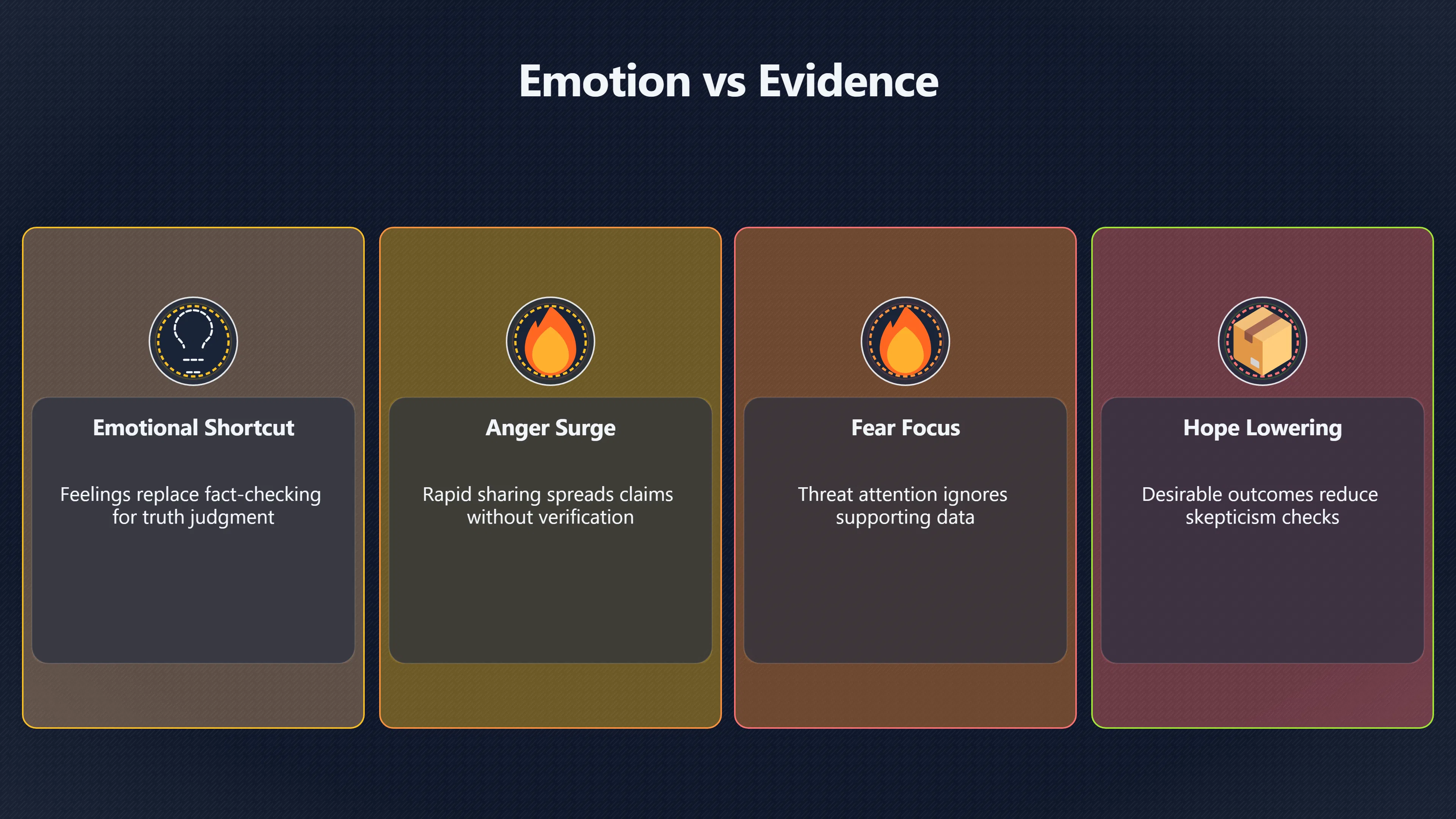
Emotional framing works by changing what readers pay attention to. Instead of asking, “What evidence supports this claim?”, readers may unconsciously ask, “How does this make me feel?” The stronger the emotional reaction, the easier it becomes for that feeling to influence judgments about credibility.
Researchers Cameron Martel, Gordon Pennycook, and David Rand found evidence that reliance on emotion increases belief in fake news. Across multiple studies, people who depended more heavily on emotional processing were more likely to believe false headlines, while greater analytical thinking was associated with better discrimination between true and false information. PMC[springer]link.springer.comon emotion promotes belief in fake newsby C Martel · 2020 · Cited by 769 — First, Study 1 found that experienced emotion, regardless of t… Several emotions appear especially useful for misinformation producers:
- Outrage creates a sense of moral urgency.
- Hope can lower scepticism when a claim promises a desirable outcome.
- Anxiety and uncertainty make people more receptive to simple explanations. Misinformation Review[American Psychological Association]apa.orgmisinformation belief actionAmerican Psychological AssociationWhat psychological factors make people susceptible to…29 Nov 2023 — The emotional content of misinfo…
The emotional content does not have to be fabricated. A real photograph, genuine tragedy, or legitimate grievance can be attached to an unsupported claim. In such cases, the emotion is authentic while the conclusion remains unjustified.
What Misinformation Studies Suggest About Belief
Research on misinformation has increasingly examined emotional responses as a distinct factor in fake news belief. Reviews of the field conclude that emotional appeals are among the psychological mechanisms that help misleading content gain attention and influence online.[PMC]pmc.ncbi.nlm.nih.govby S Munusamy · 2024 · Cited by 37 — Cognitive biases, emotional appeals, and social identity motivations are believed to play a cruci…[PMC]pmc.ncbi.nlm.nih.govEmotions in misinformation studies: distinguishing affective…by J Lühring · 2024 · Cited by 34 — We conclude that studies need to d…
One important finding is that emotion affects belief and sharing in slightly different ways. A person may share a story because it generates outrage or validates a group identity even when they have not carefully assessed its accuracy. Studies of online behaviour suggest that emotionally charged content often receives greater engagement than emotionally neutral information.[Stanford HAI]hai.stanford.eduthe data behind your doom scroll how negative news takes over your feedStanford HAIThe Data Behind Your Doom Scroll: How Negative News…25 Oct 2024 — Analyzing nearly 30 million posts, Stanford scholars rev…[Science]science.orgMisinformation exploits outrage to spread onlineby KL McLoughlin · 2024 · Cited by 114 — We tested a hypothesis that misinformation explo…
Research on COVID-19 misinformation provides a concrete example. A study of South Korean adults found that anger contributed to the spread of misinformation about the pandemic. The mechanism was not simply ignorance; emotional reactions influenced how information was processed and transmitted through social networks.[Misinformation Review]misinforeview.hks.harvard.eduanger contributes to the spread of covid 19 misinformationMisinformation ReviewAnger contributes to the spread of COVID-19 misinformationby J Han · 2020 · Cited by 108 — A survey conducted over S…
At the same time, evidence shows that emotion alone is not the whole story. Some newer research challenges simplistic claims that emotional states automatically make people gullible. A 2025 study reported that pre-existing emotions did not necessarily reduce people’s ability to distinguish true from false news. This suggests that emotional framing interacts with other factors such as prior beliefs, political identity, familiarity, and reasoning style.[Complexity Science Hub]csh.ac.atComplexity Science HubDo Emotions Make Us More Susceptible to Misinformation…12 Mar 2025 — A new study out of the Complexity Science H…
The emerging consensus is therefore more nuanced: emotions do not mechanically create false beliefs, but emotional framing can increase the likelihood that people rely on mental shortcuts instead of evaluating evidence carefully.[PMC]pmc.ncbi.nlm.nih.govThis finding is known as the illusory truth effect.Read more…
Why Emotional Headlines Often Feel True
The feeling of truth is not always the same as truth itself. Emotional framing often works alongside other cognitive effects that reinforce belief.
One important mechanism is processing fluency—the tendency to treat information that feels easy to process as more credible. Emotional headlines are often simple, vivid, and memorable, making them easier to process than cautious, evidence-heavy reporting.[The Decision Lab]thedecisionlab.comThe Decision LabIllusory truth effect - The Decision…The illusory truth effect describes how, when we are repeatedly exposed to misinf…
Another mechanism is the illusory truth effect, in which repeated statements become more believable simply because they are familiar. When emotionally framed misinformation is repeatedly encountered through social media feeds, group chats, and reposts, familiarity can combine with emotional impact to create a strong sense that the claim is probably true.[PMC]pmc.ncbi.nlm.nih.govPMCReliance on emotion promotes belief in fake newsWhat is the role of emotion in susceptibility to believing fake news? Prior work on the psychology of misinformation has focused primaril…
This combination helps explain why false stories can spread widely. Research examining large-scale information diffusion on social media found that false news often spreads farther and faster than true news. Emotional novelty and strong reactions appear to be part of the reason such content gains traction.[MIT News]news.mit.edustudy twitter false news travels faster true stories 0308MIT NewsStudy: On Twitter, false news travels faster than true stories8 Mar 2018 — Researchers from the Media Lab and Sloan found that hu…
Practical Pauses Before Sharing Emotional Claims
Because emotional framing operates quickly, effective resistance often involves creating a brief pause between reaction and action.
Ask What the Emotion Is Doing
When a headline produces an immediate surge of anger, fear, or outrage, it is worth asking whether the emotional reaction is functioning as evidence. Feelings can signal that an issue matters, but they do not verify facts.
A useful question is: What specific evidence would support this claim if the emotional language were removed?
Separate the Claim from the Story
Many misleading posts combine a compelling personal story with a broader factual assertion. The story may be genuine while the larger conclusion remains unsupported.
Readers can distinguish between:[pmc.ncbi.nlm.nih.gov]pmc.ncbi.nlm.nih.govEmotions in misinformation studies: distinguishing affective…by J Lühring · 2024 · Cited by 34 — We conclude that studies need to d…
- The emotional event being described.
- The factual claim the event is being used to prove.
The first does not automatically establish the second.
Check Before Amplifying
Research suggests that prompting people to think about accuracy can improve the quality of information they share. Even a brief moment spent considering whether a claim is true can reduce the influence of emotional impulses.[ScienceDirect]sciencedirect.comReview The Psychology of Fake Newsby G Pennycook · 2021 · Cited by 2116 — We synthesize a burgeoning literature investigatin…
Practical checks include:
- Looking for independent reporting.
- Identifying the original source.
- Reading beyond the headline.
- Checking whether evidence is presented or merely implied.
- Watching for emotionally loaded wording that substitutes for verification.

Why This Matters for Logical Fallacies
Emotional framing and fake news belief illustrate how appeals to emotion can become fallacious. The problem is not that emotions are present; emotions are part of normal human judgment. The problem arises when emotional intensity is treated as evidence for a factual conclusion.
A headline may feel alarming, inspiring, or infuriating. Those reactions may even be reasonable. Yet the truth of the underlying claim depends on evidence, not on the strength of the emotional response it produces. Research on misinformation repeatedly shows that when emotional cues dominate attention, the boundary between feeling that something is true and knowing that it is true becomes easier to cross. PMC[American Psychological Association]apa.orgmisinformation belief actionAmerican Psychological AssociationWhat psychological factors make people susceptible to…29 Nov 2023 — The emotional content of misinfo…
Amazon book picks
Further Reading
Books and field guides related to Why Emotional Headlines Feel True. Use these as the next step if you want deeper reading beyond the article.
Thinking, Fast and Slow
Explains how intuitive emotional reactions can override careful evidence evaluation.
Calling Bullshit
Teaches readers to evaluate claims instead of reacting to emotional framing.
The Skeptics' Guide to the Universe
Provides practical tools for resisting emotionally persuasive misinformation.
eBay marketplace picks
Marketplace Samples
Example marketplace items related to this page. Use the search link to explore similar finds on eBay.







Endnotes
1.
Source: pmc.ncbi.nlm.nih.gov
Title: PMCReliance on emotion promotes belief in fake news
Link:https://pmc.ncbi.nlm.nih.gov/articles/PMC7539247/
Source snippet
What is the role of emotion in susceptibility to believing fake news? Prior work on the psychology of misinformation has focused primaril...
2.
Source: sciencedirect.com
Link:https://www.sciencedirect.com/science/article/pii/S1364661321000516
Source snippet
Review The Psychology of Fake Newsby G Pennycook · 2021 · Cited by 2116 — We synthesize a burgeoning literature investigatin...
3.
Source: pmc.ncbi.nlm.nih.gov
Link:https://pmc.ncbi.nlm.nih.gov/articles/PMC11575416/
Source snippet
by S Munusamy · 2024 · Cited by 37 — Cognitive biases, emotional appeals, and social identity motivations are believed to play a cruci...
4.
Source: link.springer.com
Link:https://link.springer.com/article/10.1186/s41235-020-00252-3
Source snippet
on emotion promotes belief in fake newsby C Martel · 2020 · Cited by 769 — First, Study 1 found that experienced emotion, regardless of t...
5.
Source: pmc.ncbi.nlm.nih.gov
Link:https://pmc.ncbi.nlm.nih.gov/articles/PMC11656008/
Source snippet
Emotions in misinformation studies: distinguishing affective...by J Lühring · 2024 · Cited by 34 — We conclude that studies need to d...
6.
Source: hai.stanford.edu
Title: the data behind your doom scroll how negative news takes over your feed
Link:https://hai.stanford.edu/news/the-data-behind-your-doom-scroll-how-negative-news-takes-over-your-feed
Source snippet
Stanford HAIThe Data Behind Your Doom Scroll: How Negative News...25 Oct 2024 — Analyzing nearly 30 million posts, Stanford scholars rev...
7.
Source: pmc.ncbi.nlm.nih.gov
Link:https://pmc.ncbi.nlm.nih.gov/articles/PMC8116821/
Source snippet
This finding is known as the illusory truth effect.Read more...
8.
Source: news.mit.edu
Title: study twitter false news travels faster true stories 0308
Link:https://news.mit.edu/2018/study-twitter-false-news-travels-faster-true-stories-0308
Source snippet
MIT NewsStudy: On Twitter, false news travels faster than true stories8 Mar 2018 — Researchers from the Media Lab and Sloan found that hu...
9.
Source: sciencedirect.com
Link:https://www.sciencedirect.com/science/article/pii/S1566253524000782
Source snippet
Emotion detection for misinformation: A reviewby Z Liu · 2024 · Cited by 110 — This article comprehensively reviews emotion-based methods...
10.
Source: sciencedirect.com
Link:https://www.sciencedirect.com/science/article/pii/S0747563226001056
Source snippet
Deepfaking the past: Memory and perceived truth of...by MT Soto-Sanfiel · 2026 — The perceived truth judgments in our study align with t...
11.
Source: sciencedirect.com
Title: That’s interesting!
Link:https://www.sciencedirect.com/science/article/abs/pii/S0747563222004393
Source snippet
The role of epistemic emotions and...by A Rijo · 2023 · Cited by 44 — Fake news elicited stronger epistemic emotional responses which in...
12.
Source: apa.org
Title: misinformation belief action
Link:https://www.apa.org/topics/journalism-facts/misinformation-belief-action
Source snippet
American Psychological AssociationWhat psychological factors make people susceptible to...29 Nov 2023 — The emotional content of misinfo...
13.
Source: science.org
Link:https://www.science.org/doi/10.1126/science.adl2829
Source snippet
Misinformation exploits outrage to spread onlineby KL McLoughlin · 2024 · Cited by 114 — We tested a hypothesis that misinformation explo...
14.
Source: misinforeview.hks.harvard.edu
Title: anger contributes to the spread of covid 19 misinformation
Link:https://misinforeview.hks.harvard.edu/article/anger-contributes-to-the-spread-of-covid-19-misinformation/
Source snippet
Misinformation ReviewAnger contributes to the spread of COVID-19 misinformationby J Han · 2020 · Cited by 108 — A survey conducted over S...
15.
Source: csh.ac.at
Link:https://csh.ac.at/news/do-emotions-make-us-more-susceptible-to-misinformation-not-per-se-according-to-a-new-study/
Source snippet
Complexity Science HubDo Emotions Make Us More Susceptible to Misinformation...12 Mar 2025 — A new study out of the Complexity Science H...
16.
Source: thedecisionlab.com
Link:https://thedecisionlab.com/biases/illusory-truth-effect
Source snippet
The Decision LabIllusory truth effect - The Decision...The illusory truth effect describes how, when we are repeatedly exposed to misinf...
17.
Source: facebook.com
Link:https://www.facebook.com/AmericanPsychologicalAssociation/posts/you-keep-seeing-the-same-claim-made-over-and-over-onlineso-it-must-be-true-right/1290086699819665/
18.
Source: Wikipedia
Title: Illusory truth effect
Link:https://en.wikipedia.org/wiki/Illusory_truth_effect
Source snippet
Illusory truth effectRepetition makes statements easier to process relative to new, unrepeated statements, leading people to believe t...
19.
Source: brodhub.eu
Title: Illusory Truth Effect
Link:https://brodhub.eu/en/media-literacy/illusory-truth-effect/
Source snippet
BRODNov 16, 2023 — The illusory truth effect is a cognitive bias wherein repetition increases the perceived truthfulness of a statement...
20.
Source: ebsco.com
Link:https://www.ebsco.com/research-starters/psychology/illusory-truth-effect
Source snippet
Illusory truth effect | Psychology | Research StartersThe illusory truth effect is a cognitive phenomenon where repeated exposure to fals...
Additional References
21.
Source: researchgate.net
Link:https://www.researchgate.net/publication/335131958_Reliance_on_emotion_promotes_belief_in_fake_news
Source snippet
Reliance on emotion promotes belief in fake newsWe found that across a wide range of specific emotions, heightened emotionality at the ou...
22.
Source: fs.blog
Link:https://fs.blog/illusory-truth-effect/
Source snippet
The Illusory Truth EffectThe illusory truth effect is the reason why [advertising]({{ 'advertising/' | relative_url }}) works and why propaganda is one of the most powerful too...
23.
Source: leadalchemists.com
Link:https://www.leadalchemists.com/marketing-psychology/illusory-truth-effect/
24.
Source: researchgate.net
Link:https://www.researchgate.net/publication/345991064_Reliance_on_emotion_promotes_belief_in_fake_news
Source snippet
(PDF) Reliance on emotion promotes belief in fake newsWe found both correlational and causal evidence that reliance on emotion increases...
25.
Source: pledgeproject.eu
Link:https://www.pledgeproject.eu/fear-anger-and-uncertainty-when-disinformation-feeds-on-emotions-in-natural-disasters/
Source snippet
Fear, anger and uncertainty: when disinformation feeds on...6 Nov 2025 — This heightened emotional state, often compounded by an initial...
26.
Source: digitalcommons.uri.edu
Link:https://digitalcommons.uri.edu/cgi/viewcontent.cgi?article=1355&context=jmle
Source snippet
Facts and Feelings: Emotion and News Literacyby S Currie Sivek · 2018 · Cited by 71 — This strongly emotional framing of much fake news p...
27.
Source: psypost.org
Link:https://www.psypost.org/feeling-angry-makes-people-more-likely-to-share-news-from-low-credibility-sources/
Source snippet
source credibility, fueling the rapid spread of fake news... false claims, the specific emotions involved are not entirely understood.Re...
28.
Source: nature.com
Title: Why people share misinformation on social media?
Link:https://www.nature.com/articles/s41599-025-05511-6
Source snippet
M Wu · 2025 · Cited by 6 — How asking users to rate stories affects belief in fake news on social media. Inf Syst Res 33(3):887–...
29.
Source: researchgate.net
Title: (PDF) Detecting Fake News through Emotion Analysisnews detection tasks
Link:https://www.researchgate.net/publication/355023563_Detecting_Fake_News_through_Emotion_Analysis
Source snippet
intent to deceive others, often for malicious purposes.... worded.... same amount of coverage as other forms of fake news (i.e..Read more...
30.
Source: kennesaw.edu
Link:https://www.kennesaw.edu/news/stories/2026/research-shows-emotional-triggers-belief-fake-news.php
Source snippet
New research shows emotional triggers drive belief in fake...Mar 6, 2026 — New research shows emotional triggers drive belief in fake news...
Topic Tree