Within Phones
Do Phone Bans Raise Test Scores?
One influential English study found test-score gains from bans, especially for lower-achieving pupils, but it cannot settle every policy question.
On this page
- What the English city study found
- Why lower achieving pupils mattered
- Limits of turning one study into a slogan
Page outline Jump by section
Introduction
One of the most frequently cited pieces of evidence in debates about school phone bans is the study by economists Louis-Philippe Beland and Richard Murphy, often referred to as the “Ill Communication” study. Supporters of phone restrictions regularly invoke it as proof that banning phones raises academic attainment. Critics often respond that a single study cannot settle a complex policy question. Both reactions contain some truth.
 For discussions about logical fallacies, the important point is not whether the study found an effect—it did—but whether people overstate what that effect proves. The Beland and Murphy findings are relevant evidence about test scores in a specific setting. They are not a universal argument that every phone ban, in every school, will produce the same results.[ScienceDirect]sciencedirect.combanning mobile phones improvesTechnology, distraction & student performanceby LP Beland · 2016 · Cited by 522 — Beland and Murphy (2016) investigated the…
What the English-city study found
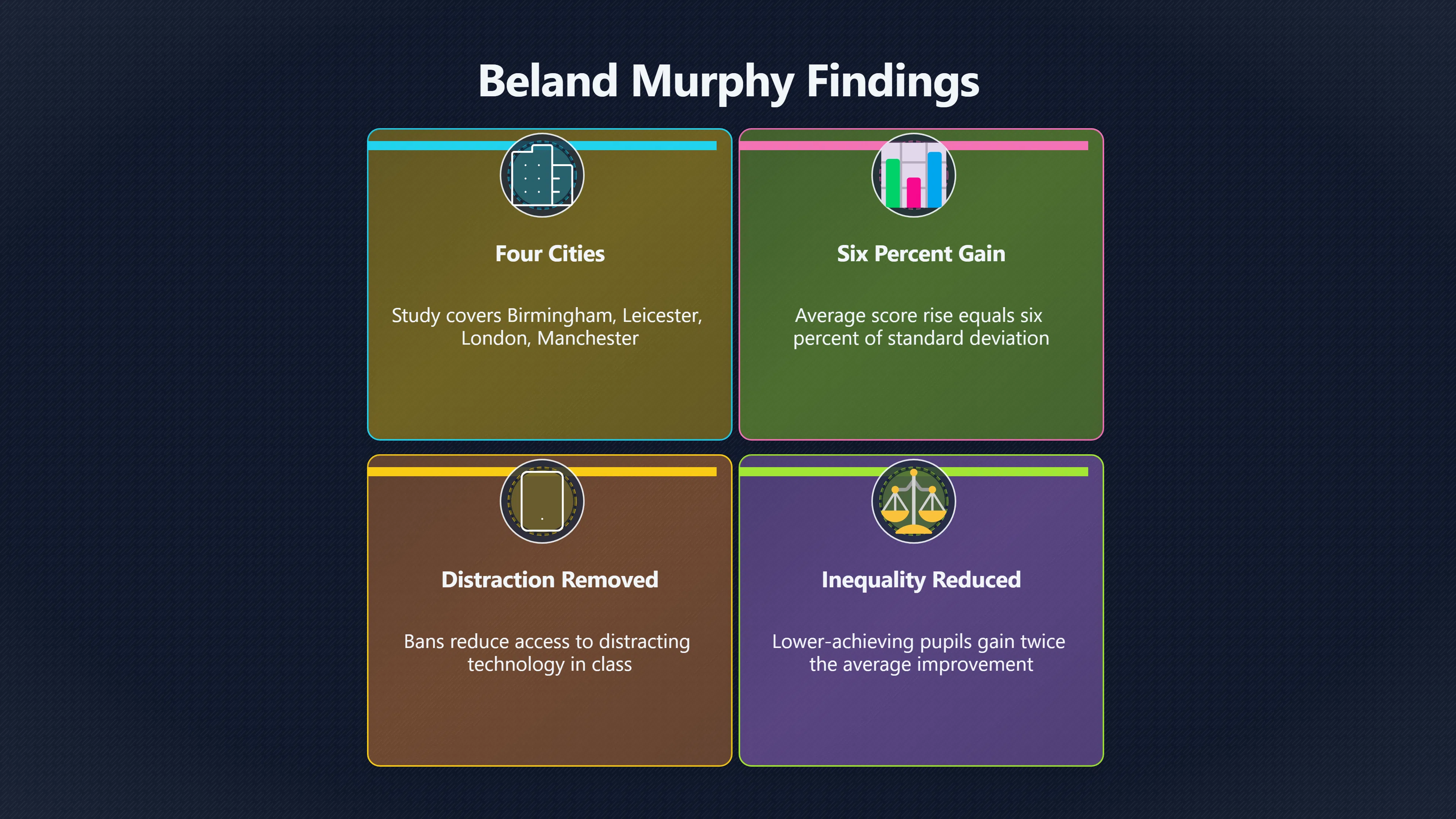
Beland and Murphy examined secondary schools in four English cities—Birmingham, Leicester, London and Manchester—that introduced mobile-phone bans at different times. They combined school policy information with administrative examination data and used a difference-in-differences design, comparing outcomes before and after bans while accounting for other factors affecting attainment.[Centre for Economic Performance]cep.lse.ac.ukThis paper investigates the impact of schools banning mobile phones on student test scores. By surveying schools in…Read more…[Centre for Economic Performance]cep.lse.ac.ukThis paper investigates the impact of schools banning mobile phones on student test scores. By surveying schools in…Read more…
Their central finding was that student performance on high-stakes examinations improved after effective bans were introduced. The estimated average gain was roughly 6 per cent of a standard deviation in test scores, a result widely reported as a meaningful improvement in academic performance.[ScienceDirect]sciencedirect.combanning mobile phones improvesTechnology, distraction & student performanceby LP Beland · 2016 · Cited by 522 — Beland and Murphy (2016) investigated the…[The Guardian]theguardian.comschools mobile phones academic resultsSchools that ban mobile phones see better academic results16 May 2015 — This view is misguided, according to Beland and Murphy, who found…
The study was notable because it examined the removal of a potentially distracting technology rather than the introduction of an educational technology. At the time, much research focused on whether computers or digital tools improved learning. Beland and Murphy instead asked whether reducing access to a distraction could improve outcomes.[ScienceDirect]sciencedirect.combanning mobile phones improvesTechnology, distraction & student performanceby LP Beland · 2016 · Cited by 522 — Beland and Murphy (2016) investigated the…
In phone-ban debates, this finding is often presented as a straightforward causal story: phones distract pupils, bans reduce distraction, and scores rise. The study provides evidence consistent with that explanation, but the strength of the claim depends on understanding exactly which pupils benefited and under what circumstances.[ScienceDirect]sciencedirect.combanning mobile phones improvesTechnology, distraction & student performanceby LP Beland · 2016 · Cited by 522 — Beland and Murphy (2016) investigated the…
Why lower-achieving pupils mattered
The most influential aspect of the study was not the average gain. It was the distribution of the gain.
Beland and Murphy reported that the largest benefits appeared among lower-achieving pupils. High-achieving students showed little measurable effect from the bans, while students who had previously struggled academically experienced much larger improvements. According to the authors’ estimates, the effect for lower-achieving pupils was more than twice the average effect and increased the likelihood of passing examinations.[ScienceDaily]sciencedaily.comMobile phone bans lead to rise in student test scores20 May 2015 — Low-achieving students benefited most from the ban, with t…[Centre for Economic Performance]cep.lse.ac.ukThis paper investigates the impact of schools banning mobile phones on student test scores. By surveying schools in…Read more…
This pattern matters because it suggests that phones may operate as an unequal distraction. If stronger students are already able to resist interruptions or recover from them more effectively, then unrestricted phone access could impose a larger academic cost on students who are already vulnerable to falling behind.[ScienceDaily]sciencedaily.comMobile phone bans lead to rise in student test scores20 May 2015 — Low-achieving students benefited most from the ban, with t…
As a result, advocates of phone bans often argue that restrictions are not merely about improving average scores but about reducing educational inequality. The original authors themselves highlighted the disproportionate gains among lower-achieving and lower-income pupils when discussing the policy implications of their work.[LSE Blogs]blogs.lse.ac.ukphone home should mobiles be banned in schoolsLSE BlogsPhone home: should mobiles be banned in schools?5 Aug 2015 — Our research shows that not only does pupil achievement improve as…
In debates about logical fallacies, however, it is important to distinguish between “this study found larger gains for disadvantaged pupils” and “therefore every school seeking greater equality should adopt the same policy.” The first statement reflects the evidence. The second introduces assumptions that go beyond the evidence itself.

Limits of turning one study into a slogan
The most common misuse of the Beland and Murphy study is treating it as a universal proof that phone bans work everywhere.
First, the study examined particular schools in particular English cities. The findings do not automatically apply to every educational system, age group, enforcement model or technological environment. A policy introduced in a highly compliant school may produce different results from one that exists largely on paper. The researchers themselves emphasised the role of effective implementation and compliance.[My College]my.chartered.collegebanning mobile phones in schools reflecting on the debateMy CollegeBanning mobile phones in schools: Reflecting on the debate16 Jan 2019 — They found that student performance in GCSE exams incre…
Second, later research has not produced a completely uniform picture. Some studies have reported little or no measurable improvement in academic outcomes following phone restrictions. A Swedish replication effort, for example, did not find the same positive effect on academic achievement. Reviews of the evidence note that findings across countries and school systems are mixed rather than unanimous.[PMC]pmc.ncbi.nlm.nih.govPMC“Phones off while school's on”: Evaluating problematicby DL King · 2024 · Cited by 26 — In contrast to Beland and Murphy's study, Kessel et al. reported no improvement in student performan…
More recent research has also complicated simple narratives. Studies in both the United Kingdom and the United States have found that reducing phone access does not necessarily translate into higher grades or broader wellbeing gains, even when phone use itself falls. These findings do not invalidate Beland and Murphy’s work; they indicate that outcomes may depend on context, implementation and the particular outcomes being measured. The Guardian 3The Guardian[The Times]thetimes.co.ukSchools with phone restrictions did not show better mental health outcomes or academic performance compared to those with more permissive…
This is where a logical fallacy can emerge. The evidence supports the narrower claim that one influential study found attainment gains after effective school phone bans, especially for lower-achieving pupils. The evidence does not support the stronger slogan that “phone bans raise test scores” as a universal rule. Converting a context-dependent empirical finding into a blanket conclusion risks overgeneralisation.
What the study can and cannot tell policymakers
The Beland and Murphy study remains important because it provides credible evidence that restricting phone access may improve academic performance under certain conditions. It is especially relevant when discussing classroom distraction and attainment among lower-achieving pupils.[ScienceDirect]sciencedirect.combanning mobile phones improvesTechnology, distraction & student performanceby LP Beland · 2016 · Cited by 522 — Beland and Murphy (2016) investigated the…[Centre for Economic Performance]cep.lse.ac.ukThis paper investigates the impact of schools banning mobile phones on student test scores. By surveying schools in…Read more…
What it cannot do is resolve every question in the wider phone-policy debate. It does not determine the best enforcement method, settle questions about student wellbeing, address parent communication concerns, or prove that all forms of restriction are equally effective. Nor does it show that a phone ban is the only way to reduce distraction.[ScienceDirect]sciencedirect.combanning mobile phones improvesTechnology, distraction & student performanceby LP Beland · 2016 · Cited by 522 — Beland and Murphy (2016) investigated the…[The Guardian]theguardian.comIt found excessive phone and social media use linked to lower grades, poor sleep, disruptive behavior, and lack of exercise. These negati…
For readers interested in logical fallacies, the key lesson is straightforward: citing Beland and Murphy is not fallacious. Treating the study as conclusive proof that every school must adopt the same policy is. The study is strong evidence within a specific evidential frame, but it is not a shortcut around the broader policy debate.[ScienceDirect]sciencedirect.combanning mobile phones improvesTechnology, distraction & student performanceby LP Beland · 2016 · Cited by 522 — Beland and Murphy (2016) investigated the…[Centre for Economic Performance]cep.lse.ac.ukThis paper investigates the impact of schools banning mobile phones on student test scores. By surveying schools in…Read more…

Amazon book picks
Further Reading
Books and field guides related to Do Phone Bans Raise Test Scores?. Use these as the next step if you want deeper reading beyond the article.
Thinking, Fast and Slow
Helps readers evaluate claims about school policies and research evidence.
The Demon-Haunted World
Teaches how to assess evidence without overstating conclusions.
eBay marketplace picks
Marketplace Samples
Example marketplace items related to this page. Use the search link to explore similar finds on eBay.







Endnotes
1.
Source: sciencedirect.com
Title: banning mobile phones improves
Link:https://www.sciencedirect.com/science/article/abs/pii/S0927537116300136
Source snippet
Technology, distraction & student performanceby LP Beland · 2016 · Cited by 522 — Beland and Murphy (2016) investigated the...
2.
Source: sciencedaily.com
Link:https://www.sciencedaily.com/releases/2015/05/150518121140.htm
Source snippet
Mobile phone bans lead to rise in student test scores20 May 2015 — Low-achieving students benefited most from the ban, with t...
Published: May 2015
3.
Source: cep.lse.ac.uk
Link:https://cep.lse.ac.uk/_new/publications/abstract.asp?index=4639
Source snippet
This paper investigates the impact of schools banning mobile phones on student test scores. By surveying schools in...Read more...
4.
Source: cep.lse.ac.uk
Link:https://cep.lse.ac.uk/pubs/download/dp1350.pdf
Source snippet
Centre for Economic PerformanceTechnology, Distraction & Student Performance Louis-...by LP Beland · 2015 · Cited by 519 — This paper in...
5.
Source: cep.lse.ac.uk
Link:https://cep.lse.ac.uk/_NEW/PUBLICATIONS/abstract.asp?index=8230
Source snippet
Centre for Economic Performancetechnology, distraction and student performanceLouis-Philippe Beland and Richard Murphy This paper inves...
6.
Source: theguardian.com
Title: schools mobile phones academic results
Link:https://www.theguardian.com/education/2015/may/16/schools-mobile-phones-academic-results
Source snippet
Schools that ban mobile phones see better academic results16 May 2015 — This view is misguided, according to Beland and Murphy, who found...
Published: May 2015
7.
Source: cep.lse.ac.uk
Link:https://cep.lse.ac.uk/_NEW/NEWS/abstract.asp?index=6044
Source snippet
Centre for Economic PerformanceStudents who use digital devices in class 'perform worse...Research published last year by the London Sch...
8.
Source: blogs.lse.ac.uk
Title: phone home should mobiles be banned in schools
Link:https://blogs.lse.ac.uk/politicsandpolicy/phone-home-should-mobiles-be-banned-in-schools/
Source snippet
LSE BlogsPhone home: should mobiles be banned in schools?5 Aug 2015 — Our research shows that not only does pupil achievement improve as...
9.
Source: my.chartered.college
Title: banning mobile phones in schools reflecting on the debate
Link:https://my.chartered.college/impact_article/banning-mobile-phones-in-schools-reflecting-on-the-debate/
Source snippet
My CollegeBanning mobile phones in schools: Reflecting on the debate16 Jan 2019 — They found that student performance in GCSE exams incre...
10.
Source: theguardian.com
Link:https://www.theguardian.com/education/2025/feb/05/school-ban-phones-not-improve-grades-health-uk-study
Source snippet
It found excessive phone and [social media]({{ 'social-media/' | relative_url }}) use linked to lower grades, poor sleep, disruptive behavior, and lack of exercise. These negati...
11.
Source: thetimes.co.uk
Link:https://www.thetimes.co.uk/article/school-curbs-on-phones-do-not-improve-childrens-mental-health-lljqc73zp
Source snippet
Schools with phone restrictions did not show better mental health outcomes or academic performance compared to those with more permissive...
12.
Source: theguardian.com
Link:https://www.theguardian.com/[politics
Source snippet
study by researchers from universities including Stanford and Duke challenges the effectiveness of strict mobile phone bans in schools, f...
Additional References
13.
Source: washingtonpost.com
Link:https://www.washingtonpost.com/education/2026/05/04/cell-phone-bans-impact-study/
Source snippet
Researchers from institutions like Stanford and Duke concluded that such bans lead to negligible changes in test scores and attendance. W...
14.
Source: the74million.org
Link:https://www.the74million.org/article/banning-smartphones-at-schools-research-points-to-higher-test-scores-less-anxiety-more-exercise/
Source snippet
2016, academics Louis-Phillipe Beland and Richard Murphy... bans on mobile phones saw significant improvement in scores on high-stakes t...
15.
Source: policyexchange.org.uk
Link:https://policyexchange.org.uk/publication/disconnect/
16.
Source: pmc.ncbi.nlm.nih.gov
Title: PMC“Phones off while school’s on”: Evaluating problematic
Link:https://pmc.ncbi.nlm.nih.gov/articles/PMC11737419/
Source snippet
by DL King · 2024 · Cited by 26 — In contrast to Beland and Murphy's study, Kessel et al. reported no improvement in student performan...
17.
Source: lpbeland.com
Link:https://www.lpbeland.com/uploads/7/8/7/5/7875420/lpblabour_1-s2.0-s0927537116300136-main.pdf
Source snippet
Ill Communication: Technology, distraction &by LP Beland · 2016 · Cited by 498 — This paper investigates the impact of schools banning...
18.
Source: ideas.repec.org
Link:https://ideas.repec.org/a/eee/labeco/v41y2016icp61-76.html
Source snippet
Communication: Technology, distraction & student...by LP Beland · 2016 · Cited by 498 — This paper investigates the impact of schools ba...
19.
Source: ideas.repec.org
Link:https://ideas.repec.org/p/cep/cepdps/dp1350.html
Source snippet
Communication: Technology, Distraction & Student...by LP Beland · 2015 · Cited by 493 — This paper investigates the impact of schools ba...
20.
Source: researchgate.net
Title: 301353144 Ill Communication Technology distraction student performance
Link:https://www.researchgate.net/publication/301353144_Ill_Communication_Technology_distraction_student_performance
Source snippet
Ill Communication: Technology, distraction & student...A seminal study by Beland and Murphy (2016) found that banning mobile phones in s...
21.
Source: lordslibrary.parliament.uk
Title: House of Lords Library Mobile phones in schools: Mandating a ban?
Link:https://lordslibrary.parliament.uk/mobile-phones-in-schools-mandating-a-ban/
Source snippet
Lords Library21 Nov 2024 — It found test scores increased by more than six percentage points in those schools which banned phones, so lon...
22.
Source: ideas.repec.org
Title: student performance in high stakes exams significantly increases
Link:https://ideas.repec.org/p/ehl/lserod/62574.html
Source snippet
communication: technology, distraction & studentperformaby LP Beland · 2015 · Cited by 522 — This paper investigates the impact of school...
Topic Tree