Within Sports Cause
Did the Logo Really Cause the Losing Streak?
A losing streak after a crest change can feel like proof, but timing alone cannot show that the badge caused the slump.
On this page
- Why sequence feels like evidence
- What the post hoc fallacy misses
- Questions that test a logo causation claim
Page outline Jump by section
Introduction
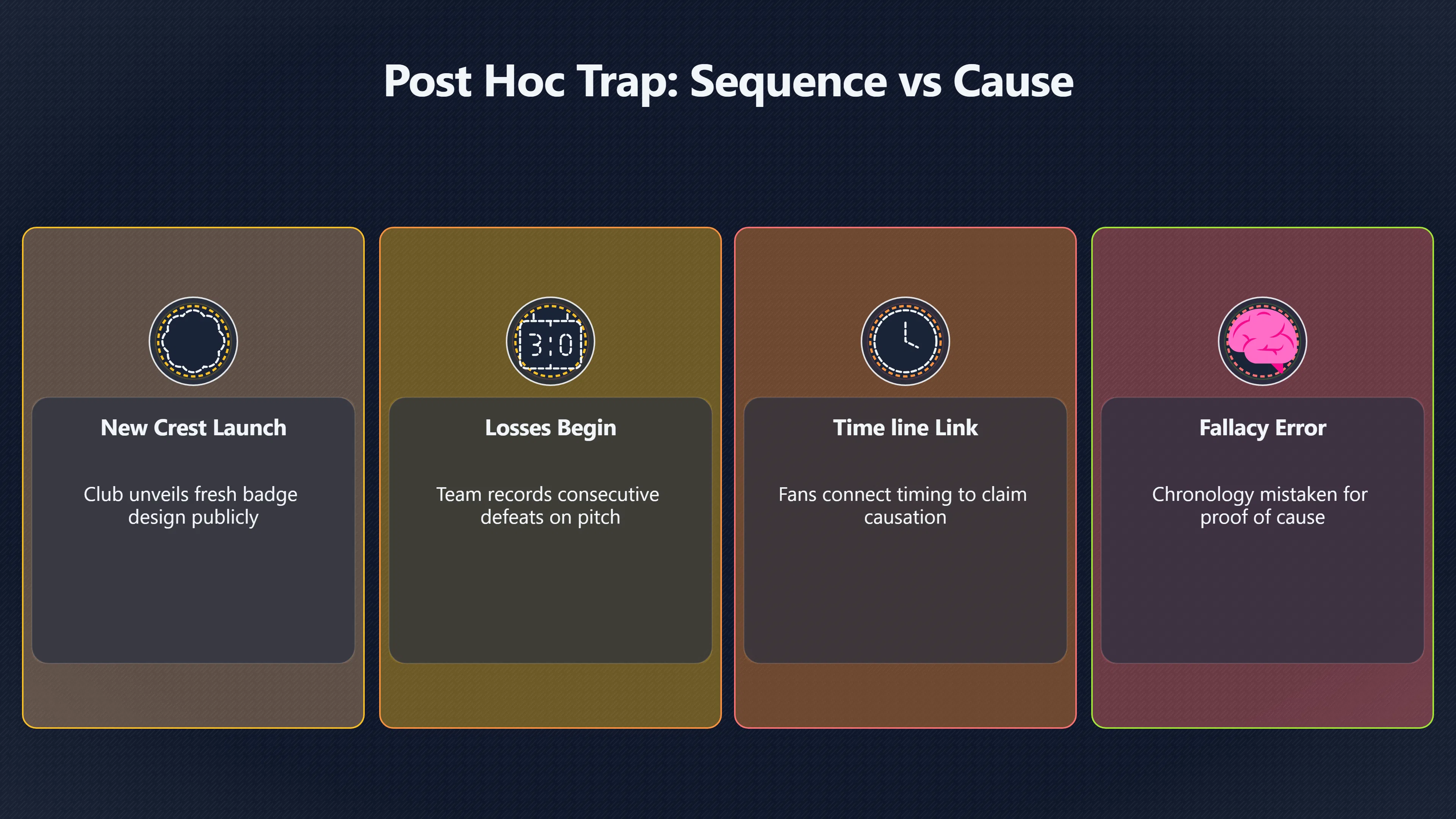
A team unveils a new crest, alternate badge, or modernised logo. A month later, the club is on a losing streak. For many supporters, the sequence feels self-explanatory: the logo changed, then the defeats arrived, so the logo must have caused the slump. This is a classic example of the post hoc fallacy—assuming that because one event happened before another, it caused it. Timing can suggest a question worth investigating, but it does not by itself establish cause.[scribbr]scribbr.compost hoc fallacyDefinition & Examples8 May 2023 — The post hoc fallacy is the assumption that because one event preceded another event, they must be caus… Sports fans are especially vulnerable to this mistake because logos are highly visible symbols. A tactical error, injury crisis, or difficult run of fixtures is harder to see than a new badge printed on every shirt and social-media graphic. When emotions are running high, the most visible change can become the easiest target.
Why Sequence Feels Like Evidence
The attraction of logo-causation claims is not irrational; it is rooted in how people naturally search for explanations.
A logo change often arrives as a clear, memorable event. Fans can point to a specific launch date, compare old and new designs, and connect the redesign to debates about tradition, ownership, or club identity. When disappointing results follow, the timeline appears neat and compelling. The human mind is generally more comfortable with a simple story than with a complex mix of injuries, recruitment decisions, tactical adjustments, luck, and opponent quality.[Wikipedia]WikipediaPost hoc ergo propter hocPost hoc ergo propter hoc
Sports branding research helps explain why logo changes attract such attention. Studies of team logo redesigns consistently find that supporters can react strongly to rebranding efforts, particularly when identification with the club is high. Changes influence attitudes toward the brand, merchandise, and perceptions of the organisation.[Emerald Publishing]emerald.comEmerald PublishingSport rebranding: the effect of different degrees of sport logo…This study sought to examine how a critical aspect o…[3ResearchGate 3ResearchGate]researchgate.netSport Fans and Their Teams' Redesigned LogosThe current study sought to identify the effect of team identification on brand a…
That emotional significance, however, does not automatically translate into competitive consequences. A fan may dislike a crest and still be watching the same players, coach, and tactical system.
What the Post Hoc Fallacy Misses
The central mistake is treating chronology as proof.
The fact that losses followed a logo change establishes only that the two events occurred in that order. It does not show that the redesign altered match outcomes. Statistically, association and causation are different concepts. Two events can occur together—or one after the other—without one producing the other. Australian Bureau of Statistics[JMP]jmp.comIntroduction to StatisticsCorrelation is a statistical measure that expresses the extent to which two variables change together at a cons…
Consider a football club that introduces a new crest before the season and then struggles through its first ten matches. Many alternative explanations could exist:
- Key players may have suffered injuries.
- The team may have faced stronger opponents than usual.
- A new manager may be implementing a different system.
- Recruitment decisions may have weakened the squad.
- Results may simply reflect ordinary variation in a small sample of matches.
Without evidence connecting the logo change to these performance factors, blaming the crest remains speculation rather than causal analysis.
Importantly, the post hoc mistake can occur even when supporters identify a real problem. Owners who mishandle a rebrand might also be making poor football decisions. In that case, both the unpopular logo and the losing streak could stem from the same underlying management issues. The logo would be a symptom of broader organisational problems, not the direct cause of defeats.
When a Logo Change Could Matter Indirectly
Avoiding the post hoc fallacy does not require claiming that branding can never influence performance.
A redesign could theoretically have indirect effects if it becomes part of a wider organisational conflict. For example, a deeply unpopular rebrand might damage trust between supporters and club leadership, create negative media attention, or contribute to a sense of instability. Research on sport rebranding shows that fan attitudes toward rebranding can influence loyalty and brand perceptions, particularly among highly identified supporters.[ResearchGate]researchgate.netSport Fans and Their Teams' Redesigned LogosThe current study sought to identify the effect of team identification on brand a…[ResearchGate However]researchgate.netSport Fans and Their Teams' Redesigned LogosThe current study sought to identify the effect of team identification on brand a…, this is a much stronger and more demanding claim than “the team started losing after the logo changed.” To establish such a connection, evidence would be needed showing a plausible mechanism linking the branding decision to morale, behaviour, or organisational effectiveness. Timing alone is insufficient.
The distinction matters because post hoc reasoning skips over the mechanism. It jumps directly from sequence to causation without demonstrating how the supposed cause produced the outcome.
Why Losing Streaks Strengthen the Belief
Losing streaks create ideal conditions for superstition.
During successful periods, supporters often tolerate controversial branding decisions. When results collapse, the same logo can become a symbol of everything perceived to be wrong with the club. The crest is constantly visible, making it an easy focal point for frustration.
This process is reinforced by selective memory. Fans remember the redesigns that were followed by poor results and forget the many cases where teams changed logos without any obvious effect on performance. The dramatic examples remain memorable, while the uneventful ones disappear from discussion.
The result is a self-reinforcing narrative:
- The logo changes.[academia.edu]academia.eduPDF) Sport Fans and Their Teams' Redesigned LogosThe current study sought to identify the effect of team identification on brand attitud…
- The team struggles.
- The timing is interpreted as proof.
- Every subsequent defeat appears to confirm the theory.
Yet none of these steps independently demonstrates causation.
Questions That Test a Logo-Causation Claim
When someone argues that a crest change caused a losing run, several questions can help separate evidence from assumption.
What mechanism connects the logo to performance?
A credible causal claim should explain how the redesign influenced players, coaches, decision-makers, or supporters in a way that plausibly affected results. Simply pointing to the timeline is not enough.
Did other important factors change at the same time?
Logo redesigns often occur alongside ownership changes, commercial strategies, coaching transitions, or squad rebuilding projects. Any of these factors may be more relevant to results than the badge itself.
Would the same argument be accepted after a winning streak?
If a club changed its logo and immediately won ten matches, many observers would hesitate to credit the crest for the success. Applying different standards to wins and losses is a warning sign that emotion may be driving the reasoning.
Is there evidence beyond the sequence of events?
The strongest causal claims require more than chronology. They need evidence that the proposed cause actually influenced the outcome. Without that additional support, the argument remains a post hoc inference rather than a demonstrated explanation.[Scribbr]scribbr.compost hoc fallacyDefinition & Examples8 May 2023 — The post hoc fallacy is the assumption that because one event preceded another event, they must be caus…
The Better Interpretation
A logo change followed by poor results may be emotionally satisfying as an explanation, but it is rarely persuasive as evidence. Sports branding research shows that redesigns can affect fan attitudes, loyalty, and perceptions of club identity. What it does not show is that a badge automatically determines wins and losses.[Emerald Publishing]emerald.comEmerald PublishingSport rebranding: the effect of different degrees of sport logo…This study sought to examine how a critical aspect o…[3ResearchGate 3ResearchGate]researchgate.netSport Fans and Their Teams' Redesigned LogosThe current study sought to identify the effect of team identification on brand a…
The post hoc mistake arises when supporters treat sequence as proof. The crest appeared first, the defeats came later, therefore the crest caused the defeats. In reality, chronology identifies a coincidence that may deserve investigation. It does not, by itself, establish a cause-and-effect relationship.[Scribbr]scribbr.compost hoc fallacyDefinition & Examples8 May 2023 — The post hoc fallacy is the assumption that because one event preceded another event, they must be caus…
Amazon book picks
Further Reading
Books and field guides related to Did the Logo Really Cause the Losing Streak?. Use these as the next step if you want deeper reading beyond the article.
Fooled by Randomness
Rating: 4.0/5 from 15 Google Books ratings
Directly addresses post hoc reasoning.
eBay marketplace picks
Marketplace Samples
Example marketplace items related to this page. Use the search link to explore similar finds on eBay.






Endnotes
1.
Source: Wikipedia
Title: Post hoc ergo propter hoc
Link:https://en.wikipedia.org/wiki/Post_hoc_ergo_propter_hoc
2.
Source: scribbr.com
Title: post hoc fallacy
Link:https://www.scribbr.com/fallacies/post-hoc-fallacy/
Source snippet
Definition & Examples8 May 2023 — The post hoc fallacy is the assumption that because one event preceded another event, they must be caus...
Published: May 2023
3.
Source: researchgate.net
Link:https://www.researchgate.net/publication/286595819_Sport_Fans_and_Their_Teams%27_Redesigned_Logos_An_Examination_of_the_Moderating_Effect_of_Team_Identification_on_Attitude_and_Purchase_Intention_of_Team-Logoed_Merchandise
Source snippet
Sport Fans and Their Teams' Redesigned LogosThe current study sought to identify the effect of team identification on brand a...
4.
Source: researchgate.net
Link:https://www.researchgate.net/publication/349937138_The_Influence_of_Logo_Change_on_Brand_Loyalty_and_the_Role_of_Attitude_Toward_Rebranding_and_Logo_Evaluation
Source snippet
Through an experimental approach, the results...Read more...
5.
Source: researchgate.net
Link:https://www.researchgate.net/publication/352796556_Sport_rebranding_the_effect_of_different_degrees_of_sport_logo_redesign_on_brand_attitude_and_purchase_intention
Source snippet
the effect of different degrees of sport logo redesign on...This study sought to examine how a critical aspect of rebranding – logo rede...
6.
Source: emerald.com
Link:https://www.emerald.com/ijsms/article/23/1/155/156606/Sport-rebranding-the-effect-of-different-degrees
Source snippet
Emerald PublishingSport rebranding: the effect of different degrees of sport logo...This study sought to examine how a critical aspect o...
7.
Source: jmp.com
Link:https://www.jmp.com/en/statistics-knowledge-portal/linear-models/what-is-correlation
Source snippet
Introduction to StatisticsCorrelation is a statistical measure that expresses the extent to which two variables change together at a cons...
8.
Source: Wikipedia
Link:https://en.wikipedia.org/wiki/Correlation
Source snippet
CorrelationIn statistics, correlation is a type of statistical relationship between two random variables or bivariate data. It usually...
9.
Source: researchgate.net
Link:https://www.researchgate.net/publication/322235137_How_Do_Fans_React_When_Sports_Teams_Are_Named_After_Corporations
Source snippet
How Do Fans React When Sports Teams Are Named After...PDF | The reaction to Red Bull naming its soccer teams after the corporation and p...
10.
Source: researchgate.net
Link:https://www.researchgate.net/publication/324019016_A_model_of_fans%27_reaction_to_resurrected_brands_of_sport_organizations
Source snippet
te or hinder a favorable reaction of fans to the resurrection of sport club...Read more...
11.
Source: scribbr.co.uk
Title: rrelation Coefficient | Types, Formulas & Examples
Link:https://www.scribbr.co.uk/stats/correlation-coefficient-meaning/
Source snippet
rrelation Coefficient | Types, Formulas & Examples - Scribbr17 Dec 2023 — A correlation coefficient is a number between -1 and 1 that t...
12.
Source: philosophy.lander.edu
Link:https://philosophy.lander.edu/logic/cause.html
Source snippet
(Non Causa Pro Causa) with Many ExamplesCum hoc ergo propter hoc is an erroneous argument concluding one state of affairs causes another...
Additional References
13.
Source: academia.edu
Link:https://www.academia.edu/76621978/Sport_Fans_and_Their_Teams_Redesigned_Logos_An_Examination_of_the_Moderating_Effect_of_Team_Identification_on_Attitude_and_Purchase_Intention_of_Team_Logoed_Merchandise
Source snippet
(PDF) Sport Fans and Their Teams' Redesigned LogosThe current study sought to identify the effect of team identification on brand attitud...
14.
Source: bmj.com
Link:https://www.bmj.com/about-bmj/resources-readers/publications/statistics-square-one/11-correlation-and-[regression
Source snippet
11. Correlation and regressionWe use correlation to denote association between two quantitative variables. We also assume that the associ...
15.
Source: peachytutors.com
Link:https://peachytutors.com/the-logical-fallacy-in-sports-examining-the-post-hoc-ergo-propter-hoc-fallacy/
Source snippet
Examining the "Post Hoc Ergo Propter Hoc" FallacyThe Latin phrase “Post Hoc Ergo Propter Hoc” translates to “After this, therefore becaus...
16.
Source: thilokunkel.com
Link:https://www.thilokunkel.com/sport-team-brands/
Source snippet
Sport Team BrandsBrand image refers to the perceptions about a brand as reflected by the brand associations held in consumer memory. Bran...
17.
Source: behance.net
Link:https://www.behance.net/search/projects/sports%20logo%20redesign
Source snippet
Sports Logo Redesign ProjectsBehance is the world's largest creative network for showcasing and discovering creative sports logo redesign...
18.
Source: effectiviology.com
Link:https://effectiviology.com/post-hoc/
Source snippet
The Post Hoc Ergo Propter Hoc FallacyThis is based on the false premise that if one event happens before another, then the first event mu...
19.
Source: medium.com
Link:https://medium.com/higher-neurons/the-post-hoc-ergo-propter-hoc-fallacy-5c8d4ceb568a
Source snippet
The Post Hoc Ergo Propter Hoc Fallacy | by Myk EffThe “post hoc ergo propter hoc” fallacy is a common logical error that people commit wh...
20.
Source: medium.com
Link:https://medium.com/%40noorfatimaafzalbutt/understanding-correlation-a-comprehensive-guide-b254be461b5c
Source snippet
Understanding Correlation: A Comprehensive GuideCorrelation is a statistical measure that describes the extent to which two variables cha...
21.
Source: s-space.snu.ac.kr
Link:https://s-space.snu.ac.kr/handle/10371/215619
Source snippet
Fans' Resistance Towards a Sports Team Rebranding...This study explores the impact of the rebranding of SK Wyverns to SSG Landers on fan...
22.
Source: westga.edu
Link:https://www.westga.edu/share/documents/pubs/091175_869.pdf
Topic Tree