Within Argument Map
When a Scientific Source Does Not Prove the Claim
A source may be real while the conclusion drawn from it goes far beyond what the evidence supports.
On this page
- Mapping the cited finding
- Reconstructing the missing bridge
- Spotting overstated conclusions
Page outline Jump by section
Introduction
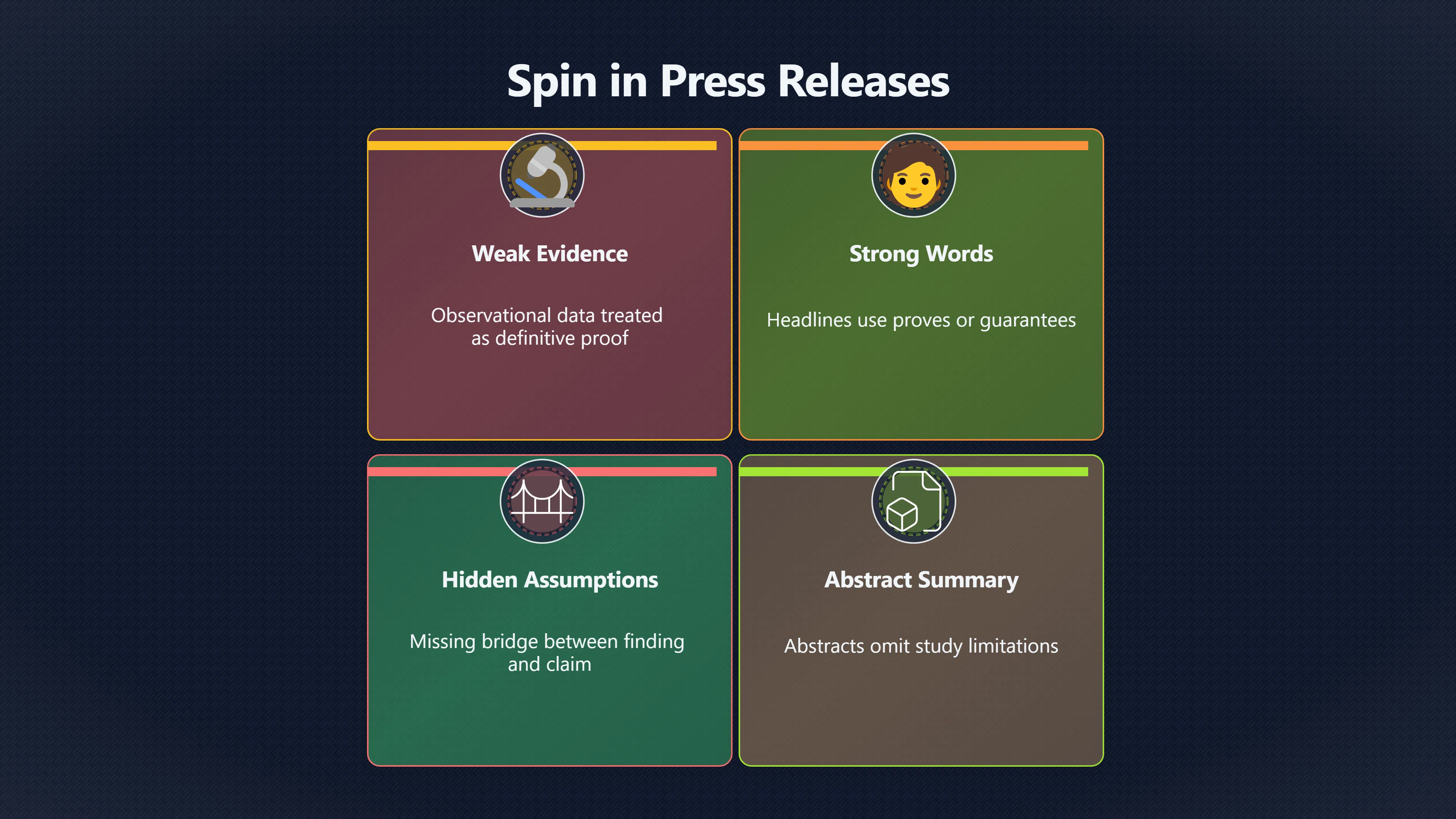
A scientific paper can be genuine, peer-reviewed, and accurately cited, yet still fail to support the conclusion attached to it. In argument mapping, this is one of the most important evidence-to-claim gaps to identify. The source itself is not fabricated; the problem lies in the inference. A study may show an association, a limited effect in a narrow population, or a preliminary finding, while the argument built upon it claims proof of causation, broad effectiveness, certainty, or policy necessity. The resulting fallacy is not usually about the citation’s existence but about the distance between what the evidence demonstrates and what the conclusion asserts. Research on scientific “spin” and causal overstatement shows that such gaps occur not only in media reporting but also in abstracts, press releases, and scientific communication itself.[PMC]pmc.ncbi.nlm.nih.govPMCPublished patterns of spin in biomedical literatureNIHby N Su · 2021 · Cited by 2 — The primary aim of this study is to identify reported spin patterns and assess the prevalence of s…[PLOS]journals.plos.orgMisrepresentation of Randomized Controlled Trials in Press…by A Yavchitz · 2012 · Cited by 353 — In this study, the researchers ev…
Mapping the Cited Finding
When analysing an argument that relies on a scientific citation, the first step is to separate the cited finding from the claim being defended.
Consider this argument:
- Study: People who sleep less tend to spend more money on food.
- Public claim: Getting more sleep will reduce food spending.
The citation may accurately report a correlation, but the conclusion introduces a causal claim that the study did not establish. Researchers and educators frequently use examples like this to demonstrate how readers leap from association to intervention without sufficient evidence.[lrdc.pitt.edu]lrdc.pitt.eduWhy Correlation Doesn't Imply Causation: ImprovingDecember 21, 2022 — by CL Willett · 2022 · Cited by 10 — “Researchers at the Sleep Research Society have found that people who are tired…
In an argument map, the cited finding should appear as one node and the conclusion as another. The critical question is:
What exactly did the study demonstrate?
Scientific findings often fall into categories such as:
- Correlation between variables.[sciencedirect.com]sciencedirect.commore…
- Experimental evidence under controlled conditions.
- Evidence from a specific population.
- Preliminary or exploratory findings.
- Evidence supporting one part of a larger causal chain.
The conclusion may require a stronger category of evidence than the study provides. Identifying that mismatch reveals the gap.
A common mistake is to treat every scientific citation as if it were direct proof. In reality, the evidential strength depends on study design, measurement quality, sample selection, and the specific question being asked. Observational studies, for example, can identify relationships but generally cannot by themselves establish causal effects.[Ovid]ovid.comAssociation Does Not Mean Causation, When…by F D'Amico · 2025 · Cited by 27 — Observational studies capture two events as they occu…[ScienceDirect]sciencedirect.commore…
Reconstructing the Missing Bridge
Argument mapping becomes especially useful when reconstructing the hidden premise that connects a citation to a conclusion.
Suppose an article states:
A study found that coffee drinkers have lower rates of a disease. Therefore, drinking coffee prevents that disease.
The hidden bridge is:
The observed association is caused by coffee itself rather than by other factors.
Once that assumption is exposed, it can be tested.
Several missing bridges commonly appear in citation-based arguments:
Correlation to causation[lrdc.pitt.edu]lrdc.pitt.eduWhy Correlation Doesn't Imply Causation: ImprovingDecember 21, 2022 — by CL Willett · 2022 · Cited by 10 — “Researchers at the Sleep Research Society have found that people who are tired…
The most familiar gap occurs when an observed association is treated as proof of cause and effect. Confounding variables, reverse causation, and selection effects can all create correlations without the claimed causal relationship. Scientific methodology devotes considerable effort to distinguishing association from causation precisely because the inference is not automatic. ScienceDirect[PMC]pmc.ncbi.nlm.nih.govPMCPublished patterns of spin in biomedical literatureNIHby N Su · 2021 · Cited by 2 — The primary aim of this study is to identify reported spin patterns and assess the prevalence of s…[Ovid]ovid.comAssociation Does Not Mean Causation, When…by F D'Amico · 2025 · Cited by 27 — Observational studies capture two events as they occu…
Limited sample to universal claim
A study conducted on a specific group may be cited as evidence for everyone. The hidden assumption is that the findings generalise across populations, contexts, and conditions.
Short-term finding to long-term prediction
Evidence showing an immediate effect may be cited to justify a prediction about years of future outcomes. The bridge requires assumptions about durability and external conditions that the original study may never have examined.
Statistical significance to practical importance
A study may detect a real effect, yet the effect size may be small. The argument then assumes that statistical significance automatically means meaningful real-world impact.
In each case, the citation provides some support, but not enough support to reach the advertised conclusion.
Why Real Sources Still Produce Misleading Arguments
People often associate misinformation with fake studies or fabricated references. Yet evidence-to-claim gaps frequently arise from authentic research.
Research on scientific communication has documented widespread patterns of “spin”, meaning presentation choices that make results appear stronger, more definitive, or more favourable than the underlying evidence warrants. Reviews of biomedical literature have identified recurring forms of spin, including overstating causal conclusions, emphasising positive interpretations despite uncertain results, and presenting exploratory findings as confirmatory evidence.[PMC]pmc.ncbi.nlm.nih.govPMCPublished patterns of spin in biomedical literatureNIHby N Su · 2021 · Cited by 2 — The primary aim of this study is to identify reported spin patterns and assess the prevalence of s…[The Embassy of Good Science]embassy.scienceThe Embassy of Good ScienceSpin of research resultsSpin is the manipulation of language to potentially mislead readers from the likely tr…
This matters because readers often encounter science indirectly. By the time a finding appears in a news article, policy speech, blog post, or social media argument, the conclusion may have drifted far beyond the original evidence.
Studies examining health communication found that exaggerated causal claims frequently appear in press releases and are then reproduced in news coverage. Importantly, the problem often begins before journalists enter the process; overstatement can already be present in institutional summaries of the research.[King's College London]kclpure.kcl.ac.ukKing's College LondonThe association between exaggeration in health related…by P Sumner · Cited by 598 — Results 40% (95% confidence i…[UK Parliament Committees]committees.parliament.ukUK Parliament CommitteesCOM0067 - Evidence on Science communicationThe proportions of news with exaggerated advice (A), or causal stateme…
For argument mapping, the lesson is simple: the presence of a citation is not the end of analysis. It is the beginning.
Spotting Overstated Conclusions
Several warning signs help identify evidence-to-claim gaps.
Strong language attached to weak evidence
Watch for words such as:
- proves
- demonstrates
- confirms
- shows conclusively
- guarantees
These terms may be inappropriate when the underlying study is observational, exploratory, or limited in scope. Research on causal overstatement repeatedly finds that stronger language is often applied to weaker forms of evidence.[ScienceDirect]sciencedirect.commore…[PLOS]journals.plos.orgMost Published Research Findings Are Falseby JPA Ioannidis · 2005 · Cited by 15946 — Published research findings are sometimes refuted by…
Recommendations that exceed the findings
A study may show a relationship between variables, while the argument recommends a behavioural change, policy intervention, or treatment programme.
The recommendation requires an additional inference step. Argument maps should display that step explicitly rather than allowing it to remain hidden.
Abstract versus study details
Research has found instances where abstracts and summaries present conclusions more strongly than the detailed results justify. Readers who rely only on abstracts, headlines, or press releases may therefore encounter a more confident claim than the underlying evidence supports.[PLOS]journals.plos.orgMisrepresentation of Randomized Controlled Trials in Press…by A Yavchitz · 2012 · Cited by 353 — In this study, the researchers ev…[ScienceDirect]sciencedirect.comNonrandomized quality improvement intervention trials…by LC Li · 2009 · Cited by 24 — Authors might have overstated the s…
Ignored uncertainty
Scientific papers commonly discuss limitations, confidence intervals, alternative explanations, and unresolved questions. Arguments that cite the study while omitting those qualifications may create a false impression of certainty.
A Practical Argument-Mapping Test
When a scientific citation appears in an argument, apply three questions:
- What does the study directly establish?
- What conclusion is the speaker asking me to accept?
- What additional assumptions are required to move from the first to the second?
If the assumptions are substantial, controversial, or unsupported, the argument contains an evidence-to-claim gap.
This approach helps distinguish between evidence that genuinely supports a conclusion and evidence that merely appears to support it. The citation may be real, the data may be accurate, and the researchers may be credible. Yet the argument can still be fallacious if the conclusion extends beyond what the evidence actually demonstrates. In argument mapping, that unsupported extension is often the weakest link in the entire chain of reasoning.
eBay marketplace picks
Marketplace Samples
Example marketplace items related to this page. Use the search link to explore similar finds on eBay.

Endnotes
1.
Source: pmc.ncbi.nlm.nih.gov
Title: PMCPublished patterns of spin in biomedical literature
Link:https://pmc.ncbi.nlm.nih.gov/articles/PMC8039230/
Source snippet
NIHby N Su · 2021 · Cited by 2 — The primary aim of this study is to identify reported spin patterns and assess the prevalence of s...
2.
Source: journals.plos.org
Link:https://journals.plos.org/plosmedicine/article?id=10.1371%2Fjournal.pmed.1001308
Source snippet
Misrepresentation of Randomized Controlled Trials in Press...by A Yavchitz · 2012 · Cited by 353 — In this study, the researchers ev...
3.
Source: lrdc.pitt.edu
Title: Why Correlation Doesn’t Imply Causation: Improving
Link:https://www.lrdc.pitt.edu/rottman/pubs/2022a/2022%20Willett%20CorrelationCausationDissertation.pdf
Source snippet
December 21, 2022 — by CL Willett · 2022 · Cited by 10 — “Researchers at the Sleep Research Society have found that people who are tired...
Published: December 21, 2022
4.
Source: pmc.ncbi.nlm.nih.gov
Link:https://pmc.ncbi.nlm.nih.gov/articles/PMC10010939/
Source snippet
How to Distinguish Correlation from Causation in Orthopaedic...by I Zaniletti · 2022 · Cited by 23 — Correlation does not imply causa...
5.
Source: ovid.com
Link:https://www.ovid.com/journals/jevcp/fulltext/10.1111/jep.14288~association-does-not-mean-causation-when-observational-data
Source snippet
Association Does Not Mean Causation, When...by F D'Amico · 2025 · Cited by 27 — Observational studies capture two events as they occu...
6.
Source: sciencedirect.com
Link:https://www.sciencedirect.com/science/article/pii/S0022480425001659
Source snippet
more...
7.
Source: embassy.science
Link:https://embassy.science/wiki/Theme%3A81c131bb-58e4-42ef-97e6-97e0476f3731
Source snippet
The Embassy of Good ScienceSpin of research resultsSpin is the manipulation of language to potentially mislead readers from the likely tr...
8.
Source: committees.parliament.uk
Link:https://committees.parliament.uk/writtenevidence/67269/html/
Source snippet
UK Parliament CommitteesCOM0067 - Evidence on Science communicationThe proportions of news with exaggerated advice (A), or causal stateme...
9.
Source: sciencedirect.com
Link:https://www.sciencedirect.com/science/article/abs/pii/S0895435608003004
Source snippet
Nonrandomized quality improvement intervention trials...by LC Li · 2009 · Cited by 24 — Authors might have overstated the s...
10.
Source: journals.plos.org
Link:https://journals.plos.org/plosmedicine/article?id=10.1371%2Fjournal.pmed.0020124
Source snippet
Most Published Research Findings Are Falseby JPA Ioannidis · 2005 · Cited by 15946 — Published research findings are sometimes refuted by...
11.
Source: kclpure.kcl.ac.uk
Link:https://kclpure.kcl.ac.uk/portal/files/59003392/bmj.g7015.full.pdf
Source snippet
King's College LondonThe association between exaggeration in health related...by P Sumner · Cited by 598 — Results 40% (95% confidence i...
Additional References
12.
Source: researchgate.net
Link:https://www.researchgate.net/publication/337355829_The_association_between_exaggeration_in_health-related_science_news_and_academic_press_releases_a_replication_study
Source snippet
(PDF) The association between exaggeration in health...18 Nov 2019 — Background: Exaggerations in health news were previously found to s...
13.
Source: facebook.com
Link:https://www.facebook.com/groups/853552931365745/posts/6922379167816394/
Source snippet
Correlation does not imply causation in research studiesCorrelation doesn't imply causation—but that won't stop people from claiming that...
14.
Source: equator-network.org
Link:https://www.equator-network.org/wp-content/uploads/2011/10/Research-publication-spin.pdf
Source snippet
Spin in research publicationsIn RCTs, data should speak for themselves1. • Scientists and sponsors are rarely neutral regarding the resul...
15.
Source: journalmsr.com
Link:https://journalmsr.com/low-prevalence-of-spin-in-conclusions-of-interventional-pediatric-orthopedic-studies/
Source snippet
Low prevalence of spin in conclusions of interventional...by J Amen · 2024 · Cited by 2 — Our objective was to investigate the prevalenc...
16.
Source: reddit.com
Link:https://www.reddit.com/r/science/comments/c1lxqs/academic_press_releases_are_often_misleading_with/
Source snippet
nd correlational claims, leading to inaccurate news headlines.Read more...
17.
Source: reddit.com
Link:https://www.reddit.com/r/PhilosophyofScience/comments/1fhimhe/how_does_science_cope_with_correlation_does_not/
Source snippet
l Nino and Australian rainfall, or of Milankovic wobbles and ice ages...
18.
Source: metaresearch.nl
Title: a brief overview of spin the twists and turns of scientific writing
Link:https://metaresearch.nl/blog/2025/2/4/a-brief-overview-of-spin-the-twists-and-turns-of-scientific-writing
Source snippet
Meta-Research CenterA Brief Overview of Spin: The Twists and Turns of Scientific...by VR van Aert — Influence of overstated abstract con...
19.
Source: researchgate.net
Link:https://www.researchgate.net/publication/362308708_Research_integrity_in_clinical_trials_innocent_errors_and_spin_versus_scientific_misconduct
Source snippet
Research integrity in clinical trials: innocent errors and spin...This article focuses on analyzing the current literature to promote re...
20.
Source: Wikipedia
Title: Correlation does not imply causation
Link:https://en.wikipedia.org/wiki/Correlation_does_not_imply_causation
Source snippet
Correlation does not imply causationThe phrase "correlation does not imply causation" refers to the inability to legitimately deduce a...
21.
Source: youtube.com
Link:https://www.youtube.com/watch?v=7bT17r_yIrw
Source snippet
a correlation is one of the most common errors in science reporting...
Topic Tree