Within Deadlines
What Proof Should an Extension Need?
Strong extension policies ask for enough evidence to verify hardship without turning every request into a punitive investigation.
On this page
- Why evidence thresholds matter
- Illness, bereavement, disability, and technical failure
- Avoiding both rubber stamps and impossible proof
Page outline Jump by section
Introduction
Arguments about deadline extensions often become slippery-slope arguments when they assume that any exception will inevitably weaken the entire rule. In practice, institutions avoid that outcome through evidence thresholds: rules about what proof is required before extra time is granted. The central policy challenge is not whether evidence should be required, but how much. If standards are too low, extensions may become difficult to distinguish from ordinary lateness. If standards are too demanding, people facing genuine illness, bereavement, disability-related disruption, or technical failures may be denied fair treatment because they cannot immediately produce extensive documentation. Effective extension systems therefore aim for evidence that is clear enough to verify a claim, proportionate to the circumstances, and practical for both applicants and decision-makers.[oiahe.org.uk]oiahe.org.ukRequests for additional considerationSeptember 15, 2025 — Some requests may not require supporting evidence, for instance if a student is asking for a short coursework extens…
Why Evidence Thresholds Matter
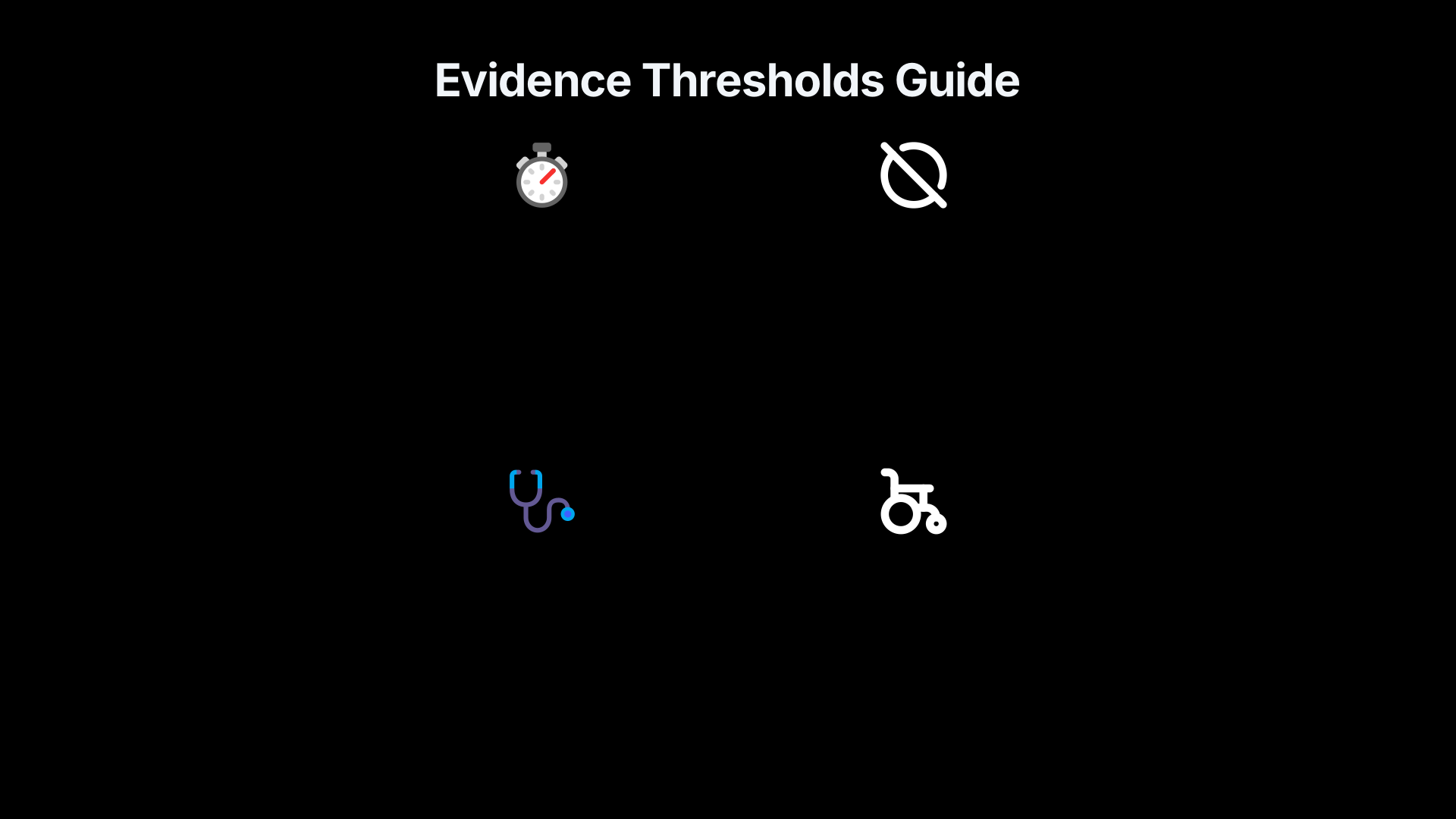
Evidence requirements are the mechanism that separates a controlled exception from an unrestricted one. When critics warn that granting one extension will lead to endless requests, they often assume there is no meaningful way to distinguish legitimate hardship from ordinary inconvenience. Evidence rules are the answer to that concern.
A well-designed threshold serves several purposes simultaneously:
- It signals that deadlines remain the default expectation.
- It provides a basis for consistent decisions.
- It protects applicants who experience circumstances beyond their control.
- It reduces accusations of favouritism or arbitrary treatment.
- It allows institutions to reject weak claims without rejecting all claims.[oiahe.org.uk]oiahe.org.ukDisability and requests for additional considerationProviders must make reasonable adjustments for a student when they know, or could reasonably be expected to have known, that the stu…
This is important because the strongest rebuttal to a slippery-slope argument is often institutional evidence that decision-makers can and do draw principled lines. The question becomes not “Will everyone ask?” but “What proof must be shown, and does this request meet that standard?”
What Counts as Enough Proof?
The most effective systems use proportionality. Minor extensions typically require less evidence than major disruptions, while long-term accommodations rely on different forms of verification than one-off emergencies.
Many universities now distinguish between short self-certified extensions and longer extensions requiring independent evidence. For example, some institutions permit a brief extension based on a student’s declaration alone, while requiring supporting documentation once the disruption exceeds a specified duration. Oxford University[UNSW Sites]unsw.edu.auSpecial consideration & short extensions | Current StudentsShort Extension is a new, automatic process that allows you to apply for an ex…
The underlying logic is straightforward: the cost of occasional misuse may be lower than the cost of forcing people with short-term illnesses or emergencies to obtain formal documentation immediately. At the same time, larger departures from the normal deadline require stronger verification because the administrative and fairness implications are greater.[oiahe.org.uk]oiahe.org.ukRequests for additional considerationSeptember 15, 2025 — Some requests may not require supporting evidence, for instance if a student is asking for a short coursework extens…
A useful evidence framework often asks three questions:
- Was the event beyond the applicant’s control?
- Did it plausibly affect the ability to meet the deadline?
- Is there evidence sufficient to make that claim credible?
The third question is not necessarily the same as demanding exhaustive proof. Credibility and certainty are different standards.
Illness and Medical Disruption
Medical circumstances illustrate why evidence thresholds must be calibrated carefully. A hospital admission may be easy to document, while a severe migraine, acute mental-health episode, or short-term illness may be harder to verify immediately.
Many extension policies therefore allow short-term self-certification for limited periods while requiring medical documentation for more substantial requests. Examples include doctor’s letters, hospital records, treatment confirmations, or other healthcare documentation showing that the condition existed and overlapped with the assessment period.[cdn.arden.ac.uk]cdn.arden.ac.ukQ A 41QA 41 - Extenuating Circumstances policy…The claim is supported by documentary evidence (e.g.: a certificate/letter from a medical pro…[Oxford University]ox.ac.ukproblems completing your assessmentThis will normally be because of a…Read more…[3secretariat.leeds.ac.uk]secretariat.leeds.ac.ukAll other applications…Read more…
The key implementation lesson is that evidence should establish impact rather than demand complete disclosure of personal medical details. Policies that require extensive clinical information can create unnecessary barriers and privacy concerns. Guidance from disability and accommodation organisations increasingly favours a commonsense approach focused on functional impact rather than exhaustive diagnostic proof.[ahead.org]ahead.orgGuidance on Documentation PracticesDisability and accommodation requests should be evaluated using a commonsense standard, without the need for specific language or ex…
This approach helps preserve the distinction between verification and investigation. Decision-makers need enough information to assess the request, not enough to reconstruct an applicant’s entire medical history.
Bereavement and Family Emergencies
Bereavement presents a different evidentiary challenge. The event may be genuine and severe, yet documentation may be difficult to obtain immediately, especially when arrangements are still unfolding.
Policies commonly accept evidence such as death notices, funeral documentation, official correspondence, or confirmation from relevant professionals. Some systems also recognise that immediate family emergencies can temporarily prevent applicants from gathering formal records.[cdn.arden.ac.uk]cdn.arden.ac.ukQ A 41QA 41 - Extenuating Circumstances policy…The claim is supported by documentary evidence (e.g.: a certificate/letter from a medical pro…
The important policy question is whether the evidence requirement matches the practical realities of the situation. Demanding highly formal documentation within a very short timeframe can effectively deny relief even when the underlying hardship is undisputed.
For slippery-slope concerns, the crucial point is that a bereavement exception need not become a general lateness exception. The distinction lies in the evidence standard and the nature of the event being documented.
Disability and Ongoing Conditions
Disability-related requests often expose the limits of event-based evidence models. A person with a recognised long-term condition may experience recurring difficulties that are already documented elsewhere.
Many institutions therefore rely on established accommodation processes rather than requiring new evidence for every affected deadline. Existing support plans, disability registrations, or approved adjustments can function as sufficient evidence, reducing repetitive administrative burdens.[Various]uswvarious1.blob.core.windows.netVariousEXTENUATING CIRCUMSTANCES REGULATIONS AND…July 25, 2023 — 5.4 You will then be able to request an extension of up to a maximum…[2secretariat.leeds.ac.uk]secretariat.leeds.ac.ukAll other applications…Read more…
This reflects an important implementation principle: evidence requirements should not repeatedly force people to prove what has already been verified. Requiring fresh documentation for every extension request may create procedural obstacles without improving decision quality.
At the same time, policies often require additional evidence when circumstances materially change, such as a significant worsening of a condition or the emergence of a new disability-related impact.[Cardiff University]cardiff.ac.ukCardiff University Extenuating-Circumstances-Procedure-for-Taught-andCardiff UniversityExtenuating-Circumstances-Procedure-for-Taught-and-…September 10, 2025 — • evidence of a disability which has worsen…
Technical Failure and Digital Evidence
Technical failures are among the most disputed extension claims because they frequently occur close to deadlines and can be difficult to verify after the fact.
Effective policies typically specify acceptable forms of evidence in advance. These may include:
- Screenshots showing error messages.
- Help-desk tickets.
- Service outage notices.
- System logs.
- Confirmation from platform administrators.
- Timestamped records demonstrating attempted submission. EPO+2University of Hull[studentsunionucl.org]studentsunionucl.orgextenuating circumstancesThis is a guide to UCL's Short-term Illness and other Extenuating Circumstances Procedure for the 2025/26 academic year…
The advantage of this approach is predictability. Applicants know what evidence they should preserve, and administrators know what they should evaluate.
The broader lesson is that evidence standards work best when they are concrete. Vague instructions such as “provide proof” create uncertainty, while specific examples improve both compliance and consistency.
Avoiding Rubber Stamps and Impossible Proof
The hardest design problem is avoiding two opposite failures.
When standards are too weak
If virtually any explanation is accepted without scrutiny, extensions can lose credibility. Decision-makers may struggle to distinguish genuine hardship from ordinary delay, and confidence in the process can decline. This is the scenario that often motivates slippery-slope concerns in the first place.
However, the existence of this risk does not show that all exceptions are dangerous. It shows that exceptions require a decision rule.
When standards are too strict
The opposite error is demanding evidence that applicants cannot realistically obtain. Someone experiencing a sudden illness, family crisis, or technical disruption may not be able to collect extensive documentation before the deadline passes.
Oversized evidence burdens can also disadvantage people with fewer financial resources, limited healthcare access, or disabilities that make documentation difficult to secure. For that reason, higher-education guidance increasingly emphasises proportional evidence requirements rather than maximal proof requirements.[oiahe.org.uk]oiahe.org.ukDisability and requests for additional considerationProviders must make reasonable adjustments for a student when they know, or could reasonably be expected to have known, that the stu…
The most robust systems therefore adopt a middle position: enough evidence to make claims credible, but not so much that legitimate requests become practically impossible.
The Practical Answer to Slippery-Slope Fears
Evidence thresholds matter because they are the institutional safeguard that slippery-slope arguments often ignore. Granting an extension does not automatically commit an organisation to granting every future request. What prevents that outcome is a transparent rule about proof.
When evidence requirements are clear, proportionate, and consistently applied, decision-makers can distinguish between hardship and ordinary lateness without turning every request into an adversarial investigation. The result is a policy that preserves both fairness and flexibility: deadlines remain meaningful, but exceptional circumstances can still be recognised on the basis of credible evidence rather than fear of where a single exception might lead.
eBay marketplace picks
Marketplace Samples
Example marketplace items related to this page. Use the search link to explore similar finds on eBay.





Endnotes
1.
Source: oiahe.org.uk
Title: Requests for additional consideration
Link:https://www.oiahe.org.uk/media/23ahuyme/gpf-requests-for-additional-consideration.pdf
Source snippet
September 15, 2025 — Some requests may not require supporting evidence, for instance if a student is asking for a short coursework extens...
Published: September 15, 2025
2.
Source: ahead.org
Title: Guidance on Documentation Practices
Link:https://www.ahead.org/professional-resources/accommodations/documentation
Source snippet
Disability and accommodation requests should be evaluated using a commonsense standard, without the need for specific language or ex...
3.
Source: cdn.arden.ac.uk
Title: Q A 41
Link:https://cdn.arden.ac.uk/s3fs-public/2024-09/QA%2041%20-%20Extenuating%20Circumstances%20policy%20v%2012%20July%202024.pdf?VersionId=D0wQ_NXjw4EARnvHSJeT.IPIN3AeqPyb
Source snippet
QA 41 - Extenuating Circumstances policy...The claim is supported by documentary evidence (e.g.: a certificate/letter from a medical pro...
4.
Source: secretariat.leeds.ac.uk
Link:https://secretariat.leeds.ac.uk/wp-content/uploads/sites/109/2023/09/mitigating_circumstances_guidance.pdf
Source snippet
All other applications...Read more...
5.
Source: oiahe.org.uk
Title: Disability and requests for additional consideration
Link:https://www.oiahe.org.uk/resources-and-publications/good-practice-framework/requests-for-additional-consideration/disability-and-requests-for-additional-consideration/
Source snippet
Providers must make reasonable adjustments for a student when they know, or could reasonably be expected to have known, that the stu...
6.
Source: epo.org
Link:https://www.epo.org/en/legal/guidelines-epc/2026/e_viii_1_6_2_1.html
Source snippet
1.6.2.1 Extension of periods under Rule 134(1)An extension under Rule 134(1) also applies if any one of the means of electronic filing...
7.
Source: ox.ac.uk
Title: problems completing your assessment
Link:https://www.ox.ac.uk/students/academic/exams/problems-completing-your-assessment
Source snippet
This will normally be because of a...Read more...
8.
Source: unsw.edu.au
Link:https://www.unsw.edu.au/student/managing-your-studies/academic-life/special-consideration
Source snippet
Special consideration & short extensions | Current StudentsShort Extension is a new, automatic process that allows you to apply for an ex...
9.
Source: uswvarious1.blob.core.windows.net
Link:https://uswvarious1.blob.core.windows.net/uswvarious-prod-uploads/documents/Extenuating_Circumstances_Regulations_and_Procedure_2023-24.pdf
Source snippet
VariousEXTENUATING CIRCUMSTANCES REGULATIONS AND...July 25, 2023 — 5.4 You will then be able to request an extension of up to a maximum...
Published: July 25, 2023
10.
Source: cardiff.ac.uk
Title: Cardiff University Extenuating-Circumstances-Procedure-for-Taught-and
Link:https://www.cardiff.ac.uk/__data/assets/pdf_file/0011/1560476/Extenuating-Circumstances-Procedure-for-Taught-and-Undergraduate-Students.pdf
Source snippet
Cardiff UniversityExtenuating-Circumstances-Procedure-for-Taught-and-...September 10, 2025 — • evidence of a disability which has worsen...
Published: September 10, 2025
11.
Source: studentsunionucl.org
Title: extenuating circumstances
Link:https://studentsunionucl.org/extenuating-circumstances
Source snippet
This is a guide to UCL's Short-term Illness and other Extenuating Circumstances Procedure for the 2025/26 academic year...
Additional References
12.
Source: eeoc.gov
Title: enforcement guidance reasonable accommodation and undue hardship under ada
Link:https://www.eeoc.gov/laws/guidance/enforcement-guidance-reasonable-accommodation-and-undue-hardship-under-ada
Source snippet
Enforcement Guidance on Reasonable Accommodation...17 Oct 2002 — This document addresses the rights and responsibilities of employers an...
13.
Source: truescreen.io
Link:https://truescreen.io/articles/admissibility-digital-evidence-guide/
Source snippet
Admissibility of Digital Evidence: Standards Courts UseAdmissibility of digital evidence is the set of legal and technical conditions a d...
14.
Source: winchester.ac.uk
Link:https://www.winchester.ac.uk/media/Exceptional-Circumstances-Policy-2025-6.pdf
Source snippet
EXCEPTIONAL CIRCUMSTANCES POLICYYou are expected to meet your assessment submission deadlines and attend scheduled assessment events as d...
15.
Source: southwales.ac.uk
Link:https://www.southwales.ac.uk/current-students/advice-zone/a-z/extenuating-circumstances/
Source snippet
University of South WalesExtenuating CircumstancesEvidence is not usually required for this type of claim. What you can request. An exten...
16.
Source: yorksj.ac.uk
Link:https://www.yorksj.ac.uk/media/content-assets/registry/policies/code-of-practice-for-assessment/13.Exceptional-circumstances-policy-202526.pdf
Source snippet
Exceptional Circumstances PolicyScreenshots from the NHS app may be used as evidence, but must show the student's name, dates, and refer...
17.
Source: jcq.org.uk
Link:https://www.jcq.org.uk/knowledge-hub/adjustments-for-candidates-with-disabilities-and-learning-difficulties/
Source snippet
Adjustments for candidates with disabilities and learning difficulties Valid from 1 September 2025 to 31 August...Read more...
Published: September 2025
18.
Source: derby.ac.uk
Link:https://www.derby.ac.uk/about/academic-regulations/student-guidance-rac/
Source snippet
✕. RAC Evidence Guidance. All RAC request types other than a 7-day extension require supporting evidence.Read more...
19.
Source: tameside.ac.uk
Title: HE Extensions and Extenuating Circumstances Policy2025
Link:https://www.tameside.ac.uk/pdfs/HE%20Extensions%20and%20Extenuating%20Circumstances%20Policy2025.pdf
Source snippet
Evidence may include official documentation to support the reason you are giving to request an extension to your deadline. This could...
20.
Source: qub.ac.uk
Link:https://www.qub.ac.uk/directorates/AcademicStudentAffairs/AcademicAffairs/GeneralRegulations/StudentSupport/ExceptionalCircumstancesProcedure/
Source snippet
Consideration of significant disruption during an assessment. 1.3...Read more...
21.
Source: kent.ac.uk
Link:https://www.kent.ac.uk/education/documents/student-conduct-experience/mitigation-of-extenuating-circumstances.docx
Source snippet
s, then the extensions permitted in the Late Submission Policy...Read more...
Topic Tree