Within Tu Quoque
When Double Standards Are the Point
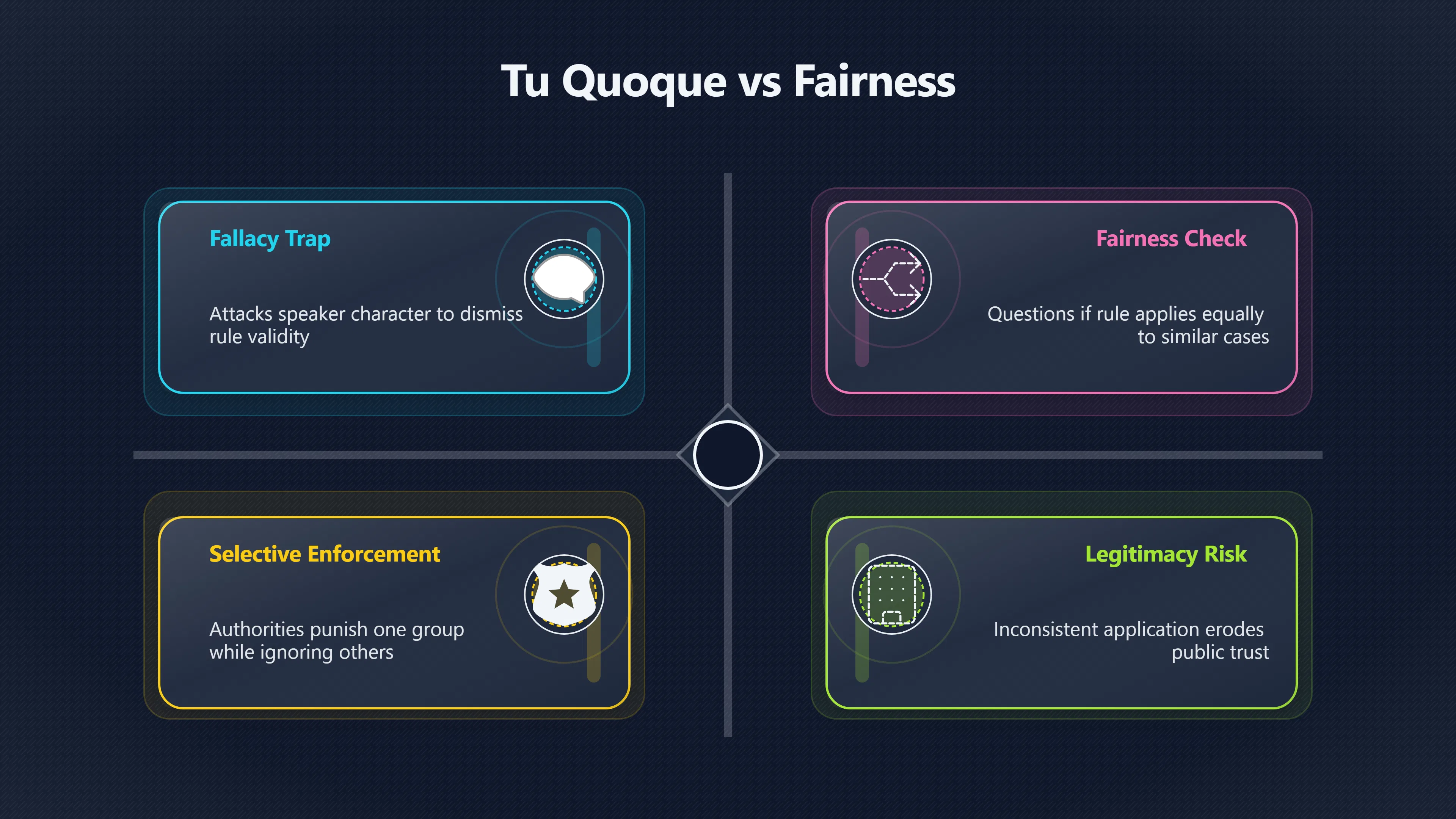
Pointing out inconsistency can be directly relevant when the dispute is about fair enforcement or equal treatment.
On this page
- Why fairness claims invite comparison
- Selective enforcement versus distraction
- Testing whether like cases are really alike
Page outline Jump by section
Introduction
Accusations of hypocrisy are often dismissed as examples of the tu quoque fallacy: “You do it too, therefore your argument is wrong.” In many cases that dismissal is correct. A rule does not become false merely because someone violates it. However, disputes about double standards occupy a special position. When the issue is whether rules are being applied fairly, consistently, and equally, comparing how different people are treated is not a distraction from the argument—it is often the argument itself.
 The key distinction is simple. If a hypocrisy charge is used to avoid addressing a claim, it remains a fallacy. If it is used to show that the same standard is being enforced differently against similar cases, it may identify a genuine problem of fairness, legitimacy, or governance. In debates about institutions, discipline, regulation, and public authority, equal treatment is frequently the central question rather than a side issue.[Informal Logic]informallogic.caSource details in endnotes.[PhilPapers]philpapers.orgThough textbook tu quoque arguments are fallacies of relevance, many versions of arguments from hypocrisy are indirectly relevant to the…
When Double Standards Are the Point
A classic tu quoque argument attacks the speaker:
“You broke the rule, so your defence of the rule is worthless.”
That response does not tell us whether the rule itself is justified.
A double-standards argument asks a different question:
“Why is this rule enforced against one person but ignored when someone else does the same thing?”
Here the focus shifts from the speaker’s character to the consistency of the decision-making process. The concern is not whether the rule exists, but whether authorities are applying it impartially.
This distinction matters because many systems derive legitimacy from equal treatment. Legal and constitutional traditions across democratic societies emphasise equality before the law and the idea that no individual should receive special exemptions merely because of status, influence, or identity. The principle that people in comparable circumstances should be treated comparably is widely recognised as a core element of the rule of law. PMC[EU Agency for Fundamental Rights]fra.europa.euEU Agency for Fundamental Rights Article 20EU Agency for Fundamental RightsArticle 20 - Equality before the lawArticle 16 (1) Citizens are equal before the law and public authoriti…[European Commission]commission.europa.euEuropean Commission What is the rule of law?European CommissionUnder the rule of law, all public powers always act within the constraints set out by law, in accordance with the valu…
As a result, pointing to inconsistent enforcement is not automatically a logical fallacy. It may be evidence that the institution itself is failing to live up to its stated standards.
Why Fairness Claims Invite Comparison
Claims about fairness almost always require comparison. A rule cannot be shown to be fairly applied by looking at a single case in isolation.
Suppose a university disciplines one student for plagiarism. If the evidence is clear and the procedures are followed, the decision may appear justified. However, if numerous other students committed materially similar violations and received no sanction, concerns about fairness arise. The issue is no longer simply whether plagiarism occurred. The issue becomes whether enforcement is being administered consistently.
The same logic appears in many settings:
- A regulator fines one company while ignoring competitors engaged in similar conduct.
- A workplace punishes junior employees for behaviour tolerated among senior managers.
- A sports league penalises one team for an infraction routinely overlooked elsewhere.
- A government prosecutes some offenders while systematically overlooking politically connected individuals.
In each case, comparison is necessary because the complaint concerns unequal treatment. The accusation is not merely “you are hypocritical.” It is “your enforcement practices are inconsistent with the standards you claim to uphold.”[European Commission]commission.europa.euEuropean Commission What is the rule of law?European CommissionUnder the rule of law, all public powers always act within the constraints set out by law, in accordance with the valu…[2venice.coe.int]venice.coe.intRule of Law ChecklistEquality before the law and non-discrimination. 1. Principle. Does the… Is there a perception that prosecutorial…
Selective Enforcement Versus Distraction
Not every allegation of double standards succeeds. People frequently invoke hypocrisy when they are actually attempting to divert attention from their own conduct.
A useful test is to ask whether the comparison changes the evaluation of the decision itself.
A genuine selective-enforcement challenge
Imagine an organisation that states:
“Any employee who falsifies records will be dismissed.”
If evidence shows that executives who falsified records were retained while lower-level staff were terminated, the inconsistency directly bears on whether the organisation is enforcing its rule fairly.
The comparison is relevant because equal treatment is part of the policy’s justification.
A distracting hypocrisy reply
Now imagine someone responds:
“You fined me for speeding, but some police officers have also exceeded speed limits.”
Unless the claim is that officers were treated differently under the same circumstances, the observation may not affect whether the speeding violation occurred. It may simply redirect attention away from the case at hand.
The difference lies in the target of the criticism. Genuine double-standard arguments scrutinise the enforcement system. Mere tu quoque responses focus on the personal inconsistency of an opponent.[stanford]plato.stanford.eduto Fallacies - Stanford Encyclopedia of Philosophy9. At (2010, 179) Walton says that a fallacy is an argument that seems to be correct bu… Encyclopedia of Philosophy[Internet Encyclopedia of Philosophy]iep.utm.eduInternet Encyclopedia of PhilosophyFallaciesIf the fallacious attack points out some despicable trait of the arguer, it also may be calle…

Testing Whether Like Cases Are Really Alike
Many disputes over alleged double standards arise because the parties disagree about whether the compared situations are genuinely comparable.
A strong fairness argument requires more than finding superficial similarities.
Relevant similarities
The comparison should involve cases that share the factors that matter for the rule being enforced.
For example, if two public officials are accused of the same misconduct, similarities in evidence, severity, timing, and authority may be relevant. If those factors differ substantially, different outcomes may be justified.
Relevant differences
Authorities often possess legitimate reasons for treating cases differently:
- Different levels of harm.
- Different evidential standards.
- Different legal jurisdictions.
- Different prior records.
- Different responsibilities or duties.
The presence of unequal outcomes alone does not prove a double standard. The key question is whether the differences relied upon actually justify the distinction.
This is why many accusations of hypocrisy become contentious. One side sees two equivalent cases receiving different treatment. The other side argues that the cases differ in ways that matter. The debate then shifts from moral outrage to the more precise question of whether the distinctions are relevant.[EU Agency for Fundamental Rights]fra.europa.euEU Agency for Fundamental Rights Article 20EU Agency for Fundamental RightsArticle 20 - Equality before the lawArticle 16 (1) Citizens are equal before the law and public authoriti…[UNDP]undp.org6. The principles of equality and non-discrimination are a.Read more…
Selective Enforcement and Institutional Legitimacy
Concerns about double standards become especially significant when institutions exercise coercive power.
Legal scholars and governance bodies frequently identify arbitrary or selective enforcement as a threat to the rule of law because it undermines predictability, equality, and public trust. Citizens are more likely to accept unfavourable decisions when they believe the same standards apply to everyone. Conversely, perceived favouritism can weaken confidence even when individual decisions are legally defensible. PMC 3Wikipedia ScienceDirect This helps explain why accusations of double standards are common in political debate. They are often attempts to challenge the legitimacy of[sciencedirect.com]sciencedirect.comSelective enforcement of regulationby D Chen · 2011 · Cited by 90 — Selective enforcement occurs when law enforcers derail the course of… enforcement rather than the validity of the underlying rule.
A government may be correct that corruption is wrong. Critics can still raise a serious fairness objection if anti-corruption measures are directed exclusively at political opponents while allies receive protection. The criticism does not deny the rule. It questions whether the rule is being administered impartially.
The Boundary Between Tu Quoque and Fairness Criticism
The easiest way to distinguish a fallacious hypocrisy reply from a legitimate double-standards argument is to ask what conclusion is being drawn.
The reasoning is usually fallacious when it follows this pattern:
- You violate the rule.
- Therefore the rule is false or should be ignored.
The reasoning may be legitimate when it follows this pattern:
- You claim the rule should apply to everyone.
- Similar cases are treated differently.
- Therefore there may be a problem with the fairness or legitimacy of enforcement.
The first attacks the truth or value of the rule through the speaker’s inconsistency. The second examines whether the rule is being applied consistently across cases. Informal-logic scholars have argued that some arguments from hypocrisy become relevant precisely because they reveal issues of authority, sincerity, practicality, or enforcement rather than attempting to refute the underlying claim directly.[Informal Logic]informallogic.caSource details in endnotes.[PhilPapers]philpapers.orgThough textbook tu quoque arguments are fallacies of relevance, many versions of arguments from hypocrisy are indirectly relevant to the…
What Makes a Strong Double-Standards Argument?
A persuasive challenge to unfair enforcement usually establishes four points:
- A clear rule exists.
The standard being discussed must be identifiable rather than vague or improvised.
- Comparable cases can be identified.
The examples must share the features relevant to the rule.
- The outcomes differ.
Similar conduct receives materially different treatment.
- No adequate justification explains the difference.
The disparity appears arbitrary, biased, or preferential.
When these conditions are met, pointing out inconsistency is not merely rhetorical. It becomes evidence that an institution, authority, or decision-maker may not be applying its own standards fairly.
Within discussions of logical fallacies, this is the crucial lesson. Not every accusation of hypocrisy is a tu quoque fallacy. When the fairness of enforcement is itself under examination, comparisons between cases are often essential. The challenge is to determine whether the comparison exposes unequal treatment or merely shifts attention away from the issue being judged.
Amazon book picks
Further Reading
Books and field guides related to When Double Standards Are the Point. Use these as the next step if you want deeper reading beyond the article.
Thinking, Fast and Slow
Helps readers understand how people evaluate consistency, equal treatment, and decision-making.
The Righteous Mind
Explores why groups apply standards differently and disagree about fairness.
A Rulebook for Arguments
Helps distinguish valid fairness critiques from fallacious personal attacks.
eBay marketplace picks
Marketplace Samples
Example marketplace items related to this page. Use the search link to explore similar finds on eBay.



Endnotes
1.
Source: philpapers.org
Link:https://philpapers.org/rec/AIKTQA
Source snippet
Though textbook tu quoque arguments are fallacies of [relevance]({{ 'relevance/' | relative_url }}), many versions of arguments from hypocrisy are indirectly relevant to the...
2.
Source: plato.stanford.edu
Title: There are
Link:https://plato.stanford.edu/entries/fallacies/
Source snippet
Stanford Encyclopedia of PhilosophyFallacies - Stanford Encyclopedia of Philosophyby H Hansen · 2015 · Cited by 426 — The ad hominem fall...
3.
Source: venice.coe.int
Link:https://www.venice.coe.int/images/SITE%20IMAGES/Publications/Rule_of_Law_Check_List.pdf
4.
Source: pmc.ncbi.nlm.nih.gov
Link:https://pmc.ncbi.nlm.nih.gov/articles/PMC9006207/
Source snippet
Reconciling the Theory and the Practice of the Rule of Law in...by J Beqiraj · 2022 · Cited by 29 — These principles are grouped into...
5.
Source: undp.org
Link:https://www.undp.org/sites/g/files/zskgke326/files/2022-08/ENGLISH_UNDP%20Print_The%20Principle%20of%20Equality%20and%20Non-Dicrimination%20Analysis%20of%20Case%20Law%202013-2020.pdf
Source snippet
6. The principles of equality and non-discrimination are a.Read more...
6.
Source: Wikipedia
Title: Selective enforcement
Link:https://en.wikipedia.org/wiki/Selective_enforcement
7.
Source: sciencedirect.com
Link:https://www.sciencedirect.com/science/article/pii/S1755309111000037
Source snippet
Selective enforcement of regulationby D Chen · 2011 · Cited by 90 — Selective enforcement occurs when law enforcers derail the course of...
8.
Source: Wikipedia
Title: Tu quoque
Link:https://en.wikipedia.org/wiki/Tu_quoque
Source snippet
Tu quoqueTu quoque, literally "you, too", is a rhetorical technique that intends to discredit the opponent's argument by attacking th...
9.
Source: Wikipedia
Title: Ad hominem
Link:https://en.wikipedia.org/wiki/Ad_hominem
Source snippet
Ad hominemAd hominem short for argumentum ad hominem refers to when a speaker attacks the character, motive, or some other attribute o...
10.
Source: plato.stanford.edu
Title: category mistakes
Link:https://plato.stanford.edu/entries/category-mistakes/
Source snippet
Mistakes - Stanford Encyclopedia of Philosophyby O Magidor · 2019 · Cited by 172 — Category mistakes are sentences such as 'The number tw...
11.
Source: review.law.stanford.edu
Title: Marshall 72 Stan. L. Rev. 1421
Link:https://review.law.stanford.edu/wp-content/uploads/sites/3/2020/05/Marshall-72-Stan.-L.-Rev.-1421.pdf
Source snippet
Protection Clause protects generally against the law being applied differently against people of...Read more...
12.
Source: plato.stanford.edu
Link:https://plato.stanford.edu/archives/fall2025/entries/fallacies/notes.html
Source snippet
to Fallacies - Stanford Encyclopedia of Philosophy9. At (2010, 179) Walton says that a fallacy is an argument that seems to be correct bu...
13.
Source: informallogic.ca
Link:https://informallogic.ca/index.php/informal_logic/article/view/543/506
14.
Source: fra.europa.eu
Title: EU Agency for Fundamental Rights Article 20
Link:https://fra.europa.eu/en/eu-charter/article/20-equality-law
Source snippet
EU Agency for Fundamental RightsArticle 20 - Equality before the lawArticle 16 (1) Citizens are equal before the law and public authoriti...
15.
Source: commission.europa.eu
Title: European Commission What is the rule of law?
Link:https://commission.europa.eu/strategy-and-policy/policies/justice-and-fundamental-rights/upholding-rule-law/rule-law/what-rule-law_en
Source snippet
European CommissionUnder the rule of law, all public powers always act within the constraints set out by law, in accordance with the valu...
16.
Source: iep.utm.edu
Link:https://iep.utm.edu/fallacy/
Source snippet
Internet Encyclopedia of PhilosophyFallaciesIf the fallacious attack points out some despicable trait of the arguer, it also may be calle...
17.
Source: study.com
Link:https://study.com/academy/lesson/look-whos-talking-tu-quoque-fallacy-definition-examples.html
Source snippet
Tu Quoque Fallacy | Definition & Examples - LessonMore precisely, the tu quoque fallacy, a circumstantial ad hominem, attempts to counter...
18.
Source: finmasters.com
Title: Tu Quoque Fallacy
Link:https://finmasters.com/tu-quoque-fallacy/
Source snippet
Definition and ExamplesTu quoque is a fallacy in which someone asserts that their opponent's argument must be invalid because it is incon...
19.
Source: thoughtco.com
Title: Tu Quoque
Link:https://www.thoughtco.com/tu-quoque-fallacy-ad-hominem-fallacy-250335
Source snippet
Ad Hominem Fallacy That You Did It Too21 Aug 2019 — The Tu Quoque fallacy is a form of the ad hominem fallacy which does not attack a per...
Additional References
20.
Source: philosophicalsociety.com
Link:https://www.philosophicalsociety.com/HTML/LogicalFallacies.html
Source snippet
Logical FallaciesInconsistency, moreover, may raise issues of hypocrisy or double standards, but it does not bear upon the argument at ha...
21.
Source: logicallyfallacious.com
Link:https://www.logicallyfallacious.com/logicalfallacies/Ad-Hominem-Tu-quoque
Source snippet
Ad Hominem (Tu quoque)Description: Claiming the argument is flawed by pointing out that the one making the argument is not acting consist...
22.
Source: researchgate.net
Link:https://www.researchgate.net/publication/401073238_Selective_Enforcement_in_the_Criminal_Justice_System_Between_Discretion_and_Abuse_of_Authority
Source snippet
(PDF) Selective Enforcement in the Criminal Justice System10 Apr 2026 — Selective enforcement has been shown to undermine the principles...
23.
Source: legalblogs.wolterskluwer.com
Link:https://legalblogs.wolterskluwer.com/competition-blog/rethinking-the-rule-of-law-in-eu-economic-governance-insights-from-the-2025-report/
Source snippet
the Rule of Law in EU Economic Governance29 Jul 2025 — Legal certainty, equal treatment, and impartial enforcement are essential for busi...
24.
Source: dergipark.org.tr
Link:https://dergipark.org.tr/en/download/article-file/5316284
Source snippet
argument, commonly dismissed as a fallacy or an obsolete defence in international...Read more...
25.
Source: cliffsnotes.com
Link:https://www.cliffsnotes.com/cliffs-questions/8524229
Source snippet
made the case to me that I need to lose weight, citing several health problems...
26.
Source: europeanlawinstitute.eu
Link:https://www.europeanlawinstitute.eu/fileadmin/user_upload/p_eli/Publications/ELI_Charter_of_Fundamental_Constitutional_Principles_of_a_European_Democracy.pdf
Source snippet
Principle 25: Equality before the law. Everyone is equal...Read more...
27.
Source: ebsco.com
Link:https://www.ebsco.com/research-starters/religion-and-philosophy/ad-hominem
Source snippet
However, the personal decisions of the advice givers...Read more...
28.
Source: reneual.eu
Link:https://www.reneual.eu/projects-and-publications/reneual-2-0?catid=2&id=21&view=article
Source snippet
bitrary measures, even when exercising their discretion.Read more...
29.
Source: academia.edu
Link:https://www.academia.edu/593058/Tu_quoque_arguments_subjunctive_inconsistency_and_questions_of_relevance
Source snippet
scourse, particularly in political and ethical contexts.Read more...
Topic Tree