Within Politics
The Missing Middle in Deregulation Debates
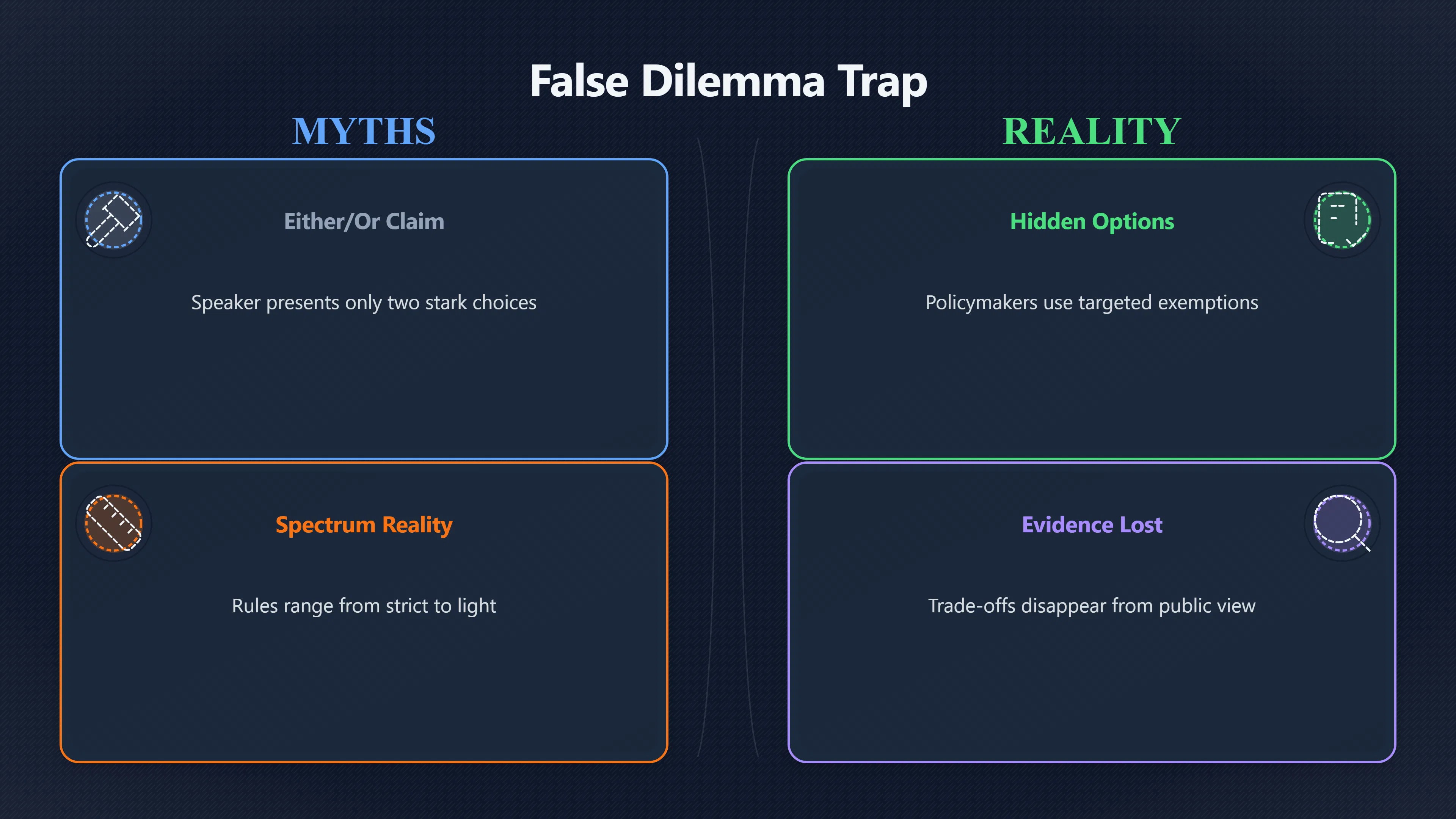
Deregulation claims can turn a spectrum of policy choices into a forced choice between freedom and collapse.
On this page
- How complex regulatory choices become two option claims
- What evidence is lost when tradeoffs disappear
- How to test whether the binary is real
Page outline Jump by section
Introduction
False dilemma framing is a common logical fallacy in political debates about deregulation. It occurs when speakers present a complex policy question as if only two choices exist: remove regulations or accept economic decline; protect regulation or destroy innovation; choose freedom or choose bureaucracy. In reality, most regulatory systems contain a wide range of options between these extremes. Policymakers can redesign rules, simplify compliance, target specific sectors, improve enforcement, replace prescriptive requirements with performance standards, or remove ineffective regulations while retaining protections that address genuine market failures. By reducing this spectrum to a binary choice, false dilemma arguments can obscure important trade-offs and weaken public understanding of policy choices. OECD[John Braithwaite]johnbraithwaite.comJohn BraithwaiteResponsive regulation: transcending the deregulation debateOur work on responsive regulation flourished during the time…
 Within political speech, this fallacy is particularly influential because regulatory policy is often technical and difficult for non-specialists to evaluate. Simplified narratives are easier to communicate than nuanced discussions of costs, benefits and institutional design. As a result, debates that should focus on evidence frequently become contests between competing extremes.
How Complex Regulatory Choices Become Two-Option Claims
Deregulation debates often involve questions about economic growth, consumer protection, environmental standards, labour conditions, financial oversight or competition policy. These issues rarely present policymakers with only two realistic options.
A false dilemma emerges when a speaker compresses a broad policy spectrum into a stark either-or proposition. Common formulations include:
- “Either we eliminate these regulations or businesses will stop investing.”
- “Either we keep current regulations or corporations will exploit everyone.”
- “Either regulators get out of the way or innovation dies.”
- “Either we impose strict controls or markets become chaotic.”
These claims create rhetorical clarity but frequently distort the actual policy landscape. Research on regulatory reform consistently shows that governments employ numerous intermediate approaches, including regulatory simplification, targeted exemptions, risk-based enforcement, performance standards, self-certification systems, sunset reviews and hybrid regulatory models. Regulatory reform is therefore not synonymous with complete deregulation.[KDI]kdi.re.krgulatory Reform, The lessons from implementation in…The trade-specific regulatory agenda offers some helpful examples of the potenti… [3OECD 3OECD]
The attraction of the binary frame is political as much as logical. It allows advocates to align their preferred position with positive values such as freedom, growth or safety while associating alternatives with failure or danger. Once the debate is framed as a choice between prosperity and stagnation, or liberty and control, many potentially viable middle-ground options disappear from public discussion.
Why Deregulation Debates Are Especially Vulnerable
Regulation affects multiple goals simultaneously. A rule may increase compliance costs while also reducing safety risks. It may limit some business activity while improving consumer confidence. It may slow market entry in one area while creating more stable long-term conditions for investment.
Because regulations often generate both benefits and costs, they are particularly susceptible to oversimplification. Economic outcomes depend not only on whether regulation exists but on how it is designed, enforced and adapted over time. OECD analyses of regulatory reform repeatedly emphasise regulatory quality, institutional design and policy implementation rather than simple increases or decreases in the number of rules. OECD[JCA]regulatoryreform.comRegulatory Policies in OECD CountriesFor example, the OECD Report on Regulatory Reform in Denmark noted concerns that the use of a centra…
What Evidence Is Lost When Trade-Offs Disappear
The main damage caused by false dilemma framing is not merely logical error. It is the removal of evidence that would allow citizens and policymakers to evaluate realistic alternatives.
When debates become binary, several important questions often disappear:
- Which specific regulations are causing problems?
- Which regulations generate measurable public benefits?
- Are there lower-cost methods of achieving the same objective?
- Can compliance burdens be reduced without removing protections?
- Do outcomes vary across industries or sectors?
- What evidence exists from previous reforms?
Research on regulatory reform frequently finds that effects differ substantially across sectors and institutional contexts. Studies examining deregulation and growth show considerable variation in outcomes, with some reforms producing benefits and others generating mixed or uncertain results. The impact depends on market structure, enforcement capacity, competition levels and the specific regulations involved. OECD[2fmg.ac.uk]fmg.ac.ukDeterminants of Regulatory Reformby S Djankov · 2017 · Cited by 8 — Changes in insolvency, labor law and minority shareholder protections…
A binary narrative can therefore conceal the very evidence needed to judge whether a proposal is likely to succeed.
The Missing Middle
One of the most important omissions in false dilemma rhetoric is the possibility of regulatory redesign.
Scholars and practitioners have long discussed alternatives that transcend the simple regulation-versus-deregulation divide. Responsive regulation, risk-based regulation, performance-based standards and periodic regulatory review all represent efforts to improve outcomes without embracing either total control or complete market freedom.[John Braithwaite]johnbraithwaite.comJohn BraithwaiteResponsive regulation: transcending the deregulation debateOur work on responsive regulation flourished during the time…[OECD]oecd.orgRegulatory reformFor example, ill-consulted reforms have led to undue burdens that have caused protests and voter dissatisfaction; po…
For example, a debate about environmental compliance might be framed publicly as a choice between burdensome regulation and unrestricted industrial activity. Yet policymakers may have additional options, including emissions trading systems, targeted monitoring, outcome-based standards or simplified reporting requirements. OECD reviews have highlighted such alternatives as examples of regulatory innovation that do not fit neatly into either side of a binary framing.[OECD]oecd.orgTaking Stock of Regulatory Reformby A MULTIDISCIPLINARY — The trade-specific regulatory agenda offers some helpful examples of the po…
The existence of these middle positions demonstrates why the forced-choice narrative is often misleading.
How to Test Whether the Binary Is Real
Not every two-option claim is necessarily fallacious. Sometimes only a small number of practical alternatives genuinely exist. The challenge is determining whether the presented choice reflects reality or rhetorical simplification.
Several questions can help evaluate deregulation arguments.
Are Intermediate Options Ignored?
A strong indicator of false dilemma framing is the omission of obvious alternatives.
If a speaker claims that the only choices are maintaining every existing rule or eliminating regulation entirely, ask whether partial reform, targeted exemptions, updated standards or improved enforcement could address the underlying problem.
The existence of credible intermediate options weakens the binary claim.
Is the Debate About a Specific Rule or Regulation in General?
False dilemmas often shift from a discussion of particular regulations to sweeping claims about regulation as a whole.
A business burden caused by one licensing requirement does not automatically justify eliminating unrelated consumer protections. Likewise, evidence that one industry benefited from regulation does not prove that all regulations are effective.
Separating individual policies from broader ideological narratives helps reveal missing alternatives.
Is Evidence Replaced by Predictions of Disaster?
Binary arguments frequently rely on catastrophic predictions.
Claims that economic collapse, mass unemployment, runaway exploitation or total stagnation will inevitably result from one side of the choice should prompt scrutiny. Complex policy systems rarely produce outcomes that are both certain and absolute.
Economists and regulatory scholars routinely emphasise uncertainty, context and trade-offs when assessing reforms. Broad ideological calls for either wholesale deregulation or wholesale re-regulation have been criticised precisely because they ignore the imperfect and context-dependent nature of policy design.[MIT Economics]economics.mit.eduJoskow Alfred…by PL Joskow · 2009 — Whatever conclusions one comes to about the need for and nature of regulation or deregulation or r…

Does the Speaker Define Success Too Narrowly?
Another warning sign appears when only one policy objective is considered.
If economic growth is treated as the sole criterion, concerns about safety, environmental protection, market integrity or consumer welfare may disappear from the analysis. Conversely, if protection is treated as the only objective, compliance costs and innovation effects may be ignored.
A realistic evaluation requires examining multiple goals simultaneously rather than reducing the debate to a single dimension.
Why Recognising the Fallacy Matters
False dilemma framing in deregulation debates does more than simplify arguments. It shapes how citizens understand governance itself. When audiences repeatedly hear that every regulatory choice is a struggle between freedom and control, they may overlook the practical work of designing institutions that balance competing objectives.
Evidence from regulatory reform research points toward a more complex reality. Successful governance often involves continual adjustment, selective reform, experimentation and evaluation rather than movement toward either extreme. Regulatory systems can be excessive, inadequate or simply poorly designed, and different problems require different solutions. OECD[JCA]regulatoryreform.comRegulatory Policies in OECD CountriesFor example, the OECD Report on Regulatory Reform in Denmark noted concerns that the use of a centra…
Recognising the false dilemma does not determine whether a particular deregulation proposal is good or bad. Instead, it restores the missing middle of the conversation, allowing debates to focus on evidence, trade-offs and realistic policy alternatives rather than forced choices between opposing extremes.
Amazon book picks
Further Reading
Books and field guides related to The Missing Middle in Deregulation Debates. Use these as the next step if you want deeper reading beyond the article.
Asking the Right Questions
Teaches readers to test whether presented choices are exhaustive.
The Myth of the Rational Voter
Encourages scrutiny of simplified political narratives and policy framing.
eBay marketplace picks
Marketplace Samples
Example marketplace items related to this page. Use the search link to explore similar finds on eBay.





Endnotes
1.
Source: oecd.org
Link:https://www.oecd.org/en/topics/policy-issues/regulatory-reform.html
Source snippet
Regulatory reformFor example, ill-consulted reforms have led to undue burdens that have caused protests and voter dissatisfaction; po...
2.
Source: economics.mit.edu
Link:https://economics.mit.edu/sites/default/files/2022-09/Deregulation%20-%20Where%20Do%20We%20Go%20From%20Here.pdf
Source snippet
Joskow Alfred...by PL Joskow · 2009 — Whatever conclusions one comes to about the need for and nature of regulation or deregulation or r...
3.
Source: oecd.org
Link:https://www.oecd.org/content/dam/oecd/en/publications/reports/2008/11/taking-stock-of-regulatory-reform_g1gh9f57/9789264056572-en.pdf
Source snippet
Taking Stock of Regulatory Reformby A MULTIDISCIPLINARY — The trade-specific regulatory agenda offers some helpful examples of the po...
4.
Source: kdi.re.kr
Link:https://www.kdi.re.kr/upload/7669/jacobzone-0502.pdf
Source snippet
gulatory Reform, The lessons from implementation in...The trade-specific regulatory agenda offers some helpful examples of the potenti...
5.
Source: regulatoryreform.com
Link:https://regulatoryreform.com/wp-content/uploads/2015/02/OECD-Regulatory-Policies-in-OECD-Countries-2002.pdf
Source snippet
Regulatory Policies in OECD CountriesFor example, the OECD Report on Regulatory Reform in Denmark noted concerns that the use of a centra...
6.
Source: oecd.org
Title: First, it summarises the evidence on the evolution of regulatory
Link:https://www.oecd.org/en/publications/the-implementation-and-the-effects-of-regulatory-reform_413754754615.html
Source snippet
The Implementation and the Effects of Regulatory Reformby R Gönenç · 2000 · Cited by 227 — This paper reviews trends, outcomes and is...
7.
Source: fmg.ac.uk
Link:https://www.fmg.ac.uk/sites/default/files/publications/DP765.pdf
Source snippet
Determinants of Regulatory Reformby S Djankov · 2017 · Cited by 8 — Changes in insolvency, labor law and minority shareholder protections...
8.
Source: johnbraithwaite.com
Link:https://johnbraithwaite.com/wp-content/uploads/2016/06/Responsive-Regulation-Transce.pdf
Source snippet
John BraithwaiteResponsive regulation: transcending the deregulation debateOur work on responsive regulation flourished during the time...
Additional References
9.
Source: uu.nl
Link:https://www.uu.nl/sites/default/files/rebo_use_dp_2010_10-18.pdf
Source snippet
REVIEW OF ECONOMIC THEORIES OF REGULATIONAbstract. This paper reviews the economic theories of regulation. It discusses the public and pr...
10.
Source: worldometers.info
Link:https://www.worldometers.info/world-map/
Source snippet
World MapMap of the World with the names of all countries, territories and major cities, with borders. Zoomable political map of the worl...
11.
Source: cerge-ei.cz
Link:https://www.cerge-ei.cz/pdf/wp/Wp424.pdf
12.
Source: researchgate.net
Link:https://www.researchgate.net/publication/227378701_Deregulation_vs_Re-regulation
13.
Source: oecdecoscope.blog
Link:https://oecdecoscope.blog/2025/12/10/regulating-smarter-oecd-economic-outlook-recommendations-on-regulatory-policy-reforms/
Source snippet
Regulating smarter: OECD Economic Outlook...10 Dec 2025 — The summary highlights that smarter regulatory policy, such as reforms that si...
14.
Source: youtube.com
Link:https://www.youtube.com/watch?v=Wg-pFtvsvmo
15.
Source: europeanpapers.eu
Title: limited politicisation strengthening undermining economic regulation eu
Link:https://www.europeanpapers.eu/e-journal/limited-politicisation-strengthening-undermining-economic-regulation-eu
Source snippet
Limited Politicisation: Strengthening, Not Undermining...by G Tagiuri · 2026 — This article is a contribution to a Special Section that...
16.
Source: bruegel.org
Link:https://www.bruegel.org/policy-brief/efficiency-and-distribution-european-unions-digital-deregulation-push
Source snippet
reduce the burden of EU digital regulation, regardless of whether it involves lowering...Read more...
17.
Source: researchgate.net
Link:https://www.researchgate.net/publication/240300175_The_Implementation_and_the_Effects_of_Regulatory_Reform_Past_Experience_and_Current_Issues
Source snippet
The Implementation and the Effects of Regulatory ReformThis article reviews trends, outcomes and issues in regulatory reform in OECD coun...
18.
Source: bear.warrington.ufl.edu
Title: Regulatory Impact Analysis OECD
Link:https://bear.warrington.ufl.edu/centers/purc/docs//PAPERS/TRAINING/Jamaica/July2006/advancedreadings/Regulatory_Impact_Analysis_OECD.pdf
Source snippet
Regulatory Impact Analysis in OECD Countriesby D Rodrigo · 2005 · Cited by 17 — The emergence of regulatory reform and deregulation in th...
Topic Tree