Within Social Media
When Viral Posts Force False Choices
Viral claims often flatten messy issues into two-sided moral tests that hide missing evidence and reasonable nuance.
On this page
- How compression creates false dilemmas
- Common wording that turns disagreement into loyalty tests
- Better questions to ask before accepting the frame
Page outline Jump by section
Introduction
Many viral posts become persuasive not because they provide strong evidence, but because they quietly remove alternatives before the argument begins. A complicated issue involving uncertainty, competing priorities, mixed evidence, or several possible solutions is compressed into a simple choice between two camps. Readers are told, implicitly or explicitly, that they must choose one side or reveal something morally suspect about themselves.
 This pattern is a classic false dilemma, also known as a false dichotomy. The fallacy presents only two options when other reasonable positions exist. On social media, where attention is scarce and messages compete for rapid engagement, binary framing can spread especially well because it is easy to understand, emotionally charged, and highly shareable. Research on framing, misinformation, and online polarisation suggests that simplified frames can shape how audiences interpret issues long before they evaluate the evidence itself.[ResearchGate]researchgate.netResearch Gate Framing Theory in the Age of Social MediaFraming Theory in the Age of Social MediaAugust 29, 2022 — 24 Feb 2026 — Framing Theory and frame analysis has been found fun…[Department of]gvpt.umd.edu#Polarized FeedsDepartment of Government and PoliticsThree Experiments on Polarization, Framing, and Social Mediaby A Banks · 2020 · Cited by 143 — We de… Government and Politics
How Compression Creates False Dilemmas
Social media platforms reward brevity. A post that can be understood in seconds has an advantage over a nuanced explanation requiring context. The problem is that many public questions are not naturally simple.
Consider a debate about housing policy, public health, policing, climate adaptation, education reform, or technological regulation. Each topic involves trade-offs, uncertainty, competing goals, and multiple possible solutions. Yet a viral post may compress that complexity into a statement such as:
- “Either you support this policy or you do not care about the problem.”
- “Either this institution is corrupt or the criticism is fake.”
- “Either this study proves the claim or the experts are lying.”[sciencedirect.com]sciencedirect.comFake news, consumer cynicism and negative word-of-mouthby OI MOISESCU · 2025 · Cited by 5 — In today's digital era dominated by social me…
The audience is invited to choose between two extreme positions while ignoring the broad territory in between.
Communication researchers describe this process as framing. Frames highlight some aspects of reality while downplaying others. On social media, frames often become more influential because users encounter information in short, isolated fragments rather than in longer discussions.[ResearchGate]researchgate.netResearch Gate Framing Theory in the Age of Social MediaFraming Theory in the Age of Social MediaAugust 29, 2022 — 24 Feb 2026 — Framing Theory and frame analysis has been found fun…
The resulting false choice is powerful because it changes the debate itself. Instead of asking, “What does the evidence show?” readers are pushed toward asking, “Which side am I on?”
Why Binary Frames Spread So Easily
False dilemmas are not merely reasoning errors. They are often effective social tools.
A two-sided conflict is easier to share than a complicated explanation. It creates a story with heroes, villains, and a clear decision. Research on viral communication and misinformation repeatedly finds that emotionally engaging, simplified content tends to travel efficiently through social networks.[Sage Journals]journals.sagepub.comSage Journals Viral journalismStrategy, tactics and limitations of the fast…by A Denisova · 2023 · Cited by 120 — This paper starts with the analysis of the existin…[Yale Insights]insights.som.yale.eduhow social media rewards misinformationYale InsightsHow Social Media Rewards Misinformation | Yale Insights31 Mar 2023 — A majority of false stories are spread by a small numbe…
Several mechanisms make binary framing attractive:
It reduces cognitive effort. Evaluating multiple explanations requires attention and background knowledge. Choosing between two presented options feels easier.
It creates moral clarity. People often prefer narratives that divide the world into right and wrong rather than uncertain trade-offs.
It encourages group formation. A binary frame naturally creates an “us” and a “them,” which can strengthen group identity.
It increases engagement. Strongly polarised content often generates reactions, comments, and shares because it encourages conflict and signalling of loyalty. Research on social media algorithms and polarisation suggests that engagement-driven systems can amplify these dynamics. ScienceDirect[brookings]brookings.eduHow tech platforms fuel U.Spolitical polarization and what…27 Sept 2021 — How tech platforms fuel U.S. political polarization and what government can do about it… The result is a communication environment where nuanced positions may appear weak, indecisive, or invisible even when they are the most evidence-based positions available.
Common Wording That Turns Disagreement Into Loyalty Tests
Many false dilemmas follow recognisable patterns. The wording varies, but the structure remains similar.
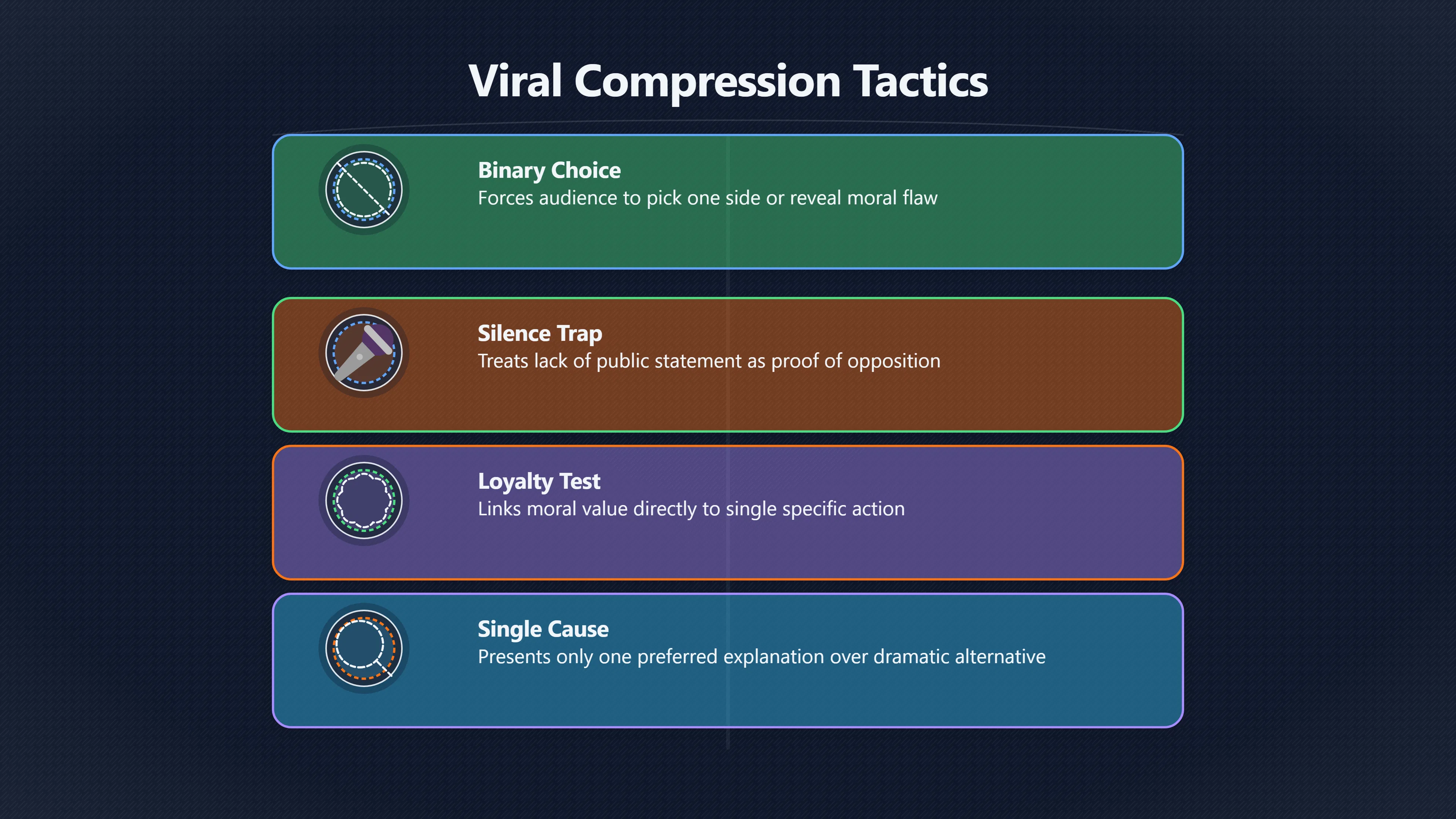
“You’re Either With Us or Against Us”
This is perhaps the clearest form of the fallacy. It assumes that neutrality, uncertainty, partial agreement, mixed views, or alternative approaches are impossible.
A person may support a goal while questioning a specific strategy. They may agree that a problem exists while disputing a proposed solution. The binary frame erases these distinctions.
“Silence Means Support”
Viral posts sometimes claim that anyone who does not publicly endorse a position must secretly support the opposing side.
This transforms a complicated question about speech, responsibility, timing, knowledge, or personal circumstances into a simple loyalty test. The absence of a public statement is treated as proof of commitment to the opposite camp.
“If You Really Cared, You Would…”
Another common formulation links a moral value to a single action.
Examples include claims that anyone who truly cares about safety, justice, freedom, science, children, democracy, or the environment must support one specific policy. The underlying assumption is that concern for a goal automatically requires agreement on the method.
In reality, people can share goals while disagreeing sharply about means.
“Only Two Explanations Exist”
Some viral claims present a choice between one preferred explanation and a dramatic alternative.
For example:
- “Either this result proves the theory or the data were manipulated.”
- “Either the event was intentional or it was impossible.”
- “Either the experts are correct about everything or they cannot be trusted at all.”
These formulations ignore the possibility of partial evidence, uncertainty, methodological limitations, honest mistakes, mixed causes, or incomplete information.
How False Choices Intensify Polarisation
The damage caused by false dilemmas extends beyond individual arguments.
When people repeatedly encounter issues framed as two-sided moral battles, disagreement becomes easier to interpret as evidence of bad character rather than differing evidence or priorities. Researchers studying polarisation have found that social media environments can encourage stronger emotional hostility between groups, even when underlying policy disagreements are more complex.[Brookings]brookings.eduHow tech platforms fuel U.Spolitical polarization and what…27 Sept 2021 — How tech platforms fuel U.S. political polarization and what government can do about it…[PMC]pmc.ncbi.nlm.nih.govThe Polarizing Impact of Political Disinformation and Hate…by PN Vasist · 2023 · Cited by 209 — In an era of deep polarization, a c…
Binary framing also discourages learning. If every issue is presented as a choice between total agreement and total opposition, there is little incentive to explore intermediate positions or revise one’s views.
Evidence from misinformation research suggests that binary evaluations can entrench divisions, while approaches that allow people to express uncertainty and degrees of confidence can improve judgment and reduce polarisation.[arXiv]arxiv.orgarXiv False Information on Web and Social Media: A SurveyarXiv False Information on Web and Social Media: A Survey
This matters because many real-world questions are probabilistic rather than absolute. Evidence accumulates gradually. Conclusions are often provisional. The demand for immediate certainty can distort how people reason about complex topics.
Better Questions to Ask Before Accepting the Frame
The fastest way to challenge a false dilemma is not necessarily to reject the conclusion. It is to question the frame itself.
Before accepting a viral claim, ask:
What options are missing?
Most genuine false dilemmas collapse a wide range of positions into only two choices.
Can someone agree with the goal but disagree with the method?
Shared values do not guarantee agreement on policy or strategy.
Is uncertainty being treated as disloyalty?
A request for evidence, clarification, or nuance is not automatically opposition.
Are there more than two plausible explanations?
Complex events often have multiple causes and multiple interpretations.
Would this issue still look binary in a longer article rather than a short post?
Many apparent two-sided conflicts become more complicated once context is restored.
Who benefits from presenting the issue as a loyalty test?
Binary framing can mobilise supporters, increase engagement, and strengthen group identity even when it weakens the quality of reasoning.
Seeing Beyond the Forced Choice
The most persuasive viral posts often succeed by narrowing the reader’s field of vision. Instead of proving that only two options exist, they assume it. Once the frame is accepted, the conclusion can appear obvious.
Recognising this mechanism changes how social media arguments look. The key question is no longer whether one of the two presented choices is correct. It becomes whether those were ever the only choices available.
In many cases, the strongest position lies in the space the viral post left out: the missing evidence, the overlooked alternative, the partial agreement, the uncertainty, or the solution that does not fit neatly into either camp. That neglected middle ground is often where the real discussion begins.
Amazon book picks
Further Reading
Books and field guides related to When Viral Posts Force False Choices. Use these as the next step if you want deeper reading beyond the article.
Thinking, Fast and Slow
Explains why people accept simplified frames and binary choices.
The Righteous Mind
Helps readers understand polarisation and loyalty-based framing online.
eBay marketplace picks
Marketplace Samples
Example marketplace items related to this page. Use the search link to explore similar finds on eBay.






Endnotes
1.
Source: researchgate.net
Title: Research Gate Framing Theory in the Age of Social Media
Link:https://www.researchgate.net/publication/362915881_Framing_Theory_in_the_Age_of_Social_Media
Source snippet
Framing Theory in the Age of Social MediaAugust 29, 2022 — 24 Feb 2026 — Framing Theory and frame analysis has been found fun...
Published: August 29, 2022
2.
Source: brookings.edu
Title: How tech platforms fuel U.S
Link:https://www.brookings.edu/articles/how-tech-platforms-fuel-u-s-political-polarization-and-what-government-can-do-about-it/
Source snippet
political polarization and what...27 Sept 2021 — How tech platforms fuel U.S. political polarization and what government can do about it...
3.
Source: insights.som.yale.edu
Title: how social media rewards misinformation
Link:https://insights.som.yale.edu/insights/how-social-media-rewards-misinformation
Source snippet
Yale InsightsHow Social Media Rewards Misinformation | Yale Insights31 Mar 2023 — A majority of false stories are spread by a small numbe...
4.
Source: arxiv.org
Title: arXiv False Information on Web and Social Media: A Survey
Link:https://arxiv.org/abs/1804.08559
5.
Source: sciencedirect.com
Link:https://www.sciencedirect.com/science/article/pii/S0047272726000253
Source snippet
Ranking for engagement: How social media algorithms fuel...by F Germano · 2026 · Cited by 12 — The framework is extended to...
6.
Source: pmc.ncbi.nlm.nih.gov
Link:https://pmc.ncbi.nlm.nih.gov/articles/PMC10106894/
Source snippet
The Polarizing Impact of Political Disinformation and Hate...by PN Vasist · 2023 · Cited by 209 — In an era of deep polarization, a c...
7.
Source: arxiv.org
Title: arXiv Perspective-taking to Reduce Affective Polarization on Social Media
Link:https://arxiv.org/abs/2110.05596
8.
Source: arxiv.org
Link:https://arxiv.org/abs/2010.06019
Source snippet
Probabilistic Social Learning Improves the Public's Detection of MisinformationOctober 12, 2020...
Published: October 12, 2020
9.
Source: researchgate.net
Link:https://www.researchgate.net/publication/341847607_Digital_Dilemmas_Exploring_Social_Media_Ethics_in_Organizations
Source snippet
f industries can face when they implement social media to communicate with...Read more...
10.
Source: sciencedirect.com
Link:https://www.sciencedirect.com/science/article/pii/S0747563225002894
Source snippet
[Fake news]({{ 'fake-news/' | relative_url }}), consumer cynicism and negative word-of-mouthby OI MOISESCU · 2025 · Cited by 5 — In today's digital era dominated by social me...
11.
Source: gvpt.umd.edu
Title: #Polarized Feeds
Link:https://gvpt.umd.edu/sites/gvpt.umd.edu/files/pubs/%23PolarizedFeeds.pdf
Source snippet
Department of Government and PoliticsThree Experiments on Polarization, Framing, and Social Mediaby A Banks · 2020 · Cited by 143 — We de...
12.
Source: journals.sagepub.com
Title: Sage Journals Viral journalism
Link:https://journals.sagepub.com/doi/10.1177/14648849221077749
Source snippet
Strategy, tactics and limitations of the fast...by A Denisova · 2023 · Cited by 120 — This paper starts with the analysis of the existin...
Additional References
13.
Source: ijraset.com
Link:https://www.ijraset.com/best-journal/logical-fallacies-in-social-media-discourse-160
Source snippet
[Logical Fallacies]({{ 'logical-fallacies/' | relative_url }}) in Social MediaBy artificially limiting the apparent choices, the false dichotomy forces the audience to choose between...
14.
Source: medium.com
Link:https://medium.com/free-factor/the-false-dilemma-social-activists-favorite-fallacy-65830b28ed23
Source snippet
The False Dilemma: Social Activists' Favorite FallacySilence is violence. The problem here, as with all false dilemmas, is that the concl...
15.
Source: emerald.com
Link:https://www.emerald.com/jbim/article/38/8/1656/204931/Towards-dissemination-detection-and-combating
Source snippet
an understanding of misinformation on social media platforms, which is a...Read more...
16.
Source: news.northeastern.edu
Title: social media political polarization research
Link:https://news.northeastern.edu/2025/11/27/social-media-political-polarization-research/
Source snippet
research reveals algorithms' hidden political power27 Nov 2025 — New research hijacks social media platform rankings to study how great a...
17.
Source: reutersinstitute.[politics]({{ ‘politics/’ | relative_url }}). ox.ac.uk
Link:https://reutersinstitute.politics.ox.ac.uk/echo-chambers-filter-bubbles-and-polarisation-literature-review
Source snippet
chambers, filter bubbles, and polarisation: a literature...19 Jan 2022 — Exposure to opposing views on social media can increase politic...
18.
Source: 2021-2025.state.gov
Title: roadmap info integrity
Link:https://2021-2025.state.gov/roadmap-info-integrity/
Source snippet
false dichotomy. A binary framing misses the real issue: digital information manipulation undermines one's ability to exercise the freedo...
19.
Source: tandfonline.com
Link:https://www.tandfonline.com/doi/full/10.1080/07421222.2025.2561381
Source snippet
Full article: Artificial Intelligence Recommendations Amplify...by H Ma · 2025 · Cited by 2 — We conducted three online experiments inve...
20.
Source: tandfonline.com
Link:https://www.tandfonline.com/doi/full/10.1080/23311886.2024.2302216
Source snippet
Exploring fake news awareness and trust in the age of...by DH Lan · 2024 · Cited by 112 — This study explores the awareness of fake news...
21.
Source: youtube.com
Link:https://www.youtube.com/watch?v=mfE2Ws2RJaM
Source snippet
Demolish the False Dilemma Fallacy: Logic You Need to Know...
22.
Source: science.org
Link:https://www.science.org/doi/10.1126/sciadv.adv7864
Source snippet
Understanding the success and failure of online political...by T Heide-Jørgensen · 2025 · Cited by 5 — Here, we study the nature of onli...
Topic Tree