Within Advertising
When Popular Ads Pretend Popular Means Proven
Popularity can signal real uptake, but it cannot prove quality, safety or value unless the advert supplies stronger evidence.
On this page
- What popularity claims really show
- Where the bandwagon inference breaks
- How to check popularity against product evidence
Page outline Jump by section
Introduction
Bandwagon advertising works by turning popularity into a persuasive shortcut. An advert shows a queue outside a shop, a “bestseller” badge, millions of users, thousands of reviews or claims such as “the nation’s favourite”, inviting consumers to conclude that widespread adoption proves quality. The appeal is powerful because popularity often contains some useful information: if many people repeatedly choose a product, there may be a good reason. The logical problem arises when an advert encourages a stronger conclusion than the evidence supports.
 Within the broader family of advertising fallacies, the bandwagon approach treats social acceptance as if it were proof. Popularity can indicate awareness, availability, fashion, market dominance or customer satisfaction, but it cannot by itself establish that a product is superior, safer, healthier or better value. Understanding that distinction helps consumers separate evidence of uptake from evidence of performance.[Federal Trade Commission]ftc.govFederal Trade CommissionFTC Policy Statement Regarding Advertising SubstantiationJune 24, 2014 — Advertisers substantiate express and imp…
What Popularity Claims Really Show
Popularity claims are not automatically misleading. In some situations they communicate genuine facts about consumer behaviour.
A statement such as “our best-selling model” may accurately describe sales performance. Likewise, “one million customers served” may correctly report scale. These claims tell consumers that many purchases have occurred. They do not automatically tell consumers why those purchases occurred.
Several factors can drive popularity:
- Extensive advertising budgets.
- Wide retail distribution.
- Lower prices or temporary discounts.
- Early market entry.
- Network effects, where a product becomes useful because many others use it.
- Genuine customer satisfaction.
The key point is that popularity is an outcome, not an explanation. A product can become popular for reasons unrelated to quality. Conversely, excellent products sometimes remain niche because they have limited marketing, distribution or brand recognition.
Advertising research helps explain why popularity cues are so influential. Large-scale field experiments have found that even simple social signals associated with advertisements can increase engagement and response rates. People often treat evidence that others have chosen something as information about what they themselves should choose.[ResearchGate]researchgate.netResearch Gate Social Influence in Social Advertising: Evidence from FieldSocial Influence in Social Advertising: Evidence from Field…June 19, 2012 — We conduct two very large field experiments th…[ACM]dl.acm.orgACM Digital LibrarySocial influence in social advertising | Proceedings of the…4 Jun 2012 — We conduct two very large field experiment…
Where the Bandwagon Inference Breaks
The bandwagon fallacy appears when an advert quietly shifts from “many people choose this” to “therefore this is the best choice”.
That jump contains a logical gap.
Imagine a skincare product advertised as “the most purchased formula this year”. The sales figure may be accurate. Yet the claim does not establish that the product works better than competitors, suits every skin type or delivers superior results. Those conclusions would require separate evidence.
The same problem appears in several common advertising patterns:
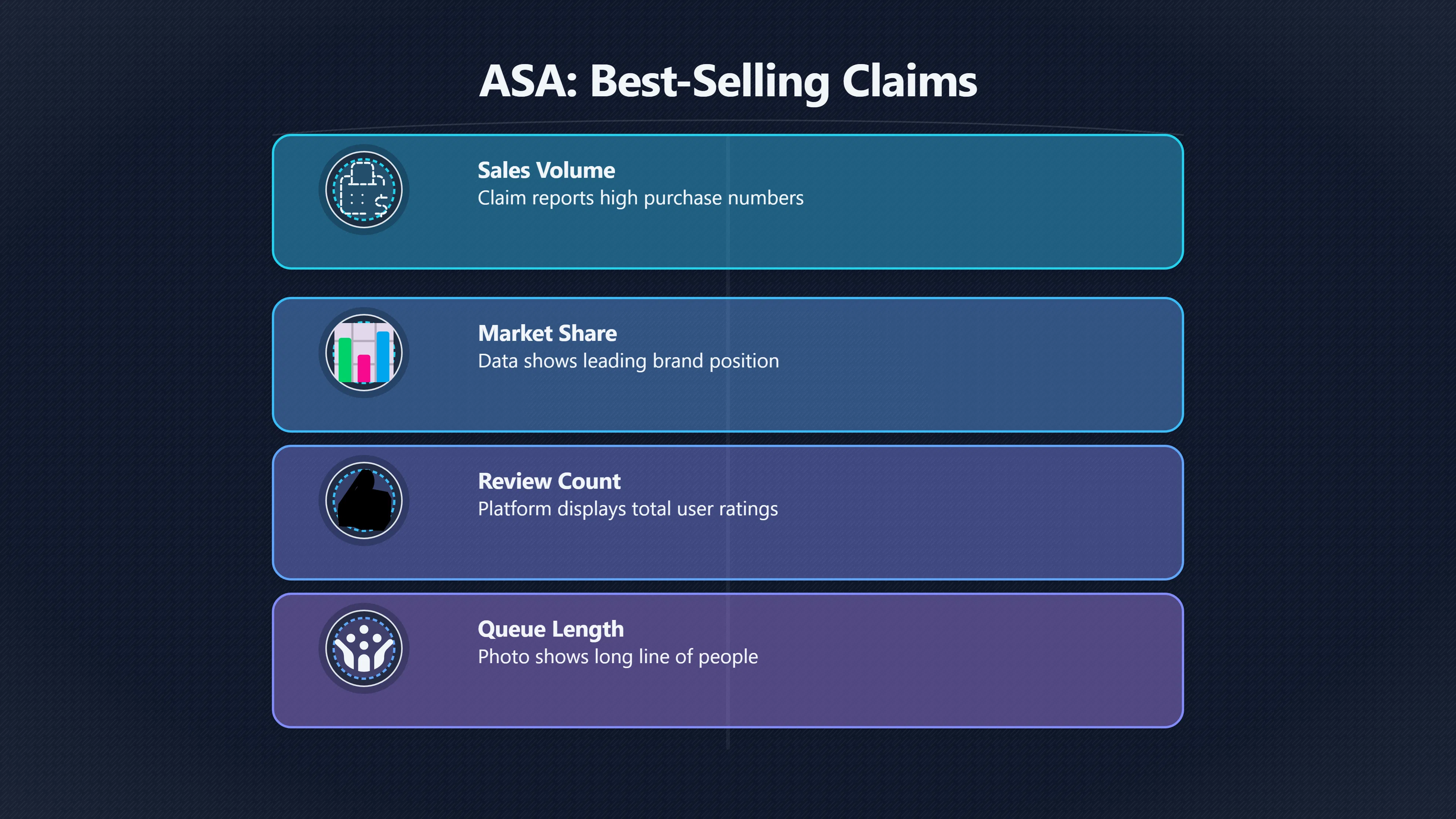
Crowds as proof of quality. Images of busy restaurants, packed shops or long queues create an impression of endorsement. A crowd may signal demand, but demand alone does not demonstrate quality.
Review counts as proof of excellence. A product with 50,000 reviews has clearly attracted attention. However, the number of reviews says little about average satisfaction, review authenticity or product suitability.
“Everyone is switching.” This message encourages consumers to avoid being left behind. Yet widespread adoption does not prove that the switch benefits every consumer.
Bestseller labels. A bestseller may genuinely be the top seller in a category. The label still does not establish superiority in durability, safety, effectiveness or value.
In logical terms, the error is treating social acceptance as evidence for claims that require independent testing or verification.
Why Consumers Find the Argument Convincing
Bandwagon advertising succeeds because social information is often useful in everyday life.
When people lack expertise, they frequently rely on the behaviour of others as a decision shortcut. If hundreds of diners choose one restaurant over another, following the crowd can sometimes be rational. Psychologists often describe this tendency as social proof: people infer that others may possess information they do not.
Advertisers exploit this tendency because it reduces the effort required to evaluate a product. Instead of examining ingredients, specifications, safety data or performance testing, consumers can rely on the apparent judgement of the crowd.
Research on social advertising demonstrates that cues linked to peers or social connections can measurably affect consumer behaviour. The effect is often stronger when the social cue comes from people perceived as similar, familiar or trustworthy. MIT Initiative on the Digital Economy[ResearchGate]researchgate.netResearch Gate Social Influence in Social Advertising: Evidence from FieldSocial Influence in Social Advertising: Evidence from Field…June 19, 2012 — We conduct two very large field experiments th…[3arXiv]arxiv.orgSocial Influence in Social Advertising: Evidence from Field…by E Bakshy · 2012 · Cited by 432 — We conduct two very large field experi…
The fact that a cue is persuasive, however, does not mean that it is logically sufficient. A crowd can be informative while still being wrong, uninformed or influenced by factors unrelated to product quality.
When Popularity Does Have Legitimate Value
Critiquing bandwagon advertising does not mean ignoring popularity altogether.
In some contexts, popularity provides useful evidence.
For example:
- A software platform with millions of users may benefit from stronger support communities and compatibility.
- A frequently purchased appliance may have a larger repair network and better spare-parts availability.
- A highly rated book may indicate broad reader satisfaction.
- Repeated purchases over many years may suggest that customers receive value.
The important distinction is that popularity becomes one piece of evidence rather than the entire argument.
A sensible evaluation combines popularity information with direct evidence about performance, safety, reliability, price or suitability.
Why Regulators Care About Implied Meanings
Advertising regulators frequently focus not only on explicit claims but also on the messages consumers are likely to infer.
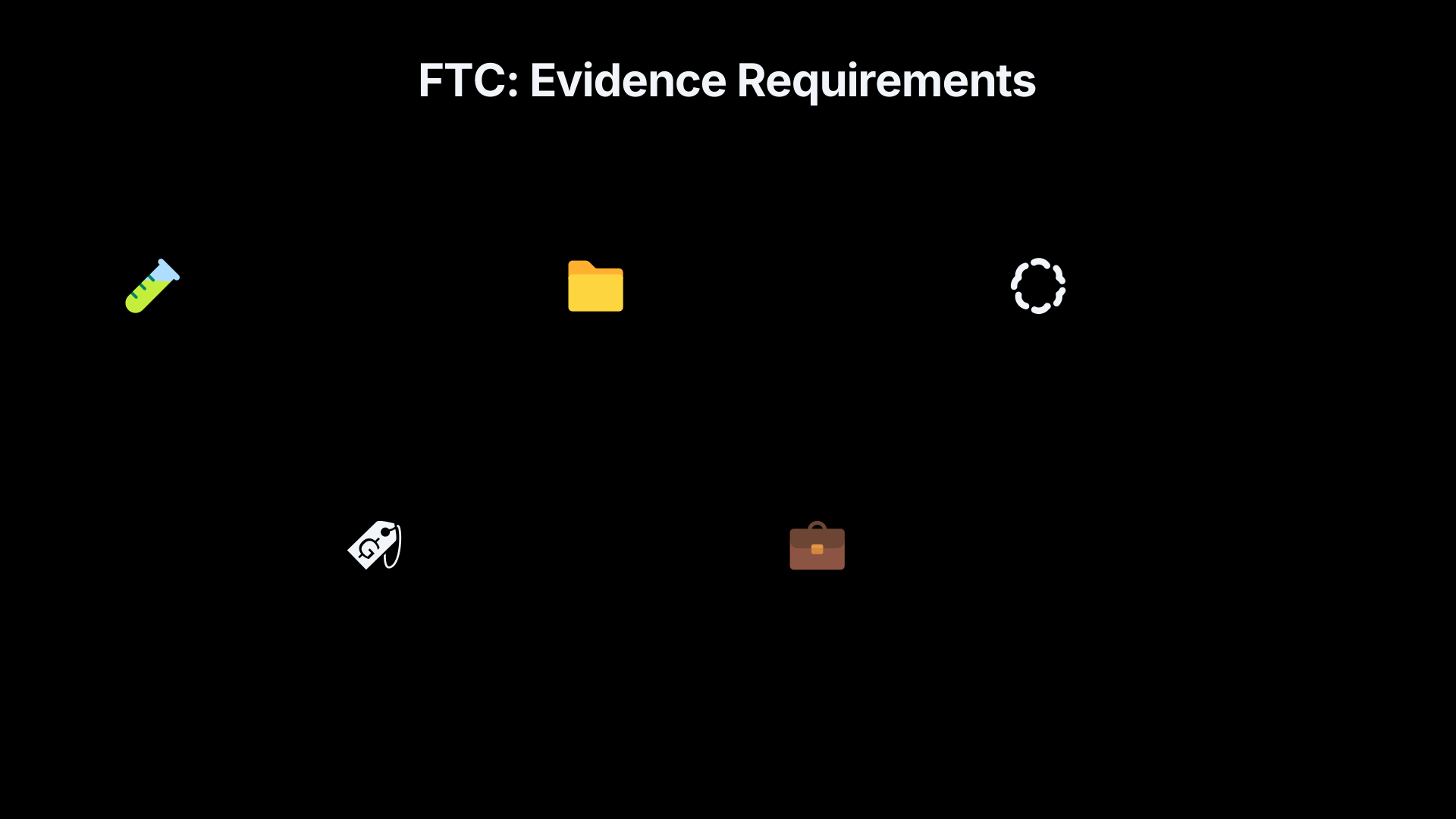
Both US and UK advertising guidance emphasise that advertisers must be able to support objective claims and implied messages that reasonable consumers may take from an advertisement. If an advert’s overall presentation encourages consumers to draw a factual conclusion, regulators may assess whether adequate evidence exists for that conclusion.[Kelley Drye & Warren LLP]kelleydrye.comKelley Drye & Warren LLPAdvertising and Marketing StandardsAs a general rule, claims in advertisements must be truthful and not misleadin…[Federal Trade Commission]ftc.govFederal Trade CommissionFTC Policy Statement Regarding Advertising SubstantiationJune 24, 2014 — Advertisers substantiate express and imp…[ASA]asa.org.ukSubstantiation - ASA12 Mar 2026 — Marketers must hold documentary evidence to prove claims that consumers are likely to regard as objecti…
This matters because popularity language often sits near the boundary between factual reporting and implied superiority.
Claims such as:[asa.org.uk]asa.org.uktypes of claims superlativeTypes of claims: Superlative11 Apr 2025 — A superlative claim can be a broad claim, such as “the best” or 'best-selling', or a specific c…
- “Best-selling”[asa.org.uk]asa.org.uktypes of claims best sellingTypes of claims: "Best-selling"11 Apr 2025 — In most cases, “best-selling” claims are likely to be understood as comparisons with iden…
- “Number 1”
- “Leading brand”
- “Most customers”
- “Highest rated”
are frequently treated as objective comparative claims that require supporting evidence. UK Advertising Standards Authority guidance notes that claims such as “best-selling”, “leading” and “No. 1” generally need evidence relating to sales, market share or other verifiable measures.[ASA]asa.org.ukSubstantiation - ASA12 Mar 2026 — Marketers must hold documentary evidence to prove claims that consumers are likely to regard as objecti…[ASA]asa.org.ukSubstantiation - ASA12 Mar 2026 — Marketers must hold documentary evidence to prove claims that consumers are likely to regard as objecti…[ASA]asa.org.ukSubstantiation - ASA12 Mar 2026 — Marketers must hold documentary evidence to prove claims that consumers are likely to regard as objecti…
The existence of evidence for a popularity claim, however, still does not automatically justify broader implications about quality or effectiveness.
How to Check Popularity Against Product Evidence
Consumers do not need to ignore popularity signals. They simply need to place them in the correct category.
A useful approach is to ask three questions:
What exactly is being measured?
“Most popular” could mean sales volume, website visits, social media mentions or customer ratings. Each metric measures something different.
Does the claim explain why people choose it?
Popularity is stronger evidence when accompanied by concrete reasons. Independent testing, reliability data, expert evaluations or transparent customer satisfaction figures provide more useful information than popularity alone.
Would the product still look convincing without the crowd?
Imagine removing the queue, the review count and the bestseller badge. What evidence remains? If the product’s case largely disappears, the advert may be relying heavily on bandwagon persuasion.
The Core Limitation of Popularity Claims
Popularity can reveal that many people have made a choice. It cannot by itself establish that the choice was informed, correct or optimal.
That limitation is what makes bandwagon advertising a recurring logical fallacy. The crowd may point toward something worth investigating, but it cannot replace evidence about quality, safety, effectiveness or value. The strongest advertisements use popularity as supporting context. The weakest ones ask consumers to treat popularity as proof.
eBay marketplace picks
Marketplace Samples
Example marketplace items related to this page. Use the search link to explore similar finds on eBay.



Endnotes
1.
Source: asa.org.uk
Link:https://www.asa.org.uk/advice-online/substantiation.html
Source snippet
Substantiation - ASA12 Mar 2026 — Marketers must hold documentary evidence to prove claims that consumers are likely to regard as objecti...
2.
Source: researchgate.net
Title: Research Gate Social Influence in Social Advertising: Evidence from Field
Link:https://www.researchgate.net/publication/227396836_Social_Influence_in_Social_Advertising_Evidence_from_Field_Experiments
Source snippet
Social Influence in Social Advertising: Evidence from Field...June 19, 2012 — We conduct two very large field experiments th...
Published: June 19, 2012
3.
Source: dl.acm.org
Link:https://dl.acm.org/doi/10.1145/2229012.2229027
Source snippet
ACM Digital LibrarySocial influence in social advertising | Proceedings of the...4 Jun 2012 — We conduct two very large field experiment...
4.
Source: arxiv.org
Link:https://arxiv.org/abs/1206.4327
Source snippet
Social Influence in Social Advertising: Evidence from Field...by E Bakshy · 2012 · Cited by 432 — We conduct two very large field experi...
5.
Source: ide.mit.edu
Link:https://ide.mit.edu/wp-content/uploads/2020/10/mksc.2020.1240.pdf
Source snippet
MIT Initiative on the Digital EconomySocial Advertising Effectiveness Across Products: A Large7 Oct 2020 — In this paper, we define socia...
6.
Source: kelleydrye.com
Link:https://www.kelleydrye.com/advertising-and-privacy-law/advertising-and-marketing-standards
Source snippet
Kelley Drye & Warren LLPAdvertising and Marketing StandardsAs a general rule, claims in advertisements must be truthful and not misleadin...
7.
Source: asa.org.uk
Title: types of claims best selling
Link:https://www.asa.org.uk/advice-online/types-of-claims-best-selling.html
Source snippet
Types of claims: "Best-selling"11 Apr 2025 — In most cases, “best-selling” claims are likely to be understood as comparisons with iden...
8.
Source: asa.org.uk
Title: types of claims superlative
Link:https://www.asa.org.uk/advice-online/types-of-claims-superlative.html
Source snippet
Types of claims: Superlative11 Apr 2025 — A superlative claim can be a broad claim, such as “the best” or 'best-selling', or a specific c...
9.
Source: asa.org.uk
Title: types of claims leading
Link:https://www.asa.org.uk/advice-online/types-of-claims-leading.html
Source snippet
Types of claims: "Leading"11 Apr 2025 — In most cases, a “leading” claim will be interpreted as a best-selling claim that needs to be sup...
10.
Source: asa.org.uk
Title: types of claims no 1
Link:https://www.asa.org.uk/advice-online/types-of-claims-no-1.html
Source snippet
Types of claims: "No. 1"11 Apr 2025 — In most cases a 'number 1' claim presented as a best-selling claim that needs to be supported by sa...
11.
Source: youtube.com
Title: How Is The Bandwagon Fallacy Used In Advertising?
Link:http://www.youtube.com/watch?v=-wcWq30GLFc
Source snippet
The Bandwagon Fallacy...
12.
Source: youtube.com
Title: The Bandwagon Fallacy
Link:http://www.youtube.com/watch?v=a-AFaBcUui4
Source snippet
Propaganda Bandwagon - Old Navy Commercial...
13.
Source: youtu.be
Title: Social Proof
Link:https://youtu.be/mWdIrgCCWYw
Source snippet
Prof Robert Cialdini explains the principle of social proof avvedpuriswar...
14.
Source: youtu.be
Title: Social Proof
Link:https://youtu.be/WeGl8ASNmro?si=Kd6GwacKvXX8-rrZ
15.
Source: ftc.gov
Link:https://www.ftc.gov/legal-library/browse/ftc-policy-statement-regarding-advertising-substantiation
Source snippet
Federal Trade CommissionFTC Policy Statement Regarding Advertising SubstantiationJune 24, 2014 — Advertisers substantiate express and imp...
Published: June 24, 2014
16.
Source: committees.parliament.uk
Title: ukadvertising standards authority
Link:https://committees.parliament.uk/writtenevidence/130620/html/
Source snippet
standards authority - written evidence (fdo0116)8 Apr 2024 — Health claims in food specifically refer to a relationship between a food /...
17.
Source: emergentmind.com
Title: social influence in social advertising
Link:https://www.emergentmind.com/topics/social-influence-in-social-advertising
Source snippet
29 Jan 2026 — Explore how social influence shapes online advertising by leveraging peer cues and crowd ratings to enhance engagement and...
Additional References
18.
Source: academyofphysicalmedicine.co.uk
Link:https://academyofphysicalmedicine.co.uk/wp-content/uploads/2017/04/ASA-Guidance.pdf
Source snippet
ASA GUIDANCE: Marketing Claims“Biggest”, “best-selling”, “leading” and other, similar claims are generally treated as objective claims th...
19.
Source: mbhb.com
Link:https://www.mbhb.com/intelligence/snippets/seven-points-to-consider-regarding-advertising-claims/
Source snippet
Seven Points to Consider Regarding Advertising ClaimsAdvertising must be truthful and non-deceptive, advertisers must have evidence to ba...
20.
Source: cs.tau.ac.il
Link:https://www.cs.tau.ac.il/~fiat/cgt12/EC_2012/docs/p146.pdf
Source snippet
TAU Computer ScienceSocial Influence in Social Advertising: Evidence from Field...by E BAKSHY · Cited by 432 — As far as we know, the pr...
21.
Source: allaboutadvertisinglaw.com
Link:https://www.allaboutadvertisinglaw.com/2024/11/understanding-false-advertising-claims-an-excerpt-from-the-advertising-law-tool-kit.html
Source snippet
This is the easiest claim to make, because if an ad is literally false, or false on its face, consumer deception is presumed.Read more...
22.
Source: millercanfield.com
Title: resources FTC Power to Demand Substantiation for Ads Faces Fiery Lawsuit
Link:https://www.millercanfield.com/resources-FTC-Power-to-Demand-Substantiation-for-Ads-Faces-Fiery-Lawsuit.html
Source snippet
FTC's Power to Demand Substantiation for Ads Faces Fiery...23 Jun 2025 — Under current Federal Trade Commission (FTC) policy, an adverti...
23.
Source: bizlawuk.co.uk
Title: every rule you need to know of business while making a marketing claim
Link:https://www.bizlawuk.co.uk/every-rule-you-need-to-know-of-business-while-making-a-marketing-claim/
Source snippet
ASA rules you need to know while making marketing claims.14 Oct 2021 — Unless they are blatantly fake, [testimonials]({{ 'testimonials/' | relative_url }}) or endorsements used...
24.
Source: hunton.com
Title: 93936 navigating over the counter product ads after ftc warning
Link:https://www.hunton.com/media/publication/93936_navigating-over-the-counter-product-ads-after-ftc-warning.pdf
Source snippet
Navigating Over-The-Counter Product Ads After FTC Warningby A Ghiam · 2023 — False statements by necessary implication are claims that wh...
25.
Source: greenly.earth
Title: complying with the advertising standards authority asa rules
Link:https://greenly.earth/en-gb/blog/company-guide/complying-with-the-advertising-standards-authority-asa-rules
Source snippet
Complying with the Advertising Standards Authority (ASA)...3 Mar 2023 — In this article we'll look at what the updated ASA advertising g...
26.
Source: contractorcalculator.co.uk
Link:https://www.contractorcalculator.co.uk/asa_case_study.aspx
Source snippet
eld for all websites selling advertising, whilst at the same time making it...Read more...
27.
Source: asa.org.uk
Title: substantiation sampling references and consumer goods
Link:https://www.asa.org.uk/advice-online/substantiation-sampling-references-and-consumer-goods.html
Source snippet
Substantiation: Consumer surveys and sample claims29 Apr 2026 — This guidance aims to answer some key questions that the Copy Advice team...
Topic Tree