Within Circularity
When Explanations Just Rename the Claim
Some explanations sound scientific while merely restating the thing they were meant to explain in different words.
On this page
- Why the opium example is circular
- How synonyms disguise weak support
- Questions that expose reworded conclusions
Page outline Jump by section
Introduction
One of the most deceptive forms of circular reasoning occurs when an explanation sounds technical but merely restates the claim it was supposed to explain. Instead of providing a cause, mechanism, or independent reason, the explanation simply renames the phenomenon in different words. Because the language appears scientific or specialised, the weakness can be easy to miss.
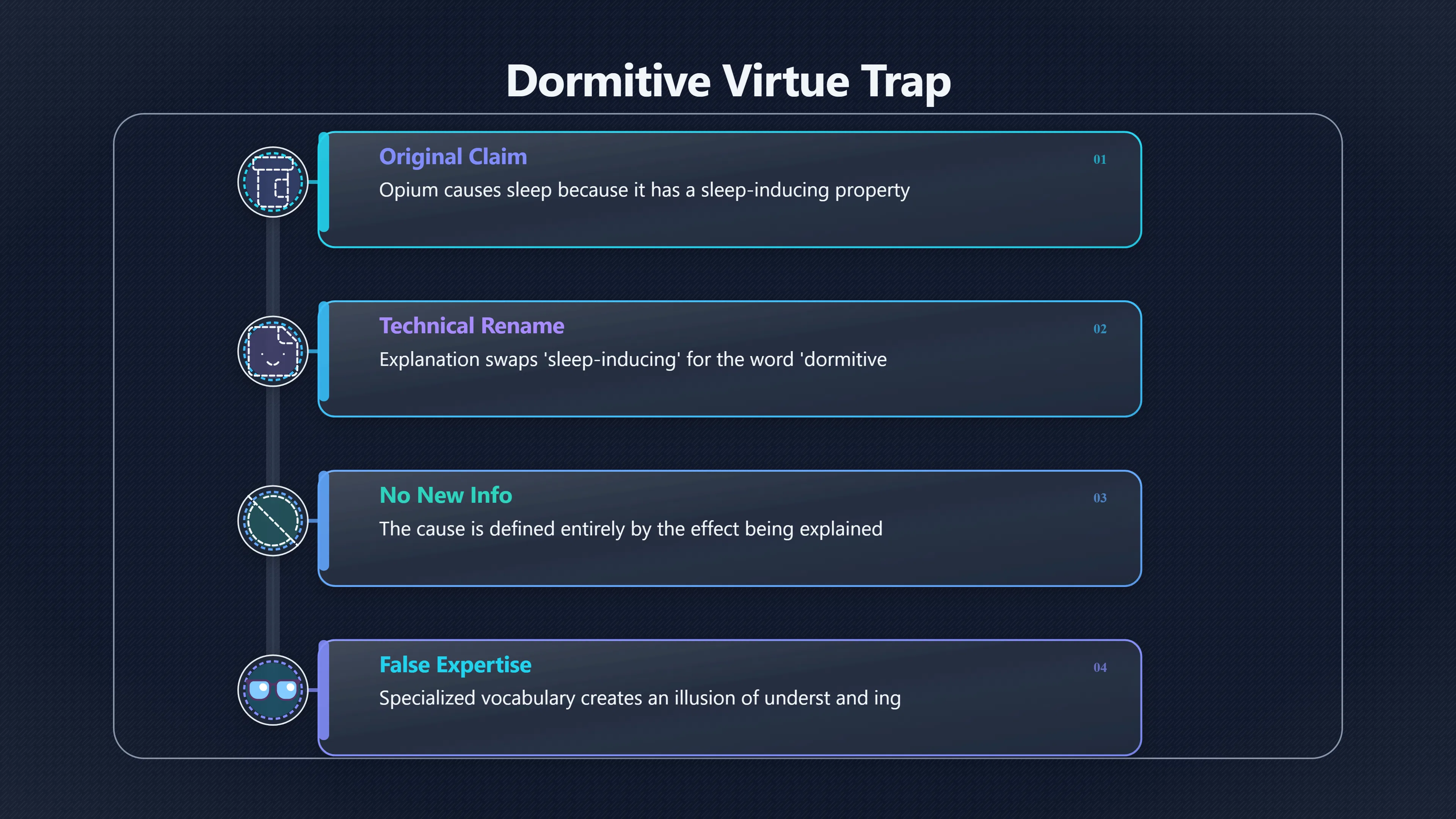
 The classic example is the claim that opium causes sleep because it possesses a “soporific” or “dormitive” property. Since soporific means “sleep-inducing”, the explanation effectively says that opium causes sleep because it has the property of causing sleep. Nothing new has been learned. The conclusion has merely been translated into different vocabulary. Philosophers and logicians have long used this example as a model of explanatory failure and as a warning about circular reasoning hidden behind impressive terminology.[Elanor Taylor]elanortaylor.orgElanor TaylorA Dormitive Virtue Puzzle.by E Taylor · Cited by 2 — Molière's comedy The Imaginary Invalid a doctor “explains” that opium r…[2media.podcasts.ox.ac.uk]media.podcasts.ox.ac.ukford Lectures on General Philosophy, 2018-19“Why does opium make one sleep?” “Because it contains a dormitive virtue, whose nature is t…
Why the Opium Example Is Circular
The famous “dormitive virtue” example is commonly traced to a satirical scene in Molière’s 1673 play The Imaginary Invalid. In the scene, a medical student is asked why opium induces sleep and replies that it contains a “dormitive virtue”, a response that earns approval from the assembled doctors. The joke works because the answer appears scholarly while explaining nothing.[Elanor Taylor]elanortaylor.orgElanor TaylorA Dormitive Virtue Puzzle.by E Taylor · Cited by 2 — Molière's comedy The Imaginary Invalid a doctor “explains” that opium r…
The structure of the reasoning is:
- Question: Why does opium make people sleep?[media.podcasts.ox.ac.uk]media.podcasts.ox.ac.ukford Lectures on General Philosophy, 2018-19“Why does opium make one sleep?” “Because it contains a dormitive virtue, whose nature is t…
- Answer: Because it has a sleep-causing property.
At first glance, the answer resembles an explanation. On inspection, however, the property is defined entirely by the effect being explained. The supposed cause adds no information beyond the original observation. Philosophers often describe this as a failure of explanatory distance: the explanation sits so close to the claim that it effectively repeats it.[Elanor Taylor]elanortaylor.orgElanor TaylorA Dormitive Virtue Puzzle.by E Taylor · Cited by 2 — Molière's comedy The Imaginary Invalid a doctor “explains” that opium r…
A genuine explanation would introduce something independent of the conclusion. Modern pharmacology, for example, explains sedative effects through chemical interactions with receptors and nervous-system processes. Whether that explanation is complete or not, it at least introduces mechanisms that are not simply synonyms for “causes sleep”. The dormitive-virtue explanation does not.[stanford]plato.stanford.eduEncyclopedia of Philosophy Scientific ExplanationStanford Encyclopedia of PhilosophyScientific Explanation - Stanford Encyclopedia of Philosophy9 May 2003 — Issues concerning scientific… Encyclopedia of Philosophy
How Synonyms Disguise Weak Support
Reworded conclusions are persuasive because people often mistake labels for explanations. Once a phenomenon receives a technical-sounding name, it can feel as though understanding has increased even when no new evidence has been provided.
Consider these examples:
- “The medicine works because it is effective.”
- “He succeeds because he has a success-oriented personality.”
- “The market fell because investors became pessimistic.”
- “The child is disruptive because she has disruptive tendencies.”
Each statement sounds explanatory. Yet in each case the proposed reason largely restates the outcome. The explanation merely converts a verb into a noun, adjective, or trait and then presents that reformulation as a cause.
This pattern appears in many fields. In everyday conversation, people often infer hidden qualities from observed behaviour and then use those qualities to explain the same behaviour. The reasoning becomes circular because the evidence for the quality is the very behaviour it supposedly explains.[Wikipedia]WikipediaCircular reasoningCircular reasoning
Technical language can make the problem harder to detect. A specialised term may create an impression of expertise, causing listeners to assume that a mechanism has been identified. Yet a new label is not automatically a new explanation. The crucial question is whether the term refers to independently established processes or merely redescribes the original fact.

When a Property Really Explains Something
Not every reference to a property or disposition is fallacious. Scientific explanations frequently invoke properties such as mass, electrical charge, elasticity, or toxicity. The difference lies in whether the property contributes independent explanatory content.[stanford]plato.stanford.eduEncyclopedia of Philosophy Scientific ExplanationStanford Encyclopedia of PhilosophyScientific Explanation - Stanford Encyclopedia of Philosophy9 May 2003 — Issues concerning scientific… Encyclopedia of Philosophy
A property becomes informative when it:
- Connects to broader theories.
- Generates testable predictions.
- Explains multiple observations rather than one isolated fact.
- Can be investigated independently of the specific outcome being discussed.
For example, saying that a substance is toxic is not necessarily circular if toxicity has been independently studied, measured, and linked to identifiable biological mechanisms. The explanation does more than restate the observation; it places the observation within a wider causal framework.
The dormitive-virtue example became famous precisely because it lacks these features. The alleged virtue is defined only through the effect it is supposed to explain.[Elanor Taylor]elanortaylor.orgElanor TaylorA Dormitive Virtue Puzzle.by E Taylor · Cited by 2 — Molière's comedy The Imaginary Invalid a doctor “explains” that opium r…
Questions That Expose Reworded Conclusions
A useful way to test an explanation is to ask whether it provides information that someone who already knows the original claim did not possess before.
Several questions help reveal disguised circularity:
What does the new term add?
If removing the technical word leaves the meaning unchanged, the explanation may be a restatement.
Could the explanation be true if the conclusion were false?
If the proposed cause is defined entirely by the outcome, the answer is usually no.
Does the explanation identify a mechanism?
Mechanisms describe how or why something happens. Mere relabelling does not.
Can the proposed cause be investigated independently?
An independently measurable property is more informative than one inferred solely from the phenomenon it allegedly explains.
Have I learned anything new?
Perhaps the simplest test is whether the explanation increases understanding or merely replaces familiar words with unfamiliar ones.
Why Reworded Explanations Remain Persuasive
People naturally seek causes, and language often rewards explanations that sound complete rather than explanations that genuinely add information. A concise label can create a powerful illusion of understanding. Once a phenomenon has been named, the mind may treat the naming itself as an explanation.
Molière’s dormitive-virtue joke has endured for centuries because it captures this tendency perfectly. The example demonstrates that circular reasoning does not always appear as an obvious logical loop. Sometimes it hides behind sophisticated vocabulary, abstract traits, or scientific-sounding terminology. The conclusion returns disguised as an explanation, and the disguise is mistaken for evidence.[Elanor Taylor]elanortaylor.orgElanor TaylorA Dormitive Virtue Puzzle.by E Taylor · Cited by 2 — Molière's comedy The Imaginary Invalid a doctor “explains” that opium r…[2media.podcasts.ox.ac.uk]media.podcasts.ox.ac.ukford Lectures on General Philosophy, 2018-19“Why does opium make one sleep?” “Because it contains a dormitive virtue, whose nature is t…
Recognising reworded conclusions is therefore an important skill in evaluating arguments. Whenever an explanation seems impressive, it is worth asking whether it reveals a genuine mechanism or merely renames the claim it was meant to explain.
Amazon book picks
Further Reading
Books and field guides related to When Explanations Just Rename the Claim. Use these as the next step if you want deeper reading beyond the article.
The Demon-Haunted World
Shows the difference between genuine explanations and empty labels.
eBay marketplace picks
Marketplace Samples
Example marketplace items related to this page. Use the search link to explore similar finds on eBay.

Endnotes
1.
Source: media.podcasts.ox.ac.uk
Link:https://media.podcasts.ox.ac.uk/philfac/2018_millican_genphil/GenPhil_2018_MT_Handouts.pdf
Source snippet
ford Lectures on General Philosophy, 2018-19“Why does opium make one sleep?” “Because it contains a dormitive virtue, whose nature is t...
2.
Source: plato.stanford.edu
Title: Encyclopedia of Philosophy Scientific Explanation
Link:https://plato.stanford.edu/archives/win2014/entries/scientific-explanation/
Source snippet
Stanford Encyclopedia of PhilosophyScientific Explanation - Stanford Encyclopedia of Philosophy9 May 2003 — Issues concerning scientific...
Published: May 2003
3.
Source: plato.stanford.edu
Title: science theory observation
Link:https://plato.stanford.edu/entries/science-theory-observation/
Source snippet
Stanford Encyclopedia of PhilosophyTheory and Observation in Scienceby NM Boyd · 2009 · Cited by 101 — The strict contrast between theory...
4.
Source: Wikipedia
Title: Circular reasoning
Link:https://en.wikipedia.org/wiki/Circular_reasoning
5.
Source: plato.stanford.edu
Title: Encyclopedia of Philosophy Fallacies
Link:https://plato.stanford.edu/entries/fallacies/
Source snippet
They include more than one inference. Descartes...Read more...
6.
Source: Wikipedia
Link:https://en.wikipedia.org/wiki/Moli%C3%A8re
Source snippet
MolièreFrench playwright, actor, and poet, ing that is why your daughter is mute" to mock an unsatisfactory explanation...
7.
Source: plato.stanford.edu
Link:https://plato.stanford.edu/entries/analysis/s1.html
Source snippet
and Descriptions of AnalysisThis supplement collects together various definitions and descriptions of analysis that have been offered in...
8.
Source: plato.stanford.edu
Link:https://plato.stanford.edu/archives/fall2019/entries/analysis/s1.html
Source snippet
and Descriptions of AnalysisThis supplement collects together various definitions and descriptions of analysis that have been offered in...
9.
Source: plato.stanford.edu
Title: causation law
Link:https://plato.stanford.edu/entries/causation-law/
Source snippet
in the Law - Stanford Encyclopedia of Philosophyby M Moore · 2019 · Cited by 92 — The basic questions concerning causation in the law are...
10.
Source: plato.stanford.edu
Title: mathematics explanation
Link:https://plato.stanford.edu/entries/mathematics-explanation/
Source snippet
Explanationby P Mancosu · 2008 · Cited by 88 — The philosophical analysis of mathematical explanation concerns itself with two different...
11.
Source: elanortaylor.org
Link:https://www.elanortaylor.org/uploads/9/1/8/2/91822306/taylor_final_dormitive.pdf
Source snippet
Elanor TaylorA Dormitive Virtue Puzzle.by E Taylor · Cited by 2 — Molière's comedy The Imaginary Invalid a doctor “explains” that opium r...
12.
Source: britannica.com
Link:https://www.britannica.com/biography/Moliere-French-dramatist
Source snippet
Molière | Plays, Tartuffe, Dom Juan, Misanthrope, & FactsIn his plays, on a double vision that holds together opposing ideas, such as wis...
Additional References
13.
Source: facebook.com
Link:https://www.facebook.com/groups/352181896150872/posts/1317544012947984/
Source snippet
Molière's Timeless Comedic Genius and SatireWhat people are saying. Commenters praise Moliere's slapstick humor and satire, citing favori...
14.
Source: researchgate.net
Link:https://www.researchgate.net/publication/291986502_Moliere_Reasoning_With_Fools
Source snippet
Molière: Reasoning With FoolsThis book argues that new light can be shed on the words and actions of these characters, and on the tenor o...
15.
Source: ndl.ethernet.edu.et
Link:https://ndl.ethernet.edu.et/bitstream/123456789/19524/1/13.pdf.pdf
Source snippet
National Digital Library of EthiopiaRealism about causality in philosophy and social scienceby R Groff · Cited by 93 — This book is a uni...
16.
Source: upload.wikimedia.org
Link:https://upload.wikimedia.org/wikipedia/commons/7/7f/Opium_and_the_opium-appetite_-with_notices_of_alcoholic_beverages%2C_cannabis_indica%2C_tobacco_and_coca%2C_and_tea_and_coffee%2C_in_their_hygienic_aspects_and_pathologic_relations%28IA_66640160R.nlm.nih.gov%29.pdf
Source snippet
and the opium-appetiteown person. Afterswallowing in succession several lozenges to the amount of 4 grains in all, he began to have an un...
17.
Source: reddit.com
Link:https://www.reddit.com/r/askphilosophy/comments/6knpt3/are_dormitive_virtues_fallacies/
Source snippet
Are Dormitive Virtues fallacies?: r/askphilosophyMoliere's famous criticism of abstract philosophy is his satire of a group of doctor's...
18.
Source: mastodon.online
Title: hosted on mastodon.online”“Dormitive virtue” (or “virtus…”
Link:https://mastodon.online/%40tomstafford/111875480426003891
Source snippet
Mastodon hosted on mastodon.online""Dormitive virtue" (or "virtus…" - Tom Stafford4 Feb 2024 — "Dormitive virtue" (or "virtus dormitiva")...
19.
Source: escholarship.org
Title: qt35n0642p noSplash e8fa9c0ce12eebc92b923d6f4b6a2d25
Link:https://escholarship.org/content/qt35n0642p/qt35n0642p_noSplash_e8fa9c0ce12eebc92b923d6f4b6a2d25.pdf
Source snippet
The Government of the Senses Aesthetic Subjectivity and...by JJ Weiner · 2015 · Cited by 1 — Locke gives the further example of painting...
20.
Source: philpapers.org
Link:https://philpapers.org/archive/LAWPTB.pdf
Source snippet
Permission to believe: - Descriptive and prescriptive beliefs...by CP Lawrence · 2020 — Molière's jibe about opium putting you to sleep...
21.
Source: fitelson.org
Link:https://fitelson.org/confirmation/hume_enquiry.pdf
Source snippet
An Enquiry concerning Human Understandingby D HUME · Cited by 12965 — rhubarb always proved a purge, or opium a soporific* to every one...
22.
Source: scribd.com
Link:https://www.scribd.com/document/456860881/Moliere-Encyclopedia-Britannica
Source snippet
and beginnings in the theater, forming a troupe and touring...Read more...
Topic Tree