Within Fallacy Lab
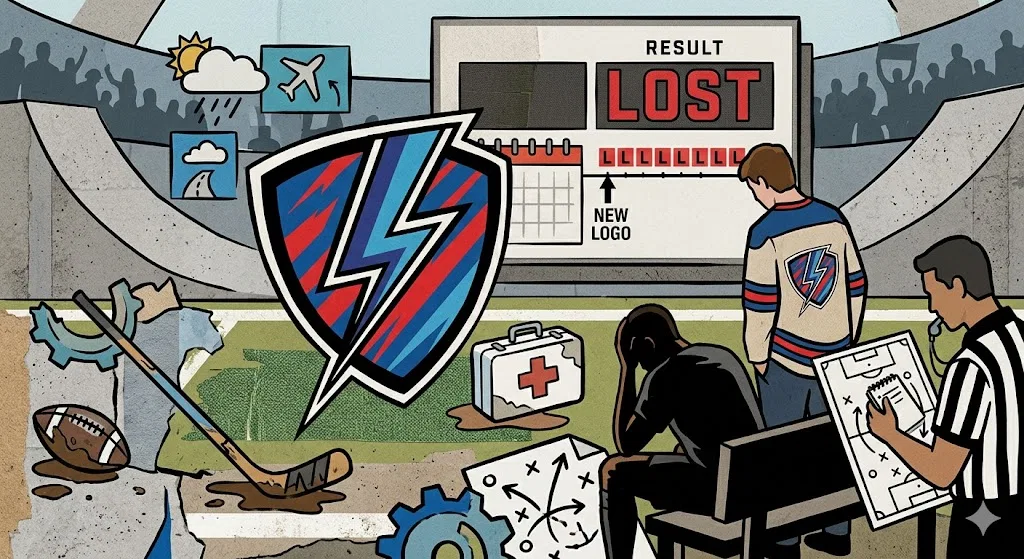
Did the Logo Cause the Losing Streak?
Sports superstitions show how timing can be mistaken for cause when performance has many possible explanations.
On this page
- Sequence and superstition
- Performance variables
- Better causal checks
Page outline Jump by section
Introduction
“Team Logo Causation” is a useful name for a familiar sports superstition: a team changes, mistreats, hides, modernises, steps on, or stops wearing a logo, and fans then treat the next losing streak as proof that the logo caused it. The reasoning feels persuasive because the timing is easy to see. The new badge appeared; the defeats followed. But within logical fallacies, this is usually a post hoc error: assuming that because one event came before another, it caused the later event. Chronology can raise a question, but it is not enough to prove cause.[Scribbr]scribbr.comPost Hoc Fallacy | Definition & ExamplesPost Hoc Fallacy | Definition & Examples
Sports make this fallacy especially tempting because outcomes are emotional, public, uncertain and full of variables. A logo can matter greatly as a symbol of identity, tradition and belonging, yet that symbolic importance is not the same as evidence that it changed player performance, tactics, injuries, fixture difficulty, confidence, recruitment, refereeing decisions or random variation.
Why a logo becomes an easy suspect
A team logo is not just a graphic mark. In sport, it is often treated as the visible shorthand for the club, the city, the dressing room, the supporters and the “name on the front” of the shirt. That is why redesigns can provoke unusually strong reactions. Research on sport rebranding has found that logo redesigns can affect fans’ attitudes and purchase intentions, with colour changes and more radical changes producing especially negative responses in one experimental study of sport logo redesign.[Emerald Publishing]emerald.comSource details in endnotes. Design specialists interviewed about NFL branding make the same point in practical terms: sports marks are tied to fan identity, heritage and emotional protection, so supporters often tolerate old imperfections more readily than future-facing redesigns that feel generic or rootless.[Creative Bloq]creativebloq.comSource details in endnotes.
That emotional force can make a logo a convenient causal story. If a club changes its crest and then loses five matches, the badge is visible in every photograph, broadcast graphic, shirt sale and social media argument. By contrast, the real performance variables are scattered and less memorable: an injured full-back, an ageing squad, weaker shot quality, travel fatigue, fixture congestion, tactical mismatch, new coaching instructions, or simply the ordinary noise of sport.
The fallacy is not that fans care about logos. They often have good reasons to care. A poor rebrand can damage trust, make merchandise less appealing, or signal that owners do not understand club culture. The fallacy appears when symbolic disappointment becomes a performance claim: “We are losing because of the logo.”
Sequence and superstition
The basic pattern is simple:
- A visible logo-related event happens.
- A bad run follows.
- The timing is treated as causal evidence.
- Counter-evidence is ignored, reinterpreted or folded into the superstition.
This is close to the classic post hoc fallacy. The problem is not that the proposed cause is impossible in every sense. A rebrand could indirectly affect morale if players, staff or supporters experience it as part of wider instability. But the mere order of events does not establish that connection. The Australian Bureau of Statistics explains the broader statistical distinction clearly: correlation describes variables moving together, while causation means one event is the result of another; in practice, establishing cause is harder than merely observing association.[Australian Bureau of Statistics]abs.gov.auSource details in endnotes.
Sports superstitions persist because they are often built from partial reinforcement. Sometimes a player wears a certain shirt and wins. Sometimes a fan watches from a certain chair and the team scores. Sometimes a club avoids stepping on the dressing-room logo and then plays well. The “hit” is remembered; the misses are excused. A classic review of sport superstition explains that when a behaviour happens to coincide with success, athletes may repeat it, and occasional later successes keep the belief alive even when reinforcement is intermittent. During slumps, rituals may be revised, intensified or replaced.[Sage Journals]journals.sagepub.comSage Journals
That is why a logo superstition can survive both winning and losing. If the team wins after restoring an old crest, the logo “worked”. If the team keeps losing, the argument may shift: the curse is deeper, the change came too late, the wrong alternate shirt was used, someone disrespected the badge, or the club has not properly returned to its roots. The claim becomes difficult to falsify because every result is made to fit the story.
The dressing-room logo shows the difference between respect and causation
The most concrete version of logo superstition is the unwritten rule against stepping on a team logo in the dressing room, especially in hockey culture. Reports and commentary describe it as a matter of respect, pride and team-first identity, not simply as a literal mechanism for winning matches. One hockey commentary piece argues that not stepping on the logo functions as a locker-room rule about respect for the team, while also noting the obvious tension: teams may protect a carpet logo while opponents skate over a larger logo at centre ice every game.[Two in the Box]twointhebox.comTwo in the Box Tread lightly, logo etiquette in the locker roomTwo in the Box Tread lightly, logo etiquette in the locker room
A widely circulated example came when Justin Bieber accidentally stood on the Chicago Blackhawks’ dressing-room logo while visiting the Stanley Cup in 2013. The club’s communications staff described it as an inadvertent step, said he moved quickly when reminded, and framed the issue as respect for a tradition.[Diehardsport]diehardsport.comSource details in endnotes. Another hockey writer later explained that media members learn not to step on locker-room logos largely because it avoids public reprimand, illustrating how a ritual can become a practical social rule even for people who do not believe in any mystical effect.[Sporting News]sportingnews.comSporting News Why I don't step on the logo in NHL locker roomsSporting News Why I don't step on the logo in NHL locker rooms
That distinction matters. A team can rationally enforce a symbolic norm without claiming the norm causes goals. “Do not step on the logo” may build shared identity, discipline and respect. “We lost because someone stepped on the logo” is a different kind of statement. The first is a cultural rule; the second is a causal claim that needs evidence.
Performance has too many moving parts for one symbol to explain a streak
A losing streak is rarely a single-cause event. In team sport, performance is a bundle of ability, form, opponent quality, injuries, selection, tactics, travel, officiating, confidence and chance. Research on elite sport injuries, for example, repeatedly finds that player availability matters for success; one review abstract states plainly that injuries have a detrimental impact on team and individual athletic success, and that increased availability improves the chance of success.[PubMed]pubmed.ncbi.nlm.nih.govSource details in endnotes. That does not mean injuries explain every slump, but it shows the kind of concrete variable a causal account must consider before blaming a logo.
Chance also matters more than many fans like to admit. Work on team sports often separates skill from randomness because short windows of matches can exaggerate luck. In cricket, for instance, a large study of 44,224 matches estimated that winning the toss increased the chance of winning by a small but significant margin, with the effect depending on conditions and team match-up.[arXiv]arxiv.orgSource details in endnotes. In football and basketball, analysts often have to account for regression to the mean: unusually good or bad runs are often followed by more ordinary results, not because a curse has lifted, but because extreme runs are partly noise.
This is why the “event time window” is so important. A five-match losing streak after a crest change may feel damning, but five matches may be too few to separate a logo story from schedule strength, injuries, fixture congestion and ordinary variance. The smaller and more emotionally selected the window, the easier it is to mistake a striking sequence for proof.
When logo claims are not completely irrational
The strongest version of the logo argument is not mystical. It is indirect and social: a logo change can signal ownership priorities, alienate supporters, reduce atmosphere, provoke media scrutiny, lower trust, or become one more symbol of a club losing touch with its identity. Those things may plausibly affect the environment around a team, especially if they sit alongside poor decisions in recruitment, coaching or governance.
But that stronger version is also harder to prove. It needs a chain of evidence. Did supporters actually disengage? Did attendance, chants, merchandise sentiment or survey responses change? Did players or staff report morale effects? Did the slump begin before the logo issue? Were similar teams without logo changes also losing? Did performance indicators such as shots, expected goals, turnovers, penalties or defensive errors change after the event?
This is where the fallacy test becomes useful. A logo can be relevant to brand attitude and fan behaviour, as rebranding research suggests.[Emerald Publishing]emerald.comSource details in endnotes. It does not follow automatically that the logo caused poor sporting results. Treating those as the same claim turns a plausible cultural criticism into a weak causal argument.
Better causal checks
A good check does not ask fans to stop caring. It asks them to separate symbolism from evidence. When someone says, “The new logo caused the losing streak,” the better questions are:
- What changed besides the logo? Look at injuries, selection, coach changes, transfers, age profile, travel and opponent strength.
- Was the team already declining? A logo change may arrive during a wider commercial or sporting reset, making it a marker rather than a cause.
- What is the comparison group? Other teams lose after no rebrand, and some teams win after major redesigns.
- Is the time window cherry-picked? Starting the count on the day of a logo reveal may ignore earlier poor form or later recovery.
- What mechanism is being claimed? Fan anger, player morale and superstition are different mechanisms; each needs different evidence.
- What evidence would change the conclusion? If no result can disprove the curse, the claim is functioning as folklore, not analysis.
The cleanest conclusion is modest: logo events can affect fan identity, mood and commercial behaviour, and they can become powerful symbols during a bad run. Sports superstitions also have real psychological functions, especially under uncertainty and pressure. Research on top sportspersons found ritual commitment was greater when uncertainty and importance were high, with psychological tension helping to explain that commitment.[Vrije Universiteit Amsterdam]research.vu.nlVrije Universiteit Amsterdam But the existence of a ritual, or the emotional meaning of a logo, is not proof that a badge caused a losing streak. In logical fallacy terms, the mistake is letting a memorable sequence stand in for causal evidence.
Amazon book picks
Further Reading
Books and field guides related to Did the Logo Cause the Losing Streak?. Use these as the next step if you want deeper reading beyond the article.
Fooled by Randomness
Rating: 4.0/5 from 15 Google Books ratings
Directly relevant to losing streaks and causal myths.
eBay marketplace picks
Marketplace Samples
Example marketplace items related to this page. Use the search link to explore similar finds on eBay.


Endnotes
1.
Source: scribbr.com
Title: Post Hoc Fallacy | Definition & Examples
Link:https://www.scribbr.com/fallacies/post-hoc-fallacy/
2.
Source: emerald.com
Link:https://www.emerald.com/ijsms/article/23/1/155/156606/Sport-rebranding-the-effect-of-different-degrees
3.
Source: journals.sagepub.com
Title: Sage Journals
Link:https://journals.sagepub.com/pb-assets/cmscontent/IRS/IRS-Demystifying-sport-superstition-1471356802020.pdf
4.
Source: diehardsport.com
Link:https://www.diehardsport.com/nhl/justin-bieber-stands-blackhawks-logo-locker-room-photo/
5.
Source: arxiv.org
Link:https://arxiv.org/abs/1605.08753
6.
Source: research.vu.nl
Title: Vrije Universiteit Amsterdam
Link:https://research.vu.nl/ws/portalfiles/portal/2177196/Schippers%20Journal%20of%20Applied%20Social%20Psychology%2036%202006%20u.pdf
7.
Source: arxiv.org
Link:https://arxiv.org/html/2506.03057v1
8.
Source: creativebloq.com
Link:https://www.creativebloq.com/design/logos-icons/appeasing-fans-doesnt-mean-standing-still-inside-the-art-of-nfl-logos
9.
Source: abs.gov.au
Link:https://www.abs.gov.au/statistics/understanding-statistics/statistical-terms-and-concepts/correlation-and-causation
10.
Source: twointhebox.com
Title: Two in the Box Tread lightly, logo etiquette in the locker room
Link:https://twointhebox.com/2013/07/11/tread-lightly-logo-etiquette-in-the-locker-room/
11.
Source: sportingnews.com
Title: Sporting News Why I don’t step on the logo in NHL locker rooms
Link:https://www.sportingnews.com/us/nhl/news/why-i-dont-step-on-the-logo-in-nhl-locker-rooms/o14bamzyud8w1apzwotmqk3zw
12.
Source: pubmed.ncbi.nlm.nih.gov
Link:https://pubmed.ncbi.nlm.nih.gov/28446456/
13.
Source: pubmed.ncbi.nlm.nih.gov
Link:https://pubmed.ncbi.nlm.nih.gov/20511389/
14.
Source: pubmed.ncbi.nlm.nih.gov
Link:https://pubmed.ncbi.nlm.nih.gov/26839047/
15.
Source: scribbr.co.uk
Title: rrelation and causation
Link:https://www.scribbr.co.uk/research-methods/correlation-and-causation/
16.
Source: philosophy.lander.edu
Link:https://philosophy.lander.edu/logic/cause.html
Additional References
17.
Source: youtube.com
Link:https://www.youtube.com/watch?v=QZ7_OX51JuM
Source snippet
Data fallacies/Statistical fallacies to avoid. Cherry picking, Simpson's paradox, Gambler's fallacy...
18.
Source: youtube.com
Title: 10 Sports Curses That Will Make You Believe in Fate
Link:https://www.youtube.com/watch?v=4DXd8qgDCY4
Source snippet
Sports superstitions psychology logical fallacies post hoc The Fallacy Of Moving The Goalpost Lernabit...
19.
Source: youtube.com
Title: Ad hoc Fallacy vs. Post hoc Fallacy
Link:https://www.youtube.com/watch?v=fUJimOi0hio
Source snippet
The Lottery Trap: Why Your Brain Falls for the Illusion of Control | Psychology of Randomness...
20.
Source: youtube.com
Link:https://www.youtube.com/watch?v=zzJgn12le4Q
Source snippet
The Curses Of American Sports...
21.
Source: sportsblog.com
Link:https://www.sportsblog.com/jeffnixon/bills-beat-the-dolphins-to-end-the-streak-/
22.
Source: facebook.com
Link:https://www.facebook.com/groups/853552931365745/posts/6922379167816394/
23.
Source: semanticscholar.org
Link:https://www.semanticscholar.org/paper/Examining-the-superstitions-of-sport-fans%3A-types-of-End-Grieve/0ca81b5890a761999bdd06b3b36aa6cc87efbb52
24.
Source: researchgate.net
Link:https://www.researchgate.net/publication/288259527_Examining_the_superstitions_of_sport_fans_Types_of_superstitions_perceptions_of_impact_and_relationship_with_team_identification
25.
Source: facebook.com
Link:https://www.facebook.com/groups/welcometojetsville/posts/1301255729932367/
26.
Source: scitechnol.com
Link:https://www.scitechnol.com/peer-review/luck-clustering-in-sports-applications-and-implications-for-performance-and-strategy-EWNS.php?article_id=22281
Topic Tree