Within Fallacy Lab
What Is the Wording Sneaking In?
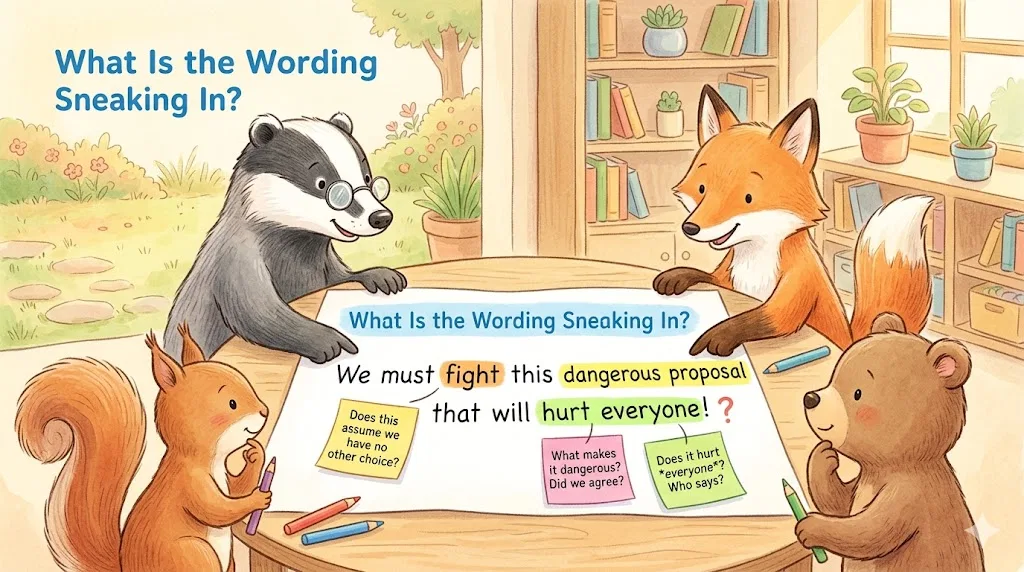
Loaded wording can smuggle assumptions into an argument before the evidence has been examined.
On this page
- Emotionally charged terms
- Presuppositions
- Neutral rewrites
Page outline Jump by section
Introduction
Loaded language and hidden assumptions are fallacy mechanisms that work before an argument has been properly examined. Instead of proving a point, they tilt the reader’s judgement through emotionally charged wording, flattering or hostile labels, or questions that quietly treat a disputed claim as already settled. The problem is not that emotion, vivid language or assumptions are always illegitimate. Ordinary communication depends on framing, emphasis and shared background. The fallacy appears when wording does argumentative work that evidence has not earned.
In logical fallacies, this matters because the error can be hard to spot. A sentence may look like a question, a description or a harmless phrase, while actually pushing a conclusion. “Are we going to continue wasting money on this policy?” does not merely ask about future spending; it presupposes that the spending is wasteful. The critical reader’s task is to separate the claim from the emotional packaging, then ask whether the hidden premise has been independently supported. The Internet Encyclopedia of Philosophy treats complex or loaded questions as cases where wording makes a controversial presupposition, and describes loaded questions as questions that unfairly presume the answer.[Internet Encyclopedia of Philosophy]iep.utm.eduSource details in endnotes.
How loaded wording does the work of an argument
Loaded language uses words with strong emotional or evaluative force to make a claim feel more acceptable, outrageous, dangerous or virtuous than the evidence alone would show. Calling a tax “investment in the future” frames it differently from calling it a “raid on workers’ pay packets”. Calling a protest “public resistance” differs from calling it “mob disruption”. The facts may still need discussion, but the wording has already told the audience what emotional stance to take.
That is why loaded language belongs within informal fallacies rather than formal logic. The problem is not usually an invalid syllogism. It is a pressure on judgement created by word choice, framing and implied evaluation. Purdue OWL’s general account of fallacies is useful here: fallacies undermine an argument’s logic and are often marked by a lack of evidence supporting the claim. Loaded wording becomes fallacious when it substitutes mood, stigma or approval for the missing support.[Purdue OWL]owl.purdue.eduPurdue OWL® - Purdue University…
Psychology research helps explain why this works. A 2018 study in Psychological Science found that when people intend to persuade, they spontaneously use more emotionally loaded words, and may keep doing so even when emotional appeals could backfire. This does not mean emotional language is automatically manipulative; it does show that persuasion and emotional wording are closely linked in ordinary communication.[PubMed]pubmed.ncbi.nlm.nih.govSource details in endnotes.
A practical test is to ask: “Would this sentence still be persuasive if the charged word were replaced by a neutral one?” If “reckless cuts” becomes “budget reductions”, “common-sense reform” becomes “proposed reform”, or “bureaucratic meddling” becomes “regulation”, the argument may suddenly look much thinner. That thinning is the clue. The original wording was not just describing the issue; it was carrying part of the conclusion.
Emotionally charged terms
Emotionally charged terms are not fallacious simply because they are strong. Some strong descriptions are accurate. “Fraud”, “abuse”, “negligence” and “corruption” may be justified when the evidence meets those standards. The fallacy arises when the speaker uses the force of such words before demonstrating that they apply.
There are three common patterns:
- Condemnation before evidence: “This corrupt scheme must be stopped” presents corruption as settled before showing improper conduct.
- Praise before evidence: “This bold, humane reform deserves support” encourages approval before establishing that the reform is effective or humane.
- Identity pressure: “Any decent person would agree” shifts attention from the claim to the reader’s desire to be seen as decent.
The mechanism is especially visible in public communication because framing is unavoidable. A 2024 review in Psychological Science in the Public Interest notes that speakers must choose what to say, what not to say and how to say it, and that these choices can influence how people think, feel and act across politics, health, business, journalism, law and personal life. The same review also cautions that framing is a normal feature of communication, not automatically a trick.[Sage Journals]journals.sagepub.comSource details in endnotes.
That distinction matters. A campaigner may legitimately use vivid language to communicate moral urgency. A journalist may fairly call a proven falsehood a falsehood. A patient advocate may describe suffering in emotionally direct terms because the emotion is part of the reality being discussed. Loaded language becomes a fallacy when the emotional label replaces the evidence, blocks alternative descriptions, or makes disagreement feel morally suspect before the reasoning has been tested.
Presuppositions
A presupposition is background information that a statement or question takes for granted. In ordinary conversation, presuppositions are useful. “When did you arrive?” presupposes that you arrived. “Do you want another cup of tea?” presupposes that you have already had one. Most of the time, such assumptions are harmless and efficient.
In argument, however, presuppositions can smuggle in disputed claims. The classic loaded-question pattern is: “Have you stopped doing X?” Either a yes or no answer seems to accept that X was happening before. The respondent is pushed into defending themselves from a premise they may reject. The Internet Encyclopedia of Philosophy’s example, asking whether a president will continue “wasting taxpayer’s money” on a policy, shows the same structure: the question presupposes that the policy is wasteful rather than asking whether it is.[Internet Encyclopedia of Philosophy]iep.utm.eduSource details in endnotes.
Linguistics gives this mechanism a precise explanation. The Stanford Encyclopedia of Philosophy discusses “accommodation”, where listeners adjust the conversational background to make sense of a speaker’s presupposition. In ordinary conversation, people often accept such background adjustments smoothly because conversation would be exhausting if every assumption had to be challenged.[stanford]plato.stanford.eduEncyclopedia of PhilosophyPresupposition (Stanford Encyclopedia of Philosophy/Fall 2014 Edition)… Encyclopedia of Philosophy
That smoothness is exactly what makes hidden assumptions powerful in fallacious reasoning. The audience may unconsciously accept the premise just to keep the conversation moving. Once accepted, the argument can proceed as if the contested point has already been established. The fallacy is not merely that an assumption exists; all reasoning uses assumptions. The problem is that the assumption is controversial, relevant and unargued.
Loaded questions in surveys, interviews and debate
Loaded assumptions are especially damaging when the format limits the respondent’s ability to object. In a debate, the speaker may be able to say, “I reject the premise.” In a multiple-choice survey, courtroom question or rapid interview, the design may force an answer that appears to concede the hidden claim.
Survey researchers treat this as a measurement problem as well as a reasoning problem. Pew Research Center warns that even accurate sampling is wasted if the questions are ambiguous or biased, because the wording of questions is part of what determines whether a survey measures real opinions, experiences and behaviours.[Pew Research Center]pewresearch.orgPew Research Center Writing Survey Questions | Pew Research CenterPew Research Center Writing Survey Questions | Pew Research Center SurveyMonkey gives the practical version: injecting an opinion or assumption into a survey question produces biased responses, and a loaded question can force respondents to answer about something they may not have experienced or accepted.[SurveyMonkey]surveymonkey.comSurvey Monkey How To Avoid Asking Leading Questions And Loaded QuestionsSurvey Monkey How To Avoid Asking Leading Questions And Loaded Questions
A simple example is:
“Why are customers unhappy with our new booking system?”
This presupposes that customers are unhappy. A neutral version would be:
“How satisfied or dissatisfied are customers with our new booking system?”
The neutral version leaves room for approval, indifference, mixed experience or dissatisfaction. It asks for evidence rather than embedding the answer.
The same issue appears in interviews and memory research. In the well-known Loftus and Palmer car crash experiment, participants’ speed estimates were influenced by the verb used in the question, such as “smashed” rather than “hit”; later, some participants were more likely to report seeing broken glass that was not present. The study is usually discussed as evidence that wording can influence eyewitness reports, though later discussion also notes limits such as the artificial laboratory setting.[Simply Psychology]simplypsychology.orgloftus palmerloftus palmer
For logical fallacies, the lesson is narrower but important: wording is not a transparent container for a claim. It can shape the answer, the memory, the emotional stance and the apparent range of acceptable replies.
Hidden assumptions are not always wrong
The aim is not to ban assumptions. Every argument has background commitments. “We should repair the bridge before winter” assumes there is a bridge, that winter weather matters, and that repair is possible. Those assumptions may be uncontroversial in context. An argument becomes suspect when the hidden assumption is doing real argumentative work and has not been defended.
A good way to distinguish fair assumptions from fallacious ones is to ask four questions:
- Is the assumption necessary for the statement to make sense?
“The minister has failed again” presupposes a previous failure. If that history is disputed, the wording is loaded.
- Would a reasonable opponent reject the assumption?
“How should we punish these freeloaders?” presupposes that the people in question are freeloaders and deserve punishment.
- Does the assumption decide the argument in advance?
“When will the company stop exploiting its workers?” skips over whether exploitation has been established.
- Can the assumption be supported independently?
If the speaker can show evidence of exploitation, waste or corruption, the wording may be forceful but not necessarily fallacious. If not, the label is doing more work than the proof.
This is why loaded language often overlaps with begging the question. Begging the question occurs when reasoning depends on a premise that already assumes the conclusion. The IEP describes it as circular reasoning in which the conclusion is derived from premises that presuppose the conclusion, and notes that the issue is whether a key premise has been adopted blindly or can be independently defended.[Internet Encyclopedia of Philosophy]iep.utm.eduSource details in endnotes.
Neutral rewrites
Neutral rewriting is not about making every sentence bland. It is a diagnostic method. By rewriting a loaded claim in plainer terms, readers can see which part is evidence and which part is emotional or presupposed evaluation.
Consider these before-and-after examples:
Loaded wordingWhat it sneaks inMore neutral rewrite“Why is the council still wasting money on this scheme?”The scheme is wasteful.“What evidence supports continuing or ending this scheme?”“Do you support this attack on family values?”The policy attacks family values.“How might this policy affect families with different needs?”“The company’s so-called apology proves it has no respect for customers.”The apology is insincere and the motive is contempt.“Was the company’s apology specific, timely and matched by action?”“Only extremists oppose this common-sense measure.”Opponents are extreme; the measure is common sense.“What are the strongest arguments for and against this measure?”“How badly has remote working damaged productivity?”Remote working has damaged productivity.“What effect has remote working had on productivity, if any?”
The rewrite does not settle the issue. It makes the issue discussable. If the original claim is true, it should survive neutral phrasing because the evidence will still support it. If it becomes much weaker, the original wording was probably carrying an unsupported conclusion.
Neutral rewriting is also useful in self-editing. A writer who wants to argue fairly can keep strong language where it is justified, but should first state the claim in neutral terms, provide evidence, then explain why a stronger evaluative term is warranted. The order matters: evidence first, label second.

How to respond without accepting the premise
The safest response to loaded wording is not always to answer the surface question. Sometimes the right move is to name and separate the assumption.
For example:
- “Before answering that, I would not accept that the policy is wasteful. The question is whether its costs are justified by its benefits.”
- “That assumes the group acted irresponsibly. What evidence supports that?”
- “I can answer whether the proposal should continue, but not on the assumption that it is an attack on anyone.”
- “The wording gives only two moral categories. There may be other positions.”
This response works because it changes the task. Instead of accepting the speaker’s frame, it identifies the hidden premise and asks for support. It also avoids a common trap: responding with equal and opposite loaded language. Calling a loaded question “dishonest propaganda” may be emotionally satisfying, but unless dishonesty is shown, it repeats the same error.
The strongest critical response is usually calm and specific: identify the loaded term, restate the issue neutrally, and ask what evidence would justify the presupposition. That keeps the focus on reasoning rather than tone-policing. Some arguments are both emotionally worded and well supported; others are politely phrased but fallacious. The test is not whether the language is vivid. The test is whether the wording is smuggling in a conclusion that the argument still needs to prove.
Why this fallacy is easy to miss
Loaded language and hidden assumptions are easy to miss because they exploit normal habits of understanding. Readers do not process every word as a formal premise. They follow context, infer background, respond to tone and make quick judgements about what kind of situation they are in. Framing research suggests that these effects are not rare distortions but part of how language guides mental models.[Sage Journals]journals.sagepub.comSource details in endnotes.
They are also easy to miss because the wording may match the audience’s existing beliefs. A hostile label aimed at an opponent feels like accuracy; the same technique aimed at one’s own side feels unfair. That asymmetry is one reason this fallacy is common in political speech, advertising, activism, management language and social media disputes. The more familiar the emotional frame feels, the less visible it becomes as a frame.
The remedy is not suspicion of all rhetoric. It is disciplined translation. Strip the sentence back to its claim, expose the implied premise, and ask whether the evidence supports both. When a claim remains persuasive after that process, it is stronger. When it collapses, the wording was doing the reasoning’s job.
eBay marketplace picks
Marketplace Samples
Example marketplace items related to this page. Use the search link to explore similar finds on eBay.






Endnotes
1.
Source: owl.purdue.edu
Link:https://owl.purdue.edu/owl/general_writing/academic_writing/logic_in_argumentative_writing/fallacies.html
Source snippet
Purdue OWL® - Purdue University...
2.
Source: plato.stanford.edu
Title: Encyclopedia of Philosophy
Link:https://plato.stanford.edu/archives/fall2014/entries/presupposition/
Source snippet
Presupposition (Stanford Encyclopedia of Philosophy/Fall 2014 Edition)...
3.
Source: surveymonkey.com
Title: Survey Monkey How To Avoid Asking Leading Questions And Loaded Questions
Link:https://www.surveymonkey.com/curiosity/how-to-avoid-asking-leading-and-loaded-questions/
4.
Source: owl.purdue.edu
Title: using paper checkers responsibly
Link:https://owl.purdue.edu/owl/research_and_citation/using_paper_checkers_responsibly.html
5.
Source: plato.stanford.edu
Link:https://plato.stanford.edu/archives/win2025/entries/fallacies/
6.
Source: youtube.com
Title: Change My Mind: Loaded Language
Link:https://www.youtube.com/watch?v=voJszy317mk
Source snippet
Logical Fallacies - Loaded Question...
7.
Source: youtube.com
Title: Logical Fallacies
Link:https://www.youtube.com/watch?v=HjAhROTY7YA
Source snippet
Complex Question (Logical Fallacy)...
8.
Source: iep.utm.edu
Link:https://iep.utm.edu/fallacy/
9.
Source: pubmed.ncbi.nlm.nih.gov
Link:https://pubmed.ncbi.nlm.nih.gov/29543563/
10.
Source: journals.sagepub.com
Link:https://journals.sagepub.com/doi/abs/10.1177/15291006241246966
11.
Source: pewresearch.org
Title: Pew Research Center Writing Survey Questions | Pew Research Center
Link:https://www.pewresearch.org/writing-survey-questions/
12.
Source: simplypsychology.org
Title: loftus palmer
Link:https://www.simplypsychology.org/loftus-palmer.html
13.
Source: Wikipedia
Title: Loaded question
Link:https://en.wikipedia.org/wiki/Loaded_question
14.
Source: Wikipedia
Title: Loaded language
Link:https://en.wikipedia.org/wiki/Loaded_language
15.
Source: pubmed.ncbi.nlm.nih.gov
Link:https://pubmed.ncbi.nlm.nih.gov/20363901/
16.
Source: philosophy.lander.edu
Link:https://philosophy.lander.edu/scireas/question.html
17.
Source: philosophy.lander.edu
Link:https://philosophy.lander.edu/logic/complex.html
18.
Source: resource.download.wjec.co.uk
Title: loftus and palmer
Link:https://resource.download.wjec.co.uk/vtc/2020-21/el20-21_25-4a/wjec/loftus_and_palmer.pdf
19.
Source: study.com
Title: Loaded Question | Definition & Examples
Link:https://study.com/academy/lesson/loaded-question-definition-examples.html
20.
Source: prezi.com
Title: Loaded Question
Link:https://prezi.com/rsk6zn05txep/loaded-question/
Additional References
21.
Source: researchgate.net
Link:https://www.researchgate.net/publication/264409817_Emotion_Motivation_and_the_Persuasive_Effects_of_Message_Framing
22.
Source: researchgate.net
Link:https://www.researchgate.net/publication/226490402_The_Fallacy_of_Many_Questions_On_the_Notions_of_Complexity_Loadedness_and_Unfair_Entrapment_in_Interrogative_Theory
23.
Source: logicallyfallacious.com
Link:https://www.logicallyfallacious.com/logicalfallacies/Complex-Question-Fallacy
24.
Source: reddit.com
Link:https://www.reddit.com/r/explainlikeimfive/comments/vbmyct/eli5_what_is_a_loaded_question/
25.
Source: reed.edu
Link:https://www.reed.edu/psychology/thought-lab/assets/publications/Flusberg%2C-Holmes%2C-Thibodeau%2C-Nabi%2C-Matlock-2024—Psychological-Science-in-the-Public-Interest.pdf
26.
Source: researchgate.net
Link:https://www.researchgate.net/publication/325856391_Framing_and_Bias_A_Literature_Review_of_Recent_Findings
27.
Source: calenda.org
Link:https://calenda.org/788308
28.
Source: fallacyguide.com
Link:https://fallacyguide.com/fallacies/loaded-question
29.
Source: effectiviology.com
Link:https://effectiviology.com/loaded-question/
30.
Source: sourcesofinsight.com
Link:https://sourcesofinsight.com/logical-fallacies/
Topic Tree