Within Safety Claims
When 'We Care About Safety' Is Not an Answer
A safety pledge only answers a product hazard claim when it is tied to incidents, testing, user advice, and corrective action.
On this page
- What a safety value statement can legitimately do
- Missing evidence that turns reassurance into diversion
- How readers can test whether the hazard was answered
Page outline Jump by section
Introduction
A company’s statement that “safety is our top priority” is not, by itself, an answer to a product hazard claim. Within discussions of logical fallacies and product-safety red herrings, this tactic works by replacing evidence about a specific defect with evidence about corporate values. The statement may be sincere. The problem arises when it is used instead of addressing whether a product failed, who was harmed, what testing found, what corrective action is underway, and what users should do now.
 Safety values can matter. Strong safety cultures are associated with better reporting, investigation, and prevention practices. But values are not proof that a particular hazard has been identified, understood, or controlled. When reassurance about commitment to safety substitutes for defect evidence, the discussion shifts from the product’s performance to the company’s character. That shift is the core mechanism of the red herring.[Risk Engineering]risk-engineering.orgRisk Engineering Safety culture: A contentious and confused notionRisk EngineeringSafety culture: A contentious and confused notionMarch 30, 2020 — The safety culture of an organisation is the product of…[2icsi-eu.org]icsi-eu.orgSafety Culture: From Understanding to ActionThe safety culture reflects the importance the organisational culture grants to safety in all…
What a safety-value statement can legitimately do
A safety-value statement is not automatically evasive. In a crisis or investigation, it can serve legitimate purposes.
First, it can communicate organisational priorities. Safety culture is commonly defined as the values, attitudes, behaviours, and practices that shape how an organisation manages risk and responds to hazards. A company may reasonably explain that safety is a guiding principle because stakeholders want to know whether management treats safety seriously.[Risk Engineering]risk-engineering.orgRisk Engineering Safety culture: A contentious and confused notionRisk EngineeringSafety culture: A contentious and confused notionMarch 30, 2020 — The safety culture of an organisation is the product of…[Transport Canada]tc.canada.caTransport Canada SAFETY CULTURE POLICY STATEMENT1.0Transport CanadaSAFETY CULTURE POLICY STATEMENT1.0 INTRODUCTION. Safety culture refers to the shared values, beliefs, attitudes, actions…
Second, it can signal intended actions. If a company says safety is its highest priority and then follows that statement with testing data, incident reporting, recalls, design modifications, independent reviews, or customer instructions, the values statement functions as context rather than diversion. Regulators generally focus on those concrete actions. For example, product-safety reporting rules emphasise timely disclosure of hazards and corrective measures rather than declarations of commitment. U.S. Consumer Product Safety Commission[2eCFR]ecfr.govpart 1115Immediately, that is, within 24 hours, after a subject firm has obtained information which reasonably supports the conclusion that its…
The distinction is important: a safety pledge is appropriate as an introduction. It becomes problematic when it becomes the answer.
Missing evidence that turns reassurance into diversion
The fallacy emerges when the audience receives a statement about values but not the information needed to evaluate the hazard.
Several warning signs commonly appear.
The defect disappears from the discussion.
The original question may concern overheating batteries, structural failure, entrapment risks, contamination, software errors, or another specific defect. An evasive response replaces that question with discussion of the company’s dedication to safety.
Incidents are not addressed.
If injuries, complaints, field reports, or near misses have been reported, readers should expect information about what happened and how frequently. A values statement cannot substitute for incident evidence.
Testing is not discussed.
A meaningful response normally includes test results, engineering analysis, inspection findings, or the status of an investigation. Without such information, audiences are asked to trust intentions rather than evaluate evidence.
No corrective action is identified.
When a company truly answers a hazard allegation, it usually explains whether products are being repaired, redesigned, recalled, relabelled, updated, or monitored. The absence of these details often indicates that the response is operating primarily at the level of reputation management.
No user guidance is provided.
If there is a meaningful risk, consumers need practical instructions. Should they stop using the product? Seek a repair? Install an update? Monitor for a specific symptom? A safety pledge without user guidance often leaves the central question unresolved.
The key point is not that the company may be wrong. The key point is that the audience has not been given evidence relevant to the hazard claim.

Why the tactic can sound persuasive
Safety-value statements are persuasive because they exploit a reasonable intuition: organisations that genuinely care about safety are more likely to behave responsibly.
The problem is that the inference does not reliably work in reverse. A stated commitment to safety does not establish that a specific product is safe.
This is especially true when a defect allegation concerns a narrow technical issue. A manufacturer may have decades of safety achievements, thousands of conscientious employees, and an authentic safety programme. Yet a single design flaw, production error, software defect, or quality-control failure can still exist. Product safety assessments therefore depend on evidence about the product, not merely evidence about the organisation’s intentions.
The distinction resembles the difference between character evidence and factual evidence. A good reputation may be relevant background, but it cannot settle a dispute about whether a particular event occurred.
A useful case: when safety language meets safety findings
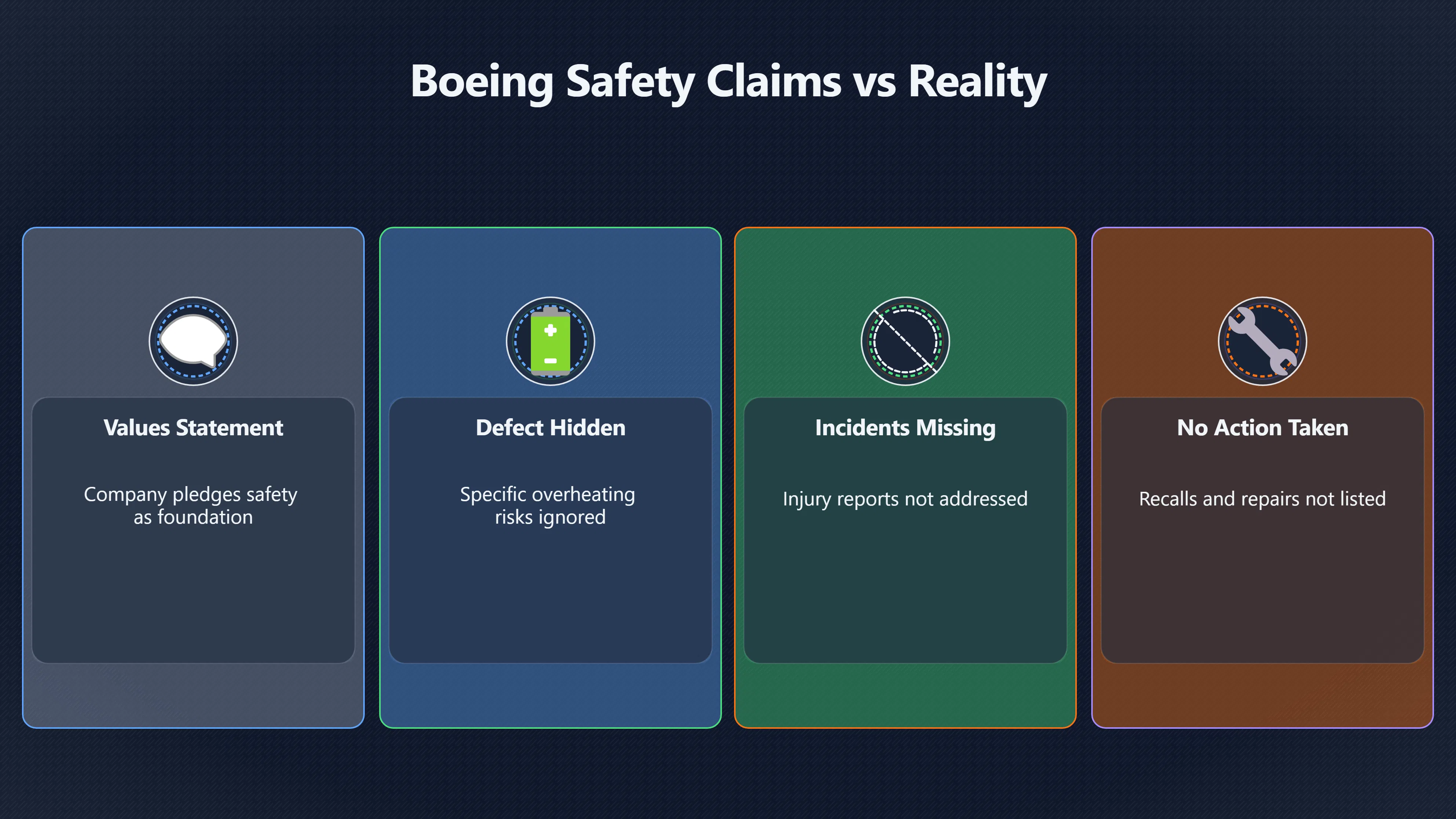
The contrast becomes clearer when examining high-profile safety controversies. Following the Boeing 737 MAX crises and later quality concerns, Boeing repeatedly emphasised safety as a foundational company value. Public statements and policy documents described safety as the company’s highest priority and foundation.[Boeing]boeing.comSafetySafety is our foundation. We strive for first-time quality and hold ourselves to the highest ethical standards as set forth i…
However, independent investigations did not stop at those statements. Regulators and review panels examined reporting systems, quality controls, employee concerns, oversight processes, training, production practices, and measurable safety outcomes. FAA-commissioned reviews and other investigations identified gaps, disconnects, and deficiencies in aspects of Boeing’s safety culture and implementation. Later investigations into production problems similarly focused on concrete failures, oversight, and corrective measures rather than corporate values language alone. Reuters 3Reuters[Business Insider]businessinsider.comThis investigation follows fatal crashes involving Boeing Max jets in 2018 and 2019. The FAA report highlighted a troubling workplace cul…
The lesson is not that safety commitments are meaningless. Rather, investigators treated those commitments as claims requiring verification through evidence. The question was not whether the company said safety mattered. The question was whether systems, decisions, and outcomes demonstrated that commitment in practice.[Reuters]reuters.comPanel finds safety 'disconnect' between Boeing management, employeesCommissioned by the U.S. Congress after fatal crashes of Boeing 737 MAX planes in 2018 and 2019, the report criticized Boeing's lack of a…[Reuters]reuters.comNational Transportation Safety Board (NTSB) has sharply criticized Boeing for failing to provide adequate training, guidance, and oversig…
How readers can test whether the hazard was answered
A simple set of questions helps distinguish a genuine response from a reassuring diversion.
- Was the specific defect named and described?
- Did the company discuss incidents, complaints, or injuries connected to the claim?
- Were testing results, engineering findings, or investigation updates provided?
- Did the response explain what is known, unknown, and still being investigated?
- Were corrective actions identified?
- Were users given practical instructions?
- Would a reader know more about the hazard after reading the statement than before?
If most of these questions remain unanswered, the response may be functioning primarily as reputation management rather than hazard communication.
Regulatory approaches reinforce this distinction. Product-safety frameworks generally emphasise reporting hazards, investigating evidence, notifying authorities, and implementing corrective actions. Requirements to report potentially dangerous defects focus on information and action, not declarations of corporate virtue. Covington & Burling 3U.S. Consumer Product Safety Commission[3eCFR]ecfr.govpart 1115Immediately, that is, within 24 hours, after a subject firm has obtained information which reasonably supports the conclusion that its…

The practical takeaway
A statement such as “we care deeply about safety” is not inherently deceptive. It can communicate values, reassure stakeholders, and frame a response. The red-herring problem arises only when the statement substitutes for evidence about the alleged defect.
When evaluating a product-safety controversy, readers should treat safety pledges as background information rather than proof. The decisive questions remain concrete: What happened? How was it investigated? What evidence exists? What risks remain? What corrective action has been taken?
Those questions test product safety. Statements about values test only what a company says it believes.
Amazon book picks
Further Reading
Books and field guides related to When 'We Care About Safety' Is Not an Answer. Use these as the next step if you want deeper reading beyond the article.
Thinking, Fast and Slow
Explains how people are persuaded by reassuring narratives and substitute signals rather than evidence.
The Skeptics' Guide to the Universe
Teaches evaluation of claims, evidence quality, and misleading argument tactics.
Calling Bullshit
Directly addresses how impressive-sounding statements can distract from evidence.
The Art of Thinking Clearly
Covers common reasoning errors that make reassurance tactics persuasive.
eBay marketplace picks
Marketplace Samples
Example marketplace items related to this page. Use the search link to explore similar finds on eBay.





Endnotes
1.
Source: risk-engineering.org
Title: Risk Engineering Safety culture: A contentious and confused notion
Link:https://risk-engineering.org/concept/safety-culture
Source snippet
Risk EngineeringSafety culture: A contentious and confused notionMarch 30, 2020 — The safety culture of an organisation is the product of...
Published: March 30, 2020
2.
Source: icsi-eu.org
Link:https://www.icsi-eu.org/sites/default/files/2020-07/Icsi_cahier_EN_safety-culture_2017.pdf
Source snippet
Safety Culture: From Understanding to ActionThe safety culture reflects the importance the organisational culture grants to safety in all...
3.
Source: tc.canada.ca
Title: Transport Canada SAFETY CULTURE POLICY STATEMENT1.0
Link:https://tc.canada.ca/sites/default/files/2022-01/SAFETY_CULTURE_POLICY_STATEMENT.pdf
Source snippet
Transport CanadaSAFETY CULTURE POLICY STATEMENT1.0 INTRODUCTION. Safety culture refers to the shared values, beliefs, attitudes, actions...
4.
Source: cpsc.gov
Title: Duty to Report to the CPSC Your Rights and Responsibilities
Link:https://www.cpsc.gov/Business–Manufacturing/Recall-Guidance/Duty-to-Report-to-the-CPSC-Your-Rights-and-Responsibilities
Source snippet
Consumer Product Safety CommissionDuty to Report to CPSC: Rights and Responsibilities...A company must report to the Commission within 2...
5.
Source: ecfr.gov
Title: part 1115
Link:https://www.ecfr.gov/current/title-16/chapter-II/subchapter-B/part-1115
Source snippet
Immediately, that is, within 24 hours, after a subject firm has obtained information which reasonably supports the conclusion that its...
6.
Source: cpsc.gov
Link:https://www.cpsc.gov/s3fs-public/RecallHandbookFINAL9_2technicalrevision_3052025.pdf
Source snippet
Consumer Product Safety CommissionProduct Safety Planning, Reporting, and Recall HandbookSection 15 requires companies to report "immedia...
7.
Source: boeing.com
Link:https://www.boeing.com/safety
Source snippet
SafetySafety is our foundation. We strive for first-time quality and hold ourselves to the highest ethical standards as set forth i...
8.
Source: reuters.com
Title: Panel finds safety ‘disconnect’ between Boeing management, employees
Link:https://www.reuters.com/business/aerospace-defense/expert-panel-finds-disconnect-between-boeing-senior-management-employees-2024-02-26/
Source snippet
Commissioned by the U.S. Congress after fatal crashes of Boeing 737 MAX planes in 2018 and 2019, the report criticized Boeing's lack of a...
9.
Source: reuters.com
Link:https://www.reuters.com/legal/litigation/us-safety-board-scrutinize-boeing-role-737-max-9-mid-air-emergency-2025-06-24/
Source snippet
National Transportation Safety Board (NTSB) has sharply criticized Boeing for failing to provide adequate training, guidance, and oversig...
10.
Source: ebsco.com
Link:https://www.ebsco.com/research-starters/business-and-management/safety-culture
Source snippet
Safety culture | Business and ManagementSafety culture refers to the collective attitudes, values, and behaviors of an organization regar...
11.
Source: businessinsider.com
Link:https://www.businessinsider.com/faa-investigated-boeings-safety-culture-and-the-results-arent-great
Source snippet
This investigation follows fatal crashes involving Boeing Max jets in 2018 and 2019. The FAA report highlighted a troubling workplace cul...
12.
Source: pmc.ncbi.nlm.nih.gov
Link:https://pmc.ncbi.nlm.nih.gov/articles/PMC7351545/
Source snippet
Boeing 737 MAX: Lessons for Engineering Ethics - PMCby J Herkert · 2020 · Cited by 232 — Thus, the case can serve a reminder to current a...
13.
Source: youtube.com
Link:https://www.youtube.com/watch?v=fLRfXxn02Uw
14.
Source: democrats-transportation.house.gov
Title: boeing 737 max investigation
Link:https://democrats-transportation.house.gov/committee-activity/boeing-737-max-investigation
Source snippet
737 MAX InvestigationThe Committee launched an investigation to ensure accountability, transparency in the certification process, and mos...
Additional References
15.
Source: researchgate.net
Link:https://www.researchgate.net/publication/346566981_Psychological_Safety_in_Aviation_New_Product_Development_Teams_Case_Study_of_737_MAX_Airplane
Source snippet
Case Study of 737 MAX Airplane5 May 2026 — In its mission statement, Boeing emphasizes that one of its core values is its commitment to s...
Published: May 2026
16.
Source: canadasafetytraining.com
Link:https://www.canadasafetytraining.com/Safety_Blog/building-a-safety-culture.aspx
Source snippet
7 Steps to Build a Strong Safety Culture in the WorkplaceCreating a safety culture in organizations is based on preventing accidents, pro...
17.
Source: worksafe.qld.gov.au
Link:https://www.worksafe.qld.gov.au/__data/assets/pdf_file/0024/19365/understanding-safety-culture.pdf
Source snippet
Understanding safety cultureFor a safety culture to be successful it needs to be led from the top—that is, safety culture needs to be emb...
18.
Source: cov.com
Link:https://www.cov.com/-/media/files/corporate/publications/2016/06/internal_investigations_involving_product_safety_issues.pdf
Source snippet
law, a manufacturer of consumer prod- ucts must report to the CPSC “immediately”—that is, within 24 hours—upon obtaining information that...
19.
Source: nelsonmullins.com
Link:https://www.nelsonmullins.com/storage/GYEkSRfSXXR0pCh2uKKywCfpOikzxkaqgyfFm9YW.pdf
Source snippet
Companies must file Section 15(b) reports “immediately”— meaning within 24 hours—after obtaining information.Read more...
20.
Source: researchgate.net
Title: 320789688 Safety Culture and Return to Work Does Perception Matter
Link:https://www.researchgate.net/publication/320789688_Safety_Culture_and_Return_to_Work_Does_Perception_Matter
Source snippet
Zohar (2000) described safety climate as employees' perception of the priority given to. safety and not based on a supervisor's...Read more...
21.
Source: transportation.gov
Title: faa oversight boeings broken safety culture 0
Link:https://www.transportation.gov/faa-oversight-boeings-broken-safety-culture-0
Source snippet
Transportation DepartmentFAA Oversight of Boeing's Broken Safety Culture25 Sept 2024 — The FAA will hold Boeing accountable for having an...
22.
Source: cpsc.gov
Link:https://www.cpsc.gov/s3fs-public/8002.pdf
Source snippet
2 report with the Office of Compliance and Field.Read more...
23.
Source: GOV.UK
Title: product safety and noncompliance notification guidance
Link:https://www.gov.uk/government/publications/notifications-of-unsafe-and-noncompliant-products/product-safety-and-noncompliance-notification-guidance
Source snippet
safety and noncompliance notification guidance for...13 May 2026 — This guidance is for market surveillance and enforcement authorities...
Published: May 2026
24.
Source: rucforsk.ruc.dk
Link:https://rucforsk.ruc.dk/ws/files/111388842/Boeing_project.pdf
Source snippet
MAX. We understand that regulatory agencies and customers have...Read more...
Topic Tree