Within Politics
Can a Fallacy Sound Perfectly Reasonable?
Fallacious arguments can sound civil and reasonable while still steering audiences away from evidence.
On this page
- How politeness changes the reception of weak arguments
- Why social approval can mask poor reasoning
- Listening cues for civil but evasive claims
Page outline Jump by section
Introduction
Political fallacies do not always arrive wrapped in anger, exaggeration or obvious manipulation. Some of the most effective flawed arguments in public debate are delivered in a calm, respectful and apparently reasonable manner. A speaker may praise opponents, acknowledge complexity and adopt a civil tone while still steering the audience away from evidence. These are often called polite fallacies: arguments whose social acceptability and courteous presentation make weaknesses in reasoning harder to notice.
 In political speech, audiences frequently evaluate not only what is said but how it is said. Civility can increase credibility, reduce resistance and create an impression of fairness. The result is that weak arguments may receive approval not because they are logically strong, but because they satisfy social expectations about respectful public conduct. Research on political communication and politeness theory suggests that audience perceptions are strongly shaped by tone, interpersonal signals and expectations of appropriate behaviour, sometimes independently of argument quality.[Al-Kindi Publishers]al-kindipublishers.orgAl-Kindi Publishers Politeness Strategies in Political DiscourseThis study explores politeness strategies in the political discourse of Philippine President Ferdinand Marcos Jr., using Brown and.Read more…
Can a Fallacy Sound Perfectly Reasonable?
Yes. A fallacy becomes especially persuasive when its logical weakness is hidden beneath language that appears balanced, thoughtful and considerate.
In political debate, people often use mental shortcuts when judging arguments. A courteous speaker can benefit from what communication researchers describe as positive evaluations generated by style, credibility and social appropriateness. When listeners perceive a speaker as reasonable, they may scrutinise the underlying logic less closely.[OUP Academic]academic.oup.comOUP AcademicThe separate and combined effects of (in)accessible and (un…by E Turkenburg · 2025 · Cited by 1 — Results of a 2 × 2 exper…
This does not mean politeness is deceptive in itself. Civility is valuable for democratic discussion. The problem arises when politeness becomes a shield that protects poor reasoning from critical examination. The audience’s approval of the speaker’s manner can be transferred, consciously or unconsciously, to the argument itself.
A classic example is a carefully phrased appeal to popularity:
“Many thoughtful citizens have come to this conclusion, so it is difficult to see how it could be wrong.”
The statement sounds measured and respectful. Yet the popularity of a belief does not establish its truth. The fallacy remains an appeal to majority opinion even though it lacks the emotional intensity often associated with flawed reasoning.[Internet Encyclopedia of Philosophy]iep.utm.eduInternet Encyclopedia of PhilosophyFallaciesA fallacy is a kind of error in reasoning. The list of fallacies below contains 231 names of…
How Politeness Changes the Reception of Weak Arguments
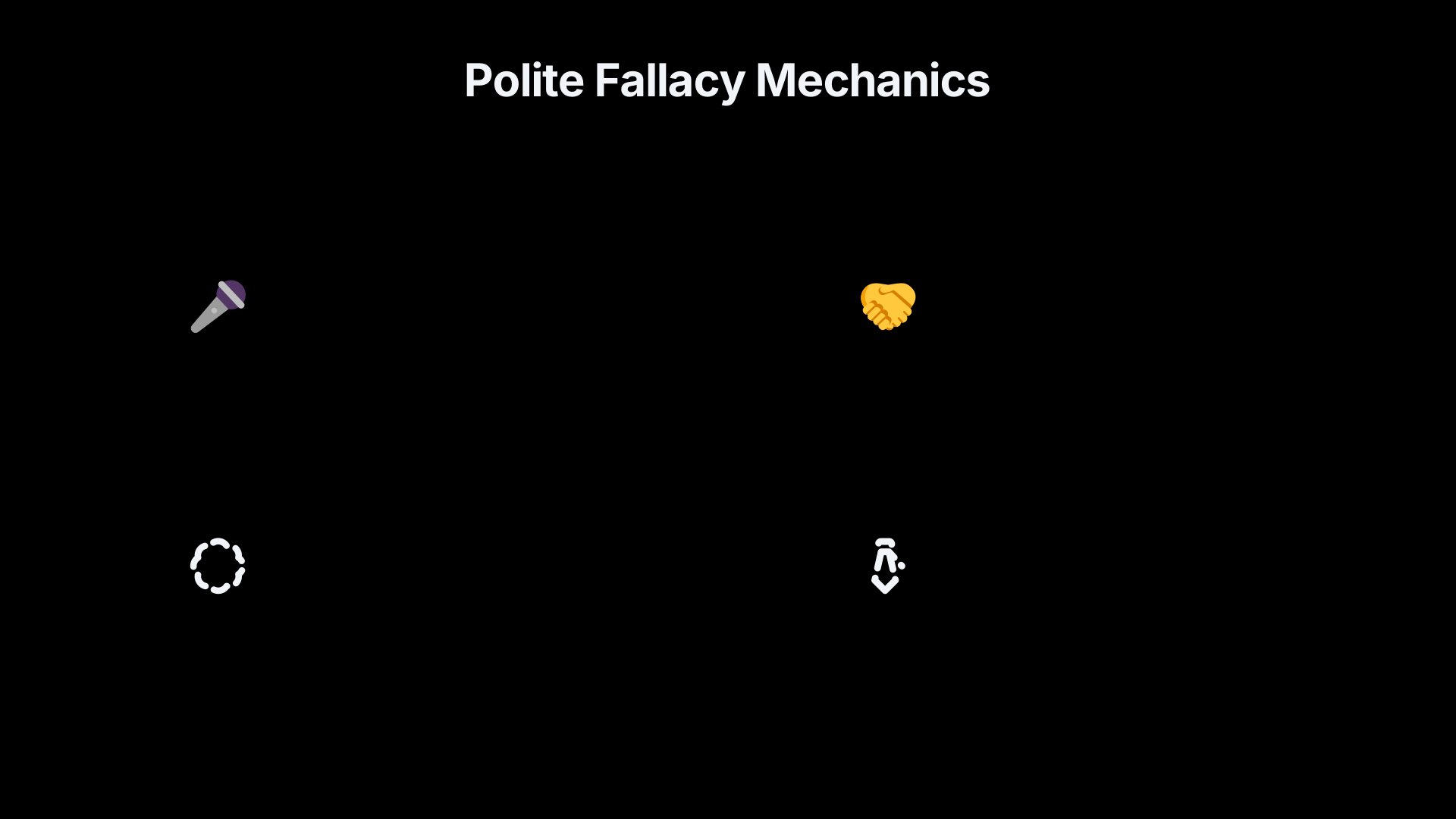
Politeness influences argument reception through several mechanisms.
It lowers psychological resistance. People tend to react less defensively when criticism is expressed respectfully. A civil speaker can therefore gain a hearing that a hostile speaker might lose. This effect is often beneficial, but it can also make audiences less alert to logical defects.[PMC]pmc.ncbi.nlm.nih.govSusceptibility to poor arguments: The interplay of cognitive…by PM Marin · 2024 · Cited by 17 — Fallacies are common errors in info…
It creates an impression of fairness. When a politician says, “I respect my opponent’s concerns, but surely everyone can see that this policy is the only sensible option,” the acknowledgement of the opponent may make the conclusion appear more balanced than it actually is. Yet the claim may still involve a false dilemma if other reasonable options exist.[Internet Encyclopedia of Philosophy]iep.utm.eduInternet Encyclopedia of PhilosophyFallaciesA fallacy is a kind of error in reasoning. The list of fallacies below contains 231 names of…
It strengthens perceived credibility. Research on argument impact and political communication shows that audience judgments are influenced by source characteristics and contextual cues, not merely by logical strength. A courteous speaker may therefore receive more trust even when evidence is limited.[OUP Academic]academic.oup.comOUP AcademicThe separate and combined effects of (in)accessible and (un…by E Turkenburg · 2025 · Cited by 1 — Results of a 2 × 2 exper…
It shifts attention from validity to character. Listeners often reward speakers who appear calm, measured and respectful. While those traits are admirable, they do not prove that the reasoning is sound. A valid argument can be delivered rudely, and a fallacious argument can be delivered elegantly.
Why Social Approval Can Mask Poor Reasoning
Political speech takes place in a social environment where approval matters. Audiences do not simply evaluate claims; they evaluate identities, relationships and norms.
Politeness signals cooperation and respect for shared rules. Because these signals are socially desirable, audiences may interpret them as evidence of intellectual reliability. Politeness theory suggests that respectful language helps regulate social distance and maintain positive interpersonal relations. As a result, people may be more inclined to grant the speaker goodwill before carefully assessing the argument itself.[PMC]pmc.ncbi.nlm.nih.govSusceptibility to poor arguments: The interplay of cognitive…by PM Marin · 2024 · Cited by 17 — Fallacies are common errors in info…
This creates a subtle risk. A listener may think:
- “The speaker sounds fair.”
- “The speaker is treating opponents respectfully.”
- “The speaker appears reasonable.”
From there, it is a short step to assuming:
- “Therefore the argument is probably correct.”
That final step is not logically justified.
Political actors understand the value of audience approval. Studies of political discourse show that politeness strategies are often used to shape public perception and maintain favourable relationships with audiences. These strategies can be entirely legitimate, but they can also accompany arguments that oversimplify evidence, rely on questionable authority or avoid direct engagement with objections.[Al-Kindi Publishers]al-kindipublishers.orgAl-Kindi Publishers Politeness Strategies in Political DiscourseThis study explores politeness strategies in the political discourse of Philippine President Ferdinand Marcos Jr., using Brown and.Read more…
Common Forms of Polite Fallacies in Political Speech
Several fallacies are particularly effective when presented in a civil manner.
The Polite Appeal to Authority
A speaker respectfully cites a prominent figure as though their status settles the issue:
“With great respect to Professor X, whose distinguished career speaks for itself, I believe the debate is effectively over.”
The politeness distracts from the key question: does the authority possess relevant expertise, and does evidence support the claim? Authority alone is not proof.[Internet Encyclopedia of Philosophy]iep.utm.eduInternet Encyclopedia of PhilosophyFallaciesA fallacy is a kind of error in reasoning. The list of fallacies below contains 231 names of…
The Courteous False Dilemma
A politician presents only two options while acknowledging alternative views politely:
“Reasonable people may disagree, but we must either adopt this policy or accept decline.”
The respectful framing can obscure the fact that additional options may exist.
The Civil Straw Man
Instead of aggressively caricaturing an opponent, a speaker offers a softened version:
“I understand why some people wish to spend more on this programme, but their approach seems to assume that budgets do not matter.”
The speaker appears charitable while still replacing the opponent’s actual position with a weaker version.

The Gentle Appeal to Consensus
Consensus can be relevant evidence in some contexts, but it becomes fallacious when presented as sufficient proof:
“Most responsible observers support this measure, which should tell us something.”
The phrase “responsible observers” adds a layer of social pressure. Disagreement may seem impolite or unreasonable even when legitimate evidence exists on the other side.
Listening Cues for Civil but Evasive Claims
Polite fallacies are difficult to detect because they rarely trigger alarm. Instead of focusing on tone, listeners should examine the relationship between evidence and conclusion.
Ask the following questions:
- What evidence actually supports the claim?
- Would the reasoning still work if the courteous language were removed?
- Is the speaker answering the strongest version of the opposing argument?
- Are alternative explanations or options being ignored?
- Is agreement being treated as proof?
- Does the speaker rely on reputation, popularity or respectability instead of evidence?
A useful exercise is to mentally separate style from substance. Imagine the argument written on paper without vocal tone, gestures or expressions of respect. If the reasoning becomes noticeably weaker, the persuasive force may have come from social presentation rather than logical merit.
Why Polite Fallacies Matter in Public Debate
Public debate depends on more than civility, but it also depends on more than logic. Healthy democratic discussion requires both respectful engagement and rigorous reasoning.
The challenge is that audiences often reward speakers who satisfy social expectations of fairness and moderation. Those expectations can improve debate by reducing hostility, yet they can also create opportunities for fallacious arguments to pass unchallenged. Research on political discourse repeatedly shows that persuasive success is influenced by presentation, audience perceptions and contextual factors alongside the actual content of arguments.[Al-Kindi Publishers]al-kindipublishers.orgAl-Kindi Publishers Politeness Strategies in Political DiscourseThis study explores politeness strategies in the political discourse of Philippine President Ferdinand Marcos Jr., using Brown and.Read more…
Recognising polite fallacies does not require becoming cynical about civility. Rather, it means treating courtesy and logical strength as separate qualities. A political argument can be admirable in tone and defective in reasoning at the same time. The most careful listeners learn to appreciate the first without automatically granting the second.
Amazon book picks
Further Reading
Books and field guides related to Can a Fallacy Sound Perfectly Reasonable?. Use these as the next step if you want deeper reading beyond the article.
Thank You for Arguing
Covers persuasive techniques that can make flawed arguments sound reasonable.
Thinking, Fast and Slow
Shows how intuitive judgments can be swayed by presentation and tone.
Mistakes Were Made (but Not by Me)
Explores self-justification and acceptance of weak reasoning.
The Righteous Mind
Helps explain why civility and group signals influence audience judgment.
eBay marketplace picks
Marketplace Samples
Example marketplace items related to this page. Use the search link to explore similar finds on eBay.


Endnotes
1.
Source: pmc.ncbi.nlm.nih.gov
Link:https://pmc.ncbi.nlm.nih.gov/articles/PMC3193988/
Source snippet
Brown & S. Levinson, 1987), politeness serves to both reflect and regulate social distance. On the basis of this notion...
2.
Source: academic.oup.com
Link:https://academic.oup.com/hcr/article/51/4/262/8078028
Source snippet
OUP AcademicThe separate and combined effects of (in)accessible and (un...by E Turkenburg · 2025 · Cited by 1 — Results of a 2 × 2 exper...
3.
Source: pmc.ncbi.nlm.nih.gov
Link:https://pmc.ncbi.nlm.nih.gov/articles/PMC11522166/
Source snippet
Susceptibility to poor arguments: The interplay of cognitive...by PM Marin · 2024 · Cited by 17 — Fallacies are common errors in info...
4.
Source: al-kindipublishers.org
Title: Al-Kindi Publishers Politeness Strategies in Political Discourse
Link:https://al-kindipublishers.org/index.php/jpds/article/download/8938/7692/25329
Source snippet
This study explores politeness strategies in the political discourse of Philippine President Ferdinand Marcos Jr., using Brown and.Read more...
Published: March 21, 2025
5.
Source: iep.utm.edu
Link:https://iep.utm.edu/fallacy/
Source snippet
Internet Encyclopedia of PhilosophyFallaciesA fallacy is a kind of error in reasoning. The list of fallacies below contains 231 names of...
Additional References
6.
Source: journals.sagepub.com
Link:https://journals.sagepub.com/doi/10.1177/00027642251403291
Source snippet
poor policies, and blame for past deeds. These findings reflect their analysis of presidential incumbents and challengers as well, which...
7.
Source: tpls.academypublication.com
Link:https://tpls.academypublication.com/index.php/tpls/article/view/8511
Source snippet
as a Strategy of Argumentation in Political Debates9 Aug 2024 — This study aims to study argumentation in political debates by figuring o...
8.
Source: doria.fi
Title: (Im)politeness Strategies and Political Persuasion on X
Link:https://www.doria.fi/bitstream/handle/10024/192339/adetunji_atinuke.pdf?sequence=4
Source snippet
by AA Adetunji · 2025 — The study used a descriptive qualitative research design, specifically a pragmatics-based discourse analytic...
9.
Source: researchgate.net
Title: 314588261 Political Communication Research Methods
Link:https://www.researchgate.net/publication/314588261_Political_Communication_Research_Methods
Source snippet
(PDF) Political Communication Research Methods2 Dec 2020 — Research methods facilitate systematic analyses of the press and public sphere...
10.
Source: researchgate.net
Link:https://www.researchgate.net/publication/398455792_Politeness_Power_and_Persuasion_A_Pragmatic_Analysis_of_Nelson_Mandela_and_Martin_Luther_King_Jr%27s_Rhetoric
Source snippet
weakness into. agency. Foucault (1980); van. Dijk (2008); Searle. (1969); Aus n (1962). Persuasion. through Ethos. Pathos, Logos. Integr...
11.
Source: researchgate.net
Title: 383012841 Fallacy as a Strategy of Argumentation in Political Debates
Link:https://www.researchgate.net/publication/383012841_Fallacy_as_a_Strategy_of_Argumentation_in_Political_Debates
Source snippet
Fallacy as a Strategy of Argumentation in Political Debates10 Aug 2024 — This study aims to study argumentation in political debates by f...
12.
Source: sciencedirect.com
Link:https://www.sciencedirect.com/science/article/abs/pii/S0747563222000577
Source snippet
When we tolerate online incivility: Dual-Process Effects of...by Y Kim · 2022 · Cited by 13 — In a web-based experiment, participants (N...
13.
Source: repository.uobaghdad.edu.iq
Link:https://repository.uobaghdad.edu.iq/file/publication/draft/bb309f8d-7de0-4402-8faf-8fe80ef932bf.pdf
Source snippet
as a Strategy of Argumentation in Political Debatesby NF Abbas · 2024 · Cited by 15 — Abstract—This study aims to study argumentation in...
14.
Source: vu.nl
Link:https://vu.nl/en/research/political-tone-seems-more-emotional-but-there-s-no-evidence
Source snippet
Political tone seems more emotional, but there's no evidenceMariken van der Velden researched word usage and emotions in [politics]({{ 'politics/' | relative_url }}) in coll...
15.
Source: onlinelibrary.wiley.com
Link:https://onlinelibrary.wiley.com/doi/full/10.1111/puar.70004
Source snippet
and Reputation Learning by Audience Networks...by M Maor · 2026 · Cited by 11 — Audiences that observe and interact with government agen...
Topic Tree