Within Fallacy Lab
When Does Emotion Replace Evidence?
Emotional appeals are not always fallacious, but they mislead when emotion substitutes for relevant support.
On this page
- Legitimate emotion
- Manipulative pressure
- Evidence after feeling
Page outline Jump by section
Introduction
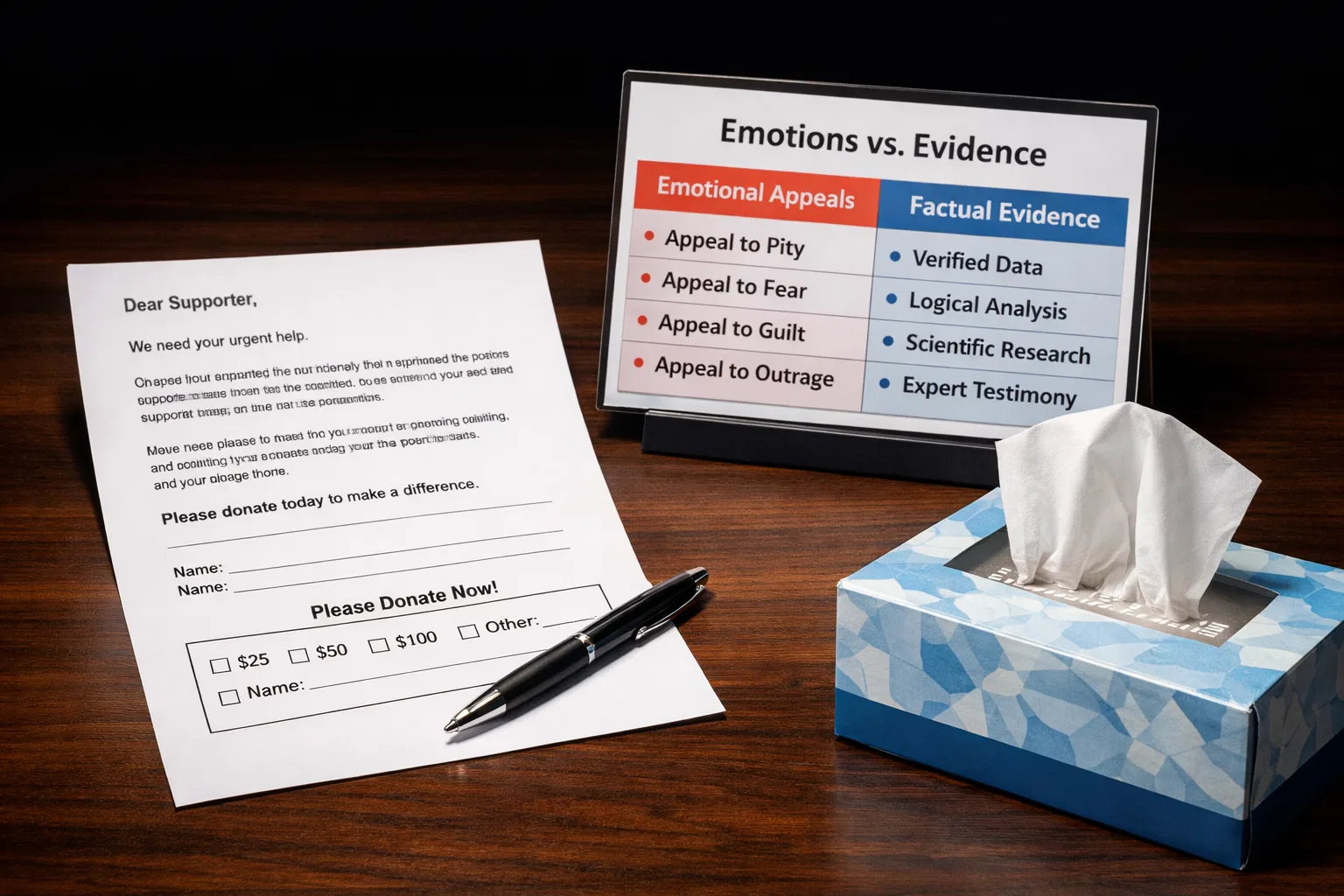
Appeals to emotion become fallacious when feeling is made to do the work that evidence should do. A speaker may rightly ask an audience to care about suffering, danger, fairness or loss; those emotions can help people recognise what is at stake. The problem begins when the audience is pushed to accept a factual claim, verdict, policy or purchase because they feel pity, fear, outrage, guilt or urgency, rather than because the reasons actually support the conclusion.
Within logical fallacies, this is a fallacy of relevance: the emotional material may be psychologically powerful while being logically beside the point. The Stanford Encyclopedia of Philosophy gives the classic contrast: sympathy may matter in practical or ethical decisions, but sympathy alone is not evidence that a proposition is true; likewise, a threat may give someone a reason to act, but not a reason to believe the threatened claim.[stanford]plato.stanford.eduEncyclopedia of PhilosophyFallacies (Stanford Encyclopedia of Philosophy)… Encyclopedia of Philosophy
When emotion is legitimate
Emotion is not the enemy of good reasoning. In rhetoric, emotional appeal is usually discussed as pathos: an appeal to an audience’s values, concerns and emotional sensibilities. Purdue OWL describes pathos as an appeal to the audience’s needs, values and emotional disposition towards a topic, evidence or argument.[Purdue OWL]owl.purdue.eduOWLUsing Rhetorical Strategies for PersuasionOWLUsing Rhetorical Strategies for Persuasion A public health campaign about road deaths, for example, may use grief or fear to make the consequences of dangerous driving vivid. That emotional force is not automatically fallacious if the campaign also gives accurate evidence about risk, harm and prevention.
The key test is relevance. Emotion can make evidence more understandable, memorable or morally salient. A survivor’s story may help readers grasp the human meaning of a policy failure. A photograph of flood damage may clarify why infrastructure decisions matter. A judge, voter, patient or consumer often needs to understand consequences, not just abstract numbers.
The appeal becomes suspect when the emotional scene is treated as proof of something it does not prove. “This defendant’s family has suffered, therefore the defendant is innocent” is not the same kind of argument as “this defendant’s family will be affected by sentencing, so mercy should be considered.” The first asks pity to settle a factual question; the second may be relevant to a practical judgement about punishment. Stanford’s discussion of ad misericordiam, or appeal to pity, makes this distinction directly: sympathy has a natural place in practical reasoning, but it becomes fallacious when mistakenly treated as evidence for belief.[stanford]plato.stanford.eduEncyclopedia of PhilosophyFallacies (Stanford Encyclopedia of Philosophy)… Encyclopedia of Philosophy
How feeling replaces evidence
The mechanism is simple but powerful: emotion changes attention. Instead of asking “What supports this claim?”, the audience is pulled towards “How does this make me feel?” That shift can make weak evidence seem stronger, missing evidence less noticeable and irrelevant details feel important.
The University of North Carolina Writing Center’s example of appeal to pity captures the structure: a student asks for an A because their cat was sick, their car broke down and they had a cold. Those facts may explain hardship, but they do not establish that the student met the grading criteria. The emotional information “might feel relevant”, as the guide puts it, but it is not logically relevant to the conclusion being requested.[The Writing Center]writingcenter.unc.eduThe Writing Center Fallacies – The Writing CenterThe Writing Center Fallacies – The Writing Center
Common emotional substitutes include:
- Pity: “You must accept my claim because rejecting it would be cruel.”
- Fear: “Believe this, or something terrible will happen.”
- Guilt: “A decent person would agree with me.”
- Outrage: “This is disgusting, therefore my explanation must be true.”
- Pride or belonging: “People like us know this is right.”
- Hope: “This would be wonderful if true, so you should believe it.”
The fallacy does not depend on the emotion being fake. The hardship may be real. The risk may be frightening. The injustice may be serious. What matters is whether the emotion is connected to the conclusion by a relevant reason. A true story can still be used fallaciously if it is made to answer the wrong question.

Manipulative pressure
Persuasive pressure is a close cousin of emotional appeal. It does not merely invite the audience to feel; it narrows the audience’s perceived freedom to think. Instead of offering better reasons, it creates stress, urgency, fear of punishment, fear of missing out or fear of social exclusion.
The classic logical form is the appeal to force, or ad baculum. In its crude version, the message is: “Accept this, or you will suffer.” Stanford notes that threats can provide reasons to act in some practical contexts, such as labour disputes or international relations, but they are not evidence that a factual proposition is true. “Believe this candidate is best or you will be evicted” is therefore irrelevant evidence for the claim about the candidate’s merits.[stanford]plato.stanford.eduEncyclopedia of PhilosophyFallacies (Stanford Encyclopedia of Philosophy)… Encyclopedia of Philosophy
Modern pressure is often softer than an open threat. It may look like a countdown timer, a shame-laden prompt, a false claim that “only two remain”, or a claim that delay proves moral failure. The UK Competition and Markets Authority has warned that misleading sale prices and fake countdown clocks can put unfair pressure on people to buy and may breach consumer law.[GOV.UK]GOV.UKCM A investigates online selling practices based on ‘urgency’ claimsCM A investigates online selling practices based on ‘urgency’ claims The OECD similarly describes urgency-based dark commercial patterns as real or fake time or quantity limits that pressure consumers by exploiting scarcity cues.[OECD]oecd.orgDark commercial patterns (ENDark commercial patterns (EN
This matters for fallacy analysis because pressure changes the conversational question. A good argument says, “Here is why this is true or worth doing.” Manipulative pressure says, “Decide now, before you can inspect the reasons.” It attacks the conditions needed for reasoning: time, attention, confidence and the ability to compare alternatives.
Fear, pity and urgency work differently
Not all emotional pressure uses the same route. Fear, pity and urgency are especially common because each targets a different weakness in judgement.
Fear pushes the audience towards immediate protection. Fear appeals can be legitimate when the danger is real and the recommended action is supported by evidence. Research on fear appeals in health communication has found that strong fear appeals can influence attitudes, intentions and behaviour, especially when people also believe they can take effective action.[PMC]pmc.ncbi.nlm.nih.govOpen source on nih.gov. But fear becomes fallacious when it exaggerates danger, hides probabilities, or leaps from “this is frightening” to “therefore this claim is true.”
Pity shifts attention from the issue to the suffering of a person or group. That suffering may be morally important, but it may not answer the question under debate. In grading, guilt, hiring, guilt by association or criminal liability, pity can blur the difference between compassion and proof. UNC’s fallacies guide treats appeal to pity as a move that tries to make people accept a conclusion by making them feel sorry for someone.[The Writing Center]writingcenter.unc.eduThe Writing Center Fallacies – The Writing CenterThe Writing Center Fallacies – The Writing Center
Urgency compresses the time available for checking. It is especially effective in sales, scams, political mobilisation and online sharing. A deadline can be legitimate when it is real and relevant. It becomes manipulative when it is artificial, misleading or designed to stop comparison. The Advertising Standards Authority has warned, for instance, that countdown clocks can create undue pressure in sensitive advertising categories such as gambling.[ASA]asa.org.ukASAIt's the final countdown… but is it really?ASAIt's the final countdown… but is it really?
Why emotional arguments can feel convincing
Emotional appeals are persuasive because people do not process arguments as detached machines. Feelings signal importance, danger, trust, disgust, loyalty and urgency. In ordinary life, those signals are useful. The problem is that the same signals can be exploited when a speaker wants acceptance without adequate support.
Research on misinformation helps explain the risk. A study by Cameron Martel, Gordon Pennycook and David Rand found correlational and causal evidence that reliance on emotion increased belief in fake news: participants induced to rely on emotion were more likely to believe false headlines than those prompted to rely on reason or a control condition.[Springer]link.springer.comSource details in endnotes. This does not mean emotion always produces false belief, but it shows why emotional processing can become a vulnerability when accuracy is the question.
Recent work on fallacy detection points in the same direction. A 2025 computational and human-subject study reported that emotionally framed fallacious arguments reduced human fallacy-detection performance, with fear and sadness among the emotional states associated with lower detection than enjoyment.[arXiv]arxiv.orgSource details in endnotes. The practical lesson is not “ignore emotion”, but “slow down when emotion is doing too much of the argumentative labour.”
A practical test: evidence after feeling
The safest way to evaluate an emotional appeal is not to suppress the emotion. It is to ask what remains after the feeling has been acknowledged.
A useful sequence is:
- Name the claim. What exactly am I being asked to believe, approve, buy, condemn or share?
- Name the emotion. Am I being moved by fear, pity, guilt, anger, hope, pride, disgust or urgency?
- Ask whether the emotion is relevant. Does it help evaluate the claim, or only make the claim feel important?
- Separate action from belief. A threat may explain why someone acts, but it does not prove the threatened statement true.
- Look for independent support. What evidence would still matter if the emotional language were removed?
- Check proportionality. Is the emotional intensity matched by the strength of the evidence, or is the argument louder than its proof?
This test keeps the useful part of emotion while resisting manipulation. If an animal-welfare advert shows distressing footage and then provides verifiable evidence about conditions, regulation and alternatives, the emotion may be part of a legitimate argument. If it shows distressing footage and then demands acceptance of an unrelated claim, the feeling has replaced evidence.

Examples that show the boundary
Consider three similar-looking arguments:
“Children will suffer if this hospital closes; here are the patient numbers, travel-time data, staffing gaps and funding options.”
This uses emotion to focus attention on a real stake, then supplies relevant evidence.
“Children will suffer if you disagree with this policy.”
This pressures the audience morally, but does not show that the policy works or that alternatives fail.
“Anyone who questions this policy clearly does not care about children.”
This moves from emotional pressure into personal attack. It avoids the policy evidence and punishes dissent.
The same boundary appears in consumer settings:
“Sale ends at midnight because the supplier discount expires then.”
The urgency may be relevant if the deadline is real.
“Sale ends in 10 minutes” on a timer that resets every visit.
The urgency is not evidence of value; it is a pressure device.
“Only a selfish person would take time to compare prices.”
The pressure is social and emotional, not evidential.
These examples show why emotional fallacies are not defined by dramatic language alone. They are defined by a mismatch between the emotional prompt and the conclusion it is being used to secure.
What good arguments do instead
A good argument can still be moving. It can tell stories, use vivid language, show consequences and appeal to shared values. What it cannot fairly do is treat those reactions as a substitute for support.
The repair is to put evidence after feeling. If the argument begins with fear, it should then show the probability, severity and cause of the danger. If it begins with pity, it should explain what conclusion the suffering is relevant to. If it begins with urgency, it should prove the deadline is real and explain why delay changes the outcome. If it begins with anger, it should identify the act, the evidence and the standard being violated.
In practice, the warning sign is not “this argument made me feel something.” The warning sign is “after I felt something, I stopped asking for reasons.” Emotional appeals become logical fallacies when they close that gap by force, guilt, sympathy or pressure rather than by evidence.
eBay marketplace picks
Marketplace Samples
Example marketplace items related to this page. Use the search link to explore similar finds on eBay.







Endnotes
1.
Source: plato.stanford.edu
Title: Encyclopedia of Philosophy
Link:https://plato.stanford.edu/entries/fallacies/
Source snippet
Fallacies (Stanford Encyclopedia of Philosophy)...
2.
Source: owl.purdue.edu
Title: OWLUsing Rhetorical Strategies for Persuasion
Link:https://owl.purdue.edu/owl/general_writing/academic_writing/establishing_arguments/rhetorical_strategies.html
3.
Source: writingcenter.unc.edu
Title: The Writing Center Fallacies – The Writing Center
Link:https://writingcenter.unc.edu/tips-and-tools/fallacies/
4.
Source: GOV.UK
Title: CM A investigates online selling practices based on ‘urgency’ claims
Link:https://www.gov.uk/government/news/cma-investigates-online-selling-practices-based-on-urgency-claims
5.
Source: oecd.org
Title: Dark commercial patterns (EN)
Link:https://www.oecd.org/content/dam/oecd/en/publications/reports/2022/10/dark-commercial-patterns_9f6169cd/44f5e846-en.pdf
6.
Source: asa.org.uk
Title: ASAIt’s the final countdown… but is it really?
Link:https://www.asa.org.uk/news/it-s-the-final-countdown-but-is-it-really.html
7.
Source: link.springer.com
Link:https://link.springer.com/article/10.1186/s41235-020-00252-3
8.
Source: arxiv.org
Link:https://arxiv.org/abs/2510.09695
Additional References
9.
Source: youtube.com
Title: Ethos, Pathos, Logos: The Powers of Persuasion and Rhetoric!
Link:https://www.youtube.com/watch?v=1FqCkyO2Ir4
Source snippet
Appeal to emotion fallacy logical fallacies pathos Critical Thinking Lecture: Informal Fallacies: Emotional Appeals The Abundant Life...
10.
Source: youtube.com
Title: Critical Thinking Lecture: Informal Fallacies: Emotional Appeals
Link:https://www.youtube.com/watch?v=poGILdwjfxo
Source snippet
Ethos, Pathos, Logos: The Powers of Persuasion and Rhetoric...
11.
Source: youtube.com
Title: Appeal to Emotion | Logical Fallacies
Link:https://www.youtube.com/watch?v=JkB3hhtLx4M
Source snippet
Critical Thinking Lecture: Informal Fallacies: Emotional Appeals...
12.
Source: youtube.com
Title: Logical Fallacies: Appeal to Emotion
Link:https://www.youtube.com/watch?v=ESVP917iLM8
Source snippet
Appeal to Emotion | Logical Fallacies...
13.
Source: youtube.com
Title: Appeal to the Reader’s Emotion
Link:https://www.youtube.com/watch?v=7_IZPVHiMOg
Source snippet
Logical Fallacies: Appeal to Emotion...
14.
Source: pmc.ncbi.nlm.nih.gov
Link:https://pmc.ncbi.nlm.nih.gov/articles/PMC5789790/
Topic Tree