Within Formal Logic
When Evidence Looks Like Proof but Isnt
A matching effect can support a hypothesis, but it does not deductively prove the one cause you already had in mind.
On this page
- The invalid if then pattern
- Everyday examples with alternative causes
- How to turn a guess into a stronger argument
Page outline Jump by section
Introduction
Affirming the consequent, sometimes understood as a form of false proof from effects, is one of the most persuasive formal fallacies because it begins with something that often feels reasonable. The pattern is simple: a person predicts that a particular cause would produce a certain effect, observes the effect, and then treats that observation as proof that the original cause must have occurred. The mistake is not noticing that the same effect may have multiple possible causes. Logic texts identify this as an invalid argument form because the conclusion does not follow necessarily from the premises, even when the premises are true.[Internet Encyclopedia of Philosophy]iep.utm.eduSource details in endnotes.[Stanford Encyclopedia of Philosophy]plato.stanford.eduEncyclopedia of Philosophy Fallaciesforms of inference, so these we may think of as deductive fallacies. They include affirming the consequent, denying the antecedent, the…
 In everyday life, seeing a predicted result can be good evidence for a hypothesis. The problem arises when supporting evidence is promoted into conclusive proof. The fallacy turns “this is consistent with my explanation” into “therefore my explanation is correct”, skipping the crucial step of ruling out alternatives.[Internet Encyclopedia of Philosophy]iep.utm.eduSource details in endnotes.[Logically Fallacious]logicallyfallacious.comLogically FallaciousAffirming the ConsequentAn error in formal logic where if the consequent is said to be true, the antecedent is said t…
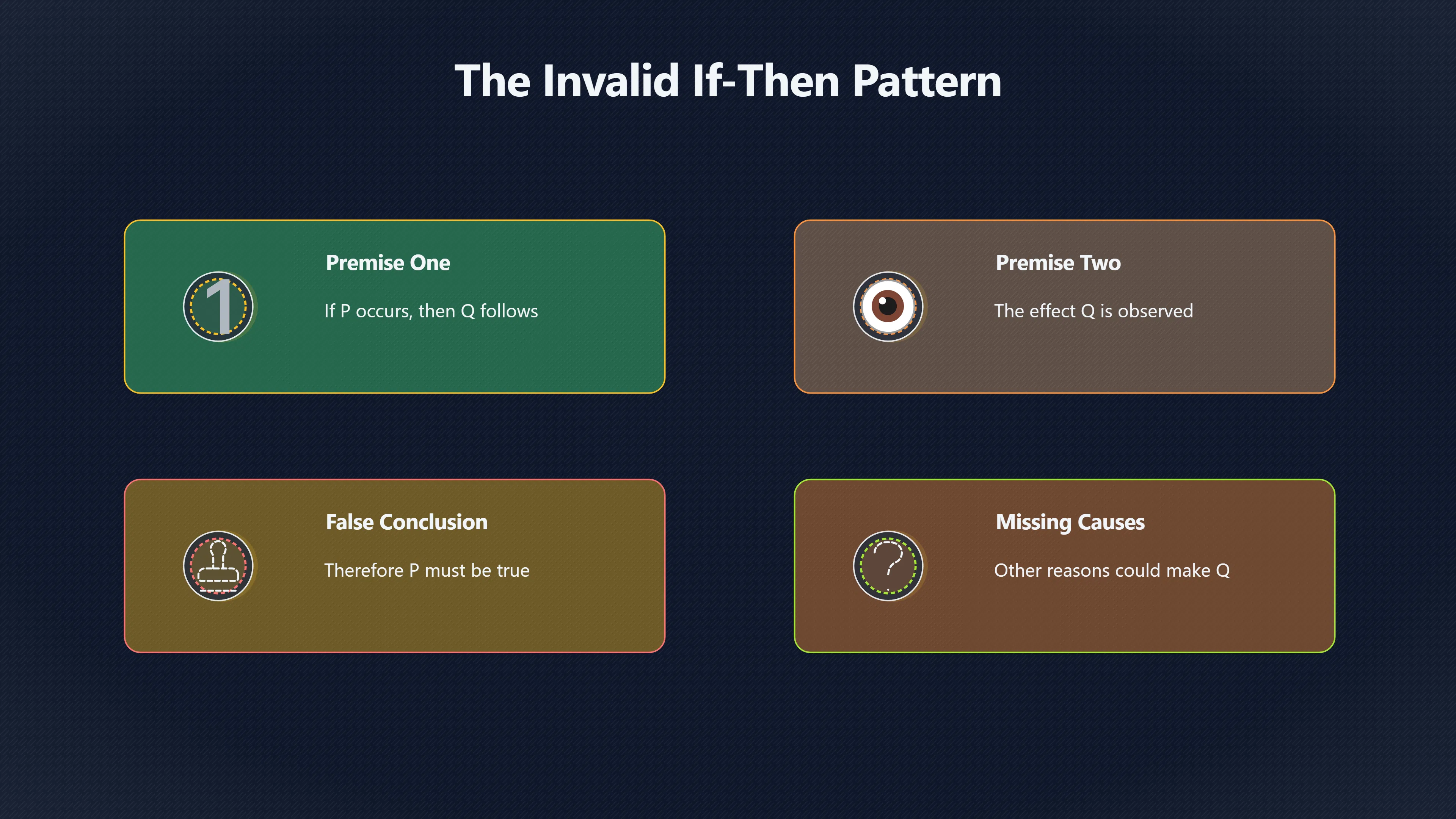
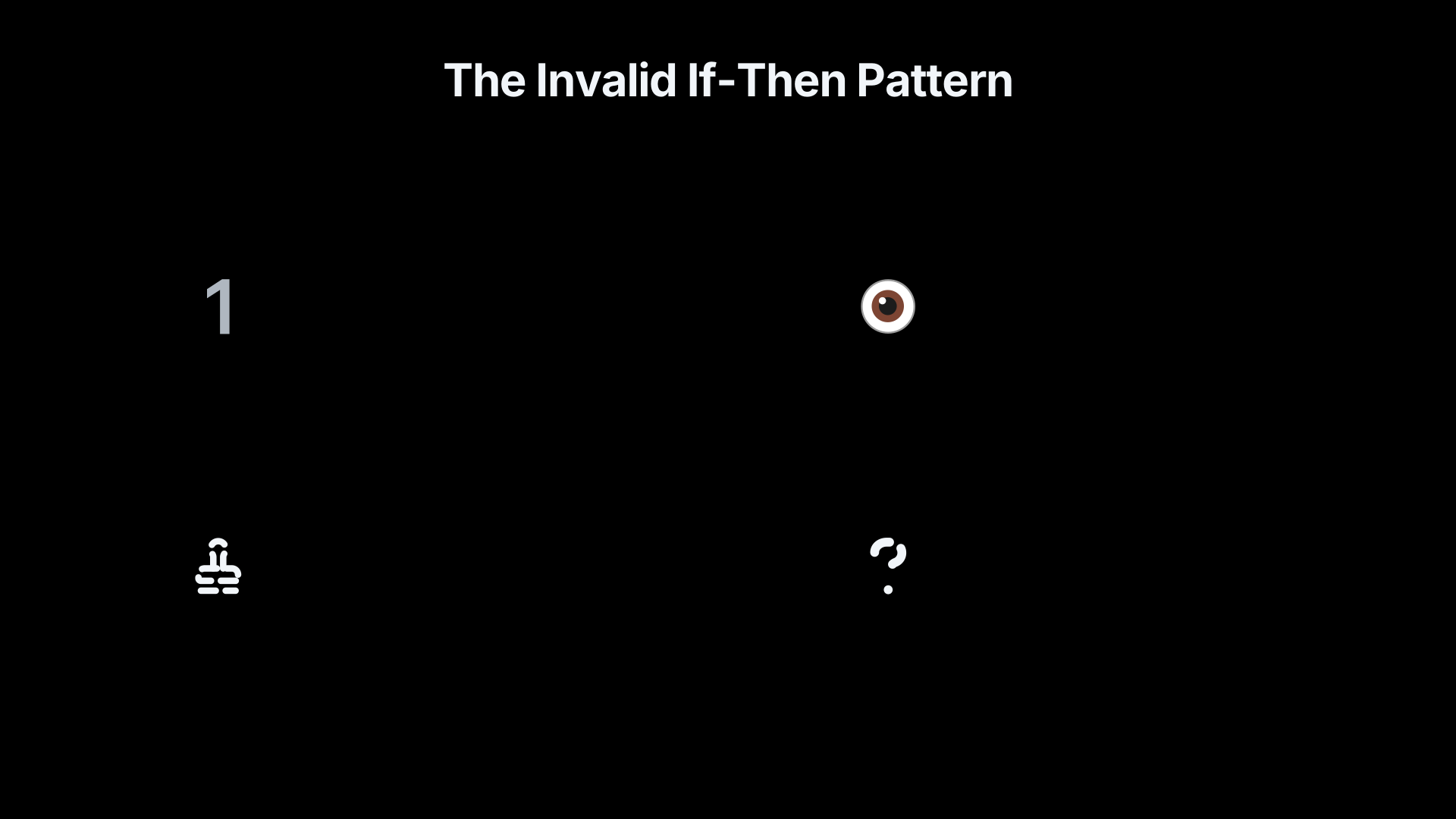
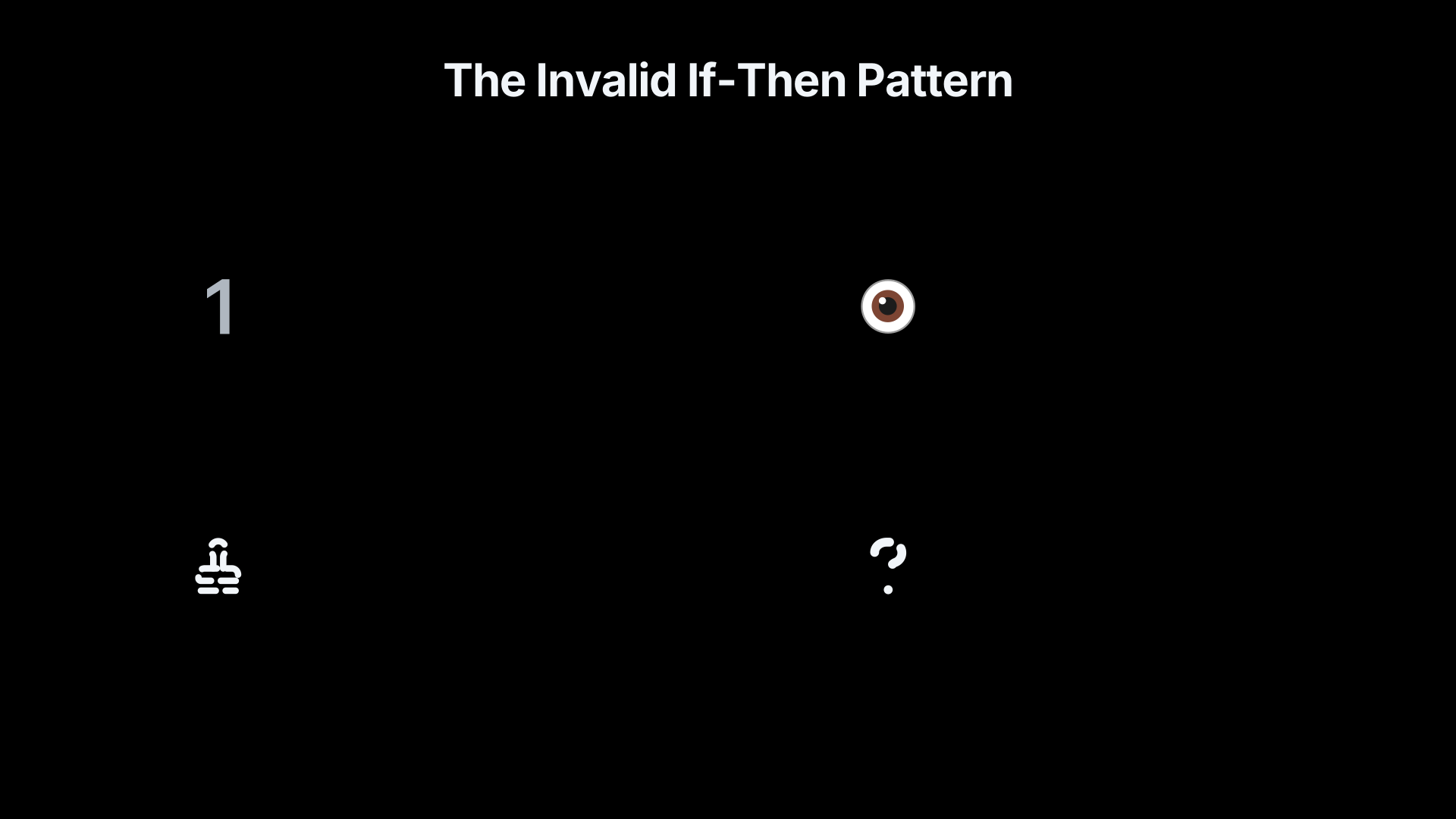
The Invalid If-Then Pattern
The structure of affirming the consequent is:(#endnote-2 “Endnote 2”)[Wikipedia]WikipediaAffirming the consequentAffirming the consequent
- If P, then Q.
- Q is true.
- Therefore, P is true.
Logic scholars classify this as a deductively invalid form of inference. The first statement says that P is sufficient for Q. It does not say that P is the only route to Q. When the argument concludes that Q proves P, it silently converts a one-way relationship into a two-way relationship.[stanford]plato.stanford.eduStanford Encyclopedia of PhilosophyArgument and Argumentationby C Dutilh Novaes · 2021 · Cited by 101 — For example, deductively invalid… Encyclopedia of Philosophy[wikipedia]WikipediaAffirming the consequentAffirming the consequent A simple example illustrates the problem:
- If it rains, the pavement will be wet.
- The pavement is wet.
- Therefore, it rained.
The pavement may indeed be wet because of rain. However, it could also be wet because of street cleaning, a burst water pipe, a sprinkler system, or many other causes. The conclusion might be true, but the argument does not prove it. That distinction between a possibly true conclusion and a logically established conclusion is the heart of the fallacy.[Wikipedia]WikipediaAffirming the consequentAffirming the consequent
Why the Pattern Feels Convincing
The fallacy succeeds because human reasoning often works by recognising patterns. If a cause repeatedly produces a particular effect, seeing the effect naturally brings the cause to mind. Cognitive research has found that people frequently show a tendency to reverse learned contingencies, treating “if P then Q” as though it also implied “if Q then P”.[ScienceDirect]sciencedirect.comThe contingency symmetry bias (affirming the consequent…by M Imai · 2021 · Cited by 21 — Humans are known to possess an “…
This intuition can be useful when generating hypotheses. The problem emerges when hypothesis generation is mistaken for proof. The effect may increase the plausibility of the proposed cause, but it does not eliminate competing explanations.[Internet Encyclopedia of Philosophy]iep.utm.eduSource details in endnotes.
Everyday Examples with Alternative Causes
False proof from effects appears in many ordinary situations because people often focus on one familiar explanation and ignore other possibilities.
Health symptoms
- If a person has influenza, they may develop a fever.
- This person has a fever.
- Therefore, they have influenza.
A fever is compatible with influenza, but it can also result from numerous infections or medical conditions. The symptom supports a diagnosis without proving a specific one.
Workplace reasoning
- If the server fails, the website will go offline.
- The website is offline.
- Therefore, the server failed.
The outage may instead be caused by network problems, configuration errors, maintenance work, or external service failures.
Relationships and behaviour
- If someone is angry, they may avoid conversation.
- They are avoiding conversation.
- Therefore, they are angry.
The behaviour could also result from stress, illness, distraction, fatigue, or a desire for privacy.
In each case, the observed effect is real evidence. The error lies in treating it as uniquely diagnostic when it is not. The argument ignores the possibility that several different causes could produce the same result.[Wikipedia]WikipediaAffirming the consequentAffirming the consequent
When the Fallacy Becomes Serious
The consequences become more significant when decisions involve guilt, liability, scientific conclusions, or public policy.
Legal and Forensic Reasoning
A well-known relative of affirming the consequent appears in the prosecutor’s fallacy. In this error, the rarity of evidence under innocence is treated as though it directly establishes guilt. Courts and evidence specialists have repeatedly warned that the probability of observing evidence if someone is innocent is not the same thing as the probability that the person is innocent given the evidence. CEBM[The Open University]open.eduThe Open University5.1 The prosecutor's fallacy | OpenLearnJudges and juries that are not comfortable with numbers may be at risk of misi…
Cases such as those involving Sally Clark and Lucia de Berk are frequently cited in discussions of how misunderstandings of conditional probabilities can contribute to wrongful conclusions. The issue is not that evidence is irrelevant; rather, evidence must be interpreted in the context of alternative explanations and background probabilities.[CEBM]cebm.ox.ac.ukthe prosecutors fallacyThe Prosecutor's Fallacy16 Jul 2018 — The Prosecutor's Fallacy is most often associated with miscarriages of justice. It's when the p…
Scientific Investigation
Scientific reasoning often begins by asking whether observations fit a theory. However, a prediction coming true does not automatically establish that the theory is correct. Multiple theories may predict the same observation. Researchers therefore seek additional tests that distinguish among competing explanations rather than relying on one successful prediction alone.
In this sense, affirming the consequent highlights a recurring risk in inquiry: confusing confirmation with demonstration. A result can support a hypothesis while still falling short of proving it uniquely.[stanford]plato.stanford.eduStanford Encyclopedia of PhilosophyArgument and Argumentationby C Dutilh Novaes · 2021 · Cited by 101 — For example, deductively invalid… Encyclopedia of Philosophy

How to Turn a Guess into a Stronger Argument
Avoiding this fallacy does not require rejecting evidence. It requires using evidence more carefully.
Ask What Else Could Produce the Effect
Whenever an argument moves from an effect to a cause, list plausible alternative causes. If several explanations remain possible, the effect cannot serve as deductive proof of any single one.
A useful question is:
“What other conditions could also create this result?”
The more alternative explanations exist, the weaker the claim that one specific cause has been established.
Look for Evidence That Differentiates Causes
A stronger argument gathers evidence that would be expected under one explanation but not under its rivals. Instead of relying on a single effect, it seeks a pattern of observations that progressively narrows the field.
For example, a wet pavement alone does not prove rain. Weather radar data, eyewitness reports, rainfall measurements, and regional weather patterns collectively provide much stronger support.
Distinguish Proof from Support
The most important correction is linguistic as well as logical.
- Weak claim: “This effect proves the cause.”
- Stronger claim: “This effect is consistent with the cause.”
- Stronger still: “This effect, together with additional evidence that excludes alternatives, supports the cause.”
This shift recognises that evidence can increase confidence without guaranteeing certainty.
The Core Lesson
Affirming the consequent is a formal fallacy because it treats an effect as proof of a particular cause. The argument begins with a genuine connection between cause and effect but then overstates what that connection can establish. Observing a predicted outcome may make a hypothesis more plausible, yet it does not logically demonstrate that the hypothesis is the only explanation. The key safeguard is to ask not merely whether the evidence fits a preferred explanation, but whether it fits other explanations as well. When evidence survives that challenge, an argument becomes stronger; when it does not, the appearance of proof dissolves into a false proof from effects.
Amazon book picks
Further Reading
Books and field guides related to When Evidence Looks Like Proof but Isnt. Use these as the next step if you want deeper reading beyond the article.
A Concise Introduction to Logic
Explains affirming the consequent as a classic invalid form.
eBay marketplace picks
Marketplace Samples
Example marketplace items related to this page. Use the search link to explore similar finds on eBay.

Endnotes
1.
Source: plato.stanford.edu
Title: Encyclopedia of Philosophy Fallacies
Link:https://plato.stanford.edu/entries/fallacies/
Source snippet
forms of inference, so these we may think of as deductive fallacies. They include affirming the consequent, denying the antecedent, the...
2.
Source: Wikipedia
Title: Affirming the consequent
Link:https://en.wikipedia.org/wiki/Affirming_the_consequent
3.
Source: encyclopedia.com
Link:https://www.encyclopedia.com/history/dictionaries-thesauruses-pictures-and-press-releases/fallacy-logical
4.
Source: sciencedirect.com
Link:https://www.sciencedirect.com/science/article/pii/S0010027721001748
Source snippet
The contingency symmetry bias (affirming the consequent...by M Imai · 2021 · Cited by 21 — Humans are known to possess an “...
5.
Source: cebm.ox.ac.uk
Title: the prosecutors fallacy
Link:https://www.cebm.ox.ac.uk/news/views/the-prosecutors-fallacy
Source snippet
The Prosecutor's Fallacy16 Jul 2018 — The Prosecutor's Fallacy is most often associated with miscarriages of justice. It's when the p...
6.
Source: open.edu
Link:https://www.open.edu/openlearn/mod/oucontent/view.php?id=170658§ion=7.1
Source snippet
The Open University5.1 The prosecutor's fallacy | OpenLearnJudges and juries that are not comfortable with numbers may be at risk of misi...
7.
Source: plato.stanford.edu
Link:https://plato.stanford.edu/entries/argument/
Source snippet
Stanford Encyclopedia of PhilosophyArgument and Argumentationby C Dutilh Novaes · 2021 · Cited by 101 — For example, deductively invalid...
8.
Source: youtube.com
Title: Affirming the Consequent
Link:https://www.youtube.com/watch?v=0wQ_pYnL1_E
Source snippet
CRITICAL THINKING - FALLACIES: Affirming the Consequent...
9.
Source: iep.utm.edu
Link:https://iep.utm.edu/fallacy/
10.
Source: iep.utm.edu
Link:https://iep.utm.edu/page/3/?cat=-
Source snippet
Internet Encyclopedia of PhilosophyFallaciesIf you have enough evidence to affirm the consequent of a conditional and then suppose that a...
11.
Source: logicallyfallacious.com
Link:https://www.logicallyfallacious.com/logicalfallacies/Affirming-the-Consequent
Source snippet
Logically FallaciousAffirming the ConsequentAn error in [formal logic]({{ 'formal-logic/' | relative_url }}) where if the consequent is said to be true, the antecedent is said t...
Additional References
12.
Source: pubmed.ncbi.nlm.nih.gov
Link:https://pubmed.ncbi.nlm.nih.gov/11848139/
Source snippet
a pitfall in interpreting probabilities in forensic evidenceby WC Leung · 2002 · Cited by 37 — This paper highlights the source of...
13.
Source: britannica.com
Title: affirmation of the consequent
Link:https://www.britannica.com/topic/affirmation-of-the-consequent
Source snippet
Encyclopedia BritannicaAffirmation of the consequent | logicApr 1, 2026 — An argument is deductively valid when the truth of the premises...
14.
Source: rephrasely.com
Link:https://rephrasely.com/usage/affirming-the-consequent-fallacy
Source snippet
Understanding the Affirming the Consequent FallacyIt occurs when someone assumes that if the consequent of a conditional statement is tru...
15.
Source: youtube.com
Title: CRITICAL THINKING
Link:https://www.youtube.com/watch?v=xZ_vSFFvPqU
Source snippet
[Logical Fallacies]({{ 'logical-fallacies/' | relative_url }}) - Affirming the Consequent...
16.
Source: arxiv.org
Title: arXiv Human Conditional Reasoning in Answer Set Programming
Link:https://arxiv.org/abs/2311.04412
17.
Source: youtube.com
Title: Logical Fallacies
Link:https://www.youtube.com/watch?v=Dsbv5mC9WwA
Source snippet
The Fallacy of Affirming the Consequent...
Topic Tree