Within Rumours
Why no disproof is not proof
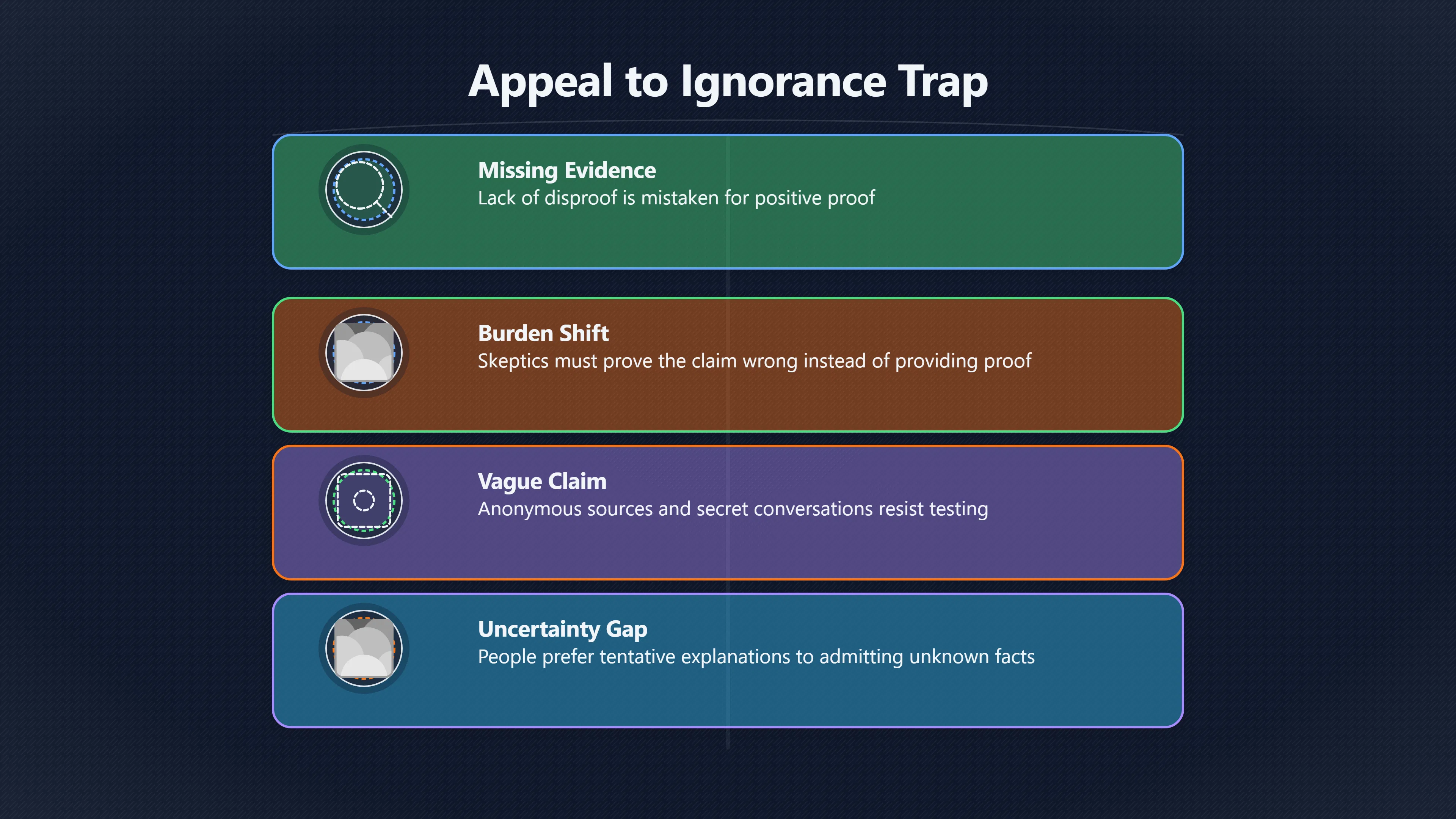
A claim does not become credible just because critics have not disproved every possible version of it.
On this page
- How rumours shift the burden of proof
- Why vague claims become harder to check
- How to label claims as confirmed, disconfirmed, or unverified
Page outline Jump by section
Introduction
A rumour does not become more credible simply because nobody has disproved it. One of the most persistent traps in rumours and unverified claims is the assumption that the absence of disproof counts as evidence. In logic, this is usually known as an appeal to ignorance: treating a lack of contrary evidence as proof that a claim is true. The result is a subtle shift from “we do not know” to “it must be true”.[fallacyfiles.org]fallacyfiles.orgLogical Fallacy: Appeal to IgnoranceAn appeal to ignorance is an argument for a conclusion based on a lack of evidence. There are two for…[wikipedia]WikipediaArgument from ignoranceArgument from ignoranceArgument from ignorance (Latin: argumentum ad ignorantiam), or appeal to ignorance, is an informal fallacy whe… This trap matters because rumours often thrive in situations where evidence is incomplete, records are inaccessible, or events are difficult to verify. Under those conditions, uncertainty itself can be mistaken for support. The rumour gains strength not from proof, but from the inability of others to eliminate every possible version of it.
Why no disproof is not proof
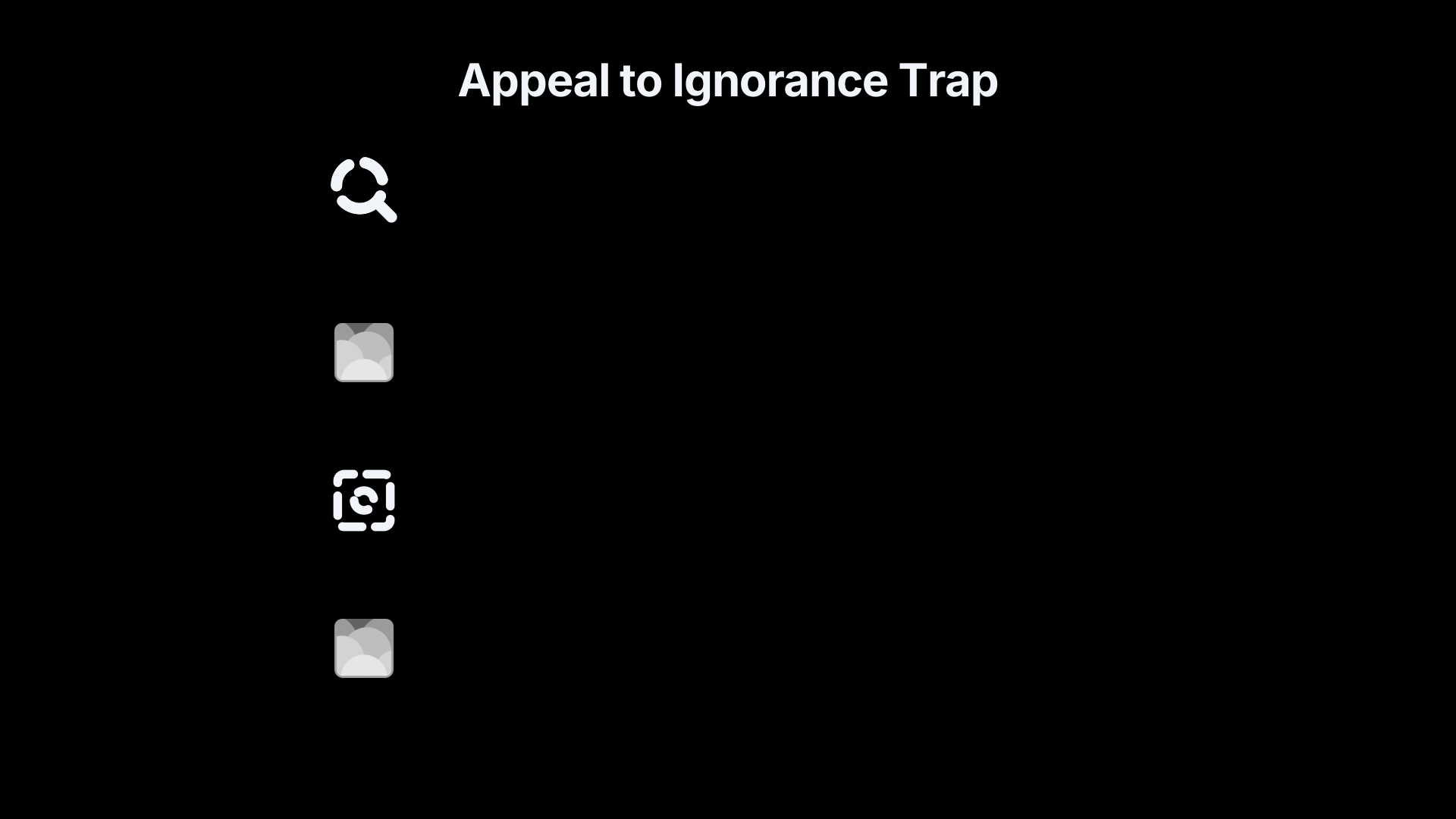
The core mistake is simple: a claim requires evidence of its own. The fact that critics have not disproved it does not supply that evidence.
Logical analysis identifies two common forms of this error:
- “Nobody has shown this rumour is false, therefore it is probably true.”
- “There is no evidence against this claim, therefore we should accept it.”
Both forms treat missing evidence as if it were positive support. Yet a lack of evidence can mean many things: the claim has not been investigated, relevant information is unavailable, or the question remains unresolved. None of those possibilities establish truth.[fallacyfiles.org]fallacyfiles.orgLogical Fallacy: Appeal to IgnoranceAn appeal to ignorance is an argument for a conclusion based on a lack of evidence. There are two for…[wikipedia]WikipediaArgument from ignoranceArgument from ignoranceArgument from ignorance (Latin: argumentum ad ignorantiam), or appeal to ignorance, is an informal fallacy whe… The problem becomes especially visible with rumours because they are often presented without verifiable sources. Instead of offering proof, the rumour relies on the challenge of proving a negative. Once that happens, the discussion shifts away from evidence and towards endless attempts at refutation.
How rumours shift the burden of proof
A reliable claim normally carries its own supporting evidence. A rumour trap reverses this expectation.
Instead of providing documentation, witnesses, records, or other verification, the rumour’s advocate may argue that sceptics must prove the claim wrong. This is a burden-of-proof shift. The responsibility moves from the person making the assertion to everyone questioning it.[QuillBot]quillbot.comQuill Bot What Is the Burden of Proof Fallacy?Definition & ExamplesJune 24, 2024 — 24 Jun 2024 — Appeal to ignorance: Asserts that a claim is true or false simply because the opposi…
The pattern often sounds like this:
- “Can you prove it never happened?”
- “Nobody has disproved the insider story.”
- “If it were false, someone would have exposed it by now.”
These statements create the impression that unanswered questions are evidence. In reality, unanswered questions are simply unanswered questions.
Logical guides consistently note that the burden of proof normally rests with the person advancing the claim. Failure to refute a statement does not automatically validate it.[fallacyfiles.org]fallacyfiles.orgLogical Fallacy: Appeal to IgnoranceAn appeal to ignorance is an argument for a conclusion based on a lack of evidence. There are two for…[QuillBot]quillbot.comQuill Bot What Is the Burden of Proof Fallacy?Definition & ExamplesJune 24, 2024 — 24 Jun 2024 — Appeal to ignorance: Asserts that a claim is true or false simply because the opposi…
Why vague claims become harder to check
Rumours often survive because they are difficult to test rather than because they are well supported.
A vague claim can be endlessly adjusted when challenged. If one version is questioned, another version appears. Anonymous sources, unnamed witnesses, secret conversations, deleted documents, or alleged cover-ups can make a rumour resistant to verification. The claim becomes harder to evaluate, but not more credible.
This creates an asymmetry:
- The rumour may require only a single sentence to state.
- Refuting every variation may require extensive investigation.
- New variations can appear faster than old ones can be checked.
As a result, people may wrongly conclude that the rumour survives scrutiny. In reality, it may simply have avoided clear testing.
The inability to conclusively disprove a flexible claim is often a sign of poor definition rather than strong evidence. A statement that cannot be clearly checked cannot be strongly confirmed either.
Why uncertainty feels persuasive
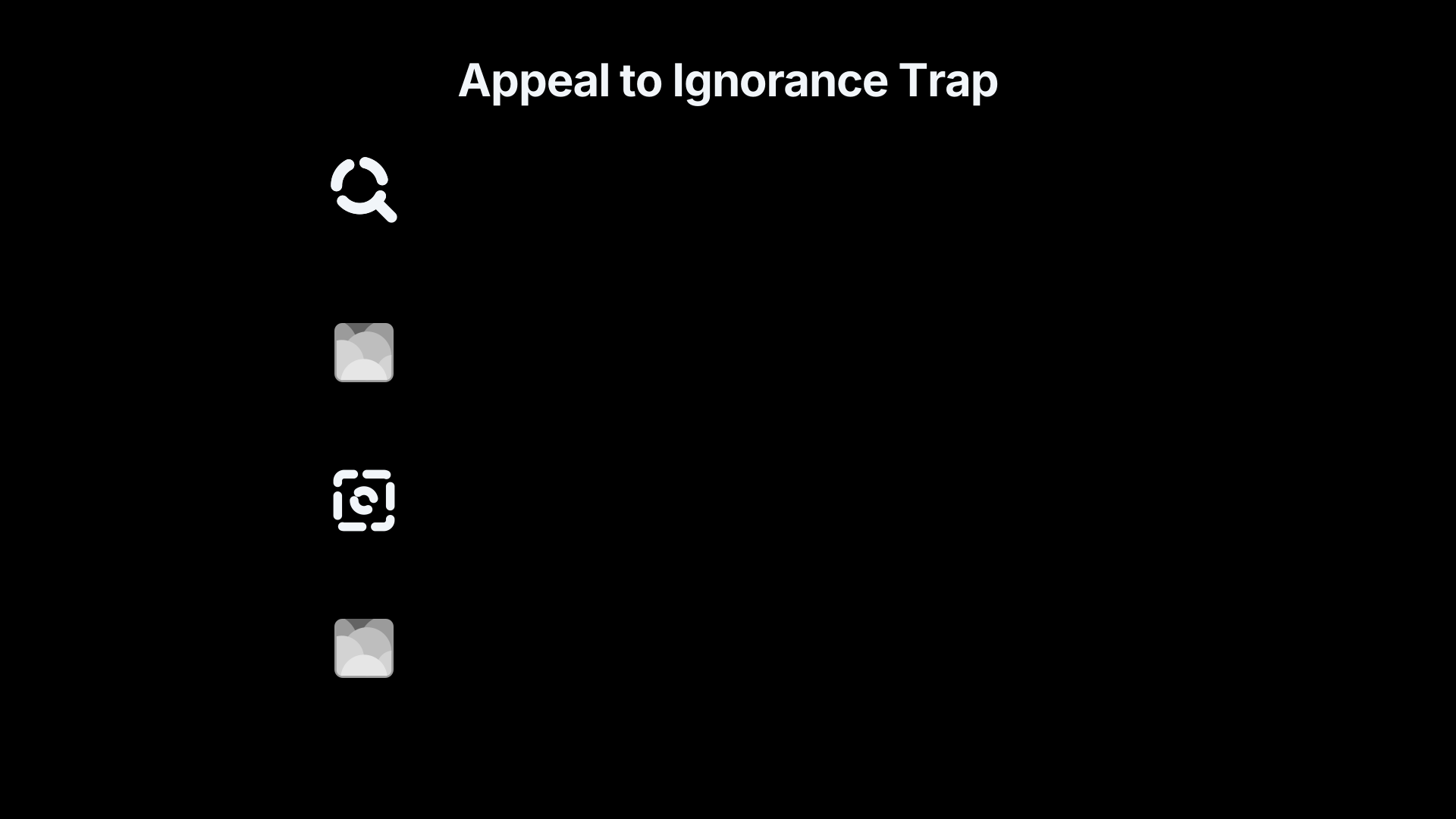
Human reasoning is uncomfortable with unresolved questions. During crises, scandals, emergencies, or breaking news events, people often prefer a tentative explanation to admitting that the facts are still unknown.
Rumours exploit that discomfort. A claim that cannot be disproved can feel plausible because it appears to fill an information gap. Psychological research on misinformation and fallacious reasoning shows that people can find arguments convincing even when the logical support is weak, especially when emotion or uncertainty is involved.[arXiv]arxiv.orgEmotionally Charged, Logically Blurred: AI-driven Emotional Framing Impairs Human Fallacy DetectionOctober 9, 2025…
The emotional appeal often follows a familiar pattern:
- A surprising claim appears.
- Evidence is incomplete.
- The absence of disproof is presented as support.
- Repetition makes the claim feel increasingly credible.
At no stage does positive evidence necessarily appear, yet confidence grows.
How to label claims as confirmed, disconfirmed, or unverified
A practical way to avoid the no-disproof trap is to separate three different states of knowledge.
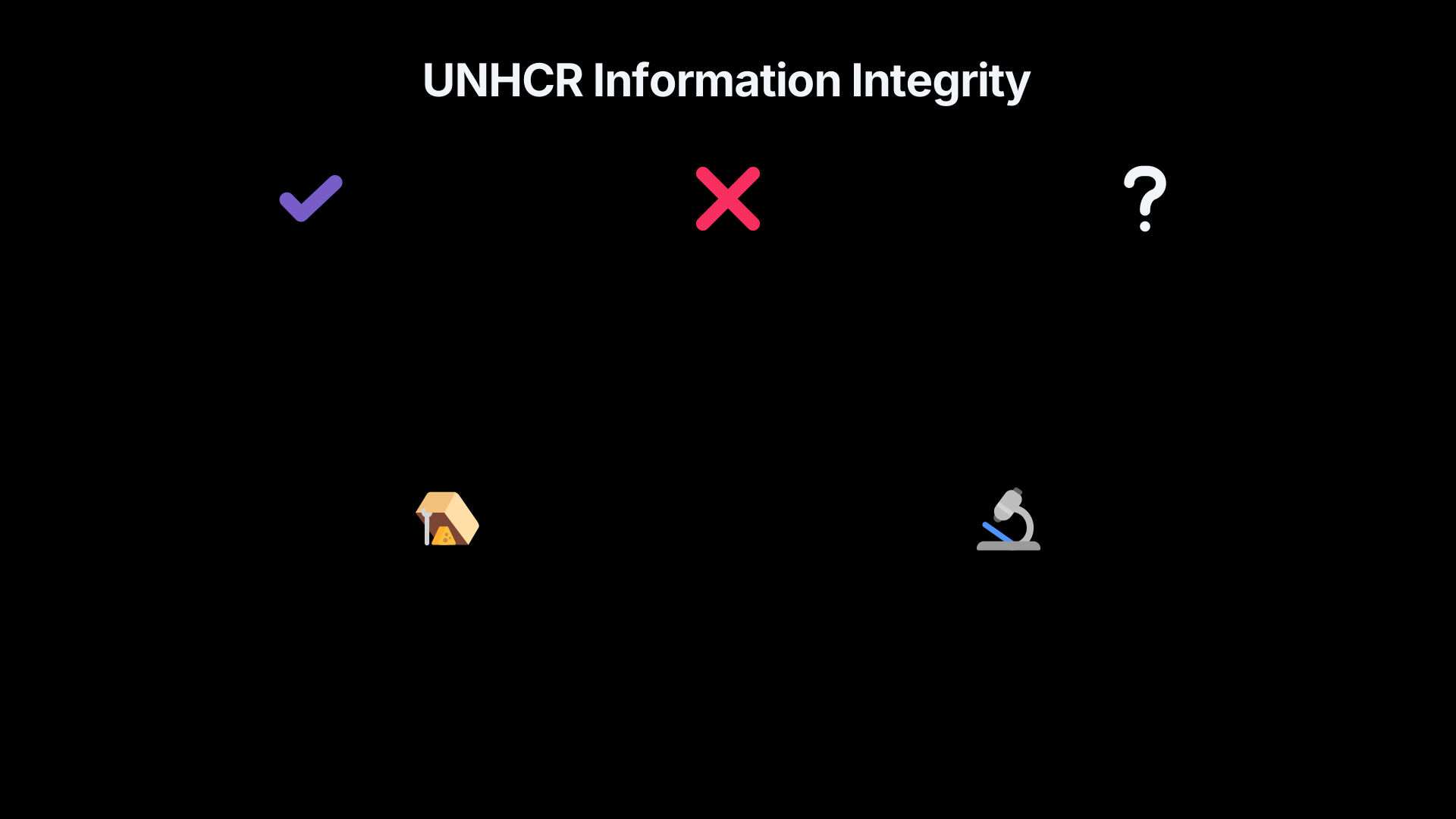
Confirmed
A claim is confirmed when reliable evidence supports it. Independent verification, documented records, credible witnesses, or strong empirical evidence move a claim into this category.
Disconfirmed
A claim is disconfirmed when reliable evidence shows it is false, misleading, fabricated, or inconsistent with known facts.
Unverified
A claim is unverified when available information does not yet justify either conclusion.
This third category is where many rumours belong. Importantly, unverified does not mean “probably true”. It also does not mean “definitely false”. It means that the evidence is currently insufficient for a confident judgement. Information-integrity frameworks commonly treat rumours as unverified information that may later prove true, false, or partly true.[UNHCR]unhcr.orgglossary termsGlossary of terms | UNHCR Information Integrity Toolkit16 Dec 2024 — Glossary of terms · Information Integrity · Risks to Informatio…
Maintaining that distinction prevents uncertainty from being mistaken for proof.
A simple test for the rumour trap
When encountering a rumour, ask one question:
What evidence supports the claim, apart from the fact that nobody has disproved it?
If the strongest argument is merely that the rumour remains unrefuted, the claim has not gained evidential support. It remains unverified.
The absence of disproof may justify continued investigation. It does not justify certainty. That distinction is what separates careful reasoning from one of the most common fallacies in rumours and unverified claims.[fallacyfiles.org]fallacyfiles.orgLogical Fallacy: Appeal to IgnoranceAn appeal to ignorance is an argument for a conclusion based on a lack of evidence. There are two for…[Wikipedia]WikipediaArgument from ignoranceArgument from ignoranceArgument from ignorance (Latin: argumentum ad ignorantiam), or appeal to ignorance, is an informal fallacy whe…
Amazon book picks
Further Reading
Books and field guides related to Why no disproof is not proof. Use these as the next step if you want deeper reading beyond the article.
The Skeptics' Guide to the Universe
Covers appeal to ignorance and evidence standards.
eBay marketplace picks
Marketplace Samples
Example marketplace items related to this page. Use the search link to explore similar finds on eBay.






Endnotes
1.
Source: fallacyfiles.org
Link:https://www.fallacyfiles.org/ignorant.html
Source snippet
Logical Fallacy: Appeal to IgnoranceAn appeal to ignorance is an argument for a conclusion based on a lack of evidence. There are two for...
2.
Source: Wikipedia
Title: Argument from ignorance
Link:https://en.wikipedia.org/wiki/Argument_from_ignorance
Source snippet
Argument from ignoranceArgument from ignorance (Latin: argumentum ad ignorantiam), or appeal to ignorance, is an informal fallacy whe...
3.
Source: quillbot.com
Title: Quill Bot What Is the Burden of Proof Fallacy?
Link:https://quillbot.com/blog/reasoning/burden-of-proof-fallacy/
Source snippet
Definition & ExamplesJune 24, 2024 — 24 Jun 2024 — Appeal to ignorance: Asserts that a claim is true or false simply because the opposi...
Published: June 24, 2024
4.
Source: arxiv.org
Link:https://arxiv.org/abs/2510.09695
Source snippet
Emotionally Charged, Logically Blurred: AI-driven Emotional Framing Impairs Human Fallacy DetectionOctober 9, 2025...
Published: October 9, 2025
5.
Source: arxiv.org
Title: arXiv Grounding Fallacies Misrepresenting Scientific Publications in Evidence
Link:https://arxiv.org/abs/2408.12812
6.
Source: unhcr.org
Title: glossary terms
Link:https://www.unhcr.org/handbooks/informationintegrity/understanding-challenge/glossary-terms
Source snippet
Glossary of terms | UNHCR Information Integrity Toolkit16 Dec 2024 — Glossary of terms · Information Integrity · Risks to Informatio...
7.
Source: unhcr.org
Link:https://www.unhcr.org/glossary
Source snippet
UNHCR master glossary of termsUNHCR's glossary offers definitions and descriptions related to the work of serving and protecting displace...
8.
Source: emergency.unhcr.org
Link:https://emergency.unhcr.org/sites/default/files/UNHCR%2C%20Handbook%20and%20Guidelines%20on%20Procedures%20and%20Criteria%20for%20Determining%20Refugee%20Status%20under%20the%201951%20Convention%20and%20the%201967%20Protocol%20Relating%20to%20the%20Status%20of%20Refugees_0_0_0_0_0_0.pdf
Source snippet
unhcr.orgUNHCR, Handbook and Guidelines on Procedures and...The 1951 Convention relating to the status of Refugees and its 1967 Protocol...
Additional References
9.
Source: facebook.com
Link:https://www.facebook.com/groups/457861264635578/posts/1662066907548335/
Source snippet
Appeal to ignorance fallacy examplesThe Fallacy of Appeal to Ignorance occurs when you argue that your conclusion must be true, because t...
10.
Source: asyl.net
Link:https://www.asyl.net/fileadmin/user_upload/publikationen/Studien/2013_06_UNHCR_Beyond_Proof_Credibility_Assessment.pdf
Source snippet
Credibility Assessment in EU Asylum SystemsAppreciation is extended to those government officials, judges, representatives from non-gover...
11.
Source: medium.com
Link:https://medium.com/activated-thinker/thinking-error-6-appeal-to-ignorance-93f4245f789d
12.
Source: yourlogicalfallacyis.com
Link:https://yourlogicalfallacyis.com/burden-of-proof
Source snippet
Your logical fallacy is burden of proofThe burden of proof lies with someone who is making a claim, and is not upon anyone else to dispro...
13.
Source: refworld.org
Link:https://www.refworld.org/policy/legalguidance/unhcr/1998/23696
Source snippet
Note on Burden and Standard of Proof in Refugee ClaimsNote on Burden and Standard of Proof in Refugee Claims · Document...
14.
Source: echr.coe.int
Link:https://www.echr.coe.int/documents/d/echr/Speech_20170127_Ravarani_JY_ENG
Source snippet
of the credibility of asylum-seekers: the burden of...The assessment of credibility and the burden of proof are core issues in asylum cases...
15.
Source: medium.com
Link:https://medium.com/unhcr-innovation-service/refugee-advisory-board-fights-misinformation-online-445d21b1f35a
Source snippet
eyman says. “We try to find the source of any rumors and...Read more...
16.
Source: scribbr.com
Link:https://www.scribbr.com/frequently-asked-questions/is-appeal-to-ignorance-a-logical-fallacy/
Source snippet
It asserts that something must be true because it hasn't...Read more...
17.
Source: euaa.europa.eu
Link:https://www.euaa.europa.eu/sites/default/files/eca-ceas-cj_en.pdf
Source snippet
Burden of proof concerning (un)authen ticity of a...Read more...
18.
Source: grammarly.com
Title: appeal to ignorance fallacy
Link:https://www.grammarly.com/blog/rhetorical-devices/appeal-to-ignorance-fallacy/
Source snippet
Definition and Examples30 Dec 2022 — The appeal to ignorance fallacy is the logical fallacy of claiming that a statement must be true bec...
Topic Tree