Within Fallacy Lab
Why Rumours Feel Like Evidence
Rumours often rely on ignorance, popularity or weak causal links instead of verifiable support.
On this page
- No disproof claims
- Sharing as social proof
- Verification questions
Page outline Jump by section
Introduction
Rumours can feel like evidence because they arrive already wrapped in social confidence: “everyone is saying it”, “no one has disproved it”, “a friend of a friend heard it”, or “this happened right before that”. In logic, the problem is not simply that a rumour is unverified. Some rumours later turn out to be true. The fallacy appears when uncertainty is treated as proof, popularity is treated as confirmation, or a weak coincidence is treated as a cause.
This makes rumours a useful case study in logical fallacies. They often rely on shortcuts that feel sensible in the moment: an appeal to ignorance, a bandwagon appeal, a hasty generalisation, a false cause, or an appeal to anonymous authority. Those shortcuts become especially persuasive during crises, breaking news, health scares and community conflict, when people want quick explanations before reliable evidence has caught up. Research on social media rumours describes them as claims whose truth is unverified at the time of posting, and distinguishes long-running rumours from fast-moving rumours that emerge during breaking events.[arXiv]arxiv.orgarXiv Detection and Resolution of Rumours in Social Media: A SurveyDetection and Resolution of Rumours in Social Media: A SurveyApril 3, 2017…
Why “No One Has Disproved It” Is Not Evidence
A common rumour fallacy is the appeal to ignorance: “Nobody has proved this is false, so it might as well be true.” The mistake is a burden-of-proof shift. A person making a claim is treated as if they have supplied evidence merely because critics have not disproved every possible version of it. Fallacy guides describe this as arguing from the absence of disproof rather than from positive support.[fallacyfiles.org]fallacyfiles.orgLogical Fallacy: Appeal to IgnoranceAppeal to ignorance often takes place in the context of a debate when one side attempts to place the…
This is especially tempting with rumours because they are often hard to test. A claim may involve an unnamed insider, a private conversation, a blurry image, a deleted post or a supposedly suppressed report. The more vague the claim, the harder it is to disprove. But that does not make it stronger. It often makes it weaker, because the claim has been protected from ordinary checking.
The careful alternative is to separate three states that rumours often blur together:
- Confirmed: reliable evidence supports the claim.
- Disconfirmed: reliable evidence shows the claim is false or misleading.
- Unverified: the claim has not yet been established either way.
The third category is not a compromise verdict of “probably true”. It is a warning label. UNHCR’s information-integrity glossary defines a rumour as unverified information passed from person to person and notes that rumours can be true, partly true or false.[UNHCR]unhcr.orgglossary additional terminologyGlossary of additional terminology23 Dec 2024 — Rumour is a piece unverified information that is transmitted from person to person… That definition matters because it prevents the two opposite errors: dismissing every rumour automatically, or accepting every rumour because it has not been disproved.
A rumour may reasonably justify caution while evidence is pending. For example, if several residents report a possible local hazard, it may be sensible to check official updates or avoid the area briefly. The fallacy begins when caution hardens into certainty without evidence: “We do not know this is false” becomes “this is what really happened”.

When Sharing Becomes Social Proof
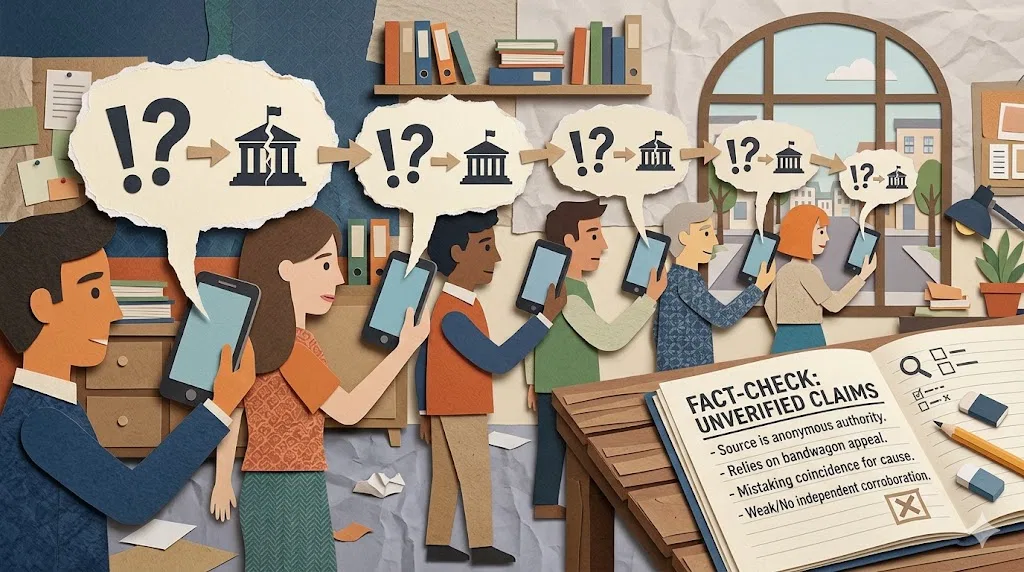
Rumours rarely spread as bare claims. They spread with visible signals of agreement: likes, reposts, forwarded messages, comments, screenshots and the repeated phrase “people are saying”. Those signals create an impression of independent confirmation even when many people are simply copying the same unverified source.
This is the bandwagon problem. In logical terms, popularity is not the same as truth. A claim can be widely shared because it is frightening, funny, novel, identity-affirming or emotionally satisfying. A large study of verified true and false news stories on Twitter from 2006 to 2017 found that false news diffused farther, faster, deeper and more broadly than true news; the dataset covered about 126,000 stories tweeted by roughly 3 million people more than 4.5 million times.[Scalable Civic Action]politics.media.mit.eduScalable Civic Action The spread of true and false news onlineScalable Civic ActionThe spread of true and false news onlineAugust 30, 2020 — by S Vosoughi · Cited by 14070 — We investigated the diffe… MIT’s summary of the study emphasised that falsehood spread more rapidly than truth in all categories examined, and that novelty appeared to be one reason false stories attracted attention.[MIT News]news.mit.edustudy twitter false news travels faster true stories 0308study twitter false news travels faster true stories 0308
The fallacy is not “many people shared it, therefore it is false”. That would be another bad inference. The mistake is “many people shared it, therefore it is true”. In a rumour chain, repetition can easily be mistaken for corroboration. Ten posts may look like ten witnesses, when all ten may trace back to the same screenshot, the same anonymous account or the same misunderstood clip.
Social cues can also shape behaviour before people have assessed accuracy. Research on misinformation and social cues finds that visible engagement signals can influence whether users like and share posts, though the effect is not always simple and may depend on the design of the platform and the context of the cue.[PMC]pmc.ncbi.nlm.nih.govPMCThe persuasive effects of social cues and sourcePMCThe persuasive effects of social cues and source The practical lesson is modest but important: popularity should be treated as a clue about attention, not a substitute for evidence.
Weak Causation Makes Rumours Feel Explanatory
Many rumours gain force because they offer a quick cause for an unsettling event: someone became ill after a vaccine, a company changed policy after a secret meeting, a public figure disappeared after a scandal, or a loud noise was heard before an emergency. The reasoning often follows the false-cause pattern: because one thing happened before another, the first must have caused the second.
This can feel reasonable because human beings look for patterns, especially under stress. But sequence is only a starting point for inquiry. To support a causal claim, a rumour needs more than timing. It needs a plausible mechanism, reliable records, comparison with alternative explanations, and evidence that the alleged cause is present where the effect occurs and absent where it does not.
Health rumours show the danger clearly. WHO Europe reported that misinformation during pandemics, health emergencies and humanitarian crises can cause mental, social, political and economic distress and affect health behaviour.[World Health Organization]who.intSource details in endnotes. A 2026 Reuters investigation described a deadly misinformation crisis in the Democratic Republic of Congo, where false rumours about a mysterious illness contributed to attacks on health workers and other deaths, according to officials and the WHO-led Africa Infodemic Response Alliance.[Reuters]reuters.comFake rumors, real killings: Inside Congo's deadly health misinformation crisisSocial media, local media, and religious leaders, including megachurch pastor Jules Mulindwa and other pastors, played a key role in ampl…
That example is not just a case of false information. It shows how fallacious reasoning can become socially dangerous. A frightening claim, repeated through trusted community channels, can turn an unverified causal story into an explanation that people act on. Once the rumour supplies a villain, later uncertainty may be interpreted as concealment rather than as a reason to slow down.
Anonymous Authority and the “Friend of a Friend”
Another common rumour structure is the appeal to anonymous authority: “a doctor said”, “someone in government told me”, “a police officer warned my neighbour”, “my cousin knows someone at the company”. The statement borrows credibility from an authority figure while withholding the details needed to evaluate that authority.
Appeals to authority are not always fallacies. It is reasonable to give weight to a named, relevant expert speaking within their field, especially when their claim is consistent with other evidence. Rumours become fallacious when the authority cannot be identified, the expertise is irrelevant, the chain of transmission is unclear, or the claim is treated as immune from checking.
The “friend of a friend” pattern is particularly slippery because it sounds close enough to be trustworthy but distant enough to avoid verification. Each person in the chain may honestly believe they are passing on a warning, not inventing a story. UNHCR distinguishes misinformation from disinformation partly by intent: misinformation is inaccurate information shared by people who may not know it is false, while disinformation is deliberately manipulative.[UNHCR]unhcr.orgglossary termsglossary terms For fallacy analysis, however, the reasoning problem can exist either way. A sincerely shared rumour can still rest on weak support.
A useful test is whether the authority can be brought into the open. Who exactly made the claim? What did they witness? Are they qualified to know? Is there a document, record, photograph, official statement or independent report that supports it? If the rumour becomes less clear each time those questions are asked, its persuasive force was probably coming from borrowed status rather than evidence.
Emotion Is Not Proof, Even When the Concern Is Real
Rumours often travel fastest when they connect with fear, anger, disgust, hope or group loyalty. Emotional force can make a claim feel true before it has been examined. That does not mean emotions are irrational or irrelevant. Fear may alert people to risk; anger may point to injustice. The fallacy is treating the strength of the feeling as proof of the claim.
Psychological research on fake news has found that relying on emotion can increase belief in false headlines, while more analytical thinking is associated with better truth discernment.[PMC]pmc.ncbi.nlm.nih.govPMCReliance on emotion promotes belief in fake newsPMCReliance on emotion promotes belief in fake news A review by Gordon Pennycook and David Rand similarly argues that poor truth discernment is linked not only to political motivation but also to lack of careful reasoning, lack of relevant knowledge and reliance on heuristics such as familiarity.[ScienceDirect]sciencedirect.comSource details in endnotes.
This helps explain why rumours can survive correction. If a rumour gave people a vivid emotional explanation, a later factual correction may feel cold, partial or evasive. Research on misinformation correction notes that retractions do not always fully remove the influence of the original misinformation from later judgements, a problem often called the continued influence effect.[Cambridge University Press & Assessment]cambridge.orgSource details in endnotes.
The logical lesson is not “ignore emotion”. It is “pause when emotion is doing the evidential work”. A claim that provokes immediate outrage or panic may still be true, but the emotion should trigger verification rather than replace it.

Verification Questions That Expose the Fallacy
Rumours become easier to assess when they are translated from social performance into testable claims. Instead of asking “Do I believe this?”, start with “What exactly would have to be true for this claim to be reliable?”
For an everyday reader, the most useful checks are simple:
- What is the precise claim?
Strip away commentary. Is the rumour claiming that something happened, that someone intended something, that a cause has been identified, or that a future event is certain?
- Who is the original source?
A repost is not a source. A screenshot of a repost is even weaker. Verification guides for user-generated content stress the importance of checking source, date, location and context, especially during emergencies.[verificationhandbook.com]verificationhandbook.comSource details in endnotes.
- Is there independent corroboration?
Look for separate reporting, documents, direct witnesses or official records that do not all trace back to the same post. UNICEF’s misinformation guidance recommends checking whether reliable sources are also discussing the claim and warns that absence of corroboration from credible sources raises the risk that a claim is false or misleading.[UNICEF]unicef.orgquick guide spotting misinformationquick guide spotting misinformation
- Could the evidence be old, miscaptioned or from somewhere else?
Images and videos often persuade because they feel direct. But visual evidence can be real and still misleading if it shows a different time, place or event. Bellingcat’s beginner guide to social media verification highlights geolocation and chronolocation as ways to test whether an image or video matches the claim attached to it.[bellingcat]bellingcat.comA Beginner's Guide to Social Media VerificationA Beginner's Guide to Social Media Verification
- What alternative explanations fit the same facts?
A rumour often presents one explanation as if it is the only possible one. Asking for alternatives helps reveal false-cause reasoning and hasty generalisation.
- What would change my mind?
If no evidence could weaken the rumour, it is no longer being treated as an ordinary claim. It has become a belief protected from testing.
These questions do not guarantee certainty. Their value is that they move the discussion away from social proof and towards evidential support.
How to Talk About a Rumour Without Spreading It
A tricky feature of rumours is that repeating them can amplify them, even when the intention is to criticise. This creates a practical challenge: people need to warn, correct and discuss, but careless repetition can make the claim more familiar and therefore more believable.
A safer approach is to lead with what is known before naming the rumour. For example: “Local health officials say there is no evidence for the claim that…” is better than “Have you heard the rumour that…?” The first frame gives readers an evidential anchor. The second may simply advertise the rumour.
It also helps to avoid mockery. Calling people gullible may make the correction socially costly to accept. In polarised settings, labels can even backfire for some audiences. A study reported in 2024 found that “disputed” labels on false election-fraud tweets did little to change Trump voters’ beliefs and may have reinforced false beliefs among some politically knowledgeable supporters, although the researchers noted contextual limits around the timing and platform trust.[The Guardian]theguardian.comSource details in endnotes.
The aim is not to let rumours pass unchallenged. It is to challenge the reasoning: “What is the source?”, “How do we know?”, “Could this be a repost of an older event?”, “Is there a named authority?”, “Has anyone independent verified it?” This keeps the focus on standards of evidence rather than on humiliating the person who shared the claim.
The Main Fallacies to Watch For
Rumours rarely rely on just one fallacy. Several often work together, making the claim feel stronger than it is.
Rumour patternFallacy riskWhy it misleads“No one has proved it false.”Appeal to ignoranceLack of disproof is treated as proof.“Everyone is sharing it.”Bandwagon appealPopularity is mistaken for confirmation.“My friend knows someone who saw it.”Anonymous authorityBorrowed credibility replaces checkable sourcing.“This happened after that.”False causeTiming is treated as causal evidence.“It happened once, so it is everywhere.”Hasty generalisationA narrow or unclear case becomes a broad claim.“They denied it, so they must be hiding it.”Circular suspicionAny contrary evidence is reinterpreted as support.“It feels too specific to be made up.”Vividness biasDetail and emotional force are confused with reliability.
The table should not be used as a quick way to dismiss every uncomfortable claim. Some early warnings begin as unverified reports. The point is to keep the category clear: a rumour may be worth checking, but it has not earned the status of evidence until its support can be examined.

The Takeaway: Treat Rumours as Leads, Not Proof
The most disciplined response to a rumour is neither automatic belief nor automatic disbelief. It is provisional handling. A rumour can be a lead, a signal of anxiety, a clue about what a community is discussing, or a reason to seek better information. It becomes a logical fallacy when people treat its existence, popularity or emotional force as if those things prove the underlying claim.
That distinction matters because rumours often appear during exactly the moments when clear reasoning is hardest: emergencies, scandals, public-health scares, political conflict and breaking news. In those settings, the safest question is not “Could this be true?” Almost anything could be true in a loose enough sense. The better question is: “What reliable evidence supports this specific claim, and what fallacy am I tempted to use in place of that evidence?”
Amazon book picks
Further Reading
Books and field guides related to Why Rumours Feel Like Evidence. Use these as the next step if you want deeper reading beyond the article.
The Skeptics' Guide to the Universe
Teaches how to evaluate extraordinary claims and rumours.
eBay marketplace picks
Marketplace Samples
Example marketplace items related to this page. Use the search link to explore similar finds on eBay.








Endnotes
1.
Source: arxiv.org
Title: arXiv Detection and Resolution of Rumours in Social Media: A Survey
Link:https://arxiv.org/abs/1704.00656
Source snippet
Detection and Resolution of Rumours in Social Media: A SurveyApril 3, 2017...
Published: April 3, 2017
2.
Source: fallacyfiles.org
Link:https://www.fallacyfiles.org/ignorant.html
3.
Source: unhcr.org
Title: glossary additional terminology
Link:https://www.unhcr.org/handbooks/informationintegrity/additional-resources/glossary-additional-terminology
Source snippet
Glossary of additional terminology23 Dec 2024 — Rumour is a piece unverified information that is transmitted from person to person...
4.
Source: [politics]({{ ‘politics/’ | relative_url }}). media.mit.edu
Title: Scalable Civic Action The spread of true and false news online
Link:https://politics.media.mit.edu/papers/Vosoughi_Science.pdf
Source snippet
Scalable Civic ActionThe spread of true and false news onlineAugust 30, 2020 — by S Vosoughi · Cited by 14070 — We investigated the diffe...
Published: August 30, 2020
5.
Source: news.mit.edu
Title: study twitter false news travels faster true stories 0308
Link:https://news.mit.edu/2018/study-twitter-false-news-travels-faster-true-stories-0308
6.
Source: pmc.ncbi.nlm.nih.gov
Title: PMCThe persuasive effects of social cues and source
Link:https://pmc.ncbi.nlm.nih.gov/articles/PMC10879158/
7.
Source: arxiv.org
Link:https://arxiv.org/abs/2207.07562
8.
Source: who.int
Link:https://www.who.int/europe/news/item/01-09-2022-infodemics-and-misinformation-negatively-affect-people-s-health-behaviours–new-who-review-finds
9.
Source: reuters.com
Title: Fake rumors, real killings: Inside Congo’s deadly health misinformation crisis
Link:https://www.reuters.com/business/media-telecom/fake-rumors-real-killings-inside-congos-deadly-health-misinformation-crisis-2026-05-07/
Source snippet
Social media, local media, and religious leaders, including megachurch pastor Jules Mulindwa and other pastors, played a key role in ampl...
10.
Source: unhcr.org
Title: glossary terms
Link:https://www.unhcr.org/handbooks/informationintegrity/understanding-challenge/glossary-terms
11.
Source: pmc.ncbi.nlm.nih.gov
Title: PMCReliance on emotion promotes belief in fake news
Link:https://pmc.ncbi.nlm.nih.gov/articles/PMC7539247/
12.
Source: sciencedirect.com
Link:https://www.sciencedirect.com/science/article/pii/S1364661321000516
13.
Source: cambridge.org
Link:https://www.cambridge.org/core/books/social-media-and-democracy/misinformation-and-its-correction/61FA7FD743784A723BA234533012E810
14.
Source: verificationhandbook.com
Link:https://verificationhandbook.com/
15.
Source: unicef.org
Title: quick guide spotting misinformation
Link:https://www.unicef.org/eca/stories/quick-guide-spotting-misinformation
16.
Source: bellingcat.com
Title: A Beginner’s Guide to Social Media Verification
Link:https://www.bellingcat.com/resources/2021/11/01/a-beginners-guide-to-social-media-verification/
17.
Source: bellingcat.com
Title: shadow geolocate geolocation locate image tool open source bellingcat measure
Link:https://www.bellingcat.com/resources/2024/08/22/shadow-geolocate-geolocation-locate-image-tool-open-source-bellingcat-measure/
18.
Source: bellingcat.com
Link:https://www.bellingcat.com/tag/verification/
19.
Source: bellingcat.com
Link:https://www.bellingcat.com/tag/chronolocation/
20.
Source: bellingcat.com
Link:https://www.bellingcat.com/resources/2023/05/08/chronolocation-determining-when-a-photo-was-taken-using-facebook-google-street-view-and-assorted-tiny-details/
21.
Source: sciencedirect.com
Link:https://www.sciencedirect.com/science/article/pii/S0001691824002221
22.
Source: sciencedirect.com
Link:https://www.sciencedirect.com/science/article/pii/S2405844024104999
23.
Source: sciencedirect.com
Link:https://www.sciencedirect.com/science/article/pii/S2211883724000091
24.
Source: sciencedirect.com
Link:https://www.sciencedirect.com/science/article/pii/S0001691824000921
25.
Source: unhcr.org
Link:https://www.unhcr.org/innovation/wp-content/uploads/2022/02/Using-Social-Media-in-CBP-Chapter-6-Rumours-and-Misinformation.pdf
26.
Source: help.unhcr.org
Link:https://help.unhcr.org/czech/safe-online/information/
27.
Source: theguardian.com
Link:https://www.theguardian.com/technology/2024/sep/20/trump-tweets-false-label-credibility-supporters
28.
Source: Wikipedia
Link:https://en.wikipedia.org/wiki/Misinformation
29.
Source: science.org
Title: fake news spreads faster true news twitter thanks people not bots
Link:https://www.science.org/content/article/fake-news-spreads-faster-true-news-twitter-thanks-people-not-bots
30.
Source: science.org
Link:https://www.science.org/doi/10.1126/science.aap9559
31.
Source: scribd.com
Title: Bellingcat s Online Investigation Toolkit
Link:https://www.scribd.com/document/784989239/Bellingcat-s-Online-Investigation-Toolkit
32.
Source: imedd.org
Link:https://www.imedd.org/events/bellingcat/
33.
Source: bellingcat.gitbook.io
Title: io Geolocation
Link:https://bellingcat.gitbook.io/toolkit/categories/geolocation
Additional References
34.
Source: researchgate.net
Link:https://www.researchgate.net/publication/390564549_Alleviating_the_Bandwagon_Effect_of_Crisis_Misinformation_on_Social_Media_Understanding_Social_Media_Users%27_Bandwagon_Perceptions_and_the_Credibility_of_Crisis_Misinformation_to_Protect_Organizational
35.
Source: labxchange.org
Link:https://www.labxchange.org/library/pathway/lx-pathway%3Ae14a306c-99b2-4ae8-9d59-b2169c30b54b/items/lb%3ALabXchange%3A75f36ede%3Ahtml%3A1/178803
36.
Source: logicallyfallacious.com
Link:https://www.logicallyfallacious.com/logicalfallacies/Argument-from-Ignorance
37.
Source: researchgate.net
Link:https://www.researchgate.net/publication/377300923_Logical_Fallacies_How_They_Undermine_Critical_Thinking_and_How_to_Avoid_Them
38.
Source: facebook.com
Link:https://www.facebook.com/WHO/posts/not-all-information-you-find-on-social-media-is-true-some-use-it-to-spread-misle/1082224637270259/
39.
Source: rtdna.org
Link:https://www.rtdna.org/preventing-the-spread-of-misinformation-and-disinformation
40.
Source: facebook.com
Link:https://www.facebook.com/WHO/posts/sharing-unverified-health-information-during-the-covid-19-pandemic-can-be-confus/3286468124731881/
41.
Source: researchgate.net
Link:https://www.researchgate.net/profile/Norbert-Schwarz-3/publication/347798577_When_Fake_News_Feels_True/links/5fe97fc4a6fdccdcb80cc213/When-Fake-News-Feels-True.pdf
42.
Source: advances.in
Link:https://advances.in/psychology/10.56296/knowledge-hub/psychology-of-misinformation/
43.
Source: linkedin.com
Link:https://www.linkedin.com/pulse/scientific-social-[mechanisms
Topic Tree