Within Popularity
Why Obvious Answers Can Bend Under Pressure
The Asch line studies show how group agreement can push people toward answers that conflict with what they can see.
On this page
- What the line judgement experiments tested
- What conformity reveals about popular belief
- Limits of using Asch as a fallacy example
Page outline Jump by section
Introduction
The Asch conformity experiments are among the clearest demonstrations that public agreement is not the same thing as reliable evidence. Conducted by psychologist Solomon Asch in the 1950s, the studies showed that ordinary people sometimes gave obviously incorrect answers simply because a unanimous group had already done so. The importance of these experiments for understanding appeal to popularity is straightforward: if people can be pushed toward denying what they can plainly see, then widespread agreement may reflect social pressure as much as independent judgement. The studies do not prove that majorities are usually wrong. Instead, they show that the existence of a majority can influence what people say, and sometimes even what they think, regardless of the evidence in front of them.[Wikipedia]WikipediaAsch conformity experimentsAsch conformity experiments
What the Line-Judgement Experiments Tested
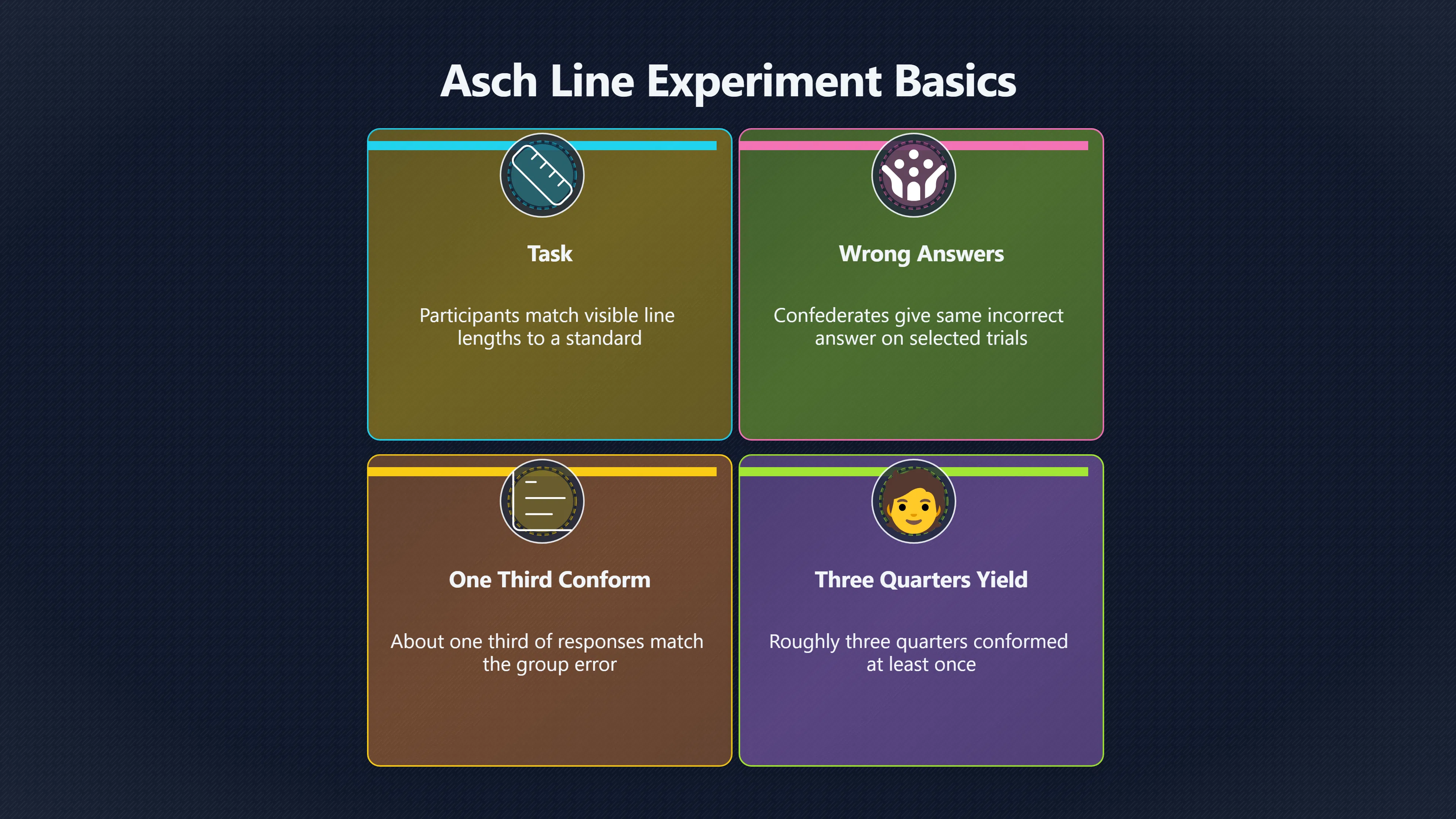
Asch designed a task that was intentionally simple. Participants looked at a standard line and then chose which of three comparison lines matched its length. Under normal conditions, mistakes were extremely rare because the correct answer was obvious. The crucial twist was that all but one member of the group were instructed participants who deliberately gave the same wrong answer on selected trials. The genuine participant typically answered after hearing the others.[Wikipedia]WikipediaAsch conformity experimentsAsch conformity experiments
The question was not whether people could perceive the correct line. The question was whether they would publicly contradict a unanimous majority.
The results were striking:[facebook.com]facebook.comSource details in endnotes.
- About one-third of responses on critical trials matched the group’s incorrect answer.
- Roughly three-quarters of participants conformed at least once.[lesswrong.com]lesswrong.comaschs conformity experimentAsch's Conformity ExperimentDec 25, 2007 — Three-quarters of the subjects in Asch's experiment gave a “conforming” answer at least once…
- A minority resisted throughout, demonstrating that conformity pressure was powerful but far from irresistible.[Simply Psychology]simplypsychology.orgSimply Psychology Asch Conformity Line ExperimentSimply PsychologyAsch Conformity Line ExperimentMay 15, 2025 — On average, about one third (32%) of the participants who were placed in t…[PMC]pmc.ncbi.nlm.nih.govPMCQuantifying compliance and acceptance through publicby S Sowden · 2018 · Cited by 71 — Most measures of social conformity conflate compliance and acceptance. Compliance occurs when indiv… The experiment is memorable because the task involved direct observation rather than complex reasoning. Participants were not evaluating political claims, scientific theories, or uncertain evidence. They were comparing visible line lengths. When conformity occurred, it happened despite strong perceptual evidence pointing in the opposite direction.[Wikipedia]WikipediaAsch conformity experimentsAsch conformity experiments
What Conformity Reveals About Popular Belief
For discussions of appeal to popularity, the key lesson is not that people blindly follow crowds. It is that agreement can be produced by forces other than truth.
Post-experiment interviews revealed several different reactions. Some participants knew the majority was wrong but went along to avoid standing out. Others began to doubt their own judgement when faced with unanimous opposition. A smaller group reported genuinely believing the majority’s answer after repeated exposure to group consensus.[Wikipedia]WikipediaAsch conformity experimentsAsch conformity experiments
These findings matter because appeal to popularity assumes that widespread belief is evidence of correctness. Asch’s research suggests an alternative explanation: a belief may become widespread because people influence one another. If social pressure helps create the appearance of consensus, then the mere existence of consensus cannot automatically be treated as proof.
The studies therefore expose a weakness in arguments such as:
Most people believe this, therefore it must be true.
Before drawing that conclusion, it is necessary to ask why the belief became widespread. Did people independently evaluate the evidence, or did social influence help generate the agreement? Asch’s experiments demonstrate that these possibilities cannot be assumed to be the same thing.[Wikipedia]WikipediaAsch conformity experimentsAsch conformity experiments
The Importance of Unanimity
One of Asch’s most influential findings emerged from later variations. When even a single person broke ranks with the majority, conformity dropped dramatically. Participants became far more willing to express their own judgement once they were no longer completely isolated.[Wikipedia]WikipediaAsch conformity experimentsAsch conformity experiments
This result highlights an important feature of majority pressure. The effect was not simply a matter of counting opinions. The social force came largely from unanimity. A lone dissenter signalled that disagreement was possible, reducing the psychological weight of the majority.[Wikipedia]WikipediaAsch conformity experimentsAsch conformity experiments
For evaluating popular beliefs, this finding suggests caution whenever apparent consensus suppresses visible disagreement. A unanimous public view may conceal private doubts if people believe they are alone in questioning the majority.
Why the Findings Matter for Logical Fallacies
Appeal to popularity is a logical error because truth is determined by evidence, not by the number of people who hold a belief. The Asch studies provide psychological evidence explaining why this distinction matters.
The experiments show that social agreement can be partially self-generating. Once a majority position becomes visible, some individuals may align with it because of social pressures rather than because the supporting evidence is persuasive. This creates a feedback loop in which popularity appears to confirm itself.[Wikipedia]WikipediaAsch conformity experimentsAsch conformity experiments
As a result, the existence of a majority tells us less than it might seem. It may indicate that many people independently reached the same conclusion. It may also indicate conformity, reputational concerns, uncertainty, or deference to others. The logical fallacy occurs when these possibilities are ignored and popularity itself is treated as proof.
Limits of Using Asch as a Fallacy Example
Although Asch’s work is highly relevant, it should not be overstated.
First, the experiments measured behaviour in a controlled laboratory setting using a simple perceptual task. Real-world beliefs often involve more information, longer time horizons, and opportunities for discussion. The line studies do not show that people routinely abandon evidence in every domain.[Wikipedia]WikipediaAsch conformity experimentsAsch conformity experiments
Second, many participants resisted the majority. Asch himself emphasised that independence remained common. In the original studies, most responses were still correct, and a substantial minority consistently refused to conform. Later commentators have argued that textbook summaries sometimes exaggerate the dominance of conformity while overlooking the persistence of independent judgement.[Wikipedia]WikipediaAsch conformity experimentsAsch conformity experiments
Third, popularity is not always irrelevant. In some situations, the fact that many people believe something can serve as a useful clue. Large groups may possess dispersed information that individuals lack. The lesson of Asch is therefore not that majorities are unreliable, but that majority agreement is not self-validating. Additional evidence is still required.[arXiv]arxiv.orgPopularity Bias Is Not Always Evil: Disentangling Benign and Harmful Bias for RecommendationSeptember 16, 2021…
Why Obvious Answers Can Bend Under Pressure
The enduring significance of the Asch conformity experiments lies in their simplicity. Participants faced a question with an answer visible before their eyes, yet many still moved toward the majority position. The studies reveal how social pressure can shape public agreement and why consensus should not automatically be treated as evidence of truth. Within discussions of appeal to popularity, Asch’s work provides a concrete reminder that widespread belief may reflect conformity as well as accuracy, making independent evidence essential whenever truth claims are at stake.[Simply Psychology]simplypsychology.orgSimply Psychology Asch Conformity Line ExperimentSimply PsychologyAsch Conformity Line ExperimentMay 15, 2025 — On average, about one third (32%) of the participants who were placed in t…[PMC]pmc.ncbi.nlm.nih.govPMCQuantifying compliance and acceptance through publicby S Sowden · 2018 · Cited by 71 — Most measures of social conformity conflate compliance and acceptance. Compliance occurs when indiv…
Amazon book picks
Further Reading
Books and field guides related to Why Obvious Answers Can Bend Under Pressure. Use these as the next step if you want deeper reading beyond the article.
Mistakes Were Made (but Not by Me)
Co-author Aronson is a leading social psychologist connected to conformity research.
Thinking, Fast and Slow
Provides wider context on errors in reasoning and decision-making.
The Righteous Mind
Examines group influence and why people align with collective beliefs.
eBay marketplace picks
Marketplace Samples
Example marketplace items related to this page. Use the search link to explore similar finds on eBay.






Endnotes
1.
Source: Wikipedia
Title: Asch conformity experiments
Link:https://en.wikipedia.org/wiki/Asch_conformity_experiments
2.
Source: pmc.ncbi.nlm.nih.gov
Link:https://pmc.ncbi.nlm.nih.gov/articles/PMC10686423/
Source snippet
power of social influence: A replication and extension of...by A Franzen · 2023 · Cited by 62 — We find an error rate of 33% for the sta...
3.
Source: pmc.ncbi.nlm.nih.gov
Title: PMCQuantifying compliance and acceptance through public
Link:https://pmc.ncbi.nlm.nih.gov/articles/PMC6204883/
Source snippet
by S Sowden · 2018 · Cited by 71 — Most measures of social conformity conflate compliance and acceptance. Compliance occurs when indiv...
4.
Source: psychology.town
Title: asch conformity line length experiments
Link:https://psychology.town/social/asch-conformity-line-length-experiments/
Source snippet
Inside Asch's Line and Length Experiments14 Nov 2025 — Explore Solomon Asch's conformity experiments: social influence, group pressure, a...
5.
Source: arxiv.org
Link:https://arxiv.org/abs/2109.07946
Source snippet
Popularity Bias Is Not Always Evil: Disentangling Benign and Harmful Bias for RecommendationSeptember 16, 2021...
Published: September 16, 2021
6.
Source: youtube.com
Title: Asch Conformity Experiment
Link:https://www.youtube.com/watch?v=FnT2FcuZaYI
Source snippet
Solomon Asch - Conformity Experiment...
7.
Source: youtube.com
Title: Solomon Asch
Link:https://www.youtube.com/watch?v=_IUlV5KI5B0
Source snippet
Asch's Conformity...
8.
Source: simplypsychology.org
Title: Simply Psychology Asch Conformity Line Experiment
Link:https://www.simplypsychology.org/asch-conformity.html
Source snippet
Simply PsychologyAsch Conformity Line ExperimentMay 15, 2025 — On average, about one third (32%) of the participants who were placed in t...
Published: May 15, 2025
9.
Source: ebsco.com
Link:https://www.ebsco.com/research-starters/history/asch-conformity-experiments
Source snippet
Asch conformity experiments | History | Research StartersRemarkably, about 36.8% of the actual participants conformed to the incorrect gr...
10.
Source: tutor2u.net
Link:https://www.tutor2u.net/psychology/reference/conformity-asch-1951?srsltid=AfmBOoqvGSIBDpMF7FGw6zyBmAlxP31Xqah-23fKRnA6Dred_4CWiGyU
Source snippet
Asch (1951) | Reference Library | Psychology3 Dec 2025 — Participants gave a wrong answer 37% of the time · On average, the real particip...
11.
Source: quizlet.com
Link:https://quizlet.com/gb/598898115/conformity-aschs-research-flash-cards/
Source snippet
Asch's research FlashcardsAsch had criticised Sherif's study for being ambiguous. Thus he designed an experiment to see whether people wo...
Additional References
12.
Source: psychstory.co.uk
Link:https://www.psychstory.co.uk/social-influence/asch-variables-affecting-conformity
Source snippet
ASCH: VARIABLES AFFECTING CONFORMITYInstead of the public-response method used by Asch, Crutchfield employed a more private, anonymous re...
13.
Source: facebook.com
Link:https://www.facebook.com/groups/489772786704436/posts/1175864018095306/
14.
Source: madeofmillions.com
Link:https://www.madeofmillions.com/articles/the-asch-conformity-study
Source snippet
The Asch Conformity StudyThe Asch Conformity Study Results. It was found that one-third of the true subjects matched incorrect lines. How...
15.
Source: studymind.co.uk
Link:https://studymind.co.uk/notes/aschs-research/
16.
Source: bps.org.uk
Title: aschs conformity study without confederates
Link:https://www.bps.org.uk/research-digest/aschs-conformity-study-without-confederates
Source snippet
Asch's "conformity study" without the confederates | BPS22 Oct 2010 — In the 1950s Solomon Asch found that when it came to making public...
17.
Source: verywellmind.com
Title: the asch conformity experiments 2794996
Link:https://www.verywellmind.com/the-asch-conformity-experiments-2794996
Source snippet
The Asch Conformity Experiments26 Oct 2025 — After combining the trials, the results indicated that participants conformed to the incorre...
18.
Source: scribd.com
Title: 02 Asch s Research Autosaved pptx
Link:https://www.scribd.com/presentation/643965156/02-Asch-s-Research-Autosaved-pptx
Source snippet
Asch's 1951 Conformity Experiment Insights | PDFAsch's classic conformity experiment from the 1950s found that about one-third of partici...
19.
Source: worldsupporter.org
Title: what aschs line experiment 100823
Link:https://www.worldsupporter.org/en/summary/what-aschs-line-experiment-100823
Source snippet
What is Asch's line experiment?Asch's line experiment, conducted by Solomon Asch in the 1950s, is a classic study in social psychology th...
20.
Source: lesswrong.com
Title: aschs conformity experiment
Link:https://www.lesswrong.com/lw/m9/aschs_conformity_experiment
Source snippet
Asch's Conformity ExperimentDec 25, 2007 — Three-quarters of the subjects in Asch's experiment gave a “conforming” answer at least once...
21.
Source: structural-learning.com
Title: solomon asch theory
Link:https://www.structural-learning.com/post/solomon-asch-theory
Source snippet
Asch Conformity Experiment: What Teachers Should Know30 Nov 2023 — Solomon Asch's conformity experiments demonstrated that individuals of...
Topic Tree