Within Equivocation
When Does Free Speech Become a Word Game?
Arguments about free speech often blur legal protection, moral entitlement, social permission and immunity from criticism.
On this page
- Legal rights versus social consequences
- How the word right changes the claim
- Questions that separate protection from permission
Page outline Jump by section
Introduction
Arguments about free speech often become examples of equivocation because the word right quietly changes meaning during the discussion. A person may begin by talking about a legal right against government censorship, then shift to a moral entitlement to be heard, then to a social expectation of acceptance, and finally to a claim of immunity from criticism. When these different meanings are treated as interchangeable, the argument can sound persuasive even though the conclusion no longer follows.
 This matters because public debates about controversial speech frequently depend on rights language. Free speech is a genuine legal and political principle, but disagreements often arise when participants use the same words to make different kinds of claims. Philosophers and legal scholars regularly distinguish the law of free speech from the morality of speech and from broader social questions about how people should respond to expression.[Stanford Encyclopedia of Philosophy]plato.stanford.eduStanford Encyclopedia of PhilosophyFreedom of Speech - Stanford Encyclopedia of Philosophyby JW Howard · 2024 · Cited by 37 — First, we c…
When Does Free Speech Become a Word Game?
The core equivocation occurs when an argument starts with one meaning of “free speech” and ends with another.
Consider this pattern:
- People have a right to free speech.
- I exercised free speech.
- Therefore, nobody should criticise me.
The first statement usually refers to a legal protection. The conclusion, however, concerns social reactions. The argument only works if “right” means the same thing throughout. In practice, it often does not.
Legal systems that protect freedom of speech generally focus on restrictions imposed by government authorities. In the United States, for example, First Amendment protections are principally limits on government action rather than guarantees against disagreement, criticism, boycotts, or social disapproval from other private individuals.[Constitution Center]constitutioncenter.orgConstitution CenterInterpretation: Freedom of Speech and the PressGenerally speaking, it means that the government may not jail, fine, or…[American Library Association]ala.orgThe First Amendment only prevents government restrictions on speech. It does not…Read more…
The persuasive force of the argument comes from borrowing the moral prestige of a constitutional liberty and then spending it on a different claim about how other people must behave.
Legal Rights Versus Social Consequences
A useful way to expose the equivocation is to separate legal protection from social consequences.
A legal free-speech right typically answers a question such as:
May the government punish or suppress this expression?
A social-consequences question asks something different:
How should other people respond to this expression?
These are not identical issues.
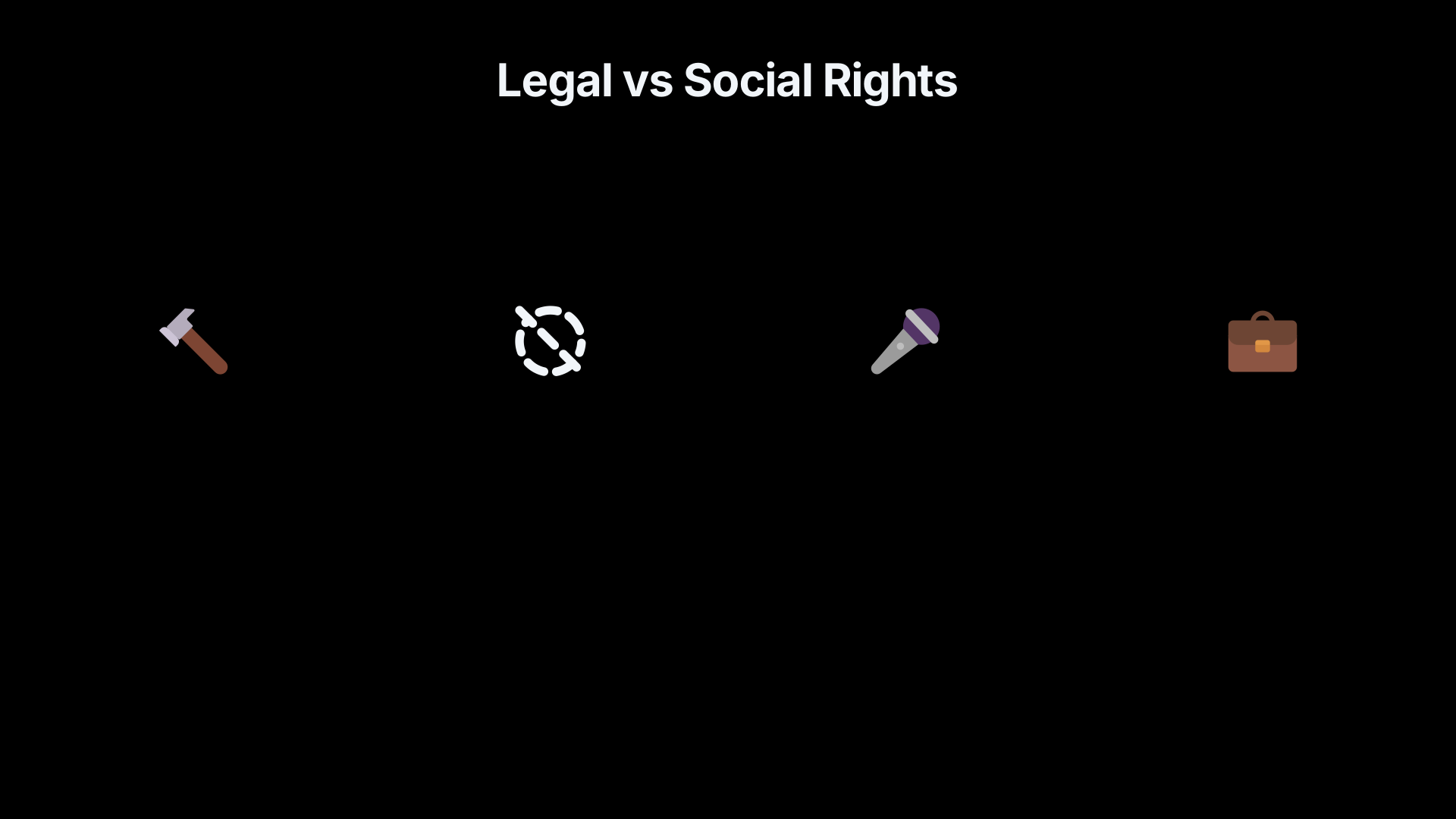
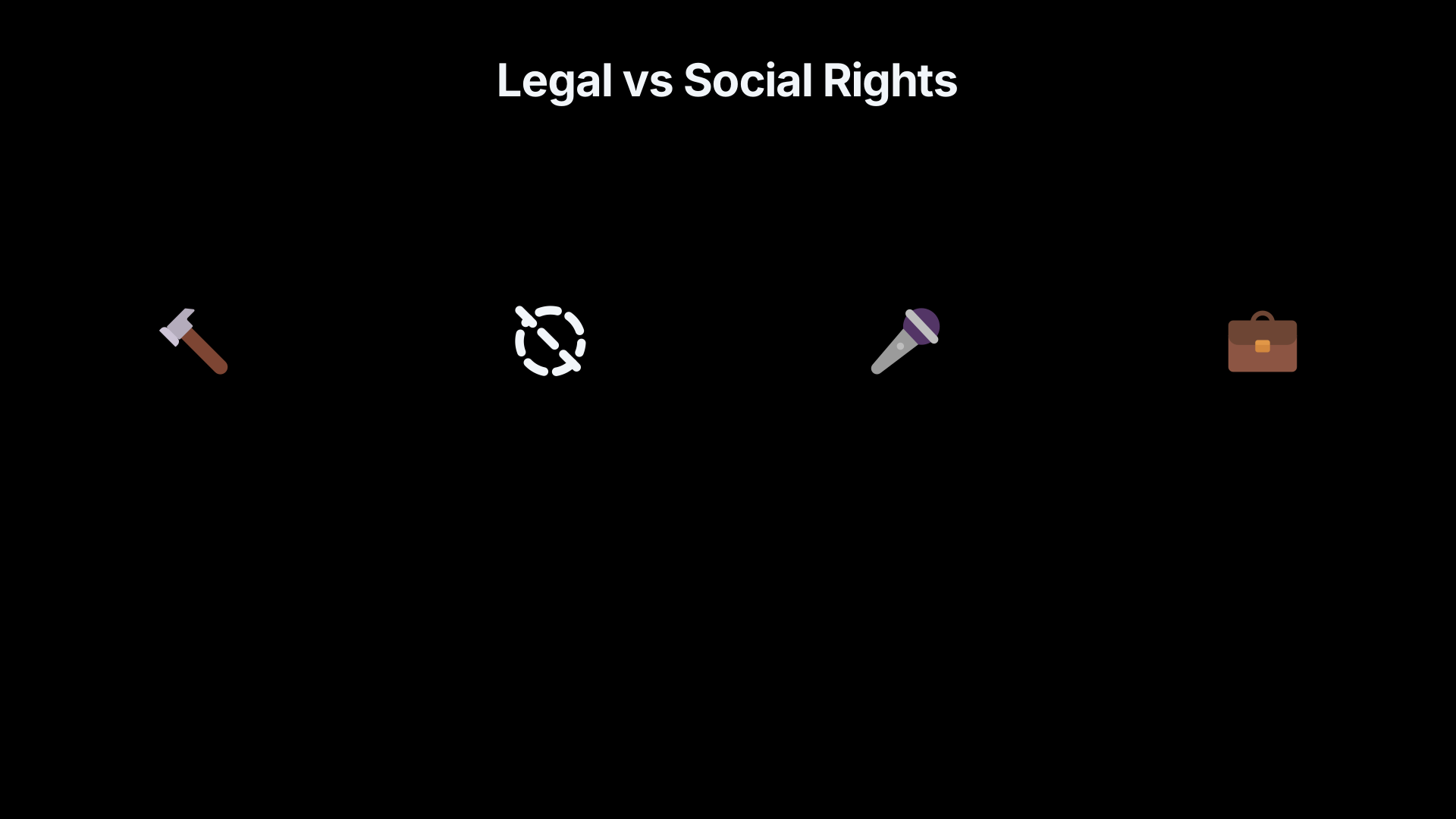
A newspaper columnist may have a legal right to publish an opinion while still facing criticism from readers. A comedian may have a legal right to tell a joke while audiences remain free to condemn it. An activist may have a legal right to protest while employers, customers, friends, or voters make their own judgments about the protest. None of these reactions automatically cancels the underlying legal protection.[Constitution Center]constitutioncenter.orgConstitution CenterInterpretation: Freedom of Speech and the PressGenerally speaking, it means that the government may not jail, fine, or…[American Library Association]ala.orgThe First Amendment only prevents government restrictions on speech. It does not…Read more…
The fallacy appears when criticism is automatically reclassified as censorship. Genuine censorship usually involves the suppression of speech through coercive power. Mere disagreement, ridicule, rebuttal, or refusal to endorse a message is something different. The distinction is widely recognised in legal discussions of free expression.[American Library Association]ala.orgThe First Amendment only prevents government restrictions on speech. It does not…Read more…
Why the Confusion Persists
The confusion persists because the same language of rights can describe several legitimate concerns at once:
- Legal protection: freedom from certain government restrictions.
- Moral liberty: the idea that people should generally be able to express opinions.
- Social tolerance: a cultural willingness to hear unpopular views.
- Personal approval: a desire for agreement, respect, or positive reception.
All four may be important, but they are not the same claim. An argument becomes fallacious when it moves between them without notice.
How the Word “Right” Changes the Claim
The term right is especially vulnerable to equivocation because it operates in multiple domains.
A speaker might say:
“I have a right to express this opinion.”
That statement could mean:
- The law protects the expression.
- The expression is morally justified.
- Others ought to listen respectfully.
- Others ought not criticise it.
- Institutions ought to provide a platform for it.
Each interpretation adds something different.
For example, human-rights organisations often describe freedom of expression as a fundamental right because people should be able to share opinions and information without unlawful interference. That moral and political claim does not automatically settle questions about platform moderation, professional standards, or social criticism.[Amnesty International]amnesty.orgAmnesty InternationalFreedom of ExpressionYou have the right to say what you think, share information and demand a better world. You also…
Likewise, legal scholars frequently distinguish the morality of free speech from the law of free speech. Someone can support strong legal protections while still believing that certain speech is irresponsible, offensive, or harmful. The legal right and the moral evaluation remain separate questions.[Stanford Encyclopedia of Philosophy]plato.stanford.eduStanford Encyclopedia of PhilosophyFreedom of Speech - Stanford Encyclopedia of Philosophyby JW Howard · 2024 · Cited by 37 — First, we c…
The equivocation occurs when a speaker treats success in one category as automatic success in all the others.
Public Debates Where the Shift Often Appears
Controversies about universities, social media, protests, and so-called cancel culture often reveal this pattern.
One participant may argue:
“My speech is protected, therefore attempts to challenge it violate free speech.”
Another participant may respond:
“No, criticism is also speech.”
The dispute sometimes looks factual when it is actually semantic. The participants are using different meanings of free speech.
Modern debates about social-media moderation illustrate the problem. Questions about whether governments may pressure platforms, whether platforms possess editorial discretion, and whether users deserve access to particular audiences involve different rights claims that are often bundled together. Courts, commentators, and policy analysts frequently distinguish government censorship from private moderation, even when both become politically controversial.[Reuters]reuters.comSupreme Court has set a new standard for determining if public officials acted in a governmental capacity when blocking critics on social…[Business Insider]businessinsider.comThese cases—NetChoice v. Paxton in Texas and Moody v. NetChoice in Florida—involved laws limiting social-media companies from censoring c…
Similarly, discussions of cancel culture often blend legal rights with social sanctions. A person may lose reputation, invitations, customers, or professional opportunities because of speech without experiencing government censorship. Whether those consequences are fair is a separate debate from whether free-speech rights have been legally violated.[athena.unibo.it]athena.unibo.itIs the Public Moral Instigation Against Inappropriate Free…July 5, 2023 — My aim in this article is to show that cancel culture is sel…
Questions That Separate Protection From Permission
A practical way to identify the equivocation is to ask a series of clarifying questions.
Who is restricting the speech?
If the actor is the state, the issue may concern constitutional or human-rights protections. If the actor is a private individual expressing disagreement, the issue may concern social response rather than censorship.[Constitution Center]constitutioncenter.orgConstitution CenterInterpretation: Freedom of Speech and the PressGenerally speaking, it means that the government may not jail, fine, or…
What kind of right is being claimed?
Is the claim legal, moral, political, cultural, or institutional? Different answers lead to different standards of evaluation.[Stanford Encyclopedia of Philosophy]plato.stanford.eduStanford Encyclopedia of PhilosophyFreedom of Speech - Stanford Encyclopedia of Philosophyby JW Howard · 2024 · Cited by 37 — First, we c…
What conclusion is being drawn?
Does the conclusion concern freedom from punishment, freedom from criticism, access to a platform, or entitlement to an audience? These are distinct claims and should be assessed separately.
Would the argument still work if the meanings were made explicit?
Replacing the word right with its intended meaning often reveals the shift. An argument may sound powerful when it repeatedly invokes “free speech” but weaken considerably when rewritten as:
“The government may not punish me; therefore private citizens must approve of what I said.”
Once stated explicitly, the gap becomes easier to see.
Why This Matters for Evaluating Arguments
Free speech is an important political and legal principle, which is precisely why equivocation around it can be so persuasive. The prestige attached to constitutional liberties, human rights, and democratic values creates an opportunity for arguments to slide between different meanings without attracting attention.
Recognising the shift does not settle disputes about offensive speech, platform moderation, public protest, or social sanctions. Instead, it helps ensure that the debate concerns the real disagreement. The key question is not whether free speech matters. The key question is which kind of free-speech claim is actually being made.
When legal protection, moral entitlement, social permission, and immunity from criticism are kept distinct, many apparently intractable disputes become clearer. The word right stops doing hidden argumentative work, and the discussion can focus on the specific principle that is genuinely at stake.
eBay marketplace picks
Marketplace Samples
Example marketplace items related to this page. Use the search link to explore similar finds on eBay.


Endnotes
1.
Source: plato.stanford.edu
Link:https://plato.stanford.edu/entries/freedom-speech/
Source snippet
Stanford Encyclopedia of PhilosophyFreedom of Speech - Stanford Encyclopedia of Philosophyby JW Howard · 2024 · Cited by 37 — First, we c...
2.
Source: reuters.com
Link:https://www.reuters.com/legal/us-supreme-court-throws-out-rulings-public-officials-blocking-social-media-2024-03-15/
Source snippet
Supreme Court has set a new standard for determining if public officials acted in a governmental capacity when blocking critics on social...
3.
Source: amnesty.org
Link:https://www.amnesty.org/en/what-we-do/freedom-of-expression/
Source snippet
Amnesty InternationalFreedom of ExpressionYou have the right to say what you think, share information and demand a better world. You also...
4.
Source: athena.unibo.it
Link:https://athena.unibo.it/article/download/15655/16492/68792
Source snippet
Is the Public Moral Instigation Against Inappropriate Free...July 5, 2023 — My aim in this article is to show that cancel culture is sel...
Published: July 5, 2023
5.
Source: constitutioncenter.org
Link:https://constitutioncenter.org/the-constitution/amendments/amendment-i/interpretations/266
Source snippet
Constitution CenterInterpretation: Freedom of Speech and the PressGenerally speaking, it means that the government may not jail, fine, or...
6.
Source: ala.org
Link:https://www.ala.org/advocacy/intfreedom/censorship
Source snippet
The First Amendment only prevents government restrictions on speech. It does not...Read more...
7.
Source: businessinsider.com
Link:https://www.businessinsider.com/supreme-court-ruling-netchoice-big-tech-analysis
Source snippet
These cases—NetChoice v. Paxton in Texas and Moody v. NetChoice in Florida—involved laws limiting social-media companies from censoring c...
8.
Source: Wikipedia
Title: Freedom of speech
Link:https://en.wikipedia.org/wiki/Freedom_of_speech
Source snippet
Freedom of speechFreedom of speech is a principle that supports the freedom of an individual or a community to articulate their opinio...
Additional References
9.
Source: uscourts.gov
Link:https://www.uscourts.gov/about-federal-courts/educational-resources/about-educational-outreach/activity-resources/what-does-free-speech-mean
Source snippet
United States CourtsWhat Does Free Speech Mean?“Congress shall make no law...abridging freedom of speech.” Freedom of speech includes the...
10.
Source: pmc.ncbi.nlm.nih.gov
Title: Pub Med Central The Decline of Freedom of Expression and Social
Link:https://pmc.ncbi.nlm.nih.gov/articles/PMC10008147/
Source snippet
by A Masferrer · 2023 · Cited by 56 — Freedom of expression is a fundamental part of living in a free and open society and, above all...
11.
Source: acludc.org
Title: five ways first amendment protects your speech and three ways it does not
Link:https://www.acludc.org/news/five-ways-first-amendment-protects-your-speech-and-three-ways-it-does-not/
Source snippet
Five ways the First Amendment protects your speech15 Aug 2024 — The First Amendment of the US Constitution protects our fundamental right...
12.
Source: carnegieendowment.org
Link:https://carnegieendowment.org/europe/strategic-europe/2026/06/taking-the-pulse-are-western-democracies-failing-free-speech
Source snippet
s, truth-seeking, pluralism, countering hate, and preventing violence.Read more...
13.
Source: aclu.org
Link:https://www.aclu.org/news/free-speech/protecting-free-speech-in-the-face-of-government-retaliation
Source snippet
American Civil Liberties UnionProtecting Free Speech in the Face of Government...18 Sept 2025 — The First Amendment protects the rights...
14.
Source: facebook.com
Link:https://www.facebook.com/TED/posts/your-right-to-free-speech-is-a-human-right-says-greg-lukianoff-heres-why-it-shou/1484717056561101/
Source snippet
Your right to free speech is a human right, says Greg...In the eyes of the law, freedom of speech is a legal protection, not a civil one...
15.
Source: Wikipedia
Title: United States free speech [exceptions]({{ ‘exceptions/’ | relative_url }})
Link:https://en.wikipedia.org/wiki/United_States_free_speech_exceptions
Source snippet
United States free speech exceptionsAs a general rule, lies are protected, with limited exceptions such as defamation, fraud, false ad...
16.
Source: verfassungsblog.de
Title: turn against free speech america
Link:https://verfassungsblog.de/turn-against-free-speech-america/
Source snippet
Falling Far and Fast21 Sept 2025 — Since the 1930s, when the Supreme Court first began to protect First Amendment rights, it has safeguar...
17.
Source: scholar.law.colorado.edu
Title: Most of Free Speech law rests
Link:https://scholar.law.colorado.edu/cgi/viewcontent.cgi?article=1417&[context
Source snippet
colorado.eduCensorship, Copyright, and Free Speech: Some Tentative...by CL Eisgruber · 2003 · Cited by 24 — In my view, there is a good...
18.
Source: tandfonline.com
Link:https://www.tandfonline.com/doi/full/10.1080/03906701.2022.2133406
Source snippet
Taylor & Francis OnlineFull article: Hate speech or free speech: an ethical dilemma?by N Gorenc · 2022 · Cited by 48 — Freedom of opinion...
Topic Tree