Within False Cause
Why Lucky Shirts Feel Like Evidence
Superstitions often grow from memorable sequences where a personal ritual is mistaken for influence over chance outcomes.
On this page
- How a vivid win turns into a personal rule
- Illusory control and chance based outcomes
- How to test a lucky pattern without fooling yourself
Page outline Jump by section
Introduction
A lucky shirt seems like harmless fun, but it provides one of the clearest everyday examples of post hoc reasoning. The pattern is familiar: someone wears a particular shirt, their team wins, they wear it again, and another good result follows. Before long, the shirt is treated as a cause rather than a coincidence. The logic is simple but flawed: the win happened after the shirt was worn, therefore the shirt must have helped create the win. That is the essence of the post hoc fallacy—assuming that because one event came before another, it caused it.[Wikipedia]WikipediaPost hoc ergo propter hocJanuary 26, 2003 — Post hoc ergo propter hoc is an informal fallacy that states "Because event Y followed event X, event Y must have been…
 What makes lucky-shirt thinking interesting is that it does not usually arise from ignorance. It grows from normal psychological processes: memorable successes, selective memory, emotional investment, and a powerful desire to feel some control over uncertain outcomes. Understanding those mechanisms helps explain why superstitions can feel like evidence even when they are not.
How a Vivid Win Turns Into a Personal Rule
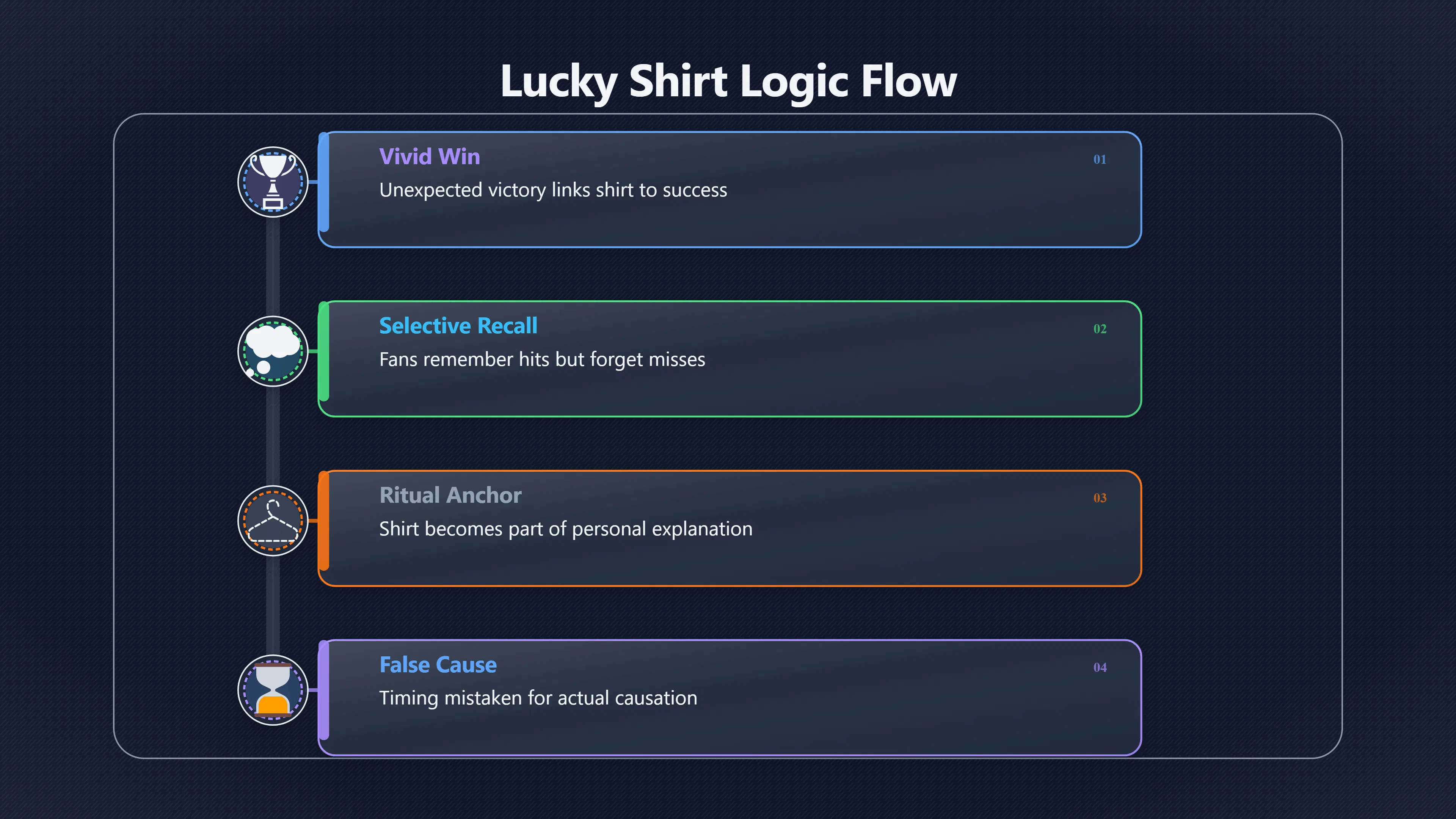
The birth of a lucky shirt often starts with a highly emotional event. A supporter wears a particular shirt during an unexpected victory. Because the outcome matters, the memory becomes unusually vivid. The shirt and the win become linked in the person’s mind.
The next time the shirt is worn, any positive outcome receives extra attention. Negative outcomes tend to be discounted or forgotten. Over time, the person remembers the hits more clearly than the misses, creating the impression that the shirt has an impressive record even when no real pattern exists.
Sports psychologists note that fans and athletes frequently develop these rituals because uncertainty creates a strong urge to find stable patterns. If a specific shirt happened to be present during an important success, it can become psychologically anchored to that success.[Sidelines]sidelinesmag.co.ukjinx or genius inside the minds of superstitious sports fans communitySidelinesJinx or genius? Inside the minds of superstitious sports fans16 Apr 2025 — Expert Dr Josephine Perry explains the psychology of…
The reasoning typically follows this sequence:
- I wore the shirt.
- My team won.
- I wore it again and they won again.
- Therefore, the shirt helps cause victories.
The problem is that the victories may have occurred regardless of what was worn. The shirt was present before the outcome, but presence alone does not establish causation. That leap from sequence to cause is exactly what the post hoc fallacy describes.[Wikipedia]WikipediaIllusion of controlEllen Langer, who first demonstrated the illusion of control, explained her findings in terms of a confusion betwee…
Why Chance Feels Like Control
The Illusion of Influence
Research on the illusion of control helps explain why lucky rituals are so persuasive. Psychologist Ellen Langer’s classic work showed that people often act as though they can influence outcomes that are actually determined by chance. Situations containing familiar actions, personal choices, or repeated routines can create a feeling of control even when objective control is absent.[Nuovo e Utile]nuovoeutile.itLanger1975 IllusionofControlSuccess in luck or chance activities is apparently uncontrollable. The issue of present concern is…Read more… Wikipedia A lucky shirt fits this pattern perfectly. Wearing it is a deliberate action. The action occurs immediately before the uncertain event. Becau[Wikipedia]WikipediaPost hoc ergo propter hocJanuary 26, 2003 — Post hoc ergo propter hoc is an informal fallacy that states "Because event Y followed event X, event Y must have been… se the ritual is under personal control, it feels connected to the outcome.
This feeling can be powerful enough that people become uncomfortable abandoning the ritual. The shirt is no longer just clothing; it becomes part of a personal explanation for success.
Why Superstitions Flourish in Uncertain Situations
Superstitions are especially common where outcomes are difficult to predict. Sport, gambling, examinations, auditions, and job interviews all involve uncertainty and limited personal control. Research consistently finds that superstitious behaviour often serves as a way to manage anxiety and create psychological comfort in these situations. PMC[Wiley Online Library]onlinelibrary.wiley.comWiley Online LibrarySuperstitious Behaviors in Sports and Exercise23 Dec 2025 — Superstitious behavior is highly prevalent in sports, pro…
From a psychological perspective, the lucky shirt may provide something real: reassurance. What it does not provide is evidence that it changes the probability of a team’s victory or a roulette wheel’s result.
That distinction matters. The ritual may influence how a person feels, but that does not mean it influences the external event they care about.

When Lucky Objects Seem to Work
An important complication is that some studies have found that lucky charms can improve performance on certain tasks. Researchers have reported that activating a superstition can increase confidence, persistence, and self-efficacy—the belief that one can succeed—which may lead to better performance in activities that depend partly on personal effort.[PubMed]pubmed.ncbi.nlm.nih.govKeep your fingers crossed!: how superstition improves…by L Damisch · 2010 · Cited by 515 — Activating a superstition boosts part…[2EurekAlert!]eurekalert.orgnews releasesKeep your fingers crossed: How superstition improves…Jul 13, 2010 — New research shows that having some kind of lucky token can actual…
This does not rescue lucky-shirt reasoning from the post hoc fallacy.[study.com]study.comPost Hoc Fallacy | Definition & Examples - LessonPut in simple terms a post hoc fallacy is an assumption that since event A happened befo…
The key question is what is being caused. If carrying a lucky charm makes someone calmer during a golf putt or more persistent during a puzzle, confidence may influence performance. The causal chain would run through the person’s behaviour and psychology.[PubMed]pubmed.ncbi.nlm.nih.govKeep your fingers crossed!: how superstition improves…by L Damisch · 2010 · Cited by 515 — Activating a superstition boosts part…
A fan’s lucky shirt, however, cannot plausibly affect the actions of players on a pitch hundreds of miles away. The shirt may alter the fan’s confidence, mood, or experience of the match, but those effects are different from causing the team’s victory.
This distinction helps separate genuine causal pathways from imagined ones. A ritual can influence the person performing it while still having no influence on the chance outcome that the person attributes to it.
How to Test a Lucky Pattern Without Fooling Yourself
The simplest way to challenge lucky-shirt thinking is to keep track of all outcomes, not just memorable successes.
Suppose someone believes a shirt is lucky because their team often wins when they wear it. A better test would be to record:
- Every game when the shirt is worn.
- Every game when it is not worn.
- Wins, losses, and draws in both groups.
- A large enough number of events to reduce the impact of coincidence.
Most supposed lucky patterns weaken once complete records replace selective memory.
Another useful question is the counterfactual test: what would probably have happened if the shirt had not been worn? If the team was heavily favoured to win anyway, the victory provides little evidence for the shirt’s influence. If losses occur frequently despite wearing the shirt, those cases must count just as much as the wins.
The goal is not to eliminate harmless rituals. It is to avoid mistaking coincidence for causation.
What Lucky Shirts Reveal About Post Hoc Reasoning
Lucky shirts are compelling because they combine emotion, memory, and uncertainty. A memorable success creates a vivid association. Repeated attention strengthens the association. The feeling of control makes the association seem meaningful. Eventually a coincidence is promoted into a personal rule.
The underlying logical error remains simple: an outcome follows a ritual, so the ritual is assumed to have caused the outcome. Yet timing alone cannot establish causation. The lucky shirt example shows how easily the human mind can transform a sequence of events into a story of influence, even when chance provides a more convincing explanation.[Wikipedia]WikipediaPost hoc ergo propter hocJanuary 26, 2003 — Post hoc ergo propter hoc is an informal fallacy that states "Because event Y followed event X, event Y must have been…[PMC]pmc.ncbi.nlm.nih.govPMCPost hoc ergo propter hochoc ergo propter hoc - PMC - NIHby L Grouse · 2016 · Cited by 10 — This faulty reasoning is the most common cause of false and misleading…
Amazon book picks
Further Reading
Books and field guides related to Why Lucky Shirts Feel Like Evidence. Use these as the next step if you want deeper reading beyond the article.
Fooled by Randomness
Rating: 4.0/5 from 15 Google Books ratings
Shows how luck is mistaken for causation and skill.
Thinking, Fast and Slow
Covers pattern-seeking and cognitive biases behind superstition.
eBay marketplace picks
Marketplace Samples
Example marketplace items related to this page. Use the search link to explore similar finds on eBay.



Endnotes
1.
Source: Wikipedia
Title: Post hoc ergo propter hoc
Link:https://en.wikipedia.org/wiki/Post_hoc_ergo_propter_hoc
Source snippet
January 26, 2003 — Post hoc ergo propter hoc is an informal fallacy that states "Because event Y followed event X, event Y must have been...
Published: January 26, 2003
2.
Source: pmc.ncbi.nlm.nih.gov
Title: PMCPost hoc ergo propter hoc
Link:https://pmc.ncbi.nlm.nih.gov/articles/PMC4958779/
Source snippet
hoc ergo propter hoc - PMC - NIHby L Grouse · 2016 · Cited by 10 — This faulty reasoning is the most common cause of false and misleading...
3.
Source: Wikipedia
Link:https://en.wikipedia.org/wiki/Illusion_of_control
Source snippet
Illusion of controlEllen Langer, who first demonstrated the illusion of control, explained her findings in terms of a confusion betwee...
4.
Source: pmc.ncbi.nlm.nih.gov
Link:https://pmc.ncbi.nlm.nih.gov/articles/PMC9292938/
Source snippet
by L Clark · 2021 · Cited by 41 — Langer [2] argued that people experience an illusion of control in situations where their behaviour...
5.
Source: pmc.ncbi.nlm.nih.gov
Title: Thus, sport and its inherent
Link:https://pmc.ncbi.nlm.nih.gov/articles/PMC8526551/
Source snippet
Jinx, Control, and the Necessity of Adjustment - PMC - NIHby O Levental · 2021 · Cited by 24 — Superstitions are behaviors human being...
6.
Source: onlinelibrary.wiley.com
Link:https://onlinelibrary.wiley.com/doi/10.1111/sjop.70059
Source snippet
Wiley Online LibrarySuperstitious Behaviors in Sports and Exercise23 Dec 2025 — Superstitious behavior is highly prevalent in sports, pro...
7.
Source: eurekalert.org
Title: news releases
Link:https://www.eurekalert.org/news-releases/920979
Source snippet
Keep your fingers crossed: How superstition improves...Jul 13, 2010 — New research shows that having some kind of lucky token can actual...
8.
Source: sidelinesmag.co.uk
Title: jinx or genius inside the minds of superstitious sports fans community
Link:https://sidelinesmag.co.uk/2025/04/16/jinx-or-genius-inside-the-minds-of-superstitious-sports-fans-community/
Source snippet
SidelinesJinx or genius? Inside the minds of superstitious sports fans16 Apr 2025 — Expert Dr Josephine Perry explains the psychology of...
9.
Source: nuovoeutile.it
Title: Langer1975 IllusionofControl
Link:https://nuovoeutile.it/wp-content/uploads/2014/10/Langer1975_IllusionofControl.pdf
Source snippet
Success in luck or chance activities is apparently uncontrollable. The issue of present concern is...Read more...
10.
Source: pubmed.ncbi.nlm.nih.gov
Link:https://pubmed.ncbi.nlm.nih.gov/20511389/
Source snippet
Keep your fingers crossed!: how superstition improves...by L Damisch · 2010 · Cited by 515 — Activating a superstition boosts part...
11.
Source: wordreference.com
Link:https://www.wordreference.com/engr/superstitious
Source snippet
Αγγλικά, Ελληνικά. superstitious adj, (person: having irrational beliefs), προληπτικός επίθ. (επίσημο), δεισιδαίμων επίθ.Read more...
12.
Source: philosophy.lander.edu
Link:https://philosophy.lander.edu/logic/cause.html
Source snippet
(Non Causa Pro Causa) with Many ExamplesCum hoc ergo propter hoc is an erroneous argument concluding one state of affairs causes another...
13.
Source: coursesidekick.com
Link:https://www.coursesidekick.com/psychology/2736685
Source snippet
The Illusion of Control: How Perception Influences...The illusion of control, coined by Ellen Langer (1975), is a subjective experience...
14.
Source: study.com
Link:https://study.com/learn/lesson/post-hoc-fallacy-overview-examples.html
Source snippet
Post Hoc Fallacy | Definition & Examples - LessonPut in simple terms a post hoc fallacy is an assumption that since event A happened befo...
15.
Source: followmentalgarden.substack.com
Title: the illusion of control
Link:https://followmentalgarden.substack.com/i/165734136/the-illusion-of-control
Source snippet
of control: Our mind needs security (even if it is a lie)11 Jun 2025 — Discover how the illusion of control affects your decisions and ho...
Additional References
16.
Source: newristics.com
Link:https://newristics.com/heuristics-biases/illusion-of-control
Source snippet
Definition, Example & How Illusion Of Control WorksIllusion of Control is the human tendency to believe that we have more control over ce...
17.
Source: thedecisionlab.com
Link:https://thedecisionlab.com/biases/illusion-of-control
Source snippet
Illusion of ControlClassic research by Langer and Roth showed that even a short streak of early wins—often called “beginner's luck”—can d...
18.
Source: psychologytoday.com
Link:https://www.psychologytoday.com/us/basics/illusion-of-control
Source snippet
Illusion of ControlThe illusion of control is a mental bias leading people to overestimate the control they have over the outcome of even...
19.
Source: huxley.media
Link:https://huxley.media/en/the-illusion-of-control-how-to-find-your-lucky-ticket/
Source snippet
THE ILLUSION OF CONTROL: How to Find Your Lucky Ticket?The illusion of control is yet another cognitive bias. It occurs when we believe w...
20.
Source: members.believeperform.com
Link:https://members.believeperform.com/the-power-of-superstitions-and-rituals-in-sport/
Source snippet
The power of superstitions and rituals in sportMany sports performers believe that performing a specific ritual before a competition impr...
21.
Source: web.colby.edu
Link:https://web.colby.edu/cogblog/2022/05/04/are-you-really-going-to-do-better-on-a-test-because-youre-wearing-your-lucky-socks-probably-but-not-for-the-reason-you-think/
Source snippet
you really going to do better on a test because you're...May 4, 2022 — Researchers found that those who kept their lucky charm for the d...
Published: May 4, 2022
22.
Source: peterhbrownpsych.com
Link:https://peterhbrownpsych.com/2010/05/11/lucky-charms-sometimes-work-the-powerful-positive-performance-psychology-of-superstition/
Source snippet
Why Lucky Charms Sometimes Work: The Powerful Positive...11 May 2010 — “Our results suggest that the activation of a superstition can in...
Published: May 2010
23.
Source: youtube.com
Link:https://www.youtube.com/watch?v=UNuWpJODsYg
24.
Source: researchprofiles.herts.ac.uk
Title: However, this scale refers solely to negative superstitions (e.g.,
Link:https://researchprofiles.herts.ac.uk/en/publications/measuring-superstitious-belief-why-lucky-charms-matter/
Source snippet
superstitious belief: why lucky charms matterby R Wiseman · 2004 · Cited by 378 — Most of this work has measured superstitious belief usi...
25.
Source: innerdrive.co.uk
Link:https://www.innerdrive.co.uk/blog/superstition-athletes/
Source snippet
Activating a superstition boosts self-efficacy – meaning, it makes you feel confident...Read more...
Topic Tree