Within Fallacy Lab
Can You Map the Reasoning?
Argument mapping helps separate claims, reasons and assumptions so weak links become easier to see.
On this page
- Claims and premises
- Hidden assumptions
- Weak link checks
Page outline Jump by section
Introduction
Argument mapping is a practical way to find fallacies by turning a piece of reasoning into a visible structure: a main claim, the reasons offered for it, any objections, and the assumptions that make the reasons relevant. Instead of asking, “Which fallacy label can I attach to this?”, the map asks, “Where exactly does the support fail?” That shift matters because many weak arguments do not announce their flaw in a neat textbook form. The problem may be a hidden assumption, a missing bridge between evidence and conclusion, a premise that depends on another premise, or an objection that has been ignored.
Within the wider subject of logical fallacies, argument mapping is best treated as an implementation tool. It does not replace judgement, evidence-checking or knowledge of fallacy types. Its value is that it slows the reader down, separates the moving parts, and makes weak links easier to test. Research and teaching guides describe argument maps as visual representations of conclusions, premises, co-premises, objections, counterarguments and inference links, commonly used to support critical thinking and debate analysis.[Wikipedia]WikipediaArgument mapArgument map
Why mapping catches what fallacy lists miss
A fallacy list can be useful, but it encourages a risky shortcut: hearing a familiar pattern and naming it too quickly. Argument mapping starts earlier. It reconstructs the reasoning before judging it. A reader identifies the conclusion, rewrites supporting claims as clear statements, shows which claims work together, and marks objections or missing assumptions. This makes the diagnosis more precise: the weakness may sit in the evidence, the inference, the wording, or the background assumption.
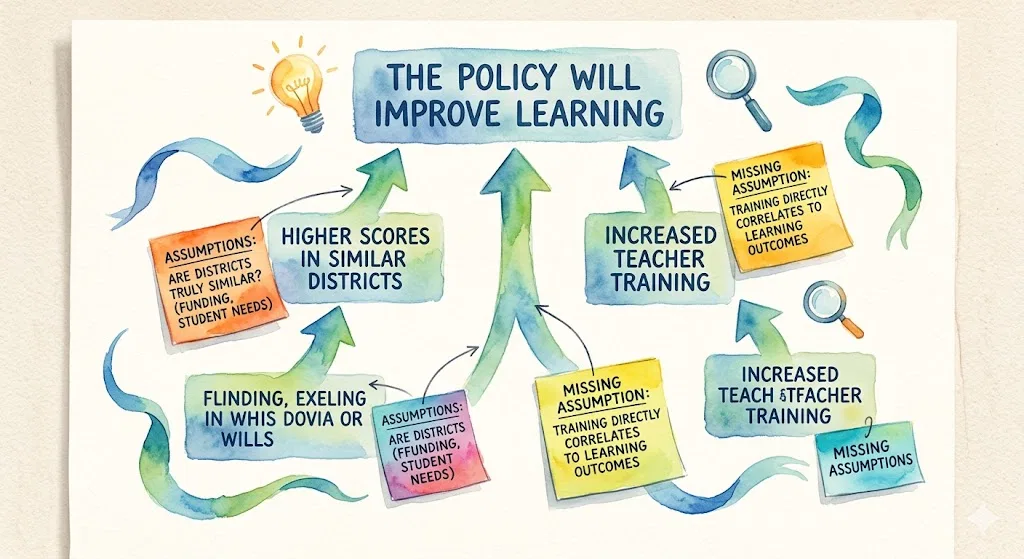
For example, consider the claim: “This new school policy will improve learning because a high-performing school introduced the same policy last year.” A fallacy-hunter might immediately suspect a weak analogy or hasty generalisation. A map asks for. The conclusion is the policy prediction. The visible reason is that another school used the policy and performed well. The hidden assumption is that the two schools are similar in the ways that matter: staffing, funding, student needs, implementation quality and measurement of “learning”. Once those parts are separated, the weak link is not merely “analogy” in the abstract. It is the unsupported assumption that success in one setting transfers to another.
This approach fits the way informal fallacies usually work. In real speech and writing, the issue is often not an invalid formal pattern but a gap between what the premises establish and what the conclusion claims. Work on argument reasoning similarly stresses that natural-language arguments often rely on implicit warrants: unstated bridges explaining why a premise supports a claim. Reconstructing those warrants is difficult because they depend on context and common sense, not just surface wording.[arXiv]arxiv.orgThe Argument Reasoning Comprehension Task: Identification and Reconstruction of Implicit WarrantsAugust 4, 2017…
Claims and premises
The first task in an argument map is to separate what is being claimed from what is being offered as support. This sounds simple, but it prevents many false diagnoses. A passage may contain background information, rhetorical emphasis, examples, concessions and side comments. Not all of them are premises. Mapping forces the reader to ask which statements actually carry argumentative weight.
A useful basic routine is:
- State the main conclusion in one complete sentence.
- List each reason as a separate claim.
- Decide whether each reason supports the conclusion independently or only works together with another reason.
- Mark objections separately from supporting reasons.
- Add any missing premise needed to make the inference work.
The distinction between independent and linked premises is especially important. Some reasons support a claim on their own; others only work as a set. In the classic “Socrates is mortal” example, “All humans are mortal” and “Socrates is human” form one linked reason. Treating them as two independent reasons would distort the argument, because neither premise alone establishes the conclusion. Argument-mapping literature highlights this as a common student error and a reason why maps can be clearer than ordinary prose outlines.[Reasoninglab]reasoninglab.comArgument Maps Improve Critical Thinkingby CR Twardy · Cited by 357 — A reason is a collection of claims which help each other…
The same point applies to fallacies. A conclusion may look unsupported because one premise seems weak in isolation, when the author intended it to function with a co-premise. Conversely, an argument may look stronger than it is because several claims are visually or rhetorically piled up, even though they all depend on the same fragile assumption. Mapping exposes whether the support is genuinely cumulative or merely repetitive.
Hidden assumptions
Hidden assumptions are often where fallacies live. A speaker may state a premise and a conclusion but leave the connecting principle unstated. In Toulmin’s model of argument, this connecting principle is commonly called the warrant: the assumption that makes the evidence relevant to the claim. Purdue OWL summarises the Toulmin method as breaking arguments into claim, grounds, warrant, qualifier, rebuttal and backing, with the warrant linking the claim to its grounds.[Purdue OWL]owl.purdue.eduOWLToulmin ArgumentPurdue OWLToulmin Argument - Purdue OWLThe Toulmin method is a style of argumentation that breaks arguments down into six component parts…
Argument mapping makes warrants visible by asking what must be true for the arrow between a premise and conclusion to work. In a policy argument, that might mean surfacing assumptions about incentives, costs, human behaviour, institutional capacity or fairness. In a scientific argument, it might mean checking whether a study actually supports the public claim being made from it.
A concrete example is health misinformation that cites a real biomedical paper as “proof” for a much stronger claim than the paper supports. Recent research on misrepresented scientific publications argues that this type of fallacy often lies in the implicit reasoning between the cited evidence and the false conclusion, not merely in the conclusion itself. The Missci and MissciPlus work reconstructs those fallacious bridges, pairing misused scientific evidence with claims that only seem supported when the reasoning is distorted.[arXiv]arxiv.orgThe Argument Reasoning Comprehension Task: Identification and Reconstruction of Implicit WarrantsAugust 4, 2017…
For a human reader, the lesson is straightforward: do not stop at “there is a source”. Map the source’s actual finding, the claim being made from it, and the missing bridge between them. The fallacy may be an overgeneralisation, cherry-picking, false cause, equivocation or appeal to authority, but the map shows the exact move that made the source appear stronger than it was.
Weak link checks
Once the argument is mapped, fallacy-finding becomes a set of targeted checks rather than a guessing game. The reader can test each link in sequence: claim, premise, assumption, inference and objection.
A strong weak-link check asks:
- Is the main claim more specific, broader or stronger than the premises allow? This catches overgeneralisation, sweeping policy conclusions and inflated scientific claims.
- Does a premise need another premise to work? This catches missing co-premises and unsupported background assumptions.
- Does the same word shift meaning between premise and conclusion? This catches equivocation, where an argument depends on using a term in two different senses.
- Is the objection aimed at the claim, the evidence or the inference? This prevents vague disagreement from being mistaken for a successful rebuttal.
- Would the reasoning still work if the example, authority or emotional detail were removed? This helps expose appeals to irrelevant authority, anecdotal reasoning and rhetorical distraction.
This is where argument maps become especially useful for policy decisions. A policy intervention usually has a chain structure: problem diagnosis, proposed mechanism, evidence base, implementation conditions, expected outcome and possible trade-offs. A fallacy may appear at any point. The problem may be misdescribed; the causal mechanism may be assumed rather than demonstrated; the evidence may come from a non-comparable setting; or the intervention may ignore a serious objection about feasibility.
Mapping also helps distinguish two different criticisms. “The evidence is false” attacks a premise. “The evidence is true but does not support the conclusion” attacks the inference. “The conclusion is too certain” attacks the qualifier. These distinctions matter because different fallacies require different repairs. A weak premise needs better evidence. A weak inference needs a narrower claim or a stronger warrant. An ignored objection needs direct engagement, not another supporting example.
A practical map for a policy claim
Take this short argument:[researchgate.net]researchgate.netSource details in endnotes.
“Cities should ban private cars from the centre because air pollution is harmful, and cities with fewer cars often have cleaner air.”
A quick map might look like this in prose:
- Main claim: Cities should ban private cars from the centre.
- Premise 1: Air pollution is harmful.
- Premise 2: Cities with fewer cars often have cleaner air.
- Hidden assumption: Banning private cars from the centre will substantially reduce harmful pollution in this city.
- Further assumption: The benefits of the ban outweigh costs such as accessibility, displacement of traffic, enforcement burden and effects on people without good transport alternatives.
- Possible objection: Pollution may shift rather than fall if traffic is displaced to surrounding neighbourhoods.
- Possible objection: A charge, low-emission zone or public transport investment may achieve similar gains with fewer side effects.
The map does not show that the car ban is wrong. It shows what must be checked before the argument is strong. Without the implementation assumptions, the argument risks moving from a true premise — pollution is harmful — to a policy conclusion without proving that this intervention will solve the problem fairly and effectively. That is the difference between identifying a fallacy and merely disagreeing with a proposal.
This kind of structure is why argument maps are used in critical-thinking teaching and complex decision analysis. Educational resources describe mapping as a way to clarify conclusions, premises, objections, suppressed premises and suppressed objections, while Rationale-style guides emphasise organising information, structuring reasoning, considering evidence, identifying assumptions and evaluating arguments.[Kelvin J. McQueen]kelvinmcqueen.comSource details in endnotes.
What the evidence says about learning with maps
Argument mapping has been studied most directly as a critical-thinking teaching tool. A controlled-trial account by Dwyer, Hogan and Stewart describes argument mapping as a box-and-arrow method designed to simplify argument structure and help learners assimilate core statements and relations. Their work compared argument mapping training with hierarchical outline training for teaching critical-thinking skills.[ResearchGate]researchgate.netResearch Gate The promotion of critical thinking skills through argument mappingResearch Gate The promotion of critical thinking skills through argument mapping
A later e-learning study, indexed by ERIC, examined an eight-week argument-mapping critical-thinking course with undergraduate psychology students, using the Halpern Critical Thinking Assessment before and after the intervention.[ERIC]ed.goveric.ed.goveric.ed.gov This does not mean that any diagram automatically improves reasoning. It suggests that mapping can be useful when it is taught as a disciplined practice: identify claims, distinguish reasons from objections, make assumptions explicit and evaluate the strength of inferential links.
Other scholarship explains why mapping can help. Davies distinguishes argument mapping from concept mapping and mind mapping: concept maps show relationships between concepts, while argument maps are built for positions that need to be defended and for objections that must be made clear.[Reasoninglab]reasoninglab.comOpen source on reasoninglab.com. Computer-assisted argument mapping can also force clarity where ordinary prose leaves the central point tacit or buries the support across dense paragraphs.[Reasoninglab]reasoninglab.comConcept Mapping, Mind Mapping and Argument MappingConcept Mapping, Mind Mapping and Argument Mapping
The practical takeaway is modest but valuable. Mapping is not a magic fallacy detector. It is a scaffold for better judgement. It reduces the chance that a reader will be swayed by fluency, length, confidence or emotional force before checking whether the reasons actually support the conclusion.
Where maps can mislead
Argument maps have limits. A clean diagram can make a reconstruction look more settled than it really is. The mapper chooses how to paraphrase claims, where to place assumptions, and whether a statement counts as evidence, conclusion, objection or background. Different fair-minded readers may map the same passage differently.
Recent work by Charles Rathkopf argues that modern argument maps represent some arguments better than others. He identifies difficulties with reductio ad absurdum arguments, charges of equivocation, logical analogies and mathematical arguments, tracing many problems to metalinguistic reasoning — reasoning about language, representation or the structure of a claim rather than simply about the object-level issue.[Charles Rathkopf]charlesrathkopf.netCharles Rathkopf Some Benefits and Limitations of Modern Argument MapCharles Rathkopf Some Benefits and Limitations of Modern Argument Map
That matters for fallacy detection because some fallacies are not just broken arrows between claims. Equivocation, for instance, may depend on a subtle shift in meaning. A map that uses the same short label for both meanings may hide the problem rather than reveal it. A false analogy may require careful comparison of relevant similarities and differences, not just a single objection box. A reductio argument may look odd if mapped as a standard support tree, because its force comes from showing that an assumption leads to an unacceptable consequence.
The remedy is not to abandon mapping, but to map humbly. Treat the diagram as a working reconstruction, not the argument itself. When wording matters, include the key phrase rather than over-paraphrasing it. When a comparison matters, list the relevant similarities and differences. When a premise is controversial, mark it as needing support instead of quietly building on it.
How to use argument mapping without turning it into a ritual
The best use of argument mapping is selective. Not every disagreement needs a full diagram. It is most useful when the argument is complex, emotionally charged, policy-relevant, evidence-heavy or easy to misread.
A practical workflow is:
- Map only the contested reasoning. Do not diagram every sentence. Focus on the claim and the reasons doing the persuasive work.
- Use neutral wording. Rewrite claims clearly, but do not make them stronger or weaker than the original.
- Separate evidence from interpretation. A statistic, quotation or study finding is not the same as the conclusion drawn from it.
- Add hidden assumptions explicitly. If the argument needs a bridge, write the bridge down.
- Test the weakest link first. A single unsupported warrant can matter more than three minor factual disputes.
- Name the fallacy last. Once the weak link is clear, the label becomes a summary, not a substitute for analysis.
This order keeps fallacy-finding fair. It reduces the temptation to use fallacy labels as conversation-stoppers. It also makes repair possible. A mapped argument can often be improved: narrow the conclusion, qualify the claim, add evidence, replace a shaky analogy, or answer a serious objection. In that sense, argument mapping is not only a way to criticise bad reasoning. It is a way to build better reasoning before the fallacy appears.
Amazon book picks
Further Reading
Books and field guides related to Can You Map the Reasoning?. Use these as the next step if you want deeper reading beyond the article.
Asking the Right Questions
Provides practical frameworks for breaking arguments into parts.
eBay marketplace picks
Marketplace Samples
Topic-anchored marketplace searches for visual, collectible, or second-hand items related to this page.
Endnotes
1.
Source: Wikipedia
Title: Argument map
Link:https://en.wikipedia.org/wiki/Argument_map
2.
Source: arxiv.org
Link:https://arxiv.org/abs/1708.01425
Source snippet
The Argument Reasoning Comprehension Task: Identification and Reconstruction of Implicit WarrantsAugust 4, 2017...
Published: August 4, 2017
3.
Source: owl.purdue.edu
Title: OWLToulmin Argument
Link:https://owl.purdue.edu/owl/general_writing/academic_writing/historical_perspectives_on_argumentation/toulmin_argument.html
Source snippet
Purdue OWLToulmin Argument - Purdue OWLThe Toulmin method is a style of argumentation that breaks arguments down into six component parts...
4.
Source: reasoninglab.com
Link:https://www.reasoninglab.com/wp-content/uploads/2013/10/Twardy-Argument-Maps-Improve-CT1.pdf
Source snippet
Argument Maps Improve Critical Thinkingby CR Twardy · Cited by 357 — A reason is a collection of claims which help each other...
5.
Source: arxiv.org
Title: arXiv Missci: Reconstructing Fallacies in Misrepresented Science
Link:https://arxiv.org/abs/2406.03181
Source snippet
Missci: Reconstructing Fallacies in Misrepresented ScienceJune 5, 2024...
Published: June 5, 2024
6.
Source: arxiv.org
Title: arXiv Grounding Fallacies Misrepresenting Scientific Publications in Evidence
Link:https://arxiv.org/abs/2408.12812
7.
Source: reasoninglab.com
Link:https://www.reasoninglab.com/steps/
8.
Source: researchgate.net
Title: Research Gate The promotion of critical thinking skills through argument mapping
Link:https://www.researchgate.net/publication/259286333_The_promotion_of_critical_thinking_skills_through_argument_mapping
9.
Source: reasoninglab.com
Title: Concept Mapping, Mind Mapping and Argument Mapping
Link:https://www.reasoninglab.com/wp-content/uploads/2013/10/Davies_ConceptMindArgumentmapping.pdf
10.
Source: reasoninglab.com
Title: Computer-Assisted Argument Mapping: A Rationale
Link:https://www.reasoninglab.com/wp-content/uploads/2015/10/Davies_Computer_assisted_Argumentmapping_Rationale_approach.pdf
11.
Source: researchgate.net
Title: 304805904 Using Argument Mapping to Improve Critical Thinking Skills
Link:https://www.researchgate.net/publication/304805904_Using_Argument_Mapping_to_Improve_Critical_Thinking_Skills
12.
Source: researchgate.net
Link:https://www.researchgate.net/publication/285707436_Improving_critical_thinking_using_web_based_argument_mapping_exercises_with_automated_feedback
13.
Source: researchgate.net
Title: 377494816 Some Benefits and Limitations of Modern Argument Map Representation
Link:https://www.researchgate.net/publication/377494816_Some_Benefits_and_Limitations_of_Modern_Argument_Map_Representation
14.
Source: researchgate.net
Link:https://www.researchgate.net/publication/225778071_Refutation_by_Parallel_Argument
15.
Source: researchgate.net
Link:https://www.researchgate.net/publication/372933530_Logical_Fallacy_Detection
16.
Source: reasoninglab.com
Link:https://www.reasoninglab.com/wp-content/uploads/2013/10/Argument-Maps-the-Rules.pdf
17.
Source: reasoninglab.com
Link:https://www.reasoninglab.com/wp-content/uploads/2013/10/riderthomason_cognitive_pedagical_benefits_of_am_2008.pdf
18.
Source: reasoninglab.com
Link:https://www.reasoninglab.com/wp-content/uploads/2013/10/Lawrence-Lengbyer_CTinIC_Inquiryct_2014_0029_0002_0014_0034-.pdf
19.
Source: reasoninglab.com
Title: Articles on Critical Thinking & Argument Mapping
Link:https://www.reasoninglab.com/research-on-critical-thinking-argument-mapping/
20.
Source: reasoninglab.com
Link:https://www.reasoninglab.com/wp-content/uploads/2013/08/Primary-Educators-Supplement.pdf
21.
Source: reasoninglab.com
Link:https://www.reasoninglab.com/wp-content/uploads/2013/10/Extended_Essay_Guide.pdf
22.
Source: reasoninglab.com
Link:https://www.reasoninglab.com/wp-content/uploads/2013/08/Educators-Guide.pdf
23.
Source: reasoninglab.com
Title: Kunsch Use of AM in Business Education 2014
Link:https://www.reasoninglab.com/wp-content/uploads/2013/10/Kunsch-Use-of-AM-in-Business-Education-2014.pdf
24.
Source: arxiv.org
Link:https://arxiv.org/html/2408.12812v2
25.
Source: reasons.io
Title: Critical Thinking with Argument Maps
Link:https://reasons.io/learn/08
26.
Source: kelvinmcqueen.com
Link:https://kelvinmcqueen.com/teaching/syllabi/logic/
27.
Source: charlesrathkopf.net
Title: Charles Rathkopf Some Benefits and Limitations of Modern Argument Map
Link:https://www.charlesrathkopf.net/uploads/argument_mapping.pdf
28.
Source: teachingchannel.com
Title: argument mapping
Link:https://www.teachingchannel.com/k12-hub/blog/argument-mapping/
29.
Source: philpapers.org
Title: Critical Thinking
Link:https://philpapers.org/browse/critical-thinking
30.
Source: iep.utm.edu
Title: critical thinking
Link:https://iep.utm.edu/critical-thinking/
31.
Source: drcharlesmrusso.substack.com
Title: argument mapping
Link:https://drcharlesmrusso.substack.com/p/argument-mapping
32.
Source: writingcenter.unc.edu
Link:https://writingcenter.unc.edu/tips-and-tools/fallacies/
Additional References
33.
Source: youtube.com
Title: The Easiest Way to Improve Critical Thinking
Link:https://www.youtube.com/watch?v=TNbWpmgDcr4
Source snippet
How to make and use argument maps: Avoid endless discussions...
34.
Source: open.edu
Link:https://www.open.edu/openlearn/ocw/mod/oucontent/view.php?id=96118§ion=1
35.
Source: jostwald.com
Link:https://www.jostwald.com/ArgumentMapping/ArgMap6-Models.pdf
36.
Source: linkedin.com
Link:https://www.linkedin.com/pulse/critical-reasoning-cat-mastering-assumptions-inferences-guajc
37.
Source: sussex.ac.uk
Link:https://www.sussex.ac.uk/skills-hub/critical-thinking
38.
Source: readlite.in
Link:https://readlite.in/reading-rituals/argument-assumptions
39.
Source: dailynous.com
Link:https://dailynous.com/heap-of-links/
40.
Source: medium.com
Link:https://medium.com/%40unfilteredreasoning/logical-fallacies-embedded-in-ai-knowledge-why-heavy-reliance-is-killing-critical-thinking-a14d063090b8
41.
Source: cliffsnotes.com
Link:https://www.cliffsnotes.com/study-notes/28640599
42.
Source: semanticscholar.org
Link:https://www.semanticscholar.org/paper/The-promotion-of-critical-thinking-skills-through-Dwyer-Hogan/a8fa5720f7e534da9adbffdb90c47e6067e49cfe
Topic Tree
Follow this branch
Parent topic
Fallacy LabRelated pages 39
- Citation Gaps When a Scientific Source Does Not Prove the Claim
- Hidden Assumptions What Assumptions Make This Policy Argument Work?
- Linked Premises Are These Reasons Independent or One Linked Argument?
- Policy Objections Do the Objections Undermine the Policy or the Reasoning?
- Weak Link Checks Which Part of the Argument Actually Fails?