Within Ad Hominem
Why online insults spread so fast
Online formats can make a short insult travel faster than a careful rebuttal, changing how audiences judge a claim.
On this page
- Quote post framing and first impressions
- Pile ons as social signals
- Keeping the claim in view
Page outline Jump by section
Introduction
Online pile-ons and quote-post personal attacks are a modern form of ad hominem argument that thrive on the design of social media platforms. Instead of answering a claim, users share a post to a wider audience, attach a brief insult or accusation, and invite others to react. The result is often a rapid shift in attention from the substance of an argument to the character, motives or identity of the person who made it. Because these exchanges are public, highly visible and rewarded by engagement metrics, a short personal attack can spread faster than a detailed rebuttal. Research on social media behaviour suggests that outrage, signalling and group dynamics all help amplify these personalised attacks, making them especially influential in shaping first impressions and public judgement.[YaleNews]news.yale.eduNews'Likes' and 'shares' teach people to express more outrage onlineNews'Likes' and 'shares' teach people to express more outrage onlineAugust 13, 2021 — 13 Aug 2021 — Yale researchers looked at 12.7 m…
 Within the broader family of ad hominem fallacies, the distinctive feature of online pile-ons is scale. A single insult may be weak argumentation. Hundreds or thousands of similar responses can create the appearance that a claim has been decisively refuted even when little attention has been paid to the underlying evidence.[Sage Journals]journals.sagepub.comSage JournalsMorally Motivated Networked Harassment as Normative…by AE Marwick · 2021 · Cited by 236 — identified 10 types of harassme…
How quote-posts reshape first impressions
Quote-post framing and first impressions
Many social media platforms allow users to repost content while adding their own commentary. This feature is powerful because most viewers encounter the commentary and the original post simultaneously. The framing message often becomes the lens through which the audience interprets everything that follows.
Research comparing replies and quote-posts on Twitter-like platforms found that quote-posts are used more often for broadcasting a message to a broader audience, while replies are more often used for direct conversation. The quote-post therefore functions less like a dialogue and more like a public framing device. A user can present an opponent as dishonest, ignorant or ridiculous before readers have evaluated the original claim for themselves.[ACM Digital Library]dl.acm.orgACM Digital LibraryTo Reply or to Quote: Comparing Conversational Framing…Our research (1) demonstrates that the quote feature is more…
This matters because social judgements are frequently formed quickly. In fast-moving online environments, many users see only the headline accusation, the mocking comment or the ratio of supportive and hostile responses. A personalised description such as “fraud”, “clown”, “liar” or “grifter” can become attached to a person’s argument before evidence receives serious attention. The audience is nudged towards evaluating the speaker rather than the claim. That is the central ad hominem shift.[ACM Digital Library]dl.acm.orgACM Digital LibraryTo Reply or to Quote: Comparing Conversational Framing…Our research (1) demonstrates that the quote feature is more…
Why brevity favours insults
Careful rebuttals require explanation, evidence and context. Personal attacks are usually shorter and easier to understand. A sarcastic sentence or cutting label can travel through networks rapidly because it demands little effort from either the author or the reader.
This asymmetry gives personalised criticism an advantage in highly competitive attention environments. A detailed correction may take several minutes to read. An insult can be understood instantly and shared again just as quickly. The speed of transmission often means that negative impressions spread before fuller information becomes available. Several widely discussed online controversies have followed this pattern, with large numbers of users condemning an individual before later evidence complicated or revised the initial story.[Kellogg Insight]insight.kellogg.northwestern.eduKellogg InsightWhat's Behind the Rush to Join an Internet Pile-on?30 Jan 2024 — Joining a social-media pile-on, calling for someone's fir…
Why pile-ons attract participants
A pile-on is more than many people disagreeing at once. It is a social process in which visible participation becomes part of the message itself.
Research from Northwestern University’s Kellogg School describes how public condemnation can function as a signal to others about one’s values and social commitments. Participants may gain approval from their own networks by joining criticism that already appears popular. In such situations, adding another hostile comment may communicate group loyalty even when it contributes little new information.[Kellogg Insight]insight.kellogg.northwestern.eduKellogg InsightWhat's Behind the Rush to Join an Internet Pile-on?30 Jan 2024 — Joining a social-media pile-on, calling for someone's fir…
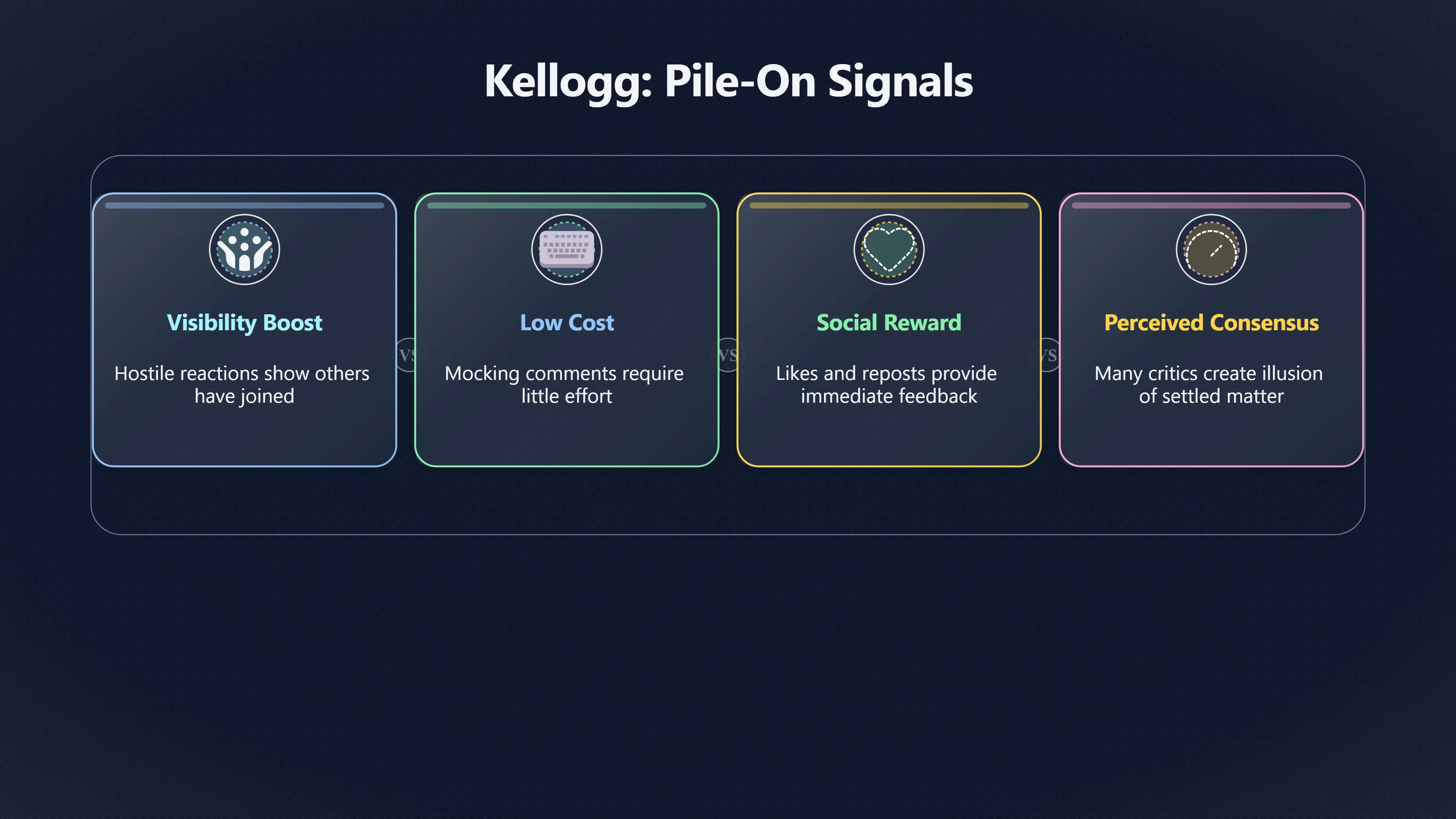
Several factors encourage this behaviour:
- Visibility: Every additional hostile reaction demonstrates that others have already joined.
- Low participation costs: Adding a mocking comment or repost requires little effort.
- Social rewards: Likes, reposts and supportive replies provide immediate feedback.
- Perceived consensus: Large numbers of critical responses can create the impression that the matter is already settled.[YaleNews]news.yale.eduNews'Likes' and 'shares' teach people to express more outrage onlineNews'Likes' and 'shares' teach people to express more outrage onlineAugust 13, 2021 — 13 Aug 2021 — Yale researchers looked at 12.7 m…
The result is that criticism increasingly becomes a performance for observers rather than an attempt to persuade the original speaker.

Pile-ons as social signals
From the perspective of argument quality, the most important feature of a pile-on is that quantity can be mistaken for evidence. Hundreds of people repeating variations of the same personal accusation do not necessarily strengthen the logical case against a claim. They mainly demonstrate that many people share a reaction.
Studies of online harassment note that one form of networked abuse involves encouraging others to target an individual, creating collective pressure that goes beyond ordinary disagreement. Researchers examining morally motivated networked harassment describe how participants may view their actions as enforcing community norms, even while engaging in name-calling, rumour spreading or coordinated hostility.[Sage Journals]journals.sagepub.comSage JournalsMorally Motivated Networked Harassment as Normative…by AE Marwick · 2021 · Cited by 236 — identified 10 types of harassme…
This creates a tension. Participants often believe they are defending a principle or holding someone accountable. Yet the practical effect may be to replace discussion of evidence with discussion of a person’s moral worth, reputation or social status.
When the crowd becomes the argument
One of the most misleading features of online pile-ons is that they can create an illusion of argumentative strength.
A reader encountering thousands of hostile responses may unconsciously reason:
- Many people are condemning this person.
- Therefore the person must be wrong.
- Therefore the claim can be dismissed.
This reasoning is flawed. The number of critics does not by itself establish the truth or falsity of a claim. A crowd can identify a genuine problem, but it can also react to incomplete information, misleading framing or emotional momentum. Research on online information diffusion has found evidence of herding behaviour, where users are influenced by the visible actions of others rather than independently evaluating the underlying information.[arXiv]arxiv.orgSource details in endnotes.
The danger is not merely that the crowd may be mistaken. It is that the crowd’s existence can substitute for argument altogether.
Keeping the claim in view
Recognising an online ad hominem pile-on requires attention to what is actually being addressed.
Useful questions include:
- Is the criticism aimed at the claim or primarily at the person?
- Does the quote-post provide evidence, or only a label or insult?
- Would the criticism still matter if a different person had made the same argument?
- Are participants introducing new reasons, or repeating social signals?
- Has the original claim been accurately represented before being criticised?
These questions help separate legitimate criticism from personal dismissal. A person’s credibility, expertise or conflicts of interest may sometimes be relevant. However, those considerations still need to connect to the quality of the evidence or reasoning. Simply attracting mass disapproval does not prove a claim false.
In online environments, this distinction becomes especially important because platform design often rewards speed, visibility and emotional reaction. The easiest content to spread is not always the strongest argument. A quote-post that turns a debate into a judgement of character may achieve enormous reach while contributing very little to determining whether the original claim is true.[ACM Digital Library]dl.acm.orgACM Digital LibraryTo Reply or to Quote: Comparing Conversational Framing…Our research (1) demonstrates that the quote feature is more…[YaleNews]news.yale.eduNews'Likes' and 'shares' teach people to express more outrage onlineNews'Likes' and 'shares' teach people to express more outrage onlineAugust 13, 2021 — 13 Aug 2021 — Yale researchers looked at 12.7 m…
Amazon book picks
Further Reading
Books and field guides related to Why online insults spread so fast. Use these as the next step if you want deeper reading beyond the article.
So You've Been Publicly Shamed
Examines social-media pile-ons and reputational punishment.
eBay marketplace picks
Marketplace Samples
Example marketplace items related to this page. Use the search link to explore similar finds on eBay.






Endnotes
1.
Source: insight.kellogg.northwestern.edu
Link:https://insight.kellogg.northwestern.edu/article/whats-behind-the-rush-to-join-an-internet-pile-on
Source snippet
Kellogg InsightWhat's Behind the Rush to Join an Internet Pile-on?30 Jan 2024 — Joining a social-media pile-on, calling for someone's fir...
2.
Source: dl.acm.org
Link:https://dl.acm.org/doi/10.1145/3625680
Source snippet
ACM Digital LibraryTo Reply or to Quote: Comparing Conversational Framing...Our research (1) demonstrates that the quote feature is more...
3.
Source: arxiv.org
Link:https://arxiv.org/abs/2207.03020
4.
Source: arxiv.org
Link:https://arxiv.org/abs/2311.09367
Source snippet
Content Detection and Behavioral Analysis on Social Mediaby S Mane · 2023 · Cited by 6 — This paper delves into the field of Aggression C...
5.
Source: news.yale.edu
Title: News’Likes’ and ‘shares’ teach people to express more outrage online
Link:https://news.yale.edu/2021/08/13/likes-and-shares-teach-people-express-more-outrage-online
Source snippet
News'Likes' and 'shares' teach people to express more outrage onlineAugust 13, 2021 — 13 Aug 2021 — Yale researchers looked at 12.7 m...
Published: August 13, 2021
6.
Source: journals.sagepub.com
Link:https://journals.sagepub.com/doi/10.1177/20563051211021378
Source snippet
Sage JournalsMorally Motivated Networked Harassment as Normative...by AE Marwick · 2021 · Cited by 236 — identified 10 types of harassme...
Additional References
7.
Source: researchgate.net
Link:https://www.researchgate.net/publication/358364726_Adolescents_on_Social_Media_Aggression_and_Cyberbullying
Source snippet
Adolescents on Social Media: Aggression and CyberbullyingBecause these behaviors target social relationships and reputational standing wi...
8.
Source: hsph.harvard.edu
Link:https://hsph.harvard.edu/research/health-communication/resources/digital-safety-kit-for-public-health/recognize-and-understand-online-harassment/
Source snippet
and understand online harassmentOnline harassment can take many forms. It might resemble in-person bullying via personal insults and thre...
9.
Source: researchgate.net
Link:https://www.researchgate.net/publication/374578042_To_Reply_or_to_Quote_Comparing_Conversational_Framing_Strategies_on_Twitter
Source snippet
To Reply or to Quote: Comparing Conversational Framing...Our research (1) demonstrates that the quote feature is more often used to broa...
10.
Source: news.exeter.ac.uk
Link:https://news.exeter.ac.uk/faculty-of-humanities-arts-and-social-sciences/even-when-peoples-opinions-are-hard-to-change-online-comments-can-shape-how-political-social-media-content-is-perceived-study-shows/
Source snippet
when people's opinions are hard to change, online...8 Apr 2026 — Online comments can shape how social media content about [politics]({{ 'politics/' | relative_url }}) is pe...
11.
Source: www-users.york.ac.uk
Link:https://www-users.york.ac.uk/~ade1/research/Social%20media/CompleteGuidetoTwitterAnalyticsSimplyMeasured.pdf
Source snippet
Complete Guide to Twitter AnalyticsThe potential reach metric allows you to quantify not only the users you engaged with, but also the fo...
12.
Source: sciencemediacentre.es
Title: online bullying public health problem needs social and governmental response
Link:https://sciencemediacentre.es/en/online-bullying-public-health-problem-needs-social-and-governmental-response
Source snippet
"Online harassment is a public health problem".Oct 10, 2023 — "We are seeing more and more episodes of abuse and harassment on social net...
13.
Source: frogmanmediagroup.com
Title: the science of first impressions what your social media profile says about you
Link:https://frogmanmediagroup.com/the-science-of-first-impressions-what-your-social-media-profile-says-about-you/
Source snippet
Studies show that people form an opinion about someone or something in seven seconds or less.Read more...
14.
Source: commonslibrary.org
Title: surviving the pile on navigating online culture wars
Link:https://commonslibrary.org/surviving-the-pile-on-navigating-online-culture-wars/
Source snippet
Surviving the Pile-On: Navigating Online Culture Wars13 Jan 2025 — Learn how to navigate online culture wars and survive social media pil...
15.
Source: kingsleynapley.co.uk
Title: crimes committed using social media new guidelines
Link:https://www.kingsleynapley.co.uk/insights/blogs/criminal-law-blog/crimes-committed-using-social-media-new-guidelines
Source snippet
harassment of an individual, and (ii) “virtual mobbing” or “dog-piling” whereby a number of individuals use social media to disparage...
16.
Source: absolutelymaybe.plos.org
Title: quote tweeting over 30 studies dispel some myths
Link:https://absolutelymaybe.plos.org/2023/01/12/quote-tweeting-over-30-studies-dispel-some-myths/
Source snippet
Tweeting: Over 30 Studies Dispel Some Myths12 Jan 2023 — I found 37 studies with data and/or content analysis for quote tweets (QTs) that...
Topic Tree