Within Anecdotes
Did the Remedy Cause the Recovery?
Feeling better after a remedy does not prove the remedy caused the recovery.
On this page
- Why timing alone is weak evidence
- Missing comparisons and natural recovery
- Questions that test a causal story
Page outline Jump by section
Introduction
When someone takes a remedy and then recovers, it is natural to connect the two events. The improvement happened after the treatment, so the treatment appears to be the cause. Yet this is one of the most common forms of false causation in health reasoning. A sequence of events alone cannot establish a cause-and-effect relationship. Many illnesses improve on their own, symptoms often fluctuate, expectations can change how people feel, and other factors may be operating at the same time. As a result, a sincere personal testimony can describe a real recovery while still misidentifying why the recovery occurred. This is why anecdotes about treatments are often starting points for investigation rather than proof of effectiveness.[NCBI]ncbi.nlm.nih.govNCBIBad evidenceSmart Health Choices - NCBI Bookshelf - NIHby L Irwig · 2008 · Cited by 37 — But we already know the dangers of assuming cause and effect…

Did the Remedy Cause the Recovery?
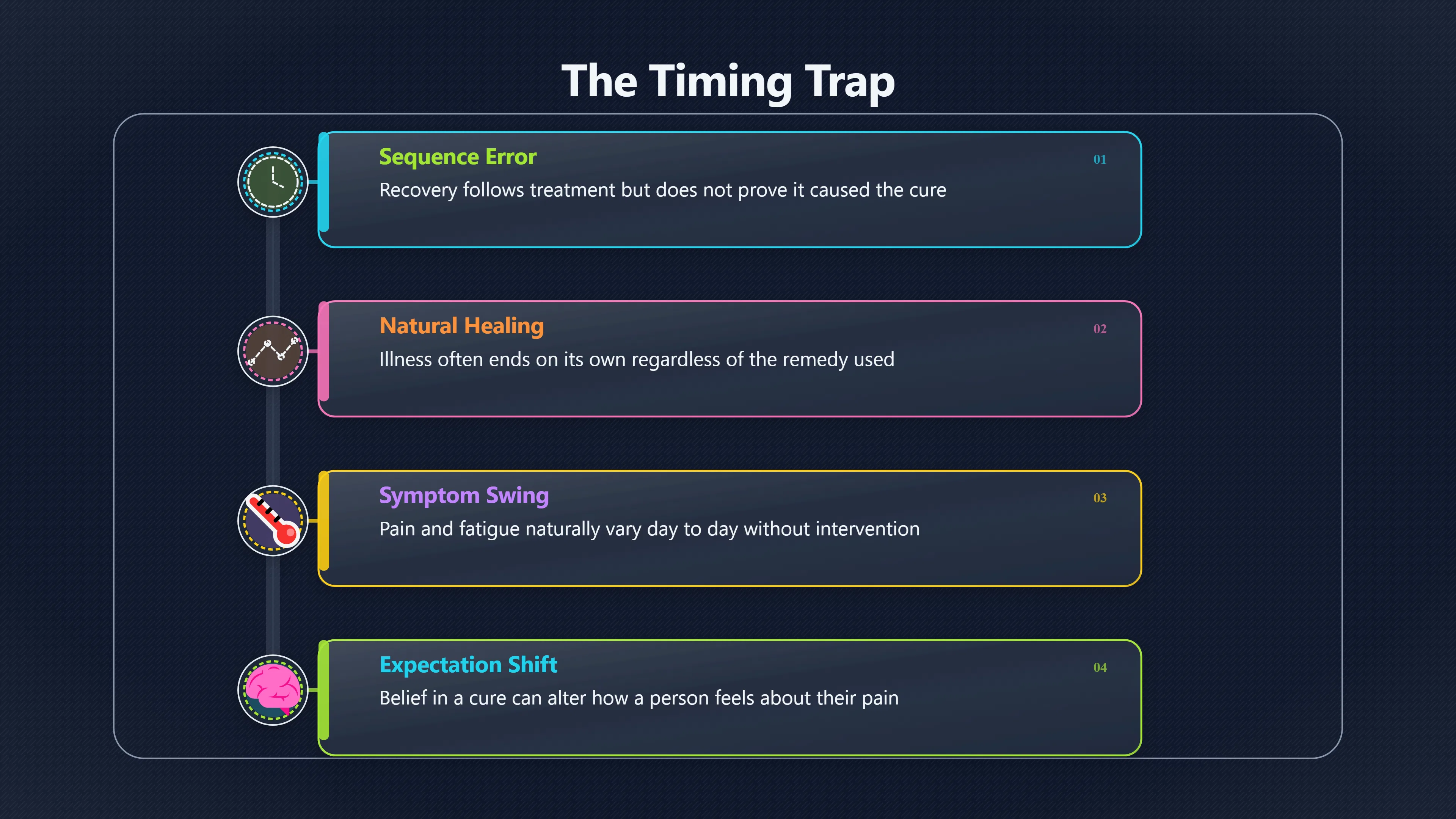
The central logical error is simple: assuming that because recovery followed a treatment, the treatment must have produced the recovery. Philosophers and statisticians sometimes summarise this as confusing sequence with causation. In everyday life it appears in claims such as:
- “I took this supplement and my symptoms disappeared.”
- “My neighbour used this diet and her cancer improved.”
- “I started this therapy and felt better within a week.”
Each story may be entirely truthful. The problem is that the story alone cannot distinguish between multiple possible explanations. The treatment might have worked, but the improvement might also have happened for reasons unrelated to the treatment.[NCBI]ncbi.nlm.nih.govNCBIBe scepticalSmart Health Choices - NCBI Bookshelfby L Irwig · 2008 · Cited by 35 — Anecdotal evidence can sound compelling, but is not a valid guide…
This fallacy is especially persuasive because recovery is emotionally significant. A person who suffered and then improved often has a strong incentive to identify a reason for that change. The remedy becomes the most visible candidate because it occurred immediately before the improvement.
Why Timing Alone Is Weak Evidence
The fact that event B followed event A tells us that A happened first. It does not tell us that A caused B.
Consider a common cold. Most people recover within a limited period regardless of whether they use a particular herbal remedy. If someone begins taking the remedy on day six and recovers on day eight, the timing feels persuasive. Yet the recovery may simply reflect the illness reaching its natural end. Without knowing what would have happened in the absence of the remedy, causation remains uncertain.[NCBI]ncbi.nlm.nih.govNCBIBad evidenceSmart Health Choices - NCBI Bookshelf - NIHby L Irwig · 2008 · Cited by 37 — But we already know the dangers of assuming cause and effect…
The same issue appears with conditions that naturally fluctuate. Pain, allergies, fatigue, skin problems, and many other symptoms often vary from day to day. People frequently seek treatment when symptoms are at their worst. Because extreme episodes are often followed by improvement anyway, any intervention introduced at that point can appear effective even if it contributed little or nothing to the outcome.[Cureus]cureus.com408370 the placebo effect in medicine and clinical practice a narrative reviewResearch should…Read more…
A before-and-after story therefore lacks a crucial piece of information: what would have happened without the treatment.
Missing Comparisons and Natural Recovery
Anecdotes typically present only one outcome. They tell us about the person who improved, not the people who did not improve.
This missing comparison matters because many health conditions have substantial rates of spontaneous improvement. If a hundred people recover after taking a remedy, the result sounds impressive. However, if ninety-eight similar people would have recovered without the remedy, the treatment’s actual contribution may be very small. Without a comparison group, those possibilities cannot be separated.[NCBI]ncbi.nlm.nih.govNCBIBe scepticalSmart Health Choices - NCBI Bookshelfby L Irwig · 2008 · Cited by 35 — Anecdotal evidence can sound compelling, but is not a valid guide…
Health researchers therefore rely on controlled studies rather than isolated stories. By comparing treated and untreated groups, they can estimate whether the treatment changes outcomes beyond what would normally occur. The comparison is what allows causal claims to be tested rather than assumed.
A useful thought experiment is to ask: would the same recovery story seem convincing if the treatment had been a glass of water, a lucky charm, or some other intervention with no known therapeutic action? If the answer is no, then timing alone is carrying too much of the argument.
When Feeling Better Does Not Mean the Disease Changed
Another reason anecdotes can mislead is that improvement in symptoms is not always the same as improvement in the underlying condition.
Research on placebo effects shows that expectations, care, reassurance, and the treatment experience itself can influence how people perceive symptoms such as pain, fatigue, anxiety, and nausea. A person may genuinely feel better after receiving an inactive treatment. The improvement is real from the patient’s perspective, but it does not necessarily demonstrate that the treatment altered the disease process itself.[NCCIH]nccih.nih.govNCCIHPlacebo Effect | NCCIHThe placebo effect is a beneficial health outcome resulting from a person's anticipation that an intervention will help.Read more…[PMC]pmc.ncbi.nlm.nih.govPMCThe placebo effect: illness and interpersonal healingplacebo effect: illness and interpersonal healing - PMCby FG Miller · 2009 · Cited by 342 — We suggest the hypothesis that the placebo ef…
For example, placebo effects are often strongest for symptoms influenced by perception and expectation. They can reduce the experience of pain or discomfort without curing the underlying illness. Health authorities and medical researchers therefore distinguish between symptom relief and evidence that a treatment changes the course of a disease.[NCCIH]nccih.nih.govNCCIHPlacebo Effect | NCCIHThe placebo effect is a beneficial health outcome resulting from a person's anticipation that an intervention will help.Read more…[Harvard Health]health.harvard.eduthe power of the placebo effectpower of the placebo effect22 Jul 2024 — The idea that your brain can convince your body a fake treatment is the real thing - the so-call…
This distinction is important because a treatment may appear successful in personal testimony even when the apparent success comes largely from symptom changes, natural healing, or both.

A Concrete Pattern in Alternative Health Claims
Many health and wellness promotions rely heavily on personal recovery stories. Testimonials often feature dramatic before-and-after narratives because they are memorable and emotionally compelling.
The weakness is that such stories usually omit critical information:
- How many people tried the treatment without improving?
- How many recovered without using it?
- Were other treatments used at the same time?
- Was the diagnosis correct?
- Would the condition likely have improved anyway?
Guides on evaluating health claims repeatedly warn that anecdotal recovery stories can create the illusion of proof while leaving these questions unanswered. A striking testimonial can therefore be evidence that someone recovered, but not evidence that the advertised remedy caused the recovery.[NCBI]ncbi.nlm.nih.govNCBIBe scepticalSmart Health Choices - NCBI Bookshelfby L Irwig · 2008 · Cited by 35 — Anecdotal evidence can sound compelling, but is not a valid guide…[NCBI]ncbi.nlm.nih.govNCBIBe scepticalSmart Health Choices - NCBI Bookshelfby L Irwig · 2008 · Cited by 35 — Anecdotal evidence can sound compelling, but is not a valid guide…
The history of medicine contains many examples of treatments that seemed effective based on enthusiastic personal reports but later failed when tested in controlled trials. The gap between anecdote and rigorous evidence exists precisely because human beings are poor at separating coincidence from causation through observation alone.[NCBI]ncbi.nlm.nih.govNCBIBe scepticalSmart Health Choices - NCBI Bookshelfby L Irwig · 2008 · Cited by 35 — Anecdotal evidence can sound compelling, but is not a valid guide…
Questions That Test a Causal Story
When confronted with a personal recovery account, a few questions help determine whether the story supports a causal claim.
What would likely have happened without the treatment?
If the condition commonly improves on its own, natural recovery is a serious alternative explanation.[NCBI]ncbi.nlm.nih.govNCBIBe scepticalSmart Health Choices - NCBI Bookshelfby L Irwig · 2008 · Cited by 35 — Anecdotal evidence can sound compelling, but is not a valid guide…
Are there comparable cases that did not improve?
A convincing causal claim requires attention to successes and failures, not only the positive examples that get reported.[NCBI]ncbi.nlm.nih.govNCBIBe scepticalSmart Health Choices - NCBI Bookshelfby L Irwig · 2008 · Cited by 35 — Anecdotal evidence can sound compelling, but is not a valid guide…
Could symptom changes reflect expectation or placebo effects?
Feeling better can be meaningful and beneficial, but it does not automatically show that the treatment altered the disease mechanism.[NCCIH]nccih.nih.govNCCIHPlacebo Effect | NCCIHThe placebo effect is a beneficial health outcome resulting from a person's anticipation that an intervention will help.Read more…[Harvard Health]health.harvard.eduthe power of the placebo effectpower of the placebo effect22 Jul 2024 — The idea that your brain can convince your body a fake treatment is the real thing - the so-call…
Were other factors changing at the same time?
Lifestyle changes, concurrent treatments, rest, diet, social support, and the passage of time can all contribute to recovery. If several factors changed together, identifying a single cause becomes difficult.[Cureus]cureus.com408370 the placebo effect in medicine and clinical practice a narrative reviewResearch should…Read more…
Is there evidence beyond the anecdote?
The strongest support comes from systematic comparisons that test whether treated groups do better than similar untreated groups. Personal stories may suggest a hypothesis, but broader evidence is needed to establish causation.[NCBI]ncbi.nlm.nih.govNCBIBe scepticalSmart Health Choices - NCBI Bookshelfby L Irwig · 2008 · Cited by 35 — Anecdotal evidence can sound compelling, but is not a valid guide…
The Takeaway
A person who recovers after using a remedy may be describing a genuine experience. The logical mistake arises when that experience is treated as proof that the remedy caused the recovery. Natural healing, symptom fluctuation, placebo effects, concurrent changes, and selective reporting can all create the appearance of effectiveness. The lesson is not that personal experiences are worthless, but that they are incomplete. To know whether a treatment truly caused improvement, we need comparisons that reveal what would have happened otherwise. Anecdotes can point towards a possibility; they cannot, by themselves, establish a cause.[NCBI]ncbi.nlm.nih.govNCBIBe scepticalSmart Health Choices - NCBI Bookshelfby L Irwig · 2008 · Cited by 35 — Anecdotal evidence can sound compelling, but is not a valid guide…[NCBI]ncbi.nlm.nih.govNCBIBe scepticalSmart Health Choices - NCBI Bookshelfby L Irwig · 2008 · Cited by 35 — Anecdotal evidence can sound compelling, but is not a valid guide…
Amazon book picks
Further Reading
Books and field guides related to Did the Remedy Cause the Recovery?. Use these as the next step if you want deeper reading beyond the article.
Trick or Treatment?
Explains placebo effects, regression to the mean, and mistaken causation.
Testing Treatments
Clarifies why comparisons and trials are needed to establish causation.
The Skeptics' Guide to the Universe
Covers causal reasoning, scientific testing, and cognitive bias.
eBay marketplace picks
Marketplace Samples
Example marketplace items related to this page. Use the search link to explore similar finds on eBay.

Endnotes
1.
Source: ncbi.nlm.nih.gov
Title: NCBIBad evidence
Link:https://www.ncbi.nlm.nih.gov/books/NBK63649/
Source snippet
Smart Health Choices - NCBI Bookshelf - NIHby L Irwig · 2008 · Cited by 37 — But we already know the dangers of assuming cause and effect...
2.
Source: ncbi.nlm.nih.gov
Title: NCBIBe sceptical
Link:https://www.ncbi.nlm.nih.gov/books/NBK63648/
Source snippet
Smart Health Choices - NCBI Bookshelfby L Irwig · 2008 · Cited by 35 — Anecdotal evidence can sound compelling, but is not a valid guide...
3.
Source: cureus.com
Title: 408370 the placebo effect in medicine and clinical practice a narrative review
Link:https://www.cureus.com/articles/408370-the-placebo-effect-in-medicine-and-clinical-practice-a-narrative-review.pdf
Source snippet
Research should...Read more...
4.
Source: nccih.nih.gov
Title: NCCIHPlacebo Effect | NCCIH
Link:https://www.nccih.nih.gov/health/placebo-effect
Source snippet
The placebo effect is a beneficial health outcome resulting from a person's anticipation that an intervention will help.Read more...
5.
Source: pmc.ncbi.nlm.nih.gov
Title: PMCThe placebo effect: illness and interpersonal healing
Link:https://pmc.ncbi.nlm.nih.gov/articles/PMC2814126/
Source snippet
placebo effect: illness and interpersonal healing - PMCby FG Miller · 2009 · Cited by 342 — We suggest the hypothesis that the placebo ef...
6.
Source: health.harvard.edu
Title: the power of the placebo effect
Link:https://www.health.harvard.edu/newsletter_article/the-power-of-the-placebo-effect
Source snippet
power of the placebo effect22 Jul 2024 — The idea that your brain can convince your body a fake treatment is the real thing - the so-call...
7.
Source: pmc.ncbi.nlm.nih.gov
Title: PMCThe Signaling Theory of Symptoms: An Evolutionary
Link:https://pmc.ncbi.nlm.nih.gov/articles/PMC10480909/
Source snippet
by L Steinkopf · 2015 · Cited by 65 — However, this phenomenon, known as the placebo effect, does not usually cure the disease, but ra...
8.
Source: cancer.gov
Title: Complementary and Alternative Medicine (CAM)
Link:https://www.cancer.gov/about-cancer/treatment/cam
Source snippet
NCI31 Oct 2024 — Modest pain improvements were seen, although a placebo effect could not be ruled out. These are healing systems and beli...
9.
Source: nccih.nih.gov
Link:https://www.nccih.nih.gov/
Source snippet
We conduct and support research and provide information about complementary health products and practices in the [context]({{ 'context/' | relative_url }}) of whole person...
10.
Source: courses.lumenlearning.com
Title: placebo effect
Link:https://courses.lumenlearning.com/suny-hvcc-healthpsychology/chapter/placebo-effect/
Source snippet
effect | Health PsychologyThe placebo effect is the concept that patients will perceive an improvement after being treated with an inert...
Additional References
11.
Source: recoverytrial.net
Link:https://www.recoverytrial.net/news/statement-from-the-chief-investigators-of-the-randomised-evaluation-of-covid-19-therapy-recovery-trial-on-hydroxychloroquine-5-june-2020-no-clinical-benefit-from-use-of-hydroxychloroquine-in-hospitalised-patients-with-covid-19
Source snippet
No clinical benefit from use of hydroxychloroquine in...5 Jun 2020 — The RECOVERY Trial has shown that hydroxychloroquine is not an effe...
Published: june 2020
12.
Source: clinicaltrials.gov
Link:https://clinicaltrials.gov/study/NCT01878019
Source snippet
Naloxone is used to treat overdoses of painkilling drugs like morphine. It may be able...Read more...
13.
Source: clinicaltrials.gov
Link:https://clinicaltrials.gov/study/NCT00065715
Source snippet
ical trial to gain access to a medical product that has not been approved...Read more...
14.
Source: researchgate.net
Title: 375016737 Placebo Effects Through the Lens of Translational Research
Link:https://www.researchgate.net/publication/375016737_Placebo_Effects_Through_the_Lens_of_Translational_Research
Source snippet
Placebo Effects Through the Lens of Translational Research27 Oct 2023 — This book sheds light on the translation of current mechanistic r...
15.
Source: jstor.org
Title: Clinical theories of placebo effects. Clinical theories of placebo
Link:https://www.jstor.org/stable/27238634
Source snippet
Placebos in chronic pain: evidence, theory, ethics, and use...by TJ Kaptchuk · 2020 · Cited by 220 — Specifically focused on chronic pai...
16.
Source: informedhealthchoices.org
Link:https://informedhealthchoices.org/wp-content/uploads/2022/11/KeyConceptPoster1.3_SecondarySchoolHealth_EN_forDownload.pdf
Source snippet
Often this is because the reason (the basis) for the claim is not trustworthy. You should...Read more...
17.
Source: pmc.ncbi.nlm.nih.gov
Link:https://pmc.ncbi.nlm.nih.gov/articles/PMC6013051/
Source snippet
neuroscience of placebo effects: connecting context...by TD Wager · 2015 · Cited by 1076 — For some, the presence of a placebo effect su...
18.
Source: avma.org.uk
Title: Thana et al 2025 Aftermath of health related harm qual study
Link:https://www.avma.org.uk/wp-content/uploads/Thana-et-al-2025-Aftermath-of-health-related-harm-qual-study.pdf
Source snippet
What do people do in the aftermath of healthcare-related harm...by L Thana · 2025 · Cited by 1 — This study aims to explore the experien...
19.
Source: chiro.org
Link:https://chiro.org/research/ABSTRACTS/Implications_of_Placebo_and_Nocebo.shtml
Source snippet
cts should lead to better treatment outcomes with fewer side effects.Read more...
20.
Source: researchgate.net
Link:https://www.researchgate.net/publication/325725713_Implications_of_Placebo_and_Nocebo_Effects_for_Clinical_Practice_Expert_Consensus
Source snippet
cts should lead to better treatment outcomes with fewer side effects.Read more...
Topic Tree