Within Fallacy Lab
Are Phone Rules Really All or Nothing?
School phone debates show how false dilemmas can hide practical middle-ground policy options.
On this page
- The all or nothing frame
- Middle ground rules
- Evidence for tradeoffs
Page outline Jump by section
Introduction
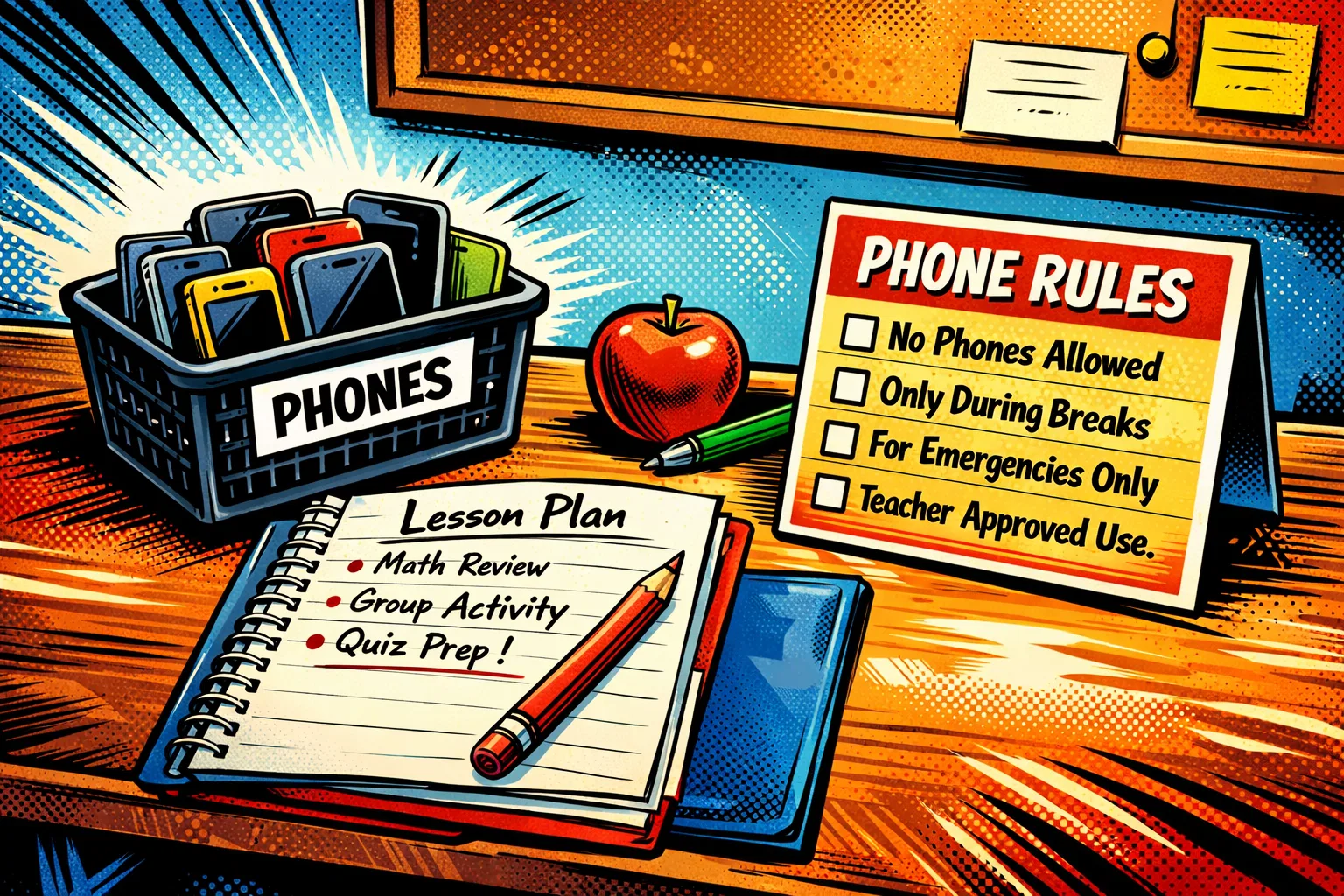
School phone debates often sound like a stark choice: either ban phones completely or accept constant distraction. That framing is tempting because it makes a messy governance problem feel simple. It is also a classic false choice. A false dilemma presents too few options as if they exhaust the real policy space; in school phone policy, that can hide practical middle-ground rules such as lesson-only restrictions, locked storage, medical exceptions, age-specific rules, supervised educational use and parent-contact protocols.[Excelsior OWL]owl.excelsior.eduOWLFalse Dilemma FallacyExcelsior OWLFalse Dilemma Fallacy - Excelsior OWLA false dilemma is a logical fallacy that presents only two options or sides to an issu…
The point is not that every ban is fallacious. A school may reasonably decide that phones should be off-site, locked away, or inaccessible all day. The fallacy appears when campaigners, parents, pupils or politicians argue as though the only possible positions are “total ban” or “anything goes”. The evidence is more mixed and more useful than that: phones can distract learning, but bans vary in design, enforcement burden, pupil effects and strength of evidence.[Sage Journals]journals.sagepub.comWhen debating the consequences of…
The all-or-nothing frame
The common false choice in phone policy is: “Either we ban phones, or we let them ruin school.” Its mirror image is: “Either pupils have unrestricted access, or schools are ignoring safety, independence and digital learning.” Both versions compress several separate questions into one emotional binary.
A better argument separates at least five issues: whether pupils may bring phones to school, where phones are stored, when they may be used, who may authorise exceptions, and what the rule is meant to achieve. The Department for Education guidance for England, for example, favours schools prohibiting mobile phone use throughout the school day, including lessons, breaktimes and lunchtime, but its own case studies describe different implementation models such as leaving phones at home, handing them in, keeping them in secure storage, or using lockable pouches.[GOV.UK]GOV.UKmobile phones in schools19 Feb 2026 — This publication provides guidance to individual schools and trusts on how to implement a policy that prohibits the use of…
That matters for fallacy-spotting because a phrase such as “phone ban” can mean several things. It may mean no phones on site. It may mean phones allowed on the journey but inaccessible during the day. It may mean no classroom use unless the teacher permits it. It may mean no recreational use, while allowing medical, disability or safeguarding exceptions. Treating all these as one policy makes the debate less precise than it appears.
The all-or-nothing frame also encourages exaggerated claims. Supporters may imply that a ban alone will solve poor concentration, bullying, mental health concerns and weak attainment. Opponents may imply that any restriction leaves children unsafe or technologically unprepared. Both arguments can be weak even when they contain a real concern. The reasoning error is not caring about distraction or safety; it is pretending those concerns point to only one possible policy.
Middle-ground rules
The middle ground in school phone policy is not a vague compromise where everyone gets half of what they want. It is a set of design choices that can be stricter in some places and more flexible in others.
A school can choose, for example, a “phone-free school day” while still allowing pupils to bring a device for travel and store it securely until dismissal. Another school might ban phones in classrooms but allow them at lunch for older pupils. A third might use lockable pouches, so pupils keep devices physically with them but cannot access them until the end of the day. A fourth might permit teacher-approved use for a specific learning activity, then return to a no-use default.
The Netherlands shows why the debate is not simply ban versus no ban. Dutch rules restrict mobile phones, tablets and smartwatches in classrooms, but exceptions are made for educational use and for pupils with specific medical or wellbeing needs. Schools still have to decide how rules apply beyond the classroom and how they will enforce them.[Eurydice]eurydice.eacea.ec.europa.eunetherlands ban mobile phones classroomnetherlands ban mobile phones classroom
England’s policy discussion also contains more than one option. The 2024 guidance was non-statutory and gave schools routes such as asking pupils to leave phones at home, handing devices in on arrival, keeping phones in lockers, or allowing pupils to retain phones if they are switched off and not accessed. Later guidance and inspection commentary pushed more strongly towards a phone-free default, but still recognised that schools may need to justify exceptions and apply them consistently.[The Guardian]theguardian.comSource details in endnotes.
A practical policy therefore needs more than a slogan. It needs answers to questions such as:
- Access: Are phones banned from the site, or only from use during the school day?
- Storage: Are devices kept at home, in bags, in lockers, at reception, or in lockable pouches?
- Exceptions: Who approves medical, disability, caring, safeguarding or travel-related access?
- Learning use: Are phones ever allowed for a teacher-directed task, or must schools use school-owned devices instead?
- Communication: How do parents contact pupils, and how do pupils contact home, without bypassing the rule?
- Enforcement: What happens after a first breach, repeated breach, refusal to hand over a device, or parental disagreement?
False-choice arguments often skip these details. Good governance lives in them.
Evidence for tradeoffs
The strongest case for restricting phones is distraction. International policy bodies and school leaders have increasingly treated smartphones as a classroom attention problem, and UNESCO’s 2023 Global Education Monitoring work argued that technology should be used in education only when it clearly supports learning outcomes. UNESCO’s tracking also shows how quickly phone restrictions have spread: by the end of 2024, 79 education systems, about 40% worldwide, had banned smartphones in schools in law or policy.[UNESCO]unesco.orgsmartphones school only when they clearly support learningsmartphones school only when they clearly support learning
There is evidence that restrictions can help some pupils. Beland and Murphy’s study of schools in four English cities found that banning mobile phones improved test scores, with the largest gains among previously lower-achieving pupils and no significant effect for high achievers. That finding is often used to support phone-free schools, especially where leaders want a low-cost intervention that may reduce attainment gaps.[LP Beland - Economist]lpbeland.comLP BelandLP Beland
But the evidence does not support every confident claim made in the public debate. A 2024 scoping review found no randomised controlled trials in the school-ban literature it reviewed, and noted that studies used different designs, samples, definitions of bans and outcome measures, making simple conclusions difficult. The London School of Economics summary of the evidence similarly describes benefits in some studies, especially for less advantaged or lower-performing pupils, but stresses that findings are mixed and not yet nuanced enough to determine which policy works best for every age group or school context.[ResearchGate]researchgate.netResearch Gate Evidence for and against banning mobile phones in schoolsResearch Gate Evidence for and against banning mobile phones in schools
Mental health claims need particular care. A 2025 Lancet Regional Health Europe study of 30 English secondary schools found that pupils in schools with restrictive policies used phones and social media less during school time, but there was no evidence of better overall mental wellbeing, anxiety, depression, sleep, physical activity, classroom behaviour or academic attainment compared with pupils in more permissive schools.[The Lancet]thelancet.comSource details in endnotes.
That does not prove phone rules are useless. It shows why “ban phones and mental health improves” is too simple. School-day access is only part of young people’s wider phone and social media use. If pupils compensate after school, if sleep is shaped by night-time use, or if mental health difficulties have many causes, a school rule may reduce visible distraction without moving every wellbeing measure.
The newest evidence also complicates simple pro-ban claims. Reporting on a large US study released in 2026 described “close to zero” average effects on test scores, attendance and perceived online bullying among schools using locked pouches, although in-school phone use fell sharply and teacher satisfaction appeared to improve.[The Washington Post]washingtonpost.comInitially, schools saw a rise in disciplinary actions and a dip in student well-being, likely tied to resistance against new rules and in…
The tradeoff is therefore not “evidence versus no evidence”. It is which outcome a policy is trying to improve, how much confidence the evidence allows, and whether the expected gain justifies the enforcement cost.
What the false choice hides
A false dilemma in this debate usually hides implementation. The phrase “ban phones” sounds like a single action, but schools have to make it work in corridors, toilets, lunch queues, classrooms, buses, after-school clubs, exams, safeguarding cases and parent communication.
Enforcement can be costly. A 2026 BMJ Mental Health economic analysis found that restrictive school smartphone policies may save a small amount of money compared with permissive policies, mainly by reducing staff time spent managing phone-related behaviour, but made little difference to pupils’ quality of life or mental wellbeing. Reporting on the same research noted that both restrictive and permissive policies still required substantial staff time, with schools spending more than 100 hours a week on average implementing phone policies.[PMC]pmc.ncbi.nlm.nih.govSource details in endnotes.[BMJ]bmj.comOpen source on bmj.com.
That finding cuts through another false choice: “strict rules are simple; flexible rules are chaotic.” Sometimes that is true. A clear, whole-school rule may reduce negotiation, teacher-by-teacher inconsistency and pupil attempts to find loopholes. But a strict rule can also create storage costs, confiscation disputes, parent complaints and disciplinary escalations if it is not resourced and communicated well.
The reverse claim is also weak: “flexibility is always more humane.” Flexible rules can protect legitimate needs, but they can also make enforcement harder. A teacher who must decide whether a pupil is checking a medical app, messaging a parent, photographing notes, using a translation tool or scrolling social media is being asked to police intent in real time. That is a governance problem, not merely a personal-responsibility problem.
The most realistic policies therefore try to reduce discretionary judgement at the busiest moments while preserving clear routes for exceptions. Medical devices, hearing-aid-linked phones, diabetes monitoring, disability adjustments and safeguarding plans should not depend on a teacher improvising under pressure. The exception system needs to be known before the conflict happens.[Eurydice]eurydice.eacea.ec.europa.eunetherlands ban mobile phones classroomnetherlands ban mobile phones classroom

Safer arguments than “ban or surrender”
A stronger argument for phone restriction does not need the false choice. It can say: “Phones are powerful distractors; pupils are still developing self-regulation; teachers need a consistent learning environment; therefore, our default should be that personal phones are inaccessible during the school day, with defined exceptions.” That argument is clearer because it names the aim, the mechanism and the exception.
A stronger argument against an over-strict ban also avoids the false choice. It can say: “Phones can create distraction and social pressure, but some pupils need devices for travel, disability, caring responsibilities or medical monitoring; therefore, the policy should restrict ordinary use while providing secure storage, emergency communication and planned access.” That is not a defence of unrestricted phone use. It is a challenge to a badly designed rule.
The difference is that both arguments admit the policy space is larger than two boxes. They allow a school to ask: Which pupils are most affected? Which harms are we targeting? What evidence supports that target? What practical burden will fall on staff? What exceptions are legally or ethically necessary? How will parents be brought into the system?
A useful school phone debate should sound less like a culture-war referendum and more like a rule-design meeting. The options are not simply “phones everywhere” or “phones nowhere”. They include:
- phone-free lessons;[GOV.UK]GOV.UKcreating a mobile phone free environment school case studiescreating a mobile phone free environment school case studies * phone-free classrooms but limited breaktime access;[cheshire-pcc.gov.uk]cheshire-pcc.gov.ukSource details in endnotes.
- bell-to-bell restrictions;
- secure storage on arrival;
- lockable pouches;
- school-owned devices for learning instead of personal phones;
- age-differentiated rules for younger pupils, older pupils and sixth formers;
- documented exceptions for medical, disability, safeguarding or caring needs;
- clear parent-contact routes through the school office.
Some of those options will be too loose for one school and too strict for another. The logical point is that they exist. Once they are visible, the debate becomes harder to win with slogans but easier to govern responsibly.
How to spot the fallacy in a phone-policy argument
The quickest test is to look for a missing middle. If someone says, “Either we ban phones completely or learning is impossible,” ask what they mean by “ban” and whether a phone-free classroom, locked storage, or all-day no-use rule would satisfy the concern. If someone says, “Either pupils can use their phones or they are unsafe,” ask whether emergency contact through the office, travel-time access, or specific exceptions would address the safety issue.
A false choice often appears in emotionally neat sentences:
- “You either trust pupils or you ban phones.”
- “You either care about learning or you allow devices.”
- “You either protect children or you let Big Tech into classrooms.”
- “You either prepare pupils for the digital world or you make school unrealistic.”
- “You either support teachers or you side with phone-addicted pupils.”
Each sentence contains a concern that may be worth discussing. Trust matters. Learning matters. Safety matters. Digital preparation matters. Teacher workload matters. The fallacy lies in making one concern cancel all the others.
Good policy reasoning keeps the tension visible. It can accept that phones may harm attention while still asking whether bans improve measured outcomes. It can accept that pupils need digital skills while still rejecting constant personal-device access. It can accept that parents worry about safety while still insisting that school cannot function if every pupil is privately reachable throughout the day.
The best antidote to the false dilemma is a more exact question: “Which rule, for which pupils, in which parts of the school day, with which exceptions, to improve which outcome, at what enforcement cost?” That question does not settle the debate automatically. It makes the debate honest.
Amazon book picks
Further Reading
Books and field guides related to Are Phone Rules Really All or Nothing?. Use these as the next step if you want deeper reading beyond the article.
The Coddling of the American Mind
Discusses student wellbeing and institutional policy tradeoffs.
eBay marketplace picks
Marketplace Samples
Example marketplace items related to this page. Use the search link to explore similar finds on eBay.




Endnotes
1.
Source: owl.excelsior.edu
Title: OWLFalse Dilemma Fallacy
Link:https://owl.excelsior.edu/argument-and-critical-thinking/logical-fallacies/logical-fallacies-false-dilemma/
Source snippet
Excelsior OWLFalse Dilemma Fallacy - Excelsior OWLA false dilemma is a logical fallacy that presents only two options or sides to an issu...
2.
Source: GOV.UK
Title: mobile phones in schools
Link:https://www.gov.uk/government/publications/mobile-phones-in-schools/mobile-phones-in-schools
Source snippet
19 Feb 2026 — This publication provides guidance to individual schools and trusts on how to implement a policy that prohibits the use of...
3.
Source: GOV.UK
Title: creating a mobile phone free environment school case studies
Link:https://www.gov.uk/government/publications/mobile-phones-in-schools/creating-a-mobile-phone-free-environment-school-case-studies
4.
Source: educationinspection.blog.gov.uk
Link:https://educationinspection.blog.gov.uk/2026/01/23/what-the-governments-updated-guidance-on-mobile-phones-means-for-school-inspections/
5.
Source: unesco.org
Title: smartphones school only when they clearly support learning
Link:https://www.unesco.org/en/articles/smartphones-school-only-when-they-clearly-support-learning
6.
Source: lpbeland.com
Title: LP Beland
Link:https://www.lpbeland.com/uploads/7/8/7/5/7875420/lpblabour_1-s2.0-s0927537116300136-main.pdf
7.
Source: researchgate.net
Title: Research Gate Evidence for and against banning mobile phones in schools
Link:https://www.researchgate.net/publication/383111257_Evidence_for_and_against_banning_mobile_phones_in_schools_A_scoping_review
8.
Source: pmc.ncbi.nlm.nih.gov
Link:https://pmc.ncbi.nlm.nih.gov/articles/PMC12911762/
9.
Source: bmjgroup.com
Link:https://bmjgroup.com/school-restrictive-smartphone-policies-may-save-a-small-amount-of-money-by-reducing-staff-costs/
10.
Source: unesco.org
Title: phone bans schools are spreading worldwide policy debate rages
Link:https://www.unesco.org/gem-report/en/articles/phone-bans-schools-are-spreading-worldwide-policy-debate-rages
11.
Source: gem-report-2023.unesco.org
Title: technology in education
Link:https://gem-report-2023.unesco.org/technology-in-education/
12.
Source: unesco.org
Link:https://www.unesco.org/gem-report/en/publication/technology
13.
Source: gem-report-2023.unesco.org
Link:https://gem-report-2023.unesco.org/
14.
Source: bmj.com
Link:https://www.bmj.com/content/390/bmj.r1729
15.
Source: bmjopen.bmj.com
Link:https://bmjopen.bmj.com/content/13/7/e075832
16.
Source: researchgate.net
Link:https://www.researchgate.net/publication/391399909_To_Ban_or_Not_to_Ban_A_Rapid_Review_on_the_Impact_of_Smartphone_Bans_in_Schools_on_Social_Well-Being_and_Academic_Performance
17.
Source: researchgate.net
Title: 400592169 Mobile phone bans in schools across the EU ENESET Analytical report
Link:https://www.researchgate.net/publication/400592169_Mobile_phone_bans_in_schools_across_the_EU_ENESET_Analytical_report
18.
Source: researchgate.net
Link:https://www.researchgate.net/publication/400639084_Health_economics_analysis_of_restrictive_school_smartphone_policies_in_secondary_schools_in_England_SMART_Schools
19.
Source: researchgate.net
Title: 301353144 Ill Communication Technology distraction student performance
Link:https://www.researchgate.net/publication/301353144_Ill_Communication_Technology_distraction_student_performance
20.
Source: cheshire-pcc.gov.uk
Link:https://www.cheshire-pcc.gov.uk/what-the-commissioner-does/projects/reducing-crime/phone-free-education/
21.
Source: journals.sagepub.com
Link:https://journals.sagepub.com/doi/abs/10.1177/20556365241270394
Source snippet
When debating the consequences of...
22.
Source: eurydice.eacea.ec.europa.eu
Title: netherlands ban mobile phones classroom
Link:https://eurydice.eacea.ec.europa.eu/news/netherlands-ban-mobile-phones-classroom
23.
Source: theguardian.com
Link:https://www.theguardian.com/education/2024/feb/19/ministers-confirm-plan-to-ban-use-of-mobile-phones-in-schools-in-england
24.
Source: thelancet.com
Link:https://www.thelancet.com/journals/lanepe/article/PIIS2666-7762%2825%2900003-1/fulltext
25.
Source: washingtonpost.com
Link:https://www.washingtonpost.com/education/2026/05/04/cell-phone-bans-impact-study/
Source snippet
Initially, schools saw a rise in disciplinary actions and a dip in student well-being, likely tied to resistance against new rules and in...
26.
Source: theguardian.com
Link:https://www.theguardian.com/[politics
Source snippet
Despite these results, the study’s authors caution against abandoning phone bans altogether, arguing that reductions in phone use could l...
27.
Source: theguardian.com
Title: The Guardian School phone policies in England a ‘huge drain’ on staff resources
Link:https://www.theguardian.com/education/2026/feb/10/school-phone-policies-drain-resources-england-study
Source snippet
The UK government recently issued guidance advocating for phone-free schools, and the teaching union NASUWT is calling for a statutory ma...
28.
Source: Wikipedia
Title: False dilemma
Link:https://en.wikipedia.org/wiki/False_dilemma
29.
Source: teachermagazine.com
Title: unesco calls for smartphone ban in schools
Link:https://www.teachermagazine.com/au_en/articles/unesco-calls-for-smartphone-ban-in-schools
Additional References
30.
Source: youtube.com
Title: UK to Ban Phones in Schools: Will It Really Work? | Connecting The Dots
Link:https://www.youtube.com/watch?v=nCye78Gy2OQ
Source snippet
This video explores the complex data, behavioral trade-offs, and nuanced policy implementation details behind locking away student device...
31.
Source: digital-futures-for-children.net
Title: Smartphone policies in schools
Link:https://www.digital-futures-for-children.net/our-work/smartphone-policies
Source snippet
LSESeveral studies show benefits for students' academic performance when smartphone use is restricted, especially for less advantaged chi...
32.
Source: youtube.com
Title: Debating Matters: ‘Smartphones should be banned in the classroom’
Link:https://www.youtube.com/watch?v=XKSZqb21Ysc
Source snippet
What Really Happens When Schools Lock Away Phones? Justin Wolfers Explains...
33.
Source: youtube.com
Title: Should Mobile Phones Be Banned in UK Schools? 20 Arguments For & Against
Link:https://www.youtube.com/watch?v=vcSWFQYzzT8
Source snippet
UK to Ban Phones in Schools: Will It Really Work? | Connecting The Dots...
34.
Source: youtube.com
Title: What Really Happens When Schools Lock Away Phones? Justin Wolfers Explains
Link:https://www.youtube.com/watch?v=-RFSbAJmVkY
Source snippet
Devices in the classroom? The debate over phones in school...
35.
Source: oecd.org
Link:https://www.oecd.org/en.html
36.
Source: youtube.com
Title: Devices in the classroom? The debate over phones in school
Link:https://www.youtube.com/watch?v=ICEkzpavdlU
Source snippet
Should Mobile Phones Be Banned in UK Schools? 20 Arguments For & Against...
37.
Source: world-education-blog.org
Link:https://world-education-blog.org/2025/12/15/are-phone-bans-working/
38.
Source: semanticscholar.org
Link:https://www.semanticscholar.org/paper/Banning-mobile-phones-in-schools%3A-evidence-from-in-Beneito-Vicente-Chirivella/163514815cc34fa7806a02dc694a998fa2da8e21
39.
Source: pastpaperhero.com
Link:https://www.pastpaperhero.com/resources/lsac-lsat-common-logical-fallacies-and-reasoning-errors-false-dilemma-and-dichotomy
Topic Tree