Within Fallacy Lab
Is Old the Same as Right?
Appeal to tradition treats age or familiarity as proof that a practice is correct or still justified.
On this page
- Tradition as context
- Tradition as proof
- Testing present reasons
Page outline Jump by section
Introduction
Appeal to tradition is the mistake of treating age, custom or familiarity as proof that a belief or practice is correct. Its everyday form is simple: “We have always done it this way, so this is the right way to do it.” That argument can feel reassuring because familiar practices often carry real experience, social meaning and practical know-how. But tradition is not the same thing as evidence. A custom may survive because it works, because changing it is costly, because powerful groups benefit from it, or simply because nobody has examined it for a long time.
Within logical fallacies, appeal to tradition is best understood as a failure of support. The conclusion may still turn out to be true, but the reason offered is too weak: “old” does not automatically mean “good”, “familiar” does not automatically mean “safe”, and “customary” does not automatically mean “justified”. Informal logic is especially useful here because the mistake depends on context, not on a simple invalid formula; informal fallacies often turn on content, purpose and the role an argument is playing in a real discussion.[Internet Encyclopedia of Philosophy]iep.utm.eduInternet Encyclopedia of PhilosophyFallaciesSo, informal fallacies are errors of reasoning that cannot easily be expressed in our standar…
Why tradition can look like evidence
Traditions are not random noise. Many practices become familiar because they solved a problem, coordinated a community, carried identity, reduced uncertainty or helped people act without having to redesign life from scratch. That is why an appeal to tradition is persuasive: it borrows credibility from the possibility that inherited practice contains hard-won experience.
This is also why the fallacy should not be confused with a careful argument from historical experience. A reasonable argument might say: “This practice has lasted because it has repeatedly met these needs, under these conditions, and the alternatives have performed worse.” A fallacious version skips that testing step and says, in effect: “This practice has lasted; therefore it is right.” The difference is not whether tradition is mentioned, but whether tradition is being used as context or as proof.
A useful contrast comes from the common idea often called Chesterton’s Fence: before removing a rule, institution or custom, first understand why it was put there. That principle is not itself an appeal to tradition. It is a warning against reckless reform and a call for inquiry. The fallacy begins when the warning hardens into a veto: “Because the fence is old, it must stay.” Chesterton’s own point, in its strongest form, is closer to “understand before changing” than “never change”.[Farnam Street]fs.blogFarnam Street Chesterton's Fence: A Lesson in ThinkingFarnam Street Chesterton's Fence: A Lesson in Thinking[Society of Gilbert Keith Chesterton]chesterton.orgtaking a fence downtaking a fence down
The same distinction appears in political thought. Edmund Burke’s defence of inherited institutions treated society as a partnership across generations, not merely a contract among the living. That gives tradition a role as accumulated social memory. But even sympathetic modern discussions of Burke separate this insight from blind deference: an inherited arrangement may deserve investigation and respect, yet still require reform when present reasons no longer support it.[PhilArchive]philarchive.orgPhil Archive A Partnership for the AgesPhil Archive A Partnership for the Ages
When “we have always done it” becomes the fallacy
The appeal to tradition usually has a recognisable mechanism. It converts a historical fact into a normative conclusion without supplying the missing bridge.
The historical fact might be true: a school has always used entrance exams, a workplace has always required long office hours, a family has always followed a certain ritual, or a profession has always trained people through a particular hierarchy. The conclusion might also be true in some cases. The problem is that the argument does not show why the past practice is still justified now.
A compact version looks like this:
- Practice X is old or familiar.
- People have followed X for a long time.
- Therefore X is correct, natural, necessary or better than the alternatives.
The weak point is the word “therefore”. Something may be old because it is effective, but it may also be old because people lacked better tools, feared punishment, excluded dissenting voices, mistook correlation for causation, or treated change itself as suspicious. Many explainers of the fallacy make this same core point: the age of a belief or practice may be historically interesting, but it does not by itself prove truth, goodness or present usefulness.[Logically Fallacious]logicallyfallacious.comSource details in endnotes.[quillbot]quillbot.comappeal to tradition fallacyappeal to tradition fallacy The fallacy often appears in softened language rather than in a blunt slogan. Phrases such as“time-tested”, “proper”, “the normal way”, “the way things are done”, or “our people have never needed that” can all be legitimate descriptions. They become suspect when they are asked to do the work of evidence. A reader should ask: what exactly has time tested — effectiveness, fairness, safety, identity, convenience, or merely endurance?
Tradition as context, not proof
A fair assessment of tradition begins by asking what kind of claim is being made. Traditions can support different kinds of reasoning, and not all of them are fallacious.
For practical customs, tradition may be a clue that a practice has worked under certain conditions. Farmers, builders, cooks, teachers and craftspeople often inherit techniques that encode tacit knowledge. The tradition is not the proof, but it is a reason to investigate carefully before discarding it. In this sense, tradition supplies a research question: “What problem did this solve, and does it still solve it?”
For identity-forming customs, the issue may not be efficiency at all. A ceremony, holiday, dress code or form of address might matter because it connects people to a shared history. Here the relevant question is not simply “Is this the most efficient option?” but “What meaning does it carry, and for whom?” Even then, meaning does not settle every dispute. A custom can be meaningful to some while imposing unfair costs on others.
For moral or factual claims, tradition is usually much weaker. “People have believed this for centuries” does not establish that the belief is true. “This role has traditionally belonged to one group” does not establish that the exclusion is just. When an argument moves from inherited acceptance to truth or moral authority, it needs independent support.
This is why fallacy identification should be careful rather than automatic. The Internet Encyclopedia of Philosophy warns that a charge of fallacious reasoning itself needs justification; it is not enough to label an argument and move on. In this case, the critic must show that tradition is being treated as conclusive proof, not merely as relevant background.[Internet Encyclopedia of Philosophy]iep.utm.eduInternet Encyclopedia of PhilosophyFallaciesSo, informal fallacies are errors of reasoning that cannot easily be expressed in our standar…
Why familiar practices feel safer than new ones
Appeal to tradition has psychological help. People do not evaluate old and new practices from a neutral starting line. Behavioural research on status quo bias shows that people often disproportionately stick with an existing option simply because it is the current one. Samuelson and Zeckhauser’s influential work described real decisions as commonly including a “do nothing” or “maintain the current decision” option, and found that people tend to favour that status quo in both experiments and consequential choices such as health plans and retirement programmes.[Springer]link.springer.comStatus quo bias in decision makingStatus quo bias in decision making
Familiarity can also feel like liking. Robert Zajonc’s research on the mere-exposure effect proposed that repeated exposure to a stimulus can improve attitudes towards it. That does not mean every familiar thing is preferred forever, or that people are helplessly biased by repetition. It does help explain why a familiar practice can feel more reasonable before anyone has compared outcomes.[psy.lmu.de]psy.lmu.demere exposure effectmere exposure effect
These biases matter because appeal to tradition rarely operates as pure logic. It often works by making alternatives feel risky, disrespectful or unnecessary before they have been assessed. A school may keep an outdated marking system because parents recognise it. A company may preserve a meeting-heavy culture because leaders rose through that system. A public institution may defend paperwork because paper has long been associated with seriousness and accountability. In each case, familiarity lowers the burden of proof for the old practice and raises it for the proposed change.
That asymmetry can be sensible when change is genuinely risky. But it becomes poor reasoning when the old practice is spared from the same scrutiny demanded of the new one.
A concrete lesson from medicine
Medicine shows why old practice deserves respect but not automatic obedience. Many medical routines were once defended by training, seniority and habit before stronger evidence challenged them. The rise of evidence-based medicine was partly a response to the limits of relying on tradition, theory, authority and unsystematic clinical experience when deciding what works for patients. A historical review of evidence-based medicine describes its development as an effort to bring explicit research evidence into clinical decision-making rather than relying only on inherited practice or expert judgement.[PMC]pmc.ncbi.nlm.nih.govPMCHistory of evidence-based medicinePMCHistory of evidence-based medicine
Ignaz Semmelweis is the memorable case. In the nineteenth century, he introduced antiseptic handwashing procedures after observing links between doctors’ practices and deadly childbed fever. Later accounts describe his work as a major turning point in hand hygiene, but also as a discovery that met resistance because it challenged accepted medical beliefs and professional habits.[PMC]pmc.ncbi.nlm.nih.govOpen source on nih.gov.
The lesson is not that tradition in medicine is always wrong. The lesson is that a familiar practice can survive inside a respected institution even when better evidence points elsewhere. Modern research on medical reversal makes the same point in a more systematic way: some established treatments or procedures later fall out of favour when stronger trials show that they are ineffective or harmful. One study of medical reversal argues for a higher evidential bar before new technologies and practices become standard; another review found that reversals occur across many classes of medical practice. PMC[Mayo Clinic Proceedings]mayoclinicproceedings.orgSource details in endnotes.
This example is powerful because it avoids a simplistic “old bad, new good” message. Evidence-based medicine does not say that older treatments are worthless or that novelty is proof. It says present practice should be answerable to present evidence.
The opposite mistake: assuming new is always better
Appeal to tradition has a mirror image: appeal to novelty. That fallacy treats newness as proof of superiority. Both mistakes confuse a timeline with an argument. “We have always done this” and “this is the latest thing” can both be evasions if they replace evidence about outcomes, values and trade-offs.
The better question is comparative: what reasons support keeping, revising or replacing the practice now? A tradition may deserve preservation because it continues to work, because it protects goods that are easy to overlook, or because the proposed replacement is untested and risky. A new practice may deserve adoption because it solves a current problem, reduces harm, includes people previously excluded, or fits changed conditions. Neither side wins by pointing to the calendar.
This matters in public debate because tradition and novelty are often used as identity signals. One speaker presents reform as disrespect for the past; another presents continuity as fear of the future. Both frames can distract from the more useful question: what is the practice for, and is it still meeting that purpose?
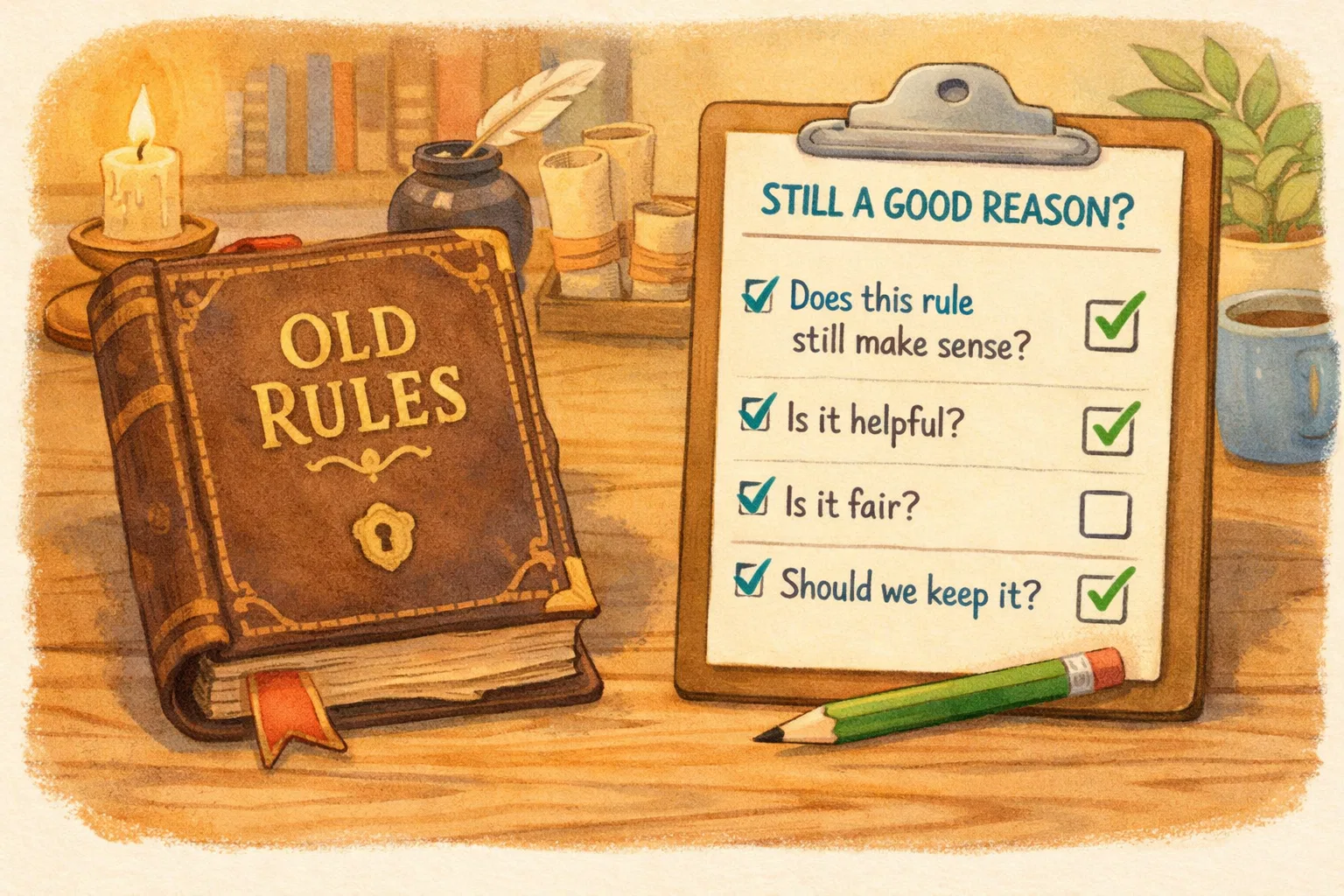
Testing present reasons
The practical antidote to appeal to tradition is not contempt for the past. It is a structured demand for present reasons. A tradition should be examined with enough historical humility to understand why it exists, and enough critical independence to ask whether those reasons still hold.
A useful test has five parts:
- Name the actual claim. Is the speaker saying the practice is true, moral, efficient, safe, beautiful, identity-forming, legally required or merely familiar? Different claims require different evidence.
- Separate origin from justification. A practice may have had a good original purpose but now serve a different function. It may also have had a bad original purpose but later acquire harmless or valuable meaning. History informs the judgement; it does not finish it.
- Ask what has changed. Technology, evidence, social conditions, costs, risks and affected groups may be different from the conditions in which the tradition developed.
- Compare real alternatives. The question is not “old practice or chaos?” but “old practice, revised practice or replacement — with what costs and benefits?”
- Look for unequal burdens. If defenders of the old practice demand rigorous proof from reformers but offer only familiarity in return, the appeal to tradition is probably doing hidden work.
This approach also helps avoid overusing fallacy labels. Calling something an appeal to tradition should not mean “I dislike old customs.” It should mean that age or familiarity is being asked to prove more than it can prove.
What the fallacy hides
Appeal to tradition is persuasive because it can hide several different arguments inside one comfortable phrase. “We have always done it this way” might really mean “changing would be expensive”, “this practice carries communal meaning”, “the alternative is untested”, “I do not want to lose status”, or “I have never had to imagine another way”. Some of those are legitimate concerns. Others are self-protective habits dressed as wisdom.
The fallacy matters because it can preserve avoidable harm while sounding cautious and respectable. It can keep ineffective systems running, discourage useful experiments, silence people who were never well served by the old arrangement, and turn memory into a substitute for moral or practical reasoning. But the cure is not reflexive disruption. The cure is to treat tradition as evidence of a question worth asking, not as the answer.
Old can mean tested. It can mean meaningful. It can mean resilient. It can also mean unexamined, inherited, convenient or protected from challenge. Appeal to tradition occurs when an argument refuses to tell the difference.
Amazon book picks
Further Reading
Books and field guides related to Is Old the Same as Right?. Use these as the next step if you want deeper reading beyond the article.
The Demon-Haunted World
Promotes testing claims with evidence rather than custom or authority.
Thinking, Fast and Slow
Explains why familiar beliefs often feel more convincing than they are.
The Art of Thinking Clearly
Covers reasoning errors tied to familiarity and convention.
eBay marketplace picks
Marketplace Samples
Example marketplace items related to this page. Use the search link to explore similar finds on eBay.




Endnotes
1.
Source: chesterton.org
Title: taking a fence down
Link:https://www.chesterton.org/taking-a-fence-down/
2.
Source: philarchive.org
Title: Phil Archive A Partnership for the Ages
Link:https://philarchive.org/archive/DEEAPF
3.
Source: quillbot.com
Title: appeal to tradition fallacy
Link:https://quillbot.com/blog/reasoning/appeal-to-tradition-fallacy/
4.
Source: link.springer.com
Title: Status quo bias in decision making
Link:https://link.springer.com/article/10.1007/BF00055564
5.
Source: psy.lmu.de
Title: mere exposure effect
Link:https://www.psy.lmu.de/allg2/download/audriemmo/ws1011/mere_exposure_effect.pdf
6.
Source: pmc.ncbi.nlm.nih.gov
Title: PMCHistory of evidence-based medicine
Link:https://pmc.ncbi.nlm.nih.gov/articles/PMC3263217/
7.
Source: pmc.ncbi.nlm.nih.gov
Link:https://pmc.ncbi.nlm.nih.gov/articles/PMC11568873/
8.
Source: pmc.ncbi.nlm.nih.gov
Title: PMCMedical Reversal: Why We Must Raise the Bar Before
Link:https://pmc.ncbi.nlm.nih.gov/articles/PMC3238324/
9.
Source: philarchive.org
Link:https://philarchive.org/archive/PATROI
10.
Source: link.springer.com
Link:https://link.springer.com/rwe/10.1007/978
11.
Source: philosophy.institute
Title: understanding fallacies reasoning errors
Link:https://philosophy.institute/logic/understanding-fallacies-reasoning-errors/
12.
Source: youtube.com
Title: Appeal to Tradition | Logical Fallacies
Link:http://www.youtube.com/watch?v=5jiTWnyliQY
Source snippet
Logical Fallacies: Appeal To Tradition...
13.
Source: iep.utm.edu
Link:https://iep.utm.edu/fallacy/
Source snippet
Internet Encyclopedia of PhilosophyFallaciesSo, informal fallacies are errors of reasoning that cannot easily be expressed in our standar...
14.
Source: fs.blog
Title: Farnam Street Chesterton’s Fence: A Lesson in Thinking
Link:https://fs.blog/chestertons-fence/
15.
Source: logicallyfallacious.com
Link:https://www.logicallyfallacious.com/logicalfallacies/Appeal-to-Tradition
16.
Source: mayoclinicproceedings.org
Link:https://www.mayoclinicproceedings.org/article/s0025-6196%2813%2900405-9/fulltext
17.
Source: plato.stanford.edu
Link:https://plato.stanford.edu/entries/fallacies/
18.
Source: plato.stanford.edu
Link:https://plato.stanford.edu/entries/argument/
19.
Source: Wikipedia
Title: Appeal to tradition
Link:https://en.wikipedia.org/wiki/Appeal_to_tradition
20.
Source: Wikipedia
Title: Status quo bias
Link:https://en.wikipedia.org/wiki/Status_quo_bias
21.
Source: Wikipedia
Title: Edmund Burke
Link:https://en.wikipedia.org/wiki/Edmund_Burke
22.
Source: Wikipedia
Title: Ignaz Semmelweis
Link:https://en.wikipedia.org/wiki/Ignaz_Semmelweis
23.
Source: Wikipedia
Title: Medical reversal
Link:https://en.wikipedia.org/wiki/Medical_reversal
24.
Source: medium.com
Link:https://medium.com/%40kooky/logical-fallacies-d01c742385ea
25.
Source: bol.com
Title: informal logic
Link:https://www.bol.com/nl/nl/f/informal-logic/30049280/
26.
Source: logicalfallacies.org
Title: Appeal To Tradition
Link:https://www.logicalfallacies.org/appeal-to-tradition.html
27.
Source: utminers.utep.edu
Link:https://utminers.utep.edu/omwilliamson/engl1311/fallacies.htm
28.
Source: prezi.com
Title: Appeal to Tradition
Link:https://prezi.com/p/w6z5asybsczo/appeal-to-tradition/
29.
Source: socialcognition.trubox.ca
Title: status quo bias
Link:https://socialcognition.trubox.ca/2024/03/13/status-quo-bias/
30.
Source: logical-fallacy.com
Title: Appeal to Tradition
Link:https://www.logical-fallacy.com/articles/appeal-to-tradition/
31.
Source: thethinkers.house
Title: Appeal to Tradition
Link:https://thethinkers.house/appeal-to-tradition/
Additional References
32.
Source: plato.stanford.edu
Title: Encyclopedia of Philosophy Informal Logic
Link:https://plato.stanford.edu/entries/logic-informal/
Source snippet
Stanford Encyclopedia of PhilosophyInformal Logic - Stanford Encyclopedia of Philosophyby L Groarke · 1996 · Cited by 97 — Different info...
33.
Source: youtube.com
Title: STAR TREK Logical Thinking #7
Link:http://www.youtube.com/watch?v=uIaYrXRLzSA
Source snippet
Appeal to Tradition (Argumentum ad Antiquitatem) Fallacy...
34.
Source: youtube.com
Title: Old Trap | Appeal to Tradition Fallacy
Link:http://www.youtube.com/watch?v=3h2h1Q7H6zU
Source snippet
Appeal to tradition fallacy Appeal to Tradition | Logical Fallacies Eternal Thinker...
35.
Source: youtube.com
Title: Logical Fallacies: Appeal To Tradition
Link:http://www.youtube.com/watch?v=YiWm9PxIPQM
Source snippet
STAR TREK Logical Thinking #7 - Argumentum Ad Antiquitam (Appeal to Tradition)...
36.
Source: researchgate.net
Link:https://www.researchgate.net/publication/5152072_Status_Quo_Bias_in_Decision-Making
37.
Source: sfu.ca
Link:https://www.sfu.ca/~swartz/walton/walton.htm
38.
Source: medium.com
Link:https://medium.com/%40fallacyinlogic/appeal-to-tradition-fallacy-definition-and-examples-df533e6cce5e
39.
Source: newdirection.online
Link:https://newdirection.online/the-european-journal/article/burke_and_the_breaking_of_the_social_contract
40.
Source: reddit.com
Link:https://www.reddit.com/r/changemyview/comments/v2zci3/cmv_i_disagree_with_chestertons_fence/
41.
Source: linkedin.com
Link:https://www.linkedin.com/pulse/chestertons-fence-principle-thoughtful-change-peopledriven-ppzoc
Topic Tree