Within Tu Quoque
When Hypocrisy Really Hurts Credibility
Hypocrisy matters most when the claim depends on personal trust, authority, sincerity or special competence.
On this page
- Claims that depend on trust
- Insincerity versus factual falsity
- How much suspicion is justified
Page outline Jump by section
Introduction
A charge of hypocrisy does not automatically defeat an argument. In most cases, the truth of a claim depends on evidence, not on whether the person making the claim lives up to it. However, there are important situations in which hypocrisy genuinely damages credibility. When an audience is being asked to trust a speaker’s judgement, sincerity, expertise, or commitment rather than independently verify the evidence, inconsistency can become relevant evidence about the speaker rather than a distraction from the issue.[Informal Logic]informallogic.caInformal Logic Tu Quoque Arguments and the Significance of HypocrisyTu quoque arguments are ad hominem arguments wherein a speaker (B) charges another (A) with inconsistency on an issue of dispute.Read more…
 This is where discussions of tu quoque become more nuanced. The key question is no longer whether hypocrisy proves a claim false—it does not—but whether the hypocrisy gives reason to doubt the speaker’s reliability, authority, or honesty. Understanding that distinction helps explain why some accusations of hypocrisy are fallacious deflections while others raise legitimate concerns about credibility.[Informal Logic]informallogic.caInformal Logic Tu Quoque Arguments and the Significance of HypocrisyTu quoque arguments are ad hominem arguments wherein a speaker (B) charges another (A) with inconsistency on an issue of dispute.Read more…
Claims That Depend on Trust
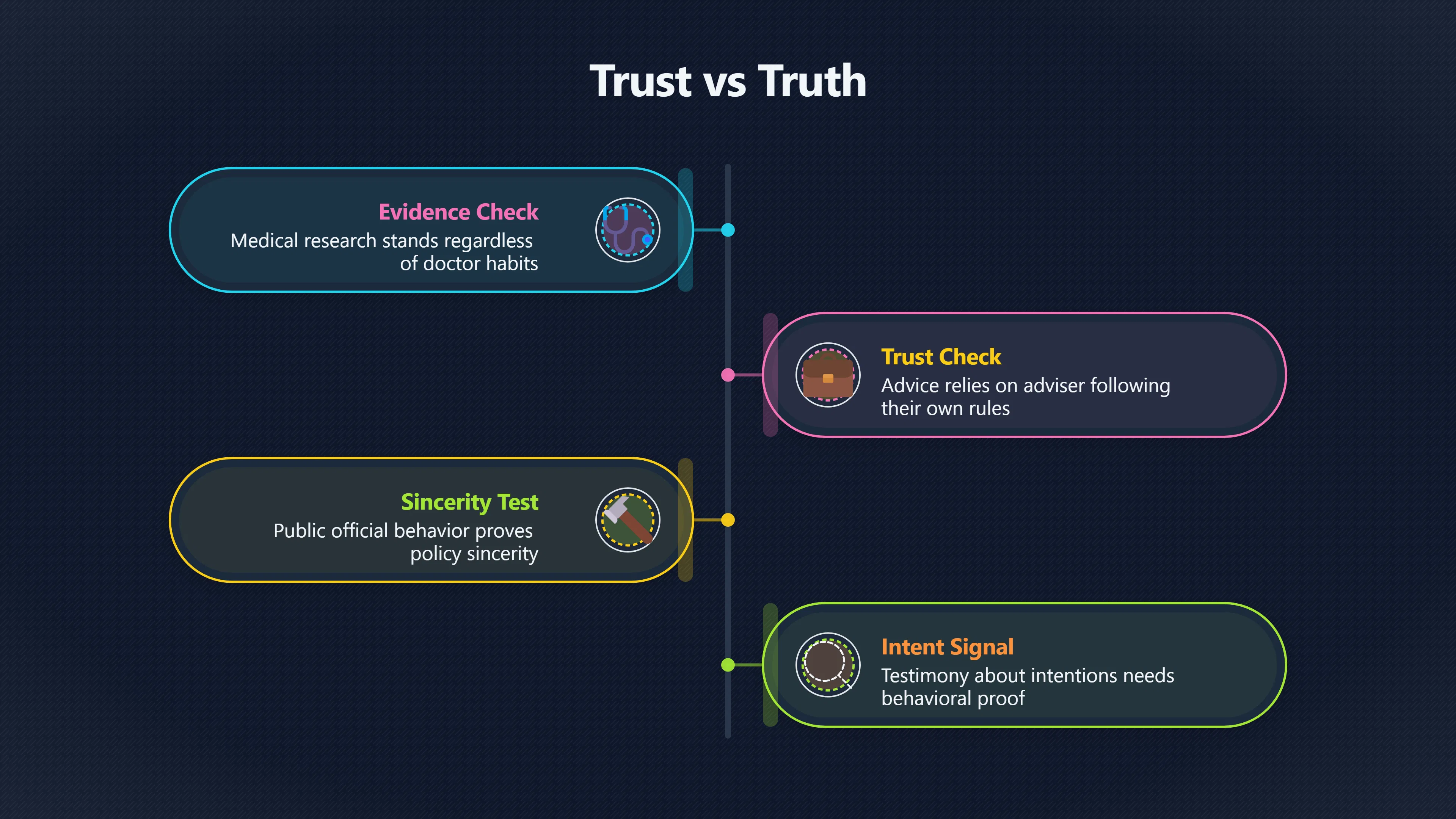
Some claims can be evaluated directly against evidence. If a doctor says smoking increases the risk of lung disease, medical research can be consulted regardless of the doctor’s personal habits. In such cases, hypocrisy may affect the doctor’s reputation but does not directly affect the strength of the evidence.[stanford]plato.stanford.eduEncyclopedia of Philosophy FallaciesIt involves not accepting a view or a recommendation because the espouser him…Read more… Encyclopedia of Philosophy
Other claims depend much more heavily on trust in the speaker. Consider situations where a person asks others to accept:
- Their expert judgement.
- Their moral leadership.
- Their practical advice.
- Their testimony about their own intentions.
- Their assurances that a policy is workable.
In these circumstances, behaviour can provide evidence about whether the speaker genuinely believes what they are saying. If a financial adviser repeatedly ignores the investment principles they recommend, or a public official routinely violates rules they impose on others, observers may reasonably wonder whether the advice is as sound or practical as claimed. The concern is not that the claim has been disproved, but that the speaker’s conduct provides information relevant to assessing credibility.[Informal Logic]informallogic.caInformal Logic Tu Quoque Arguments and the Significance of HypocrisyTu quoque arguments are ad hominem arguments wherein a speaker (B) charges another (A) with inconsistency on an issue of dispute.Read more…
Informal-logic scholar Scott Aikin argues that some arguments from hypocrisy function as challenges to authority rather than direct refutations. The inconsistency may indicate insincerity, incompetence, or knowledge of difficulties that the speaker has not disclosed. In those cases, hypocrisy becomes indirect evidence about the reliability of the source.[Informal Logic]informallogic.caInformal Logic Tu Quoque Arguments and the Significance of HypocrisyTu quoque arguments are ad hominem arguments wherein a speaker (B) charges another (A) with inconsistency on an issue of dispute.Read more…
Insincerity Versus Factual Falsity
One of the most common mistakes in public debate is treating evidence of insincerity as evidence that a factual claim is false.
These are different conclusions.
A person may be hypocritical and still be correct. A politician who violates a transparency rule may nevertheless accurately identify corruption elsewhere. A doctor who smokes may still correctly describe the health risks of smoking. A parent who struggles with debt may still give sound advice about saving money.[stanford]plato.stanford.eduEncyclopedia of Philosophy FallaciesIt involves not accepting a view or a recommendation because the espouser him…Read more… Encyclopedia of Philosophy[EBSCO]ebsco.comAd hominem | Religion and Philosophy | Research StartersAd hominem refers to a logical fallacy where individuals attack their opponents'… What hypocrisy can support is a more limited inference:
- The speaker may not fully believe what they say.
- The speaker may be applying a double standard.
- The speaker may have incentives that affect their judgement.
- The speaker may not possess the practical competence they claim.
These are credibility questions, not truth questions. The distinction matters because audiences often collapse the two. Once a speaker is exposed as inconsistent, people may feel justified in dismissing everything they say. Yet logical evaluation requires separating the reliability of the messenger from the independent merits of the message.[Informal Logic]informallogic.caInformal Logic Tu Quoque Arguments and the Significance of HypocrisyTu quoque arguments are ad hominem arguments wherein a speaker (B) charges another (A) with inconsistency on an issue of dispute.Read more…[Internet Encyclopedia of Philosophy]iep.utm.eduInternet Encyclopedia of PhilosophyFallacies… Ad Hominem Fallacy is deciding whether the personal attack is relevant or irrelevant. For…
This explains why many hypocrisy accusations are rhetorically powerful. They successfully damage trust, and damaged trust is often mistaken for disproof. The persuasive force of the accusation can exceed its evidential value.[stanford]plato.stanford.eduEncyclopedia of Philosophy FallaciesIt involves not accepting a view or a recommendation because the espouser him…Read more… Encyclopedia of Philosophy
How Much Suspicion Is Justified?
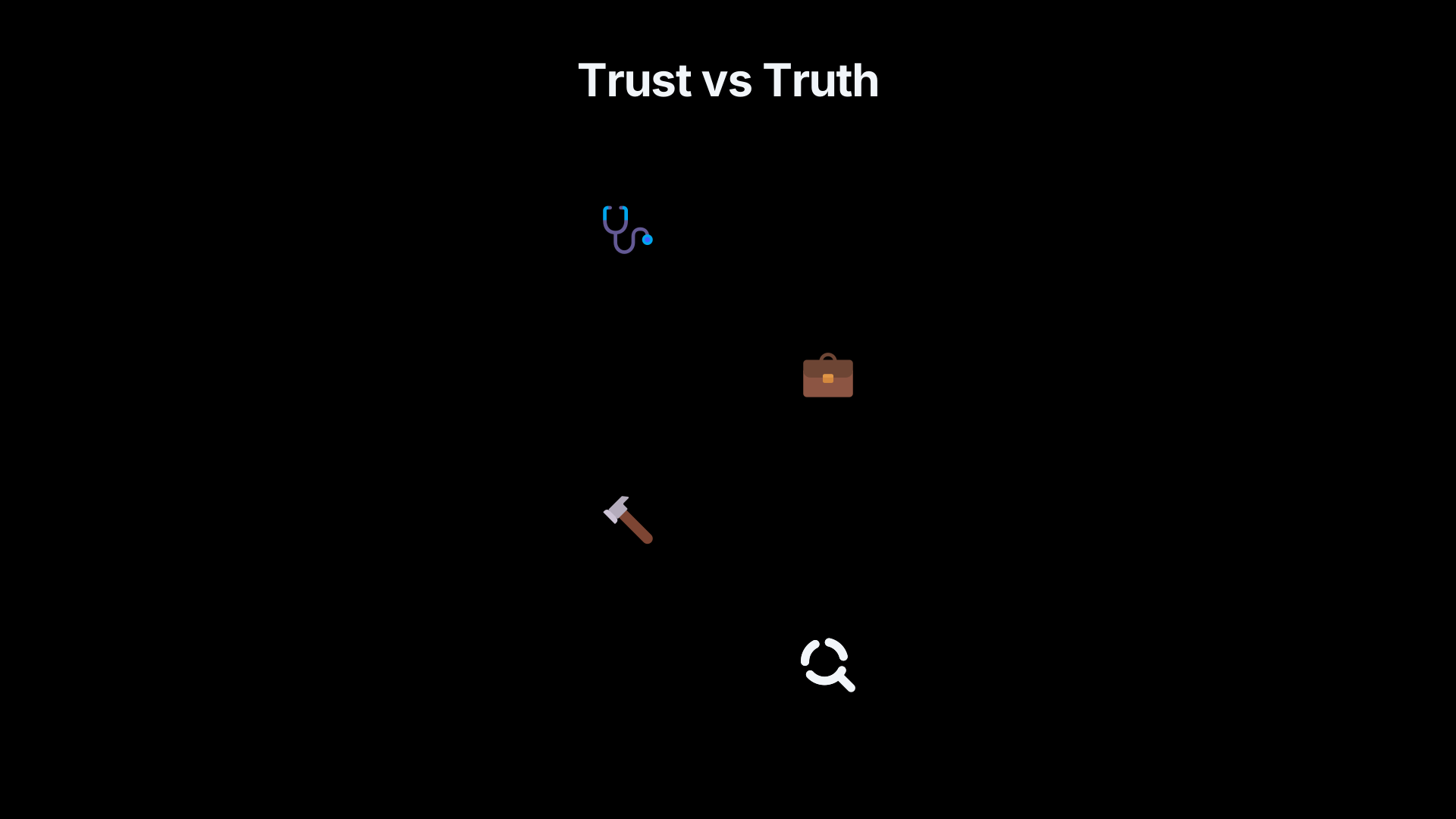
Not every inconsistency warrants the same degree of scepticism. The strength of a credibility challenge depends on the relationship between the hypocrisy and the claim being made.
A stronger challenge exists when the inconsistency directly concerns the basis of the speaker’s authority. For example:
- A regulator secretly violating regulations they publicly defend.
- A witness caught lying about facts closely related to their testimony.
- A self-proclaimed expert repeatedly failing to follow the practices they recommend.
In these cases, the inconsistency may provide relevant evidence that the audience’s trust has been misplaced.[Informal Logic]informallogic.caInformal Logic Tu Quoque Arguments and the Significance of HypocrisyTu quoque arguments are ad hominem arguments wherein a speaker (B) charges another (A) with inconsistency on an issue of dispute.Read more…
A weaker challenge exists when the inconsistency is only loosely connected to the issue. A scientist’s personal shortcomings, political preferences, or unrelated moral failures may have little bearing on the quality of their research. Attacking credibility in those circumstances risks becoming a classic ad hominem diversion.[Internet Encyclopedia of Philosophy]iep.utm.eduInternet Encyclopedia of PhilosophyFallacies… Ad Hominem Fallacy is deciding whether the personal attack is relevant or irrelevant. For…
A useful practical test is to ask: if the speaker were removed entirely, would the claim still stand on its evidence? If the answer is yes, then hypocrisy may justify caution about the source but not rejection of the claim. If the claim depends substantially on trusting the speaker’s judgement, testimony, sincerity, or authority, then the hypocrisy carries greater evidential weight.[Informal Logic]informallogic.caInformal Logic Tu Quoque Arguments and the Significance of HypocrisyTu quoque arguments are ad hominem arguments wherein a speaker (B) charges another (A) with inconsistency on an issue of dispute.Read more…
Why Credibility and Truth Must Be Kept Separate
The most careful approach is to recognise two parallel evaluations.
First, evaluate the claim itself. Is there evidence supporting it? Are the reasons sound? Has the argument been answered?
Second, evaluate the speaker. Does their behaviour affect confidence in their expertise, honesty, commitment, or authority?
Tu quoque reasoning becomes fallacious when these evaluations are merged and a credibility problem is treated as proof that a claim is false. Yet hypocrisy can remain relevant when the issue genuinely concerns whether a speaker deserves trust. The challenge is to use inconsistency as evidence about credibility without allowing it to substitute for evidence about truth.[Informal Logic]informallogic.caInformal Logic Tu Quoque Arguments and the Significance of HypocrisyTu quoque arguments are ad hominem arguments wherein a speaker (B) charges another (A) with inconsistency on an issue of dispute.Read more…[Stanford Encyclopedia of Philosophy]plato.stanford.eduEncyclopedia of Philosophy FallaciesIt involves not accepting a view or a recommendation because the espouser him…Read more…
Amazon book picks
Further Reading
Books and field guides related to When Hypocrisy Really Hurts Credibility. Use these as the next step if you want deeper reading beyond the article.
Mistakes Were Made (but Not by Me)
Directly explores self-justification, inconsistency, and hypocrisy.
Thinking, Fast and Slow
Explains how people assess evidence, expertise, and credibility.
How to Win Every Argument
Covers fallacies and the limits of credibility-based objections.
eBay marketplace picks
Marketplace Samples
Example marketplace items related to this page. Use the search link to explore similar finds on eBay.







Endnotes
1.
Source: plato.stanford.edu
Title: Encyclopedia of Philosophy Fallacies
Link:https://plato.stanford.edu/entries/fallacies/
Source snippet
It involves not accepting a view or a recommendation because the espouser him...Read more...
2.
Source: ebsco.com
Link:https://www.ebsco.com/research-starters/religion-and-philosophy/ad-hominem
3.
Source: plato.stanford.edu
Link:https://plato.stanford.edu/entries/argument/
Source snippet
and Argumentationby C Dutilh Novaes · 2021 · Cited by 105 — Argumentation can be defined as the communicative activity of producing and e...
4.
Source: plato.stanford.edu
Title: category mistakes
Link:https://plato.stanford.edu/entries/category-mistakes/
Source snippet
Mistakes - Stanford Encyclopedia of Philosophyby O Magidor · 2019 · Cited by 172 — Category mistakes are sentences such as 'The number tw...
5.
Source: plato.stanford.edu
Title: logic informal
Link:https://plato.stanford.edu/entries/logic-informal/
Source snippet
more...
6.
Source: plato.stanford.edu
Title: logic informal
Link:https://plato.stanford.edu/archives/sum2002/entries/logic-informal/
Source snippet
Logic" Different kinds of ad hominem (i.e., abusive, circumstantial and tu quoque ad hominem) are construed as different violations of th...
7.
Source: plato.stanford.edu
Link:https://plato.stanford.edu/archives/spr2023/entries/fallacies/
Source snippet
It involves not accepting a view or a recommendation because the espouser him...Read more...
8.
Source: informallogic.ca
Title: [Informal Logic]({{ ‘informal-logic/’ | relative_url }}) Tu Quoque Arguments and the Significance of Hypocrisy
Link:https://informallogic.ca/index.php/informal_logic/article/view/543/506
Source snippet
Tu quoque arguments are ad hominem arguments wherein a speaker (B) charges another (A) with inconsistency on an issue of dispute.Read more...
9.
Source: iep.utm.edu
Link:https://iep.utm.edu/fallacy/
Source snippet
Internet Encyclopedia of PhilosophyFallacies... Ad Hominem Fallacy is deciding whether the personal attack is relevant or irrelevant. For...
10.
Source: Wikipedia
Title: Tu quoque
Link:https://en.wikipedia.org/wiki/Tu_quoque
Source snippet
Tu quoqueTu quoque, literally "you, too", is a rhetorical technique that intends to discredit the opponent's argument by attacking th...
11.
Source: Wikipedia
Title: Ad hominem
Link:https://en.wikipedia.org/wiki/Ad_hominem
Source snippet
Ad hominemAd hominem short for argumentum ad hominem refers to when a speaker attacks the character, motive, or some other attribute o...
12.
Source: thoughtco.com
Title: Tu Quoque
Link:https://www.thoughtco.com/tu-quoque-fallacy-ad-hominem-fallacy-250335
Source snippet
Ad Hominem Fallacy That You Did It Too21 Aug 2019 — The Tu Quoque fallacy is a form of the ad hominem fallacy which does not attack a per...
Additional References
13.
Source: yourlogicalfallacyis.com
Link:https://yourlogicalfallacyis.com/tu-quoque
Source snippet
It is commonly employed as an effective [red herring]({{ 'red-herring/' | relative_url }}) because it takes the heat off someone having to...Read more...
14.
Source: philosophy.lander.edu
Link:https://philosophy.lander.edu/logic/person.html
Source snippet
Philosophy Home PageAd HominemThe ad hominem fallacy occurs whenever the character or circumstances of an individual who is advancing an...
15.
Source: britannica.com
Link:https://www.britannica.com/topic/ad-hominem
Source snippet
Encyclopedia BritannicaAd hominem | Definition, Fallacy, Bias, Examples, & Facts5 days ago — The tu quoque type involves responding in ki...
16.
Source: cliffsnotes.com
Link:https://www.cliffsnotes.com/cliffs-questions/8524229
Source snippet
made the case to me that I need to lose weight, citing several health problems...
17.
Source: researchgate.net
Title: 277060812 Worries About Tu Quoque as a Fallacy
Link:https://www.researchgate.net/publication/277060812_Worries_About_Tu_Quoque_as_a_Fallacy
Source snippet
(PDF) Worries About Tu Quoque as a Fallacy31 Dec 2025 — Tu quoque, Latin for "you also," is an informal logical fallacy in which disputan...
18.
Source: pimaopen.pressbooks.pub
Link:https://pimaopen.pressbooks.pub/intrologic/chapter/2-3-fallacies-of-distraction/
Source snippet
pressbooks.pub2.3 Fallacies of Distraction – An Introduction to LogicFallacies of distraction involve arguing in such a way that the issu...
19.
Source: cambridge.org
Link:https://www.cambridge.org/core/journals/leiden-journal-of-international-law/article/between-showtrials-and-utopia-a-study-of-the-tu-quoque-defence/712A7F0DAFB646CFEA04D229DBECCF46
Source snippet
Between show-trials and Utopia: A study of the tu quoque...by K Borrelli · 2019 · Cited by 19 — Tu quoque, meaning in Latin 'you too', i...
20.
Source: openstax.org
Title: Open Stax5.5 Informal Fallacies
Link:https://openstax.org/books/introduction-philosophy/pages/5-5-informal-fallacies
Source snippet
5.5 Informal Fallacies - Introduction to Philosophy15 Jun 2022 — When someone commits a tu quoque ad hominem fallacy, they attempt to und...
21.
Source: philosophicalsociety.com
Link:https://www.philosophicalsociety.com/HTML/LogicalFallacies.html
Source snippet
claim by assailing the proponent of it.Read more...
22.
Source: logicallyfallacious.com
Link:https://www.logicallyfallacious.com/logicalfallacies/Ad-Hominem-Tu-quoque
Source snippet
ently with the claims of the argument.Read more...
Topic Tree