Within Fallacy Lab
Is New Always Better?
Appeal to novelty assumes newer ideas, tools or policies are better simply because they are recent.
On this page
- Freshness as appeal
- Evidence of improvement
- Comparing old and new
Page outline Jump by section
Introduction
Appeal to novelty is the fallacy of treating newness itself as proof of superiority. It appears when a speaker, advertiser, policymaker or organisation argues that an idea, tool, treatment or reform is better mainly because it is recent, modern, updated or innovative. The mistake is not liking new things. New products and policies can be real improvements. The fallacy occurs when “new” replaces the harder question: better by what measure, for whom, at what cost, and compared with which alternative?
Within logical fallacies, appeal to novelty is an informal fallacy because its weakness depends on context, evidence and the implied assumption behind the claim, rather than on a simple invalid formula. Informal logic is concerned with how reasons support claims in ordinary argument, where missing assumptions and persuasive wording often do much of the work.[stanford]plato.stanford.eduEncyclopedia of Philosophy FallaciesFormal fallacies are those readily seen to be instances of…Read more… Encyclopedia of Philosophy
Freshness as appeal
A typical appeal to novelty has a simple hidden structure: the old option has existed for some time; the new option has just arrived; therefore, the new option is better. Logically, the conclusion does not follow. Newness can be a clue that something might be worth examining, but it is not evidence that the thing is safer, fairer, more effective, more durable or more suitable. Accessible fallacy guides describe the appeal to novelty as claiming that something is superior “exclusively” or “simply” because it is new or modern.[Logically Fallacious]logicallyfallacious.comLogically FallaciousAppeal to NoveltyClaiming that something that is new or modern is superior to the status quo, based exclusively on it…
This makes the fallacy especially persuasive in cultures that associate progress with replacement. Words such as “modern”, “next-generation”, “reimagined”, “upgraded”, “cutting-edge” and “disruptive” can make a proposal feel forward-looking before anyone has asked what has actually improved. Consumer research suggests that even the word “new” in advertising can heighten perceptions of novelty and interest, which helps explain why newness works as a marketing signal even when it does not prove product quality.[ScienceDirect]sciencedirect.comSource details in endnotes.
The fallacy often sits between two different ideas that should be kept separate. One is a factual claim: this thing is recent. The other is an evaluative claim: this thing is better. The first may be easy to verify; the second needs criteria and evidence. A new phone may have a faster processor but worse battery life. A new school policy may use updated language but create more administrative burden. A new medical device may promise access for patients with serious conditions while still involving unresolved uncertainty at the time of authorisation.[U.S. Food and Drug Administration]fda.govU.S. Food and Drug Administration Breakthrough Devices ProgramU.S. Food and Drug Administration Breakthrough Devices Program
When newness is a reason to look, not a reason to believe
Appeal to novelty should not be confused with a reasonable argument for innovation. Sometimes the newer option really is better because it solves a known defect, reflects stronger evidence, uses safer materials, reduces cost, increases accessibility, or fits changed circumstances. A new treatment may outperform an older one in a well-designed trial. A new software interface may reduce errors after proper usability testing. A new law may respond to evidence that an older framework no longer works.
The difference is the role newness plays in the argument. In a sound argument, novelty opens the inquiry: “This is new, so let us test whether it improves the result.” In the fallacy, novelty closes the inquiry: “This is new, so it must be an improvement.” That shift is easy to miss because real progress often does involve new methods. The problem is turning a historical fact into a quality guarantee.
A useful test is to replace “new” with the claimed benefit. Instead of saying “we should adopt the new system because it is modern”, ask: does it reduce waiting times, improve accuracy, cut maintenance costs, protect users, or make the process fairer? If the argument becomes weaker once the word “new” is removed, it may have been relying on freshness rather than evidence.
Evidence of improvement
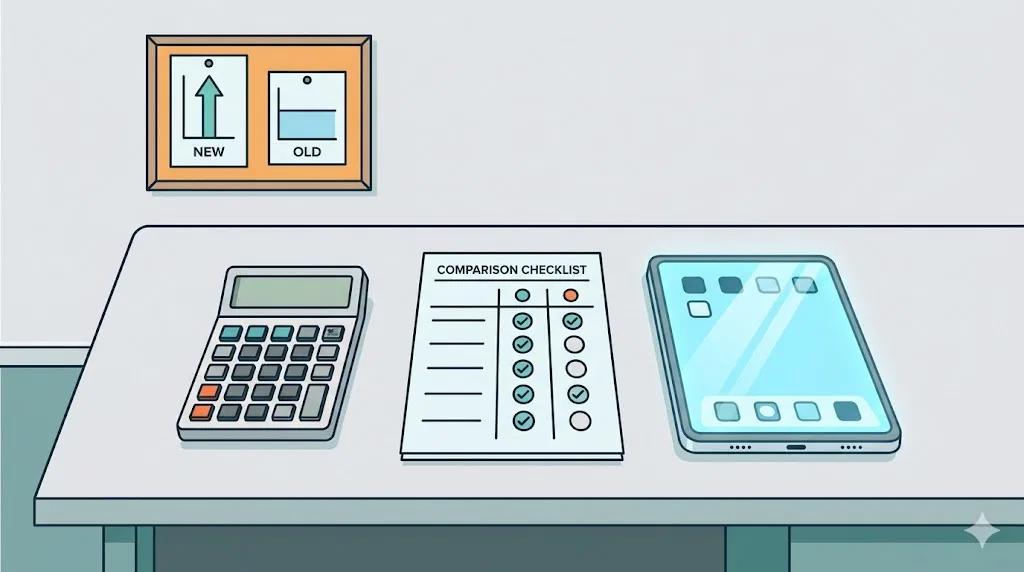
The strongest response to a new-is-better claim is not cynicism. It is comparison. The question is not whether the new option has attractive features, but whether it improves on the relevant baseline. The baseline may be an older product, the current policy, standard care, an existing workflow, or doing nothing. Without that comparison, “new” can conceal trade-offs.
In medicine, this distinction is unusually clear because a new treatment may be promising, but patient benefit depends on evidence. The Catalogue of Bias describes “novelty bias” in clinical research as the appearance that a new treatment is better because it is new, and notes that meta-analyses of medicine trials have found novelty can make an intervention appear between 2% and 27% better when it is novel.[catalogofbias.org]catalogofbias.orgSource details in endnotes. A separate review of randomised clinical trials identified 396 medical reversals, where later, stronger evidence contradicted established clinical practices.[PMC]pmc.ncbi.nlm.nih.govSource details in endnotes.
That does not mean older medicine is automatically better. It means “new” and “proved improvement” are different claims. A study of new versus established treatments found that new treatments were, on average, only very slightly more likely to have favourable results than established ones.[PMC]pmc.ncbi.nlm.nih.govSource details in endnotes. Reporting on German drug assessments, Chemistry World noted that among 216 new approvals in Germany between 2011 and 2017, only about a quarter conclusively showed a considerable or major added benefit over standard care.[Chemistry World]chemistryworld.comChemistry World Are new drugs better than existing ones? | OpinionChemistry World Are new drugs better than existing ones? | Opinion
The same discipline applies outside medicine. In technology, a new tool should be judged by outcomes: reliability, usability, security, maintainability, total cost, user learning curve and measurable benefit. Gartner’s Hype Cycle framework is used to think about how technologies evolve over time and how organisations can time deployment against business goals, not simply adopt whatever is newest.[Gartner]gartner.comOpen source on gartner.com. Research on online experiments also warns that early effects may be distorted by novelty: users may engage with a new feature at first because it is fresh, then behave differently after learning or habituation.[arXiv]arxiv.orgarXiv Novelty and Primacy: A Long-Term Estimator for Online ExperimentsarXiv Novelty and Primacy: A Long-Term Estimator for Online Experiments
Comparing old and new
The appeal to novelty has an opposite fallacy: appeal to tradition, where a claim is treated as correct because it is old or customary. Both make the same kind of mistake. One treats age as proof of quality; the other treats recency as proof of quality. A careful comparison rejects both shortcuts.
The better question is: what does each option preserve, improve, weaken or risk? Older systems can have advantages that are not glamorous: known failure modes, trained users, spare parts, tested procedures, institutional memory, legal clarity and predictable costs. Newer systems can have advantages too: better materials, more inclusive design, stronger data, improved safety standards or adaptation to present conditions. The age of the option is not the answer; it is one fact in the evaluation.
A practical comparison can ask:
- What problem is the new option meant to solve? If the problem is vague, novelty may be standing in for strategy.
- What evidence shows improvement? Look for trials, audits, user testing, independent reviews, field data or credible case comparisons.
- What does the old option do well? A replacement can lose hidden strengths that were never measured.
- Who bears the transition cost? Training, disruption, compatibility problems and maintenance may fall on users rather than decision-makers.
- What would count as failure? If no one can name a measurable downside, the proposal may be protected by hype rather than evidence.
The New Coke case shows why comparison must include more than surface preference. Coca-Cola introduced a reformulated drink in April 1985 after taste-testing and competitive pressure, but the public backlash became one of the most famous product failures in consumer-goods history; the company restored the original formula as Coca-Cola Classic within months. Coca-Cola’s own history describes the decision as a major risk that generated extraordinary consumer angst, while Britannica summarises the episode as a reformulation intended to revitalise the brand that quickly provoked a furour.[Coca-Cola Company]coca-colacompany.comnew coke the most memorable marketing blunder evernew coke the most memorable marketing blunder ever The lesson is not that reformulation is always wrong. It is that “new taste” was not the same as “better brand experience” for loyal consumers.
Why the fallacy is so tempting
Appeal to novelty works because it borrows emotional force from genuine progress. Many improvements in public health, engineering, rights, education and everyday convenience really have come from rejecting obsolete assumptions. That history makes “new” sound morally and practically attractive. No one wants to be the person defending an outdated tool merely because it is familiar.
The fallacy also offers social signalling. Supporting the newest platform, policy language or management trend can make a person look informed, ambitious and adaptive. Resisting it can be framed as fear, nostalgia or backwardness, even when the resistance is evidence-based. This rhetorical pressure is powerful because it shifts the burden of proof: critics are asked to justify why they are “against progress”, while advocates are not asked to prove that the specific new proposal improves outcomes.
Technology hype makes this pattern visible. Gartner’s model is built around the idea that expectations for emerging technologies can rise, disappoint and then settle as practical uses become clearer.[Gartner]gartner.dehype cycle fuer neue technologienhype cycle fuer neue technologien The model itself is debated, but the broader warning is useful: early excitement is not the same as mature value. A new system may be worth piloting while still being a poor candidate for full adoption.
Public policy has a similar problem. OECD work on innovation policy argues that innovations should not be treated as beneficial in themselves, but judged by their positive and negative social externalities.[OECD]oecd.orgInnovation policy transformed? (ENInnovation policy transformed? (EN That is exactly the reasoning discipline appeal to novelty tends to bypass. Innovation can help, but the word does not settle the argument.
How new-is-better claims show up in everyday arguments
Appeal to novelty rarely announces itself as a formal syllogism. It usually appears in ordinary persuasive language.
A company may say, “Our new AI-powered process is the future of customer service,” without showing whether customers get faster, fairer or more accurate help. A school may replace a familiar teaching method with a branded modern approach before comparing learning outcomes. A government may present a digital service as efficient because it is online, while ignoring users who lack access, confidence or support. A consumer may buy an upgraded product because it is the latest model, even if the older model meets their needs better.
Healthcare provides a sharper version because the stakes are high. The United States Food and Drug Administration says its Breakthrough Devices Program is intended to give patients and clinicians timely access to certain medical devices by speeding development, assessment and review, while still requiring rigorous safety and effectiveness standards.[U.S. Food and Drug Administration]fda.govU.S. Food and Drug Administration Breakthrough Devices ProgramU.S. Food and Drug Administration Breakthrough Devices Program Its guidance also recognises that premarket decisions involve uncertainty about benefits and risks, and that some questions may be answered after market access rather than before it.[U.S. Food and Drug Administration]fda.govU.S. Food and Drug Administration Breakthrough Devices ProgramU.S. Food and Drug Administration Breakthrough Devices Program This is not a fallacy by itself; regulators may reasonably balance urgency and evidence. The fallacy would be to treat “breakthrough” or “first-in-class” as proof that patients will necessarily fare better.
Artificial intelligence in healthcare shows the same caution. A recent systematic review on AI-related algorithmic decision-making in healthcare reported that although such systems may perform some tasks impressively, evidence about patient-relevant outcomes remains uncertain when compared with standard care.[ScienceDirect]sciencedirect.comSource details in endnotes. The critical question is not whether the tool is advanced, but whether it improves outcomes that matter to patients and clinicians.
Spotting the fallacy without rejecting progress
The safest way to identify appeal to novelty is to look for missing comparative evidence. Newness may be mentioned prominently, but the argument becomes fallacious when it is doing the work that evidence should do.
A claim is more suspicious when it uses age as a substitute for evaluation: “That method is outdated”, “this is the modern way”, “legacy systems are holding us back”, “everyone is moving to this”, or “the latest version must be the best.” Some of those statements may be true in a particular case, but they still need support. What is outdated about the older method? What specific weakness does the newer version fix? What evidence shows the change works after the initial excitement fades?
A fair assessment should leave room for three possible outcomes. The new option may be better. The old option may be better. Or the best answer may be a hybrid: keep the reliable parts of the older system while adopting the new elements that have actually proved their worth. This is often the most realistic route in organisations, where abrupt replacement can create risks that gradual improvement would avoid.
The goal is not to become anti-new. It is to make newness answerable to evidence. A strong case for change can say: “This is new, and here is the specific defect it fixes, the comparison showing improvement, the cost of transition, the risks we have tested, and the conditions under which we would reverse course.” That argument does not rely on novelty as a shortcut. It treats novelty as a claim to be examined.
The core lesson
Appeal to novelty matters because it turns a timeline into an argument. It asks readers, voters, patients, buyers or employees to confuse recency with merit. That confusion can waste money, bury useful older practices, rush weak evidence into high-stakes settings, and make reasonable scepticism look like hostility to progress.
The better habit is historical comparison. Ask what changed, why it changed, what evidence supports the change, and what the older option was already doing well. New can be better. Old can be better. The fallacy begins when the calendar is treated as proof.
Amazon book picks
Further Reading
Books and field guides related to Is New Always Better?. Use these as the next step if you want deeper reading beyond the article.
The Skeptics' Guide to the Universe
Provides tools for evaluating claims beyond marketing language.
An Illustrated Book of Bad Arguments
Includes reasoning patterns related to unsupported claims of superiority.
eBay marketplace picks
Marketplace Samples
Example marketplace items related to this page. Use the search link to explore similar finds on eBay.





Endnotes
1.
Source: plato.stanford.edu
Title: Encyclopedia of Philosophy Fallacies
Link:https://plato.stanford.edu/entries/fallacies/
Source snippet
Formal fallacies are those readily seen to be instances of...Read more...
2.
Source: Wikipedia
Title: Appeal to novelty
Link:https://en.wikipedia.org/wiki/Appeal_to_novelty
Source snippet
April 23, 2026 — The appeal to novelty is a logical fallacy in which one prematurely claims that an idea or proposal is correct or superi...
Published: April 23, 2026
3.
Source: sciencedirect.com
Link:https://www.sciencedirect.com/science/article/abs/pii/S0969698916300406
4.
Source: catalogofbias.org
Link:https://catalogofbias.org/biases/novelty-bias/
5.
Source: pmc.ncbi.nlm.nih.gov
Link:https://pmc.ncbi.nlm.nih.gov/articles/PMC3490226/
6.
Source: gartner.com
Link:https://www.gartner.com/en/research/methodologies/gartner-hype-cycle
7.
Source: arxiv.org
Title: arXiv Novelty and Primacy: A Long-Term Estimator for Online Experiments
Link:https://arxiv.org/abs/2102.12893
8.
Source: britannica.com
Title: New Coke
Link:https://www.britannica.com/topic/New-Coke
9.
Source: sciencedirect.com
Link:https://www.sciencedirect.com/science/article/abs/pii/S0040162516300270
10.
Source: oecd.org
Title: Innovation policy transformed? (EN)
Link:https://www.oecd.org/content/dam/oecd/en/publications/reports/2025/06/innovation-policy-transformed_a41c1db5/5ee60cb5-en.pdf
11.
Source: sciencedirect.com
Link:https://www.sciencedirect.com/science/article/pii/S2666776224003144
12.
Source: Wikipedia
Title: Appeal to tradition
Link:https://en.wikipedia.org/wiki/Appeal_to_tradition
13.
Source: Wikipedia
Title: List of fallacies
Link:https://en.wikipedia.org/wiki/List_of_fallacies
14.
Source: Wikipedia
Title: New Coke
Link:https://en.wikipedia.org/wiki/New_Coke
15.
Source: Wikipedia
Title: Gartner hype cycle
Link:https://en.wikipedia.org/wiki/Gartner_hype_cycle
16.
Source: Wikipedia
Title: Informal fallacy
Link:https://en.wikipedia.org/wiki/Informal_fallacy
17.
Source: plato.stanford.edu
Title: logic informal
Link:https://plato.stanford.edu/entries/logic-informal/
18.
Source: plato.stanford.edu
Link:https://plato.stanford.edu/archives/fall1997/entries/logic-informal/
19.
Source: plato.stanford.edu
Link:https://plato.stanford.edu/entries/argument/
20.
Source: plato.stanford.edu
Title: logic informal
Link:https://plato.stanford.edu/archives/fall2021/entries/logic-informal/
21.
Source: plato.stanford.edu
Title: logic informal
Link:https://plato.stanford.edu/archives/win2019/entries/logic-informal/
22.
Source: plato.stanford.edu
Title: logic informal
Link:https://plato.stanford.edu/archives/sum2004/entries/logic-informal/
23.
Source: oecd.org
Link:https://www.oecd.org/content/dam/oecd/en/publications/reports/2014/04/making-innovation-policy-work_g1g24173/9789264185739-en.pdf
24.
Source: oecd.org
Link:https://www.oecd.org/content/dam/oecd/en/publications/reports/2020/10/broad-based-innovation-policy-for-all-regions-and-cities_1ce6985d/299731d2-en.pdf
25.
Source: oecd.org
Link:https://www.oecd.org/en/publications/innovation-policy-and-performance_9789264006737-en.html
26.
Source: gartner.de
Title: hype cycle fuer neue technologien
Link:https://www.gartner.de/de/artikel/hype-cycle-fuer-neue-technologien
27.
Source: logicallyfallacious.com
Link:https://www.logicallyfallacious.com/logicalfallacies/Appeal-to-Novelty
Source snippet
Logically FallaciousAppeal to NoveltyClaiming that something that is new or modern is superior to the [status quo]({{ 'status-quo/' | relative_url }}), based exclusively on it...
28.
Source: fda.gov
Title: U.S. Food and Drug Administration Breakthrough Devices Program
Link:https://www.fda.gov/medical-devices/how-study-and-market-your-device/breakthrough-devices-program
29.
Source: fda.gov
Link:https://www.fda.gov/files/guidance%20documents/published/Breakthrough-Devices-Program.pdf
30.
Source: chemistryworld.com
Title: Chemistry World Are new drugs better than existing ones? | Opinion
Link:https://www.chemistryworld.com/opinion/are-new-drugs-better-than-existing-ones/3010774.article
31.
Source: coca-colacompany.com
Title: new coke the most memorable marketing blunder ever
Link:https://www.coca-colacompany.com/about-us/history/new-coke-the-most-memorable-marketing-blunder-ever
32.
Source: thebrandingjournal.com
Title: new coke
Link:https://www.thebrandingjournal.com/2025/02/new-coke/
33.
Source: logical-fallacy.com
Title: Appeal to Novelty
Link:https://www.logical-fallacy.com/articles/appeal-to-novelty/
34.
Source: youtube.com
Title: Gartner Hype Cycles, Explained
Link:https://www.youtube.com/watch?v=jB1RDz9jaj0
35.
Source: ebsco.com
Title: new coke
Link:https://www.ebsco.com/research-starters/marketing/new-coke
36.
Source: coca-colacompany.com
Link:https://www.coca-colacompany.com/about-us/history
37.
Source: bmc.com
Title: gartner hype cycle
Link:https://www.bmc.com/blogs/gartner-hype-cycle/
38.
Source: ideatovalue.com
Title: novelty bias
Link:https://www.ideatovalue.com/curi/nickskillicorn/2022/05/novelty-bias/
39.
Source: delightability.com
Title: Appeal to Novelty
Link:https://www.delightability.com/free-stuff/appeal-novelty-logical-fallacy/
Additional References
40.
Source: iep.utm.edu
Link:https://iep.utm.edu/fallacy/
Source snippet
Internet Encyclopedia of PhilosophyFallaciesA formal fallacy can be detected by examining the logical form of the reasoning, whereas an i...
41.
Source: youtube.com
Link:https://www.youtube.com/watch?v=YZMpnK4JA90
Source snippet
Chronological Snobbery - a logical fallacy...
42.
Source: youtube.com
Title: Critical Thinking: The Fallacy of Appeal to Novelty
Link:https://www.youtube.com/watch?v=KpOEr18m4vw
Source snippet
Chronological Snobbery Fallacy | Middle and High School Homeschooling Logic/Argument video...
43.
Source: hutchdatascience.org
Link:https://hutchdatascience.org/AI_for_Decision_Makers/references.html
44.
Source: businessatoecd.org
Link:https://www.businessatoecd.org/hubfs/website/documents/pdf/Innovation%20and%20Tech/Science%2C%20Technology%20and%20Innovation%20Policies%20for%20Society%20-%20April%202019.pdf
45.
Source: youtube.com
Title: Avoiding the Appeal to Novelty: When New Isn’t Always Better
Link:https://www.youtube.com/watch?v=SJWvTZ3h18E
Source snippet
Critical Thinking: The Fallacy of Appeal to Novelty...
46.
Source: researchgate.net
Link:https://www.researchgate.net/publication/387297646_Cross-sectional_evaluation_of_medical_reversals_among_National_Institute_of_Health_guideline_practices_implemented_during_the_COVID-19_pandemic_how_often_did_experts_err_in_a_time_of_crisis
47.
Source: tvtropes.org
Link:https://tvtropes.org/pmwiki/pmwiki.php/Main/AppealToNovelty
48.
Source: podiapaedia.org
Link:https://podiapaedia.org/wiki/research/pseudoscience/logical-fallacies/appeal-to-novelty-fallacy/
49.
Source: fallacyguide.com
Link:https://fallacyguide.com/fallacies/appeal-to-novelty
Topic Tree