Within Bandwagon
Why Disagreement Feels Socially Risky
People may publicly agree with a group because dissent feels embarrassing, isolating, or socially risky even when they privately doubt it.
On this page
- How normative pressure changes public agreement
- Common settings where silence feels safer
- Ways one dissenting voice changes the room
Page outline Jump by section
Introduction
Normative conformity is the social mechanism that makes people publicly agree with a group even when they privately disagree. Within bandwagon pressure, the key force is not evidence but the fear of standing alone. A person may suspect that a claim is weak, inaccurate, or unsupported, yet still nod along because disagreement risks embarrassment, exclusion, conflict, or damage to relationships. This matters for logical fallacies because apparent consensus can be mistaken for genuine agreement. When many people stay silent for social reasons, a popular view can appear stronger, more widely accepted, and more persuasive than it actually is. Research on conformity and public opinion repeatedly shows that people often adjust what they say in public to avoid social costs, even when their private judgement remains unchanged.[opentextbc.ca]opentextbc.cathe many varieties of conformitynormative social influence often represents public compliance rather than private acceptance. Public compliance is a superficial change i…

Why Disagreement Feels Socially Risky
Normative conformity operates through belonging. Human beings are highly sensitive to acceptance and rejection within groups. In many situations, the immediate social consequences of dissent feel more tangible than the abstract value of being correct.
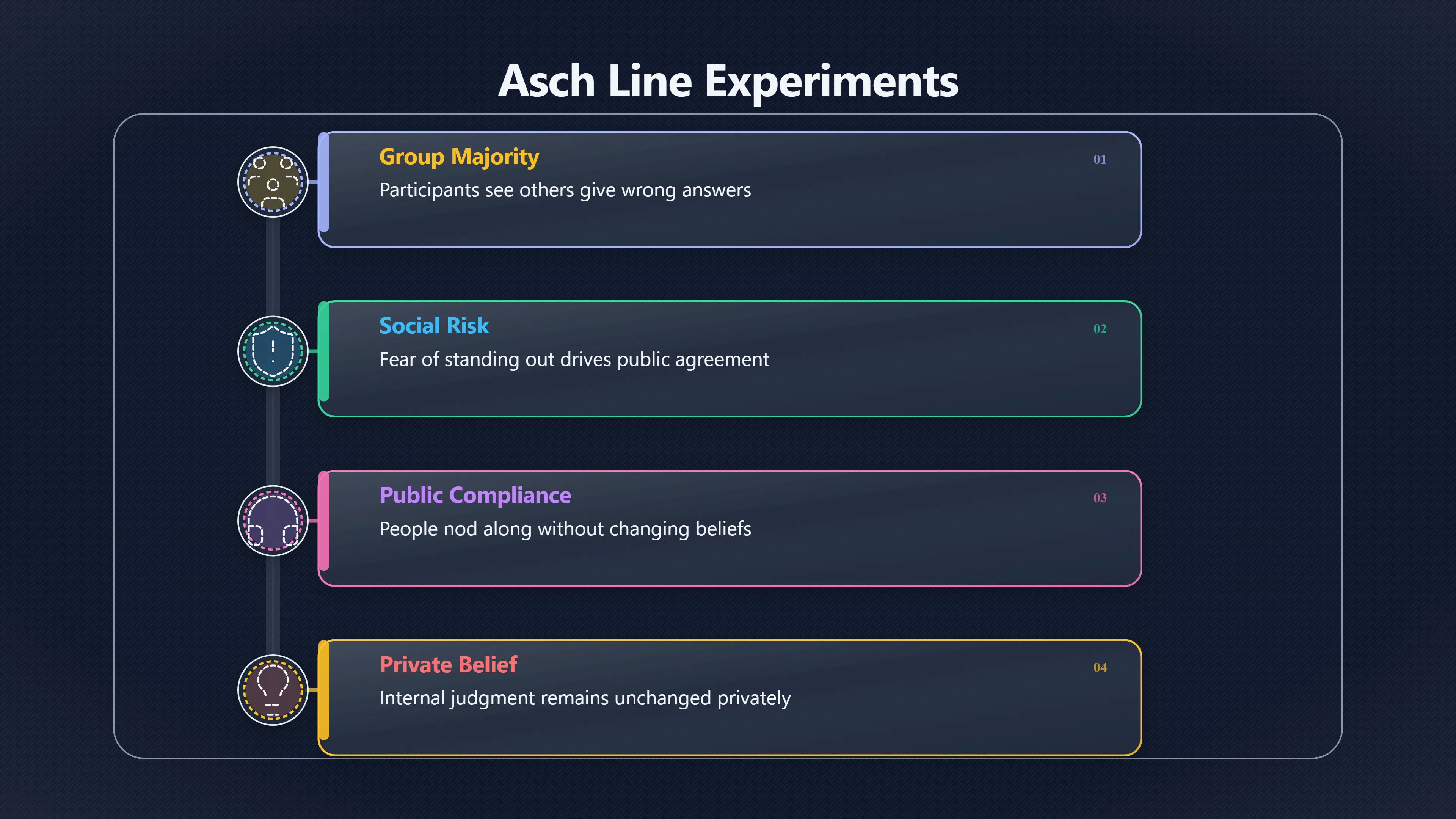
The classic conformity experiments conducted by psychologist Solomon Asch demonstrated this dynamic. Participants were placed in groups where others intentionally gave obviously incorrect answers. Many participants followed the majority at least some of the time despite being able to see that the group was wrong. Later interpretations of these experiments emphasised normative influence: people often complied publicly to avoid standing out or appearing foolish in front of others.[Simply Psychology]simplypsychology.orgSimply PsychologyAsch Conformity Line Experimentby S McLeod · Cited by 2 — Solomon Asch experimented with investigating the extent to whi…[EBSCO The important distinction is between]ebsco.comasch conformity experimentsHistory | Research StartersThe Asch conformity experiments, conducted by Solomon Asch in the 1950s, explored the impact of social pressur…public agreement and private belief. Normative conformity frequently changes what people express rather than what they actually think. Someone may outwardly support a position, laugh at a joke they dislike, or remain silent during a discussion while internally remaining unconvinced. Social psychologists describe this as public compliance rather than genuine acceptance.[opentextbc.ca]opentextbc.cathe many varieties of conformitynormative social influence often represents public compliance rather than private acceptance. Public compliance is a superficial change i…
For logical reasoning, this distinction matters because visible agreement is often treated as evidence that a claim has been independently evaluated and accepted. In reality, some of that agreement may reflect social caution rather than conviction.
How Normative Pressure Changes Public Agreement
Normative pressure alters behaviour through several connected steps.
First, people observe what appears to be the majority position. They notice who receives approval, who gets interrupted, and which opinions are treated as normal.
Second, they anticipate social consequences. These consequences may be mild—awkwardness, disapproval, being seen as difficult—or more serious, such as exclusion from a valued group.
Third, they adjust their public behaviour. Some openly agree. Others soften objections, change the subject, or remain silent.
The result is a distorted public picture. What appears to be unanimous support may actually include many people who privately disagree but see little benefit in speaking up. This is one reason bandwagon arguments can feel persuasive: the apparent size of the majority may partly be created by conformity itself.
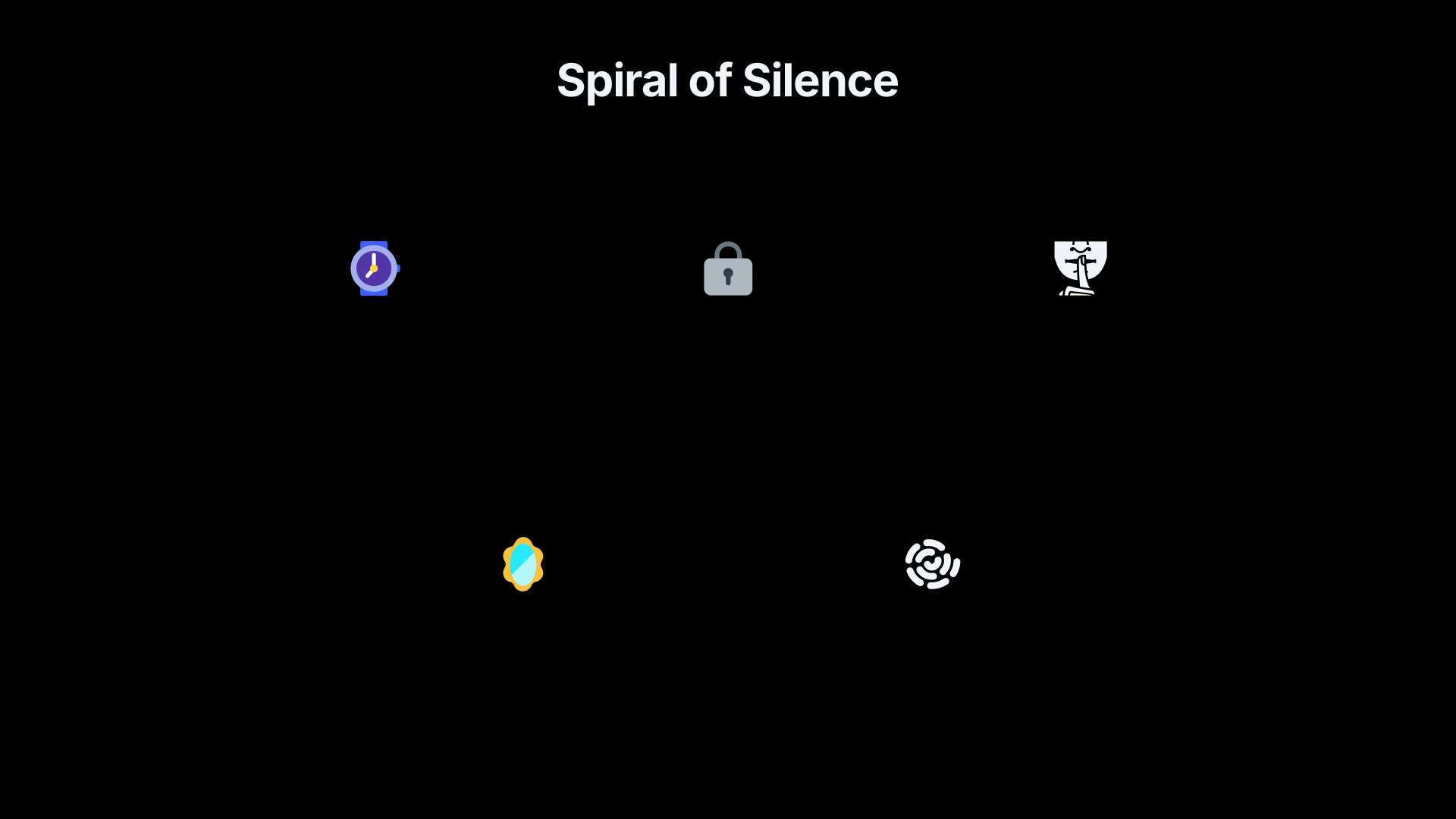
Research on the “spiral of silence” provides a useful framework. Developed by communication scholar Elisabeth Noelle-Neumann, the theory argues that people monitor the climate of opinion and become less willing to express views they believe are unpopular. Fear of social isolation encourages self-censorship, which makes the dominant view seem even more dominant. The silence of dissenters is then interpreted as agreement, reinforcing the cycle.[Encyclopedia Britannica]britannica.comEncyclopedia BritannicaSpiral of silence | Social Psychology, Communication &…According to the spiral of silence theory, most people h…[EBSCO In this way]ebsco.comasch conformity experimentsHistory | Research StartersThe Asch conformity experiments, conducted by Solomon Asch in the 1950s, explored the impact of social pressur…, normative conformity does not merely respond to perceived consensus; it can help create the appearance of consensus.
Common Settings Where Silence Feels Safer
Normative conformity is especially powerful in environments where social relationships matter and disagreement is visible.
Workplaces
Employees may hesitate to challenge a proposal supported by managers or influential colleagues. Even when concerns are legitimate, speaking up can feel risky if it threatens status, promotion prospects, or workplace relationships.
Classrooms and Training Environments
Students often gauge peer reactions before contributing. If a dominant opinion emerges early, others may withhold alternative perspectives to avoid appearing uninformed or disruptive.

Friendship Groups
Social harmony frequently takes priority over accuracy. People may laugh along, agree with plans they dislike, or avoid correcting misinformation because maintaining group cohesion feels more important than winning an argument.
Political and Cultural Discussions
Topics tied to identity often create strong conformity pressures. Individuals may fear being labelled, criticised, or excluded if they express uncertainty or disagreement. Under these conditions, silence can be mistaken for widespread endorsement.[Wikipedia]WikipediaSpiral of silenceSpiral of silence
Online Communities
Digital spaces can intensify normative pressure because approval and disapproval are publicly visible through replies, reactions, shares, and other engagement signals. Recent research examining online communities found that people who perceive themselves to be in the minority are substantially less likely to express their views publicly, helping visible opinion distributions diverge from private beliefs.[arXiv]arxiv.orgMapping the Spiral of Silence: Surveying Unspoken Opinions in Online CommunitiesFebruary 2, 2025…
Ways One Dissenting Voice Changes the Room
One of the most important findings in conformity research is that unanimity is often more powerful than numbers alone.
In variations of the Asch experiments, conformity dropped dramatically when even a single other person broke from the majority. The dissenter did not necessarily need to persuade anyone. Simply demonstrating that disagreement was possible reduced the pressure to conform. Participants became more willing to trust their own judgement once they were no longer completely isolated.[Wikipedia]WikipediaAsch conformity experimentsAsch conformity experiments
This effect reveals something important about normative conformity: many people are not convinced by the majority’s reasoning. They are responding to the social experience of being alone.
A lone dissenter changes the situation in several ways:
- It breaks the appearance of unanimous agreement.
- It signals that disagreement is socially possible.
- It reduces the personal cost of speaking up.
- It encourages others with private doubts to express them.
Research on conformity consistently finds that unanimity is a critical source of pressure. Once unanimity disappears, independent judgement becomes much easier.[PSYCHSTORY]psychstory.co.ukASCH: VARIABLES AFFECTING CONFORMITYHis findings suggested that conformity rates might be lower when individuals are not under direct gro…
Why This Matters for Logical Fallacies
Normative conformity helps explain why bandwagon reasoning can be so persuasive even when evidence is weak. People often encounter a claim that appears widely accepted and assume that widespread acceptance reflects strong justification.
However, apparent agreement can emerge from social dynamics rather than careful evaluation. If individuals stay silent because dissent feels risky, the visible majority may not accurately represent what people actually believe. The group then appears more unified than it truly is, making appeals to popularity seem more convincing.
The practical lesson is not that majorities are usually wrong. Many majorities are correct. The lesson is that popularity and truth are different questions. When evaluating a claim, it is worth asking whether support reflects evidence, or whether some portion of the apparent consensus may have been shaped by the simple human reluctance to stand alone.[opentextbc.ca]opentextbc.cathe many varieties of conformitynormative social influence often represents public compliance rather than private acceptance. Public compliance is a superficial change i…[Encyclopedia Britannica]britannica.comEncyclopedia BritannicaSpiral of silence | Social Psychology, Communication &…According to the spiral of silence theory, most people h…
Amazon book picks
Further Reading
Books and field guides related to Why Disagreement Feels Socially Risky. Use these as the next step if you want deeper reading beyond the article.
The Presentation of Self in Everyday Life
Rating: 4.5/5 from 8 Google Books ratings
Explores impression management and the social risks of standing apart.
eBay marketplace picks
Marketplace Samples
Example marketplace items related to this page. Use the search link to explore similar finds on eBay.




Endnotes
1.
Source: opentextbc.ca
Title: the many varieties of conformity
Link:https://opentextbc.ca/socialpsychology/chapter/the-many-varieties-of-conformity/
Source snippet
normative social influence often represents public compliance rather than private acceptance. Public compliance is a superficial change i...
2.
Source: ebsco.com
Title: asch conformity experiments
Link:https://www.ebsco.com/research-starters/history/asch-conformity-experiments
Source snippet
History | Research StartersThe Asch conformity experiments, conducted by Solomon Asch in the 1950s, explored the impact of social pressur...
3.
Source: psychology.town
Link:https://psychology.town/advanced-social/understanding-conformity-factors-experiments/
Source snippet
Understanding Conformity: Factors and Experiments in...30 Oct 2025 — Normative social influence is the pressure to conform in order to f...
4.
Source: britannica.com
Link:https://www.britannica.com/topic/spiral-of-silence
Source snippet
Encyclopedia BritannicaSpiral of silence | Social Psychology, Communication &...According to the spiral of silence theory, most people h...
5.
Source: ebsco.com
Link:https://www.ebsco.com/research-starters/social-sciences-and-humanities/spiral-silence
Source snippet
Spiral of silence | Social Sciences and HumanitiesThe spiral of silence is a public opinion theory developed by German communications res...
6.
Source: Wikipedia
Title: Spiral of silence
Link:https://en.wikipedia.org/wiki/Spiral_of_silence
7.
Source: arxiv.org
Link:https://arxiv.org/abs/2502.00952
Source snippet
Mapping the Spiral of Silence: Surveying Unspoken Opinions in Online CommunitiesFebruary 2, 2025...
Published: February 2, 2025
8.
Source: Wikipedia
Title: Asch conformity experiments
Link:https://en.wikipedia.org/wiki/Asch_conformity_experiments
9.
Source: psychology.town
Title: asch conformity line length experiments
Link:https://psychology.town/social/asch-conformity-line-length-experiments/
Source snippet
Inside Asch's Line and Length Experiments14 Nov 2025 — Asch also found that group size had a ceiling effect on conformity. Conformity inc...
10.
Source: Wikipedia
Title: Solomon Asch
Link:https://en.wikipedia.org/wiki/Solomon_Asch
Source snippet
Solomon AschSolomon Eliot Asch (September 14, 1907 – February 20, 1996) was a Polish-American Gestalt psychologist and pioneer in soci...
Published: September 14, 1907
11.
Source: psychology.town
Title: asch experiments conformity alternatives consequences
Link:https://psychology.town/social/asch-experiments-conformity-alternatives-consequences/
Source snippet
more...
12.
Source: psychology.town
Title: private responses. Understand social
Link:https://psychology.town/social/asch-conformity-experiments-variations-insights/
Source snippet
Exploring Variations in Conformity: Asch's Experimental...17 Nov 2025 — Explore Solomon Asch's conformity experiments: group size, disse...
13.
Source: noelle-neumann.de
Title: Spiral of Silence
Link:https://noelle-neumann.de/scientific-work/spiral-of-silence/
Source snippet
Elisabeth Noelle-NeumannThe theory explains how sways in public opinion may come about, especially in morally and emotionally laden debat...
14.
Source: simplypsychology.org
Link:https://www.simplypsychology.org/asch-conformity.html
Source snippet
Simply PsychologyAsch Conformity Line Experimentby S McLeod · Cited by 2 — Solomon Asch experimented with investigating the extent to whi...
15.
Source: psychstory.co.uk
Link:https://www.psychstory.co.uk/social-influence/asch-variables-affecting-conformity
Source snippet
ASCH: VARIABLES AFFECTING CONFORMITYHis findings suggested that conformity rates might be lower when individuals are not under direct gro...
16.
Source: doctorspin.net
Title: The Spiral of Silence
Link:https://doctorspin.net/spiral-of-silence/
Source snippet
Doctor SpinElisabeth Noelle-Neumann's well-documented theory on the spiral of silence (1974) explains why fear of isolation might serve t...
Additional References
17.
Source: scribd.com
Link:https://www.scribd.com/document/557620371/Deutsch-Morton-Harold-B-Gerard-a-Study-of-Normative-and-Informational-Social-Influences-Upon-Individual-Judgment
Source snippet
Normative vs Informational Influence Study | PDF | ConformityThis document outlines hypotheses about two types of social influence - norm...
18.
Source: researchgate.net
Link:https://www.researchgate.net/publication/330279751_Spiral_of_Silence_A_Powerful_Perspective_of_Understanding_the_Public_Opinion
Source snippet
(PDF) Spiral of Silence: A Powerful Perspective of...10 Jan 2019 — The spiral of silence theory states that people with a minority point...
19.
Source: pmc.ncbi.nlm.nih.gov
Title: PMCExamining the spiral of silence in offline and online
Link:https://pmc.ncbi.nlm.nih.gov/articles/PMC12083012/
Source snippet
by A Alkandari · 2025 · Cited by 1 — SOS is a theory that focuses on individuals' fear of being isolated if they express minority opin...
20.
Source: pewresearch.org
Link:https://www.pewresearch.org/internet/2014/08/26/social-media-and-the-spiral-of-silence/
Source snippet
f communication is the tendency of people not to speak up about policy issues in public.Read more...
21.
Source: researchgate.net
Link:https://www.researchgate.net/publication/227594074_The_Spiral_of_Silence_and_Fear_of_Isolation
Source snippet
view can induce fear of social isolation, which motivates conformity such...Read more...
22.
Source: open.ncl.ac.uk
Title: ncl.ac.uk Social Influence Theory: A review
Link:https://open.ncl.ac.uk/theories/15/social-influence-theory/
Source snippet
Influence Theory: A review - TheoryHub7 Apr 2026 — Social Influence Theory explains the impact of social influence on individuals through...
23.
Source: vaia.com
Link:https://www.vaia.com/en-us/textbooks/psychology/cultural-psychology-4-edition/chapter-8/problem-8-why-did-people-conform-so-often-in-the-asch-confor/
Source snippet
Why did people conform so often in the Asch conformity studies?Normative social influence: People tend to conform to a group's norms to g...
24.
Source: verywellmind.com
Title: [the asch conformity experiments]({{ ‘the-asch-conformity-experiments/’ | relative_url }}) 2794996
Link:https://www.verywellmind.com/the-asch-conformity-experiments-2794996
Source snippet
The Asch Conformity Experiments26 Oct 2025 — During the 1950s, psychologist Solomon Asch conducted a series of experiments designed to de...
25.
Source: opentext.uoregon.edu
Title: the many varieties of conformity
Link:https://opentext.uoregon.edu/socialpsychology/chapter/the-many-varieties-of-conformity/
Source snippet
Open Text Publishing6.1 The Many Varieties of Conformity – Principles of Social...by R Jhangiani · 2022 · Cited by 2 — Asch found that a...
26.
Source: osf.io
Title: Breaking the Spiral of Silence?
Link:https://osf.io/download/9hvgf
Source snippet
Investigating the Influence...by Z Lyua · 2025 — The spiral of silence theory typically considers that shifts in public opinion have bee...
Topic Tree