Within False Dilemma
When Is a Dilemma Actually Real?
Some decisions really do narrow to two choices, but the surrounding causes and remedies may still be more complex.
On this page
- Jointly exhaustive choices
- Relevant framing tests
- Binary action versus wider context
Page outline Jump by section
Introduction
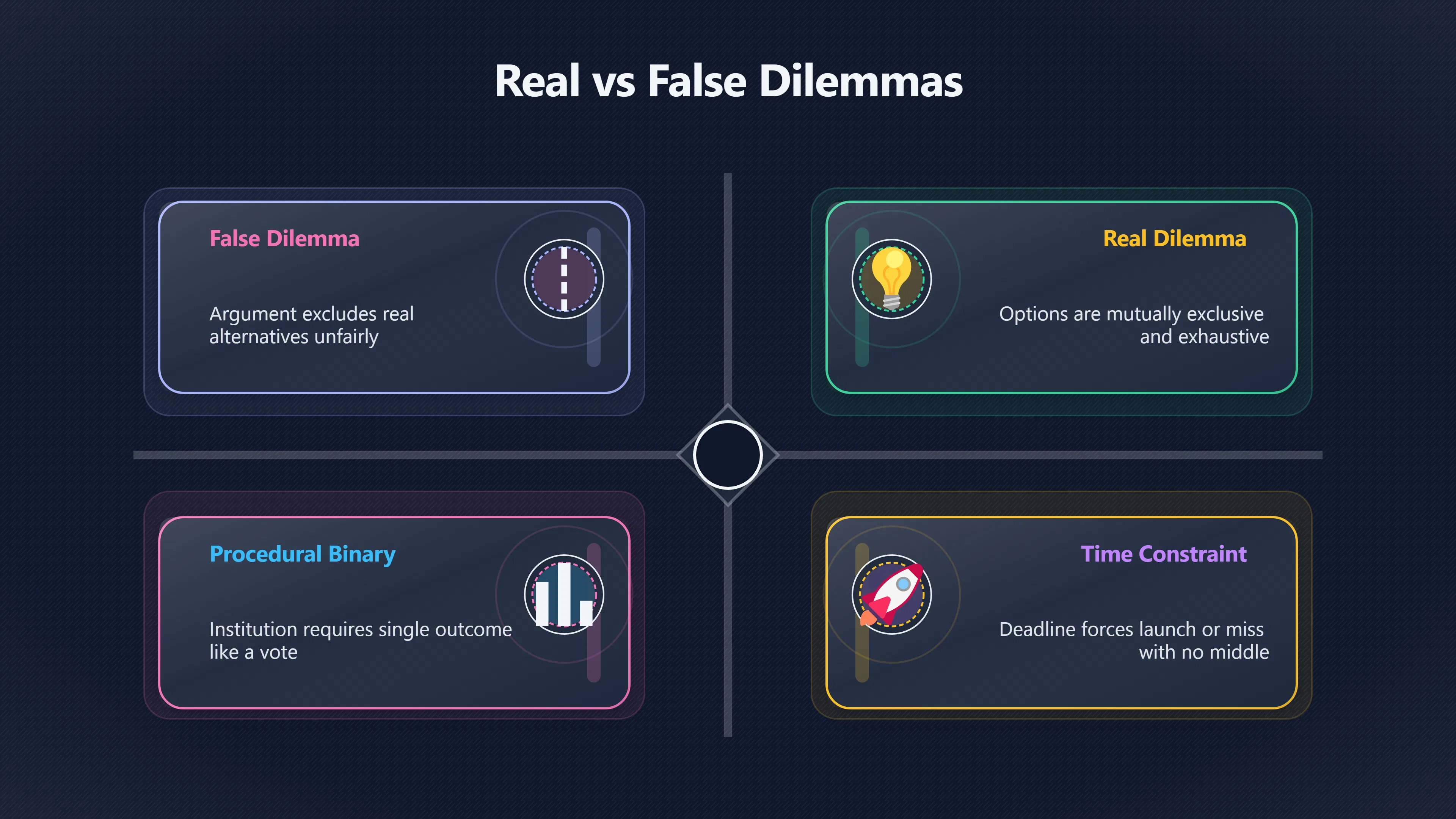
Not every either-or choice is a false dilemma. Some situations genuinely narrow to two options, and recognising this distinction is important for evaluating arguments fairly. A false dilemma becomes fallacious because it excludes real alternatives. A real dilemma, by contrast, exists when the available options are genuinely exhaustive for the decision being made, even if neither option is attractive. The key question is not whether there are only two choices on the table, but whether there are only two choices that remain possible within the relevant decision frame.[Wikipedia]WikipediaFalse dilemmaFalse dilemma
 This distinction matters because criticism of false dilemmas can itself become a mistake. People sometimes assume that every binary choice hides a middle ground. In reality, some votes, verdicts, deadlines, and emergency decisions require selecting one of two mutually exclusive outcomes. The challenge is determining when the binary reflects reality and when it reflects an artificially narrowed argument.
When Is a Dilemma Actually Real?
A dilemma is genuinely binary when the available alternatives are both mutually exclusive and jointly exhaustive. Mutually exclusive means both options cannot be chosen simultaneously. Jointly exhaustive means there is no third possibility within the decision being made.[wiki.c2.com]wiki.c2.comFalse DichotomyA dichotomy is a set of two mutually exclusive, jointly exhaustive alternatives. Dichotomies are typically expressed with…
Consider a simple logical example:
- Either a specific light is on or it is not on.
- Both conditions cannot be true at once.
- No third state exists.
This is a genuine dichotomy rather than a false one. Likewise, in formal logic, a disjunctive argument can be valid when the alternatives truly exhaust the possibilities. The logical structure itself is not defective; the problem arises only when the list of alternatives is incomplete.[Internet Encyclopedia of Philosophy]iep.utm.eduInternet Encyclopedia of PhilosophyFallaciesBut the false dilemma fallacy is due to false premises. Still other… The fallacy is called…[wikipedia]WikipediaFalse dilemmaFalse dilemma The practical lesson is that a binary choice is not suspicious merely because it contains two options. It becomes suspicious only when thereis reason to believe that other relevant options have been omitted.
Jointly Exhaustive Choices
Many real-world decisions temporarily become binary because an institution or process requires a single outcome.
Votes and Referendums
A referendum ballot may ask voters to approve or reject a proposal. Citizens may prefer dozens of alternative policies, but the immediate institutional choice is still “yes” or “no”. The wider political landscape contains many possibilities, yet the specific decision facing voters may genuinely have only two available outcomes at that moment.
Jury Verdicts
In many legal systems, a jury’s final task regarding a particular charge is to determine whether the prosecution has met the required standard of proof. Jurors may have complicated views about the defendant, the evidence, or the law, but the formal verdict often narrows to a limited set of legally defined outcomes. The binary nature comes from procedural rules, not necessarily from the complexity of reality itself.
Deadlines and Irreversible Decisions
Some decisions are constrained by time. A spacecraft either launches within a launch window or does not. A company either submits a regulatory filing before a deadline or misses it. Alternative plans may exist in theory, but the immediate decision point can still be genuinely binary because the relevant opportunity expires.
In these cases, criticism should focus on whether the process is appropriate, not on whether the final choice contains only two options.
Relevant Framing Tests
A useful way to evaluate a supposed dilemma is to ask several framing questions.
Are the Options Actually Exhaustive?
The strongest indicator of a real dilemma is that every conceivable alternative falls into one of the stated categories.
For example:
- Either a coin landed heads or it did not land heads.
- Either a particular event occurred or it did not occur.
These alternatives are exhaustive because one option is the direct negation of the other.[stanford]plato.stanford.eduEncyclopedia of Philosophy FallaciesStanford Encyclopedia of PhilosophyFallacies - Stanford Encyclopedia of Philosophyby H Hansen · 2015 · Cited by 421 — Two competing conce… Encyclopedia of Philosophy
By contrast:
- Either the economy is thriving or collapsing.
This is usually not exhaustive because economies can exist in many intermediate states.

Is the Binary About Action or About Reality?
Sometimes a binary action is embedded within a non-binary reality.
A legislature may have only two voting buttons available: support or oppose. Yet the policy question itself may involve many possible compromises, amendments, and future revisions. The vote is binary even though the underlying issue is not.
Confusing these levels often leads people either to accuse a real procedural choice of being a false dilemma or to treat a complex policy issue as though it were permanently limited to two camps.
Have Alternatives Been Ruled Out for a Genuine Reason?
Alternatives may disappear because of evidence, timing, law, or physical constraints.
For example, if a medical test conclusively rules out several diagnoses, the remaining decision may genuinely narrow to two possibilities. Likewise, emergency responders may face a choice between evacuating immediately and not evacuating immediately because waiting for additional options could create greater danger.
The mere existence of theoretical alternatives does not mean those alternatives remain live options.
Binary Action Versus Wider Context
One of the most common misunderstandings about false dilemmas is assuming that a real binary decision implies a simple world.
In practice, a decision can be genuinely binary while its causes, consequences, and remedies remain highly complex.
Consider an emergency evacuation order. At a particular moment, authorities may have to choose whether to issue the order or not. That choice may be binary because time constraints prevent lengthy experimentation. Yet the surrounding questions are not binary:
- Why did the emergency develop?
- Which populations are most vulnerable?
- How should recovery occur?
- How can future risks be reduced?
The action narrows to two immediate possibilities, while the broader situation retains many dimensions.
The same pattern appears in medicine, law, engineering, and public policy. A final decision point can require a yes-or-no answer even though understanding the problem requires a much richer framework.

Common Errors When Assessing Binary Choices
Several mistakes occur when people try to identify false dilemmas.
Assuming every middle position is available. Some situations truly lack a practical middle ground. A deadline may force a choice before additional options can be developed.
Confusing a poor choice with a false choice. A dilemma may be unpleasant without being fallacious. Two unattractive options can still be the only remaining options.
Mistaking procedural limits for argumentative manipulation. Institutions often require definitive outcomes. A court, election, or regulatory process may legitimately reduce many possibilities to a final binary decision.
Ignoring the level of analysis. The decision itself may be binary while the surrounding causes and solutions remain diverse and nuanced.
The Key Distinction
The central question is not whether an argument presents two options. The central question is whether those two options genuinely cover the available possibilities relevant to the decision at hand. A false dilemma artificially narrows the field. A real dilemma reflects genuine constraints, exhaustive alternatives, or unavoidable decision rules. Understanding that difference helps prevent two opposite errors: accepting a misleading binary when other options exist, and rejecting a legitimate binary merely because reality outside the immediate choice remains complex.[Wikipedia]WikipediaFalse dilemmaFalse dilemma[Stanford Encyclopedia of Philosophy]plato.stanford.eduEncyclopedia of Philosophy FallaciesStanford Encyclopedia of PhilosophyFallacies - Stanford Encyclopedia of Philosophyby H Hansen · 2015 · Cited by 421 — Two competing conce…
Amazon book picks
Further Reading
Books and field guides related to When Is a Dilemma Actually Real?. Use these as the next step if you want deeper reading beyond the article.
A Concise Introduction to Logic
Directly explains valid dichotomies, validity, and logical structure.
eBay marketplace picks
Marketplace Samples
Example marketplace items related to this page. Use the search link to explore similar finds on eBay.



Endnotes
1.
Source: Wikipedia
Title: False dilemma
Link:https://en.wikipedia.org/wiki/False_dilemma
2.
Source: wiki.c2.com
Link:https://wiki.c2.com/?FalseDichotomy=
3.
Source: plato.stanford.edu
Title: Encyclopedia of Philosophy Fallacies
Link:https://plato.stanford.edu/entries/fallacies/
Source snippet
Stanford Encyclopedia of PhilosophyFallacies - Stanford Encyclopedia of Philosophyby H Hansen · 2015 · Cited by 421 — Two competing conce...
4.
Source: plato.stanford.edu
Title: logic informal
Link:https://plato.stanford.edu/entries/logic-informal/
Source snippet
Logic - Stanford Encyclopedia of Philosophyby L Groarke · 1996 · Cited by 97 — It suggests that philosophy needs an [informal logic]({{ 'informal-logic/' | relative_url }}) to add...
5.
Source: web.stanford.edu
Title: Logical Fallacies
Link:https://web.stanford.edu/~jonahw/PWR1/LogicalFallacies.htm
Source snippet
FallaciesFalse Dilemma: two choices are given when in fact there are three options; From Ignorance: because something is not known to be...
6.
Source: iep.utm.edu
Link:https://iep.utm.edu/fallacy/
Source snippet
Internet Encyclopedia of PhilosophyFallaciesBut the false dilemma fallacy is due to false premises. Still other... The fallacy is called...
7.
Source: seop.illc.uva.nl
Link:https://seop.illc.uva.nl/entries/contradiction/
Source snippet
Stanford Encyclopedia of PhilosophyContradictionby LR Horn · 2006 · Cited by 130 — The law of contradictories is such that if one contrad...
8.
Source: iep.utm.edu
Link:https://iep.utm.edu/propositional-logic-sentential-logic/
Source snippet
Internet Encyclopedia of PhilosophyPropositional Logic(Disjunctive syllogism is sometimes also called “modus tollendo ponens” or... fals...
9.
Source: scribbr.co.uk
Title: False Dilemma Fallacy | Examples & Definition
Link:https://www.scribbr.co.uk/fallacy/false-dilemma/
Source snippet
30 May 2023 — The false dilemma fallacy occurs when someone misrepresents an issue by offering only two options (when more exist)...
Published: May 2023
10.
Source: microsoft.com
Title: false dilemma fallacy
Link:https://www.microsoft.com/en-us/microsoft-365-life-hacks/writing/false-dilemma-fallacy
Source snippet
What is a false dilemma fallacy? Explore...17 Dec 2024 — A type of logical fallacy that misrepresents an issue by presenting only two op...
11.
Source: logicallyfallacious.com
Title: False Dilemma
Link:https://www.logicallyfallacious.com/logicalfallacies/False-Dilemma
Source snippet
fallaciesDescription: When only two choices are presented yet more exist, or a spectrum of possible choices exists between two extremes...
12.
Source: owl.excelsior.edu
Title: logical fallacies false dilemma
Link:https://owl.excelsior.edu/argument-and-critical-thinking/logical-fallacies/logical-fallacies-false-dilemma/
Source snippet
Dilemma Fallacy - Excelsior OWLA false dilemma is a logical fallacy that presents only two options or sides to an issue when there are ac...
13.
Source: scribbr.com
Title: false dilemma fallacy
Link:https://www.scribbr.com/fallacies/false-dilemma-fallacy/
Source snippet
Examples & Definition30 May 2023 — The false dilemma fallacy means presenting a limited number of options as if they were the only option...
Published: May 2023
Additional References
14.
Source: pastpaperhero.com
Link:https://www.pastpaperhero.com/resources/lsac-lsat-common-logical-fallacies-and-reasoning-errors-false-dilemma-and-dichotomy
Source snippet
Common logical fallacies and reasoning errorsFalse dilemma occurs when an argument illegitimately limits options to two; Dichotomy errors...
15.
Source: archive.org
Link:https://archive.org/download/ThinkingFallacies/ThinkingFallacies-Part1.pdf
Source snippet
List of fallaciesA fallacy is incorrect argumentation in logic and rhetoric resulting in a lack of validity, or more generally, a lack of...
16.
Source: facebook.com
Link:https://www.facebook.com/groups/2688029951255361/posts/6694802633911386/
Source snippet
What is a false dichotomy in logical fallacyA false dichotomy (or false dilemma) is a logical fallacy in which a limited number of choice...
17.
Source: yourlogicalfallacyis.com
Link:https://yourlogicalfallacyis.com/black-or-white
Source snippet
Your logical fallacy is black or whiteYou presented two alternative states as the only possibilities, when in fact more possibilities exi...
18.
Source: philosophy.stackexchange.com
Title: which of common rules of inference are rejected on some philosophical grounds
Link:https://philosophy.stackexchange.com/questions/68932/which-of-common-rules-of-inference-are-rejected-on-some-philosophical-grounds
Source snippet
of common rules of inference are rejected on some...7 Dec 2019 — Disjunction introduction jointly with disjunctive syllogism {p∨q,¬p} ⊢...
19.
Source: digitalcommons.unomaha.edu
Link:https://digitalcommons.unomaha.edu/cgi/viewcontent.cgi?article=1029&[context
Source snippet
Called the 'False Dilemma Fallacy' (FDF)by R Conces · 2023 · Cited by 1 — Abstract: This work is a revision of the False Dilemma Fallacy...
20.
Source: facebook.com
Link:https://www.facebook.com/ThinkingPowers/posts/most-common-fallacies-9-false-choicedefinition-and-explanation-the-false-choice-/810469734411059/
Source snippet
the options that are presented are collectively exhaustive.Read more...
21.
Source: britannica.com
Title: What Is the Either-Or Fallacy?
Link:https://www.britannica.com/topic/What-Is-the-Either-Or-Fallacy
Source snippet
False Dilemma, Dichotomy...The either-or fallacy, also called a false dilemma, is a logical error that happens when someone presents...
22.
Source: youtube.com
Title: False Dilemma: Either Love it or Fear it
Link:https://www.youtube.com/watch?v=iZ3u8sP8tDo
Source snippet
Logic Series...A false dilemma is a logical fallacy that claims are only two choices when upon closer inspection they're more possibilit...
23.
Source: st.network
Link:https://st.network/analysis/top/the-false-dilemma-why-would-you-accept-not-having-a-choice.html
Source snippet
The false dilemma: Are there really only two choices?10 Aug 2020 — This fallacy contains the false supposition that, in a given matter, t...
Topic Tree